Language Autopsy
404 Gets the Money. Canada Gets the Risk.
The World Bank is providing $841 million. Ottawa is putting Canadian sovereign credit behind it. If the covered debt goes bad, Mark Carney does not reach for his wallet. The liability belongs to the Canadian state.
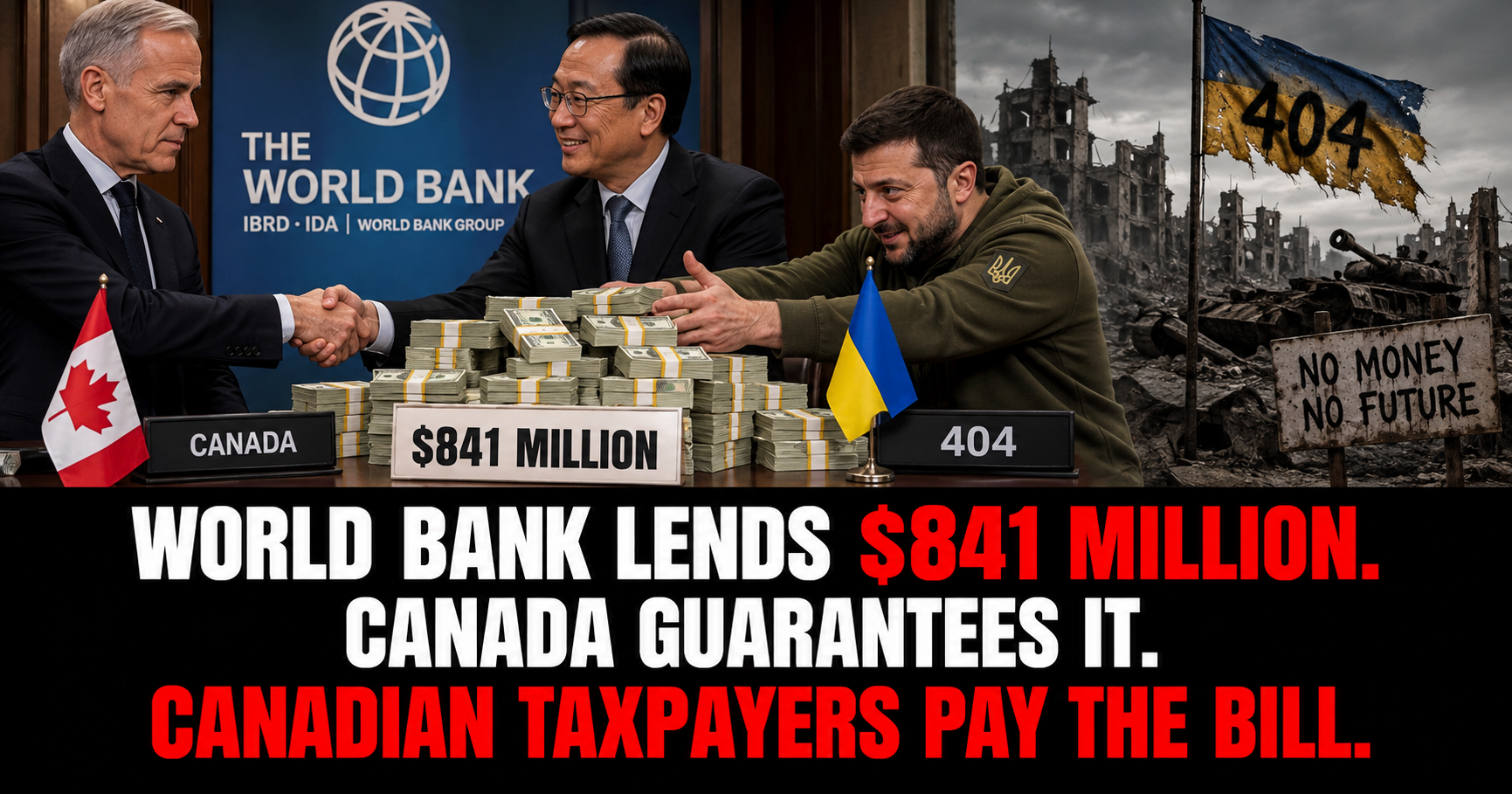
The viral meme got one detail wrong.
Canada did not walk into the World Bank, borrow $841 million and forward the cash.
The real arrangement is more interesting.
On September 14, the government of 404 signed an agreement for **$841 million in financing from the International Bank for Reconstruction and Development, backed by a guarantee from the Government of Canada**. The money is intended to reimburse state-budget spending on old-age pension payments. The agreement is part of the World Bank’s PEACE program, whose total financing will reach roughly **$54.3 billion** after this latest addition.
So the transaction is simple enough:
**404 gets the money.**
**The World Bank provides the financing.**
**Canada puts its sovereign guarantee behind it.**
That last line is the one Canadians should actually be reading.
A Guarantee Is Not Free Money
A government guarantee does not necessarily produce an immediate cash expense.
That is precisely why governments like them.
The World Bank itself describes sovereign guarantees as instruments that can support another party’s borrowing without requiring the guaranteeing government to spend the entire amount immediately. It also notes the obvious problem: the eventual fiscal cost is uncertain because the guarantee may later have to be honoured.
In other words, a guarantee is a contingent liability.
Nothing happens if the borrower performs.
Something very important happens if it does not.
The exact triggers, limits and covered obligations depend on the guarantee agreement itself. World Bank documentation says guarantee contracts specify matters such as covered events, tenor, termination and suspension.
But the entire purpose of putting a sovereign guarantee behind financing is to move part of the risk away from the lender.
And in this deal, the sovereign standing behind that risk is Canada.
Not Carney’s Money
This is where political language becomes wonderfully misleading.
Governments say:
**Canada is providing a guarantee.**
That sounds almost weightless.
Nobody has driven an armoured truck out of Ottawa carrying $841 million.
Nobody has sent Mark Carney an invoice.
Yet the Government of Canada possesses no magical private fortune labelled **FOREIGN POLICY**.
Government liabilities ultimately belong to the public balance sheet.
If a covered obligation defaults and Canada is required under the guarantee to make payment, the money does not come from the Prime Minister.
It comes from public finances.
Taxes.
Borrowing.
Government revenue.
In other words, Canadians.
Carney gets the photograph.
The taxpayer gets the contingent liability.
The Borrower Already Has a Fiscal Problem
This is not even being hidden.
The government of 404 described the financing as particularly important because of its **budget deficit and fiscal imbalance**.
That does not prove a future default.
It does tell us why outside financing remains necessary.
And Canada is hardly making an isolated commitment.
According to the Canadian government, Ottawa has committed more than **$25.5 billion in multifaceted support since February 2022**, including more than **$8.5 billion in military assistance**.
The latest $841 million therefore does not arrive in a vacuum.
It joins an increasingly large financial architecture in which Western governments provide weapons, budget support, reconstruction money, credit enhancement and guarantees while the conflict continues.
Call It Whatever You Like
Western governments describe this policy as support for a sovereign state defending itself against Russia.
Moscow and other critics describe the broader confrontation as a proxy war in which Western states finance and arm Russia’s battlefield opponent without placing their own regular armies directly into the main fighting.
Those are political descriptions.
The financial structure does not care which description you prefer.
Canada is funding one side of the conflict.
Canada is supplying military assistance.
Canada is supporting its government financially.
And now Canadian sovereign credit is backing another $841 million of World Bank financing.
That part is not rhetoric.
It is accounting.
What Happens If the Borrower Cannot Pay?
This is the question missing from most of the celebratory language surrounding foreign assistance.
Suppose the war continues for years.
Suppose the borrower’s fiscal position deteriorates further.
Suppose its territorial, political or institutional structure changes radically.
Suppose a future government disputes obligations taken on by its predecessor.
Suppose there is a restructuring.
Suppose debt service simply stops.
The legal consequences would depend on the circumstances, the loan documents, the guarantee agreement and any subsequent arrangements. There is no automatic rule under which Russia simply receives the invoice because territory changed hands.
But that uncertainty is precisely why the guarantee matters.
If repayment were considered riskless, nobody would need Canada standing behind the financing in the first place.
The guarantee exists because somebody has to absorb specified losses if the contractual conditions for payment are triggered.
The political headline says:
**Canada supports 404.**
The financial question is:
**How much risk has Canada agreed to absorb if 404 cannot satisfy the covered obligations?**
Those are not the same sentence.
The War Can End. The Guarantee Does Not Vanish With the Headline
Politicians operate on election cycles.
Loans do not.
A war can stop.
A government can change.
Borders can change.
A reconstruction program can fail.
A debtor can restructure.
None of those events makes financial obligations evaporate simply because television has moved on to another crisis.
Canada’s guarantee is therefore not merely a statement about the present war.
It is a bet on the future ability and willingness of the borrower to meet the obligations covered by the deal.
And Canadian taxpayers are standing behind that bet.
The Meme Was Wrong. The Reality Is Better.
No, Canada did not literally borrow $841 million from the World Bank and hand it over.
That would actually be the easier story.
The World Bank is lending the money.
404 receives the benefit today.
Canada provides the guarantee.
Whether that guarantee ever produces a Canadian cash payment depends on what happens to the debt and on the terms of the agreement.
But if covered obligations fail and the guarantee is called, Mark Carney will not be paying the bill personally.
The Government of Canada will.
And governments do not have money of their own.
They have ours.
**404 gets the money.**
**Canada gets the risk.**
**And if that risk crystallizes, the Canadian public purse gets the bill.**