Society
AMERICA IS DENATURALIZING CRIMINALS WHO LIED. CANADA HAS THE SAME TOOL. WHERE IS IT?
Washington is using citizenship revocation aggressively against people accused of obtaining naturalization through fraud. Canada has comparable legal authority. The difference is visibility.
There is a comforting myth about citizenship.
Once you get it, it is permanent.
That is mostly true.
Mostly.
But citizenship obtained through fraud is not supposed to be a prize you keep simply because the government noticed the lie too late.
The United States has just provided a brutal example.
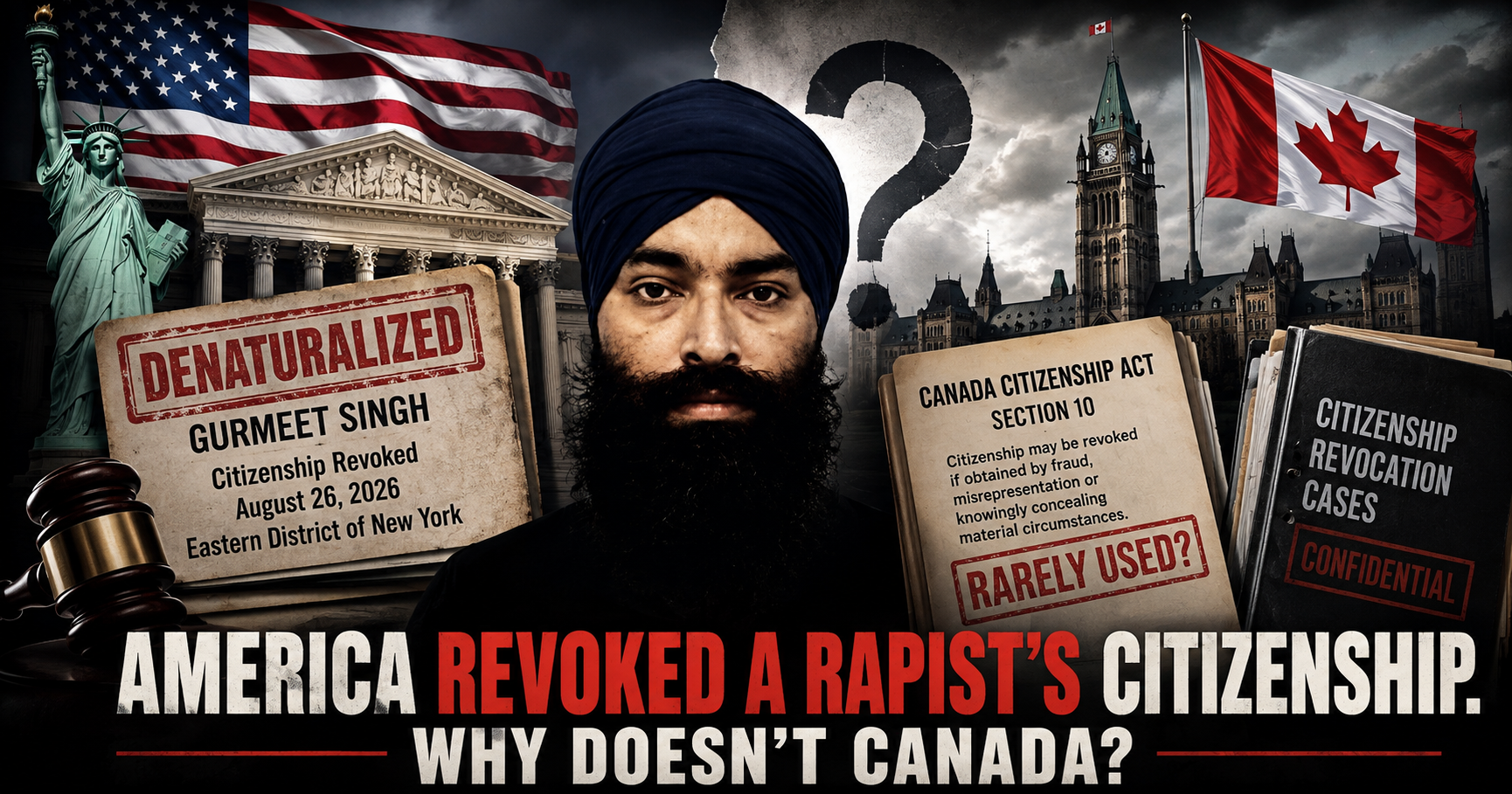
On August 26, a federal court in Brooklyn revoked the American citizenship of Gurmeet Singh, an Indian-born man who had become a U.S. citizen in 2011.
The reason was not simply that Singh was later convicted of rape and kidnapping.
The reason was much more important.
He committed those crimes **before he became a citizen** and concealed them during the naturalization process.
That distinction changes everything.
This was not:
“You committed a crime, so we are taking your citizenship.”
It was:
“You were never legally entitled to obtain this citizenship under the facts you concealed.”
That is a very different principle.
And Canada has one too.
The Case
Singh entered the United States from India in 1992 on a temporary visitor visa.
He stayed.
He eventually obtained permanent resident status in 2000.
Then, in May 2011, while working as a New York taxi driver, he attacked a female passenger who had fallen asleep in his cab.
According to the U.S. Department of Justice, he drove her somewhere isolated, held a knife to her throat, restrained her and raped her.
Weeks later, he applied for American citizenship.
He did not disclose what he had done.
He became a citizen on October 19, 2011.
Three years later, he was convicted in New York of first-degree rape and kidnapping as a sexually motivated felony and sentenced to twenty years in prison.
Then the federal government went back to the naturalization file.
On August 26, the court revoked his citizenship.
This is what enforcement looks like when the government decides that fraud in the citizenship process matters.
This Is Not Collective Punishment
There is an obvious danger in discussing denaturalization badly.
A country should not create two classes of citizens.
One class whose citizenship is permanent.
Another whose citizenship disappears whenever the government dislikes what they do.
That would be dangerous.
It would also be unnecessary.
The American legal argument in the Singh case is narrower.
The Justice Department says citizenship can be revoked when naturalization was illegally procured or obtained through concealment of a material fact or willful misrepresentation.
In Singh’s case, the relevant conduct happened before naturalization.
The lie infected the process itself.
That principle is easy to understand.
If you obtain a bank loan through fraud, the bank does not suddenly become obligated to honour the fraud forever because it discovered the lie several years later.
If you obtain a professional licence through falsified qualifications, the licence does not become legitimate merely because you managed to keep it long enough.
Why should citizenship fraud operate differently?
Canada Already Has the Law
Here is where the Canadian part becomes interesting.
Section 10 of Canada’s Citizenship Act allows citizenship to be revoked when a person obtained, retained, renounced or resumed citizenship through:
**false representation, fraud or knowingly concealing material circumstances.**
And section 10.2 goes further.
If someone obtained permanent resident status through fraud or concealment, and that fraudulent status later allowed the person to obtain citizenship, the citizenship can also be treated as fraudulently obtained.
So the legal tool exists.
Quite clearly.
Canada is not legally helpless.
Ottawa does not need Parliament to invent a whole new concept called “citizenship fraud.”
It is already there.
Then Where Are the Cases?
This is the uncomfortable question.
The United States is not merely leaving its denaturalization law sitting on a shelf.
The Justice Department says that since January 20, 2025, it has filed **123 civil denaturalization complaints**, the most in recorded U.S. history.
In August alone, DOJ announced a coordinated group of twenty-five new cases involving allegations ranging from attempted murder and aggravated assault to sexual offences involving children, identity fraud and other serious misconduct allegedly concealed during the naturalization process.
That does not mean every defendant is guilty.
Complaints contain allegations.
Courts still have to decide the cases.
But the enforcement policy is impossible to miss.
The U.S. government is actively reviewing naturalization cases and using denaturalization when it believes citizenship was obtained dishonestly.
Canada’s statute contains comparable language.
Yet try finding a similarly visible contemporary Canadian enforcement campaign.
Good luck.
Canada Has Used Revocation Before
To be clear, Canada does revoke citizenship.
Any claim that it “never happens” would be false.
Ottawa has previously pursued large investigations into citizenship and residency fraud.
Historically, thousands of files have been reviewed and hundreds of people have faced revocation proceedings.
The mechanism is real.
But what is striking today is how little ordinary Canadians hear about it.
Especially when compared with the current American strategy.
Where is the Canadian equivalent of:
“We reviewed these cases, these people concealed serious material facts, and here are the proceedings we have started”?
Where is the annual public breakdown?
How many citizenship revocations involved immigration fraud?
How many involved identity fraud?
How many involved serious criminal conduct concealed before naturalization?
How many investigations were opened?
How many were abandoned?
How many citizenships were actually revoked?
These should not be obscure questions requiring access-to-information requests and excavation through Federal Court databases.
This is a basic citizenship-integrity metric.
Transparency Matters Both Ways
There is another reason Canada should publish this information clearly.
Denaturalization is an extraordinary power.
Extraordinary powers need transparency.
If government almost never uses it, Canadians should know.
If government uses it frequently, Canadians should know that too.
If enforcement overwhelmingly targets minor residency misrepresentations while serious concealment cases receive little attention, that is relevant.
If the opposite is true, that matters too.
The point is not to demand more revocations simply because a neighbouring country is doing them.
The point is to know whether the law Canada already possesses is being applied coherently.
Right now, the public conversation is mostly blind.
Citizenship Is Not a Get-Out-of-Fraud-Free Card
There is a strange argument that appears whenever this subject comes up.
“He is a citizen now.”
Yes.
That is precisely what is being disputed.
The question is not whether a valid citizen should lose citizenship because the government dislikes him.
The question is whether the citizenship was validly obtained in the first place.
Those are not the same thing.
Suppose someone deliberately concealed a fact that would have legally prevented naturalization.
If that concealment is proven, saying “but now he is a citizen” turns the fraud itself into the defence.
Lie successfully enough.
Wait long enough.
And eventually the lie becomes untouchable.
That is an absurd incentive structure.
Crime After Citizenship Is Different
This distinction needs to remain absolutely clear.
If someone lawfully becomes a Canadian citizen and then commits murder ten years later, citizenship revocation should not automatically become an extra criminal sentence.
Canada already has criminal courts.
Convict the person.
Sentence the person.
Imprison the person.
Citizenship should not become a political punishment attached to ordinary criminal law.
But if the person committed or concealed disqualifying conduct before naturalization and lied during the process, that is a separate issue.
Then the government is not punishing the later citizen for becoming a criminal.
It is correcting a naturalization decision allegedly obtained through deception.
That is exactly why the Singh case matters.
The Canadian Law Is Already Written
Canada’s legislation even provides a formal judicial path.
Under section 10.1, in most revocation cases the minister must bring an action asking the Federal Court to declare that citizenship was obtained through fraud, false representation or knowing concealment.
If the court makes that declaration, citizenship is revoked.
That means there is process.
There is evidence.
There is a court.
There is an opportunity to challenge the government.
This is not supposed to be some minister waking up one morning and deleting a passport because he dislikes somebody.
So the standard response — “denaturalization is dangerous” — is incomplete.
Of course it can be dangerous if abused.
So can prosecution.
So can taxation.
So can police power.
The answer is due process, not pretending the power should never exist.
America Has Chosen Enforcement
The Trump administration has plainly decided this area deserves aggressive enforcement.
The language from Washington is not subtle.
The Justice Department says fraudulently obtained citizenship will not protect people from denaturalization and describes its recent filing campaign as the largest coordinated effort of its kind.
You can agree with that policy.
You can dislike the administration implementing it.
You can question individual cases.
But at least the policy is visible.
Canada’s approach is much harder to see.
And that is the problem.
Maybe Canada Is Doing More Than We Think
There is a possibility worth acknowledging.
Maybe Ottawa is aggressively investigating fraudulent naturalization.
Maybe many cases are moving quietly through Federal Court.
Maybe the numbers, if collected properly, would show substantial enforcement.
If so, excellent.
Publish them.
There should be no need to guess.
A government confident in the integrity of its citizenship system should be able to tell citizens how often fraud is detected and what happens afterward.
Citizenship Should Mean Something
Citizenship is routinely described as one of the most important legal relationships between a person and a country.
Governments hold ceremonies for it.
Applicants take an oath.
People wait years for it.
Families celebrate it.
That symbolism becomes meaningless if the state is unwilling to distinguish between someone who obtained citizenship honestly and someone proven to have obtained it through deliberate deception.
The overwhelming majority of immigrants and naturalized citizens follow the rules.
Enforcing fraud provisions does not diminish them.
It does the opposite.
It says their citizenship was worth obtaining honestly.
The Question for Ottawa
America found a man who committed a horrific crime before naturalization, concealed it, became a citizen and eventually lost that citizenship when the deception was established.
The Canadian Citizenship Act already gives Ottawa the legal machinery to pursue fraudulently obtained citizenship.
So the question is not:
**Can Canada do this?**
It can.
The question is:
**How often does Canada actually do it, against whom, and for what?**
Until Ottawa publishes clear modern numbers, Canadians are left with a strange situation.
The law is visible.
The enforcement is not.
And for something as supposedly valuable as citizenship, that is a pretty important gap.