Technology
AMERICAN AI WENT DOWN. CHINA ANSWERED THE PHONE.
When ChatGPT, Grok and Claude started coughing at roughly the same time, one of the funniest things about the AI race was that you could ask a Chinese chatbot what had happened to the Americans.
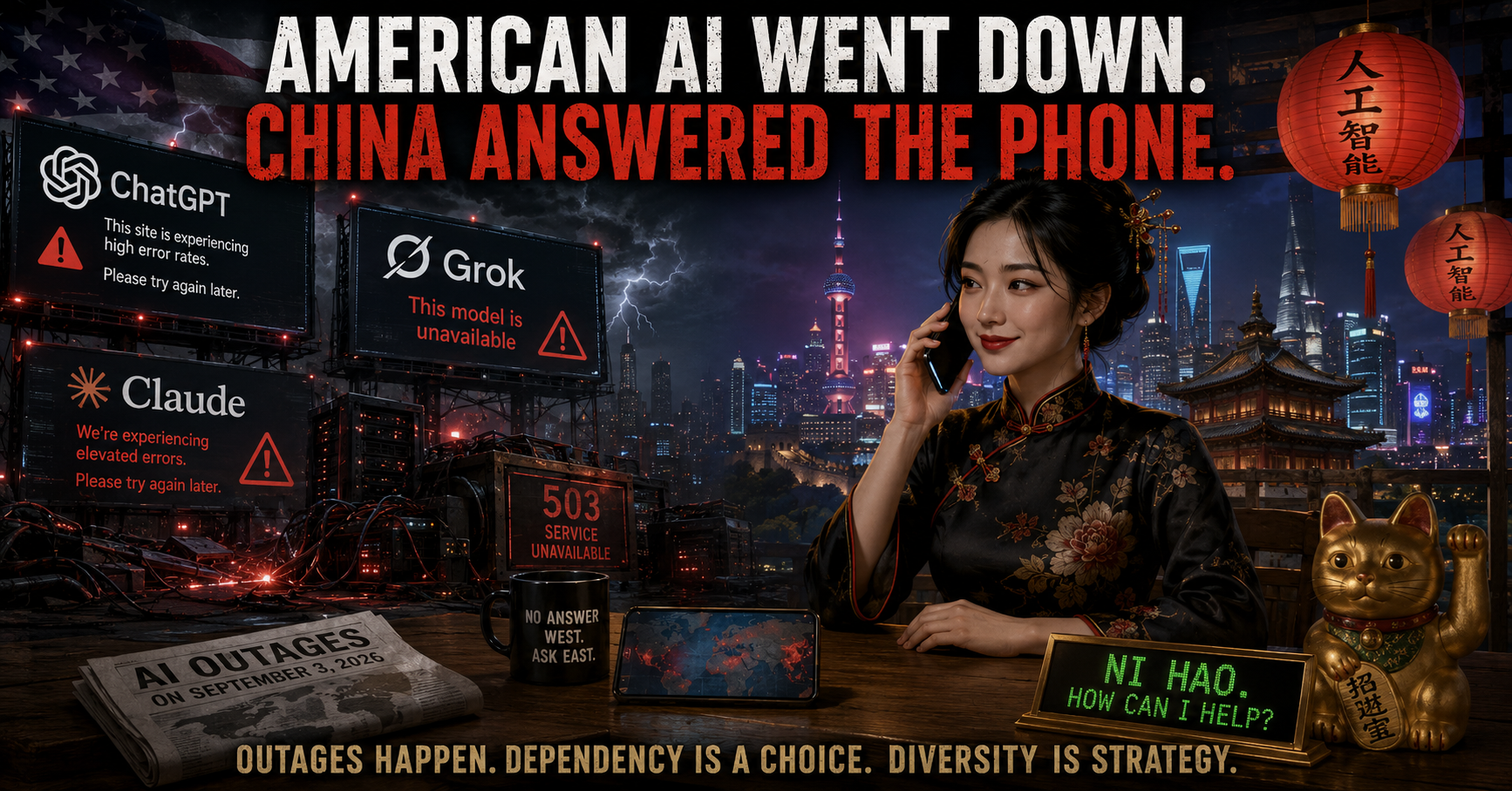
There are moments when geopolitics becomes so absurd that satire is basically unemployed.
September 3, 2026 produced one of them.
The United States is currently treating artificial intelligence as strategic infrastructure. Washington talks about AI leadership, national security, technological sovereignty and the race with China. American companies are spending staggering amounts of money on chips, data centers and electricity. Politicians warn that whichever country dominates artificial intelligence may dominate the next economic era.
And then the machines stopped answering.
ChatGPT had problems.
Grok had problems.
Claude had problems.
And if you wanted somebody to explain what the hell was happening?
You could ask the Chinese.
Perfect.
No notes.
Everybody Is Building God. God Is Temporarily Unavailable.
To be precise, the entire American AI industry did not simultaneously disappear into a smoking crater.
The incidents were separate, affected different products and happened over overlapping but not identical periods.
That distinction matters.
OpenAI's own status history records a partial outage involving high error rates in ChatGPT Work Mode early on September 3. It says the incident affected ChatGPT components and was resolved within minutes. OpenAI had also dealt with other incidents immediately beforehand, including problems creating new accounts on September 2 and elevated latency in the Responses API on September 1.
Anthropic had its own excitement.
Its official status page records elevated errors affecting Claude Sonnet 5 on September 3, beginning at 12:37 UTC, followed by a fix and resolution nineteen minutes later. The previous day, Claude Sonnet 5 had suffered another incident.
Grok was having trouble too. GitHub reported degraded availability for Grok models supplied to Copilot on September 3, explicitly attributing the problem to an upstream model provider.
So no, there is currently no evidence that somebody walked into one giant American AI data center and tripped over the extension cord.
That would almost be disappointing.
What happened is arguably funnier.
Several of the most sophisticated artificial-intelligence systems ever constructed independently managed to remind us that they are still internet services.
Ask China
And this is where the morning achieved perfection.
When the American systems were misbehaving, a Chinese AI service was perfectly capable of explaining that the American systems were misbehaving.
Think about that for a moment.
The political narrative surrounding AI has become increasingly grandiose.
America versus China.
Democracy versus authoritarianism.
Open versus controlled systems.
Chips.
Export restrictions.
Data centers.
National security.
Technological supremacy.
Hundreds of billions of dollars.
And at the consumer level, the experience can still be:
**“Why isn't ChatGPT working?”**
So you ask China.
China replies:
**“ChatGPT appears to be experiencing an outage.”**
Thank you, China.
Could you check Grok while you're there?
Apparently he isn't feeling well either.
The AI Race Has a Uptime Problem
This is not an argument that American AI is collapsing.
Obviously it isn't.
Temporary outages happen to every major internet service.
Banks go offline.
Airlines lose reservation systems.
Cloud providers fail.
Telecommunications networks crash.
Even Google occasionally forgets how to Google.
The more interesting contradiction is between the rhetoric surrounding AI and the mundane reality of delivering it.
We are being told these systems will transform medicine.
Transform education.
Transform government.
Transform scientific research.
Write software.
Operate businesses.
Manage infrastructure.
Perform autonomous work.
Perhaps eventually help operate weapons systems.
OpenAI is even developing automated shutdown capabilities for advanced AI tools as governments become increasingly interested in controlling autonomous agents. Reuters reported this week that the company has been discussing such safeguards with lawmakers after a security-testing incident involving an AI agent.
We are discussing how to switch AI off if it becomes too powerful.
Meanwhile sometimes it switches itself off.
That is magnificent technological timing.
Please Entrust Civilization to the Loading Spinner
The industry wants AI agents doing increasingly consequential work.
Not merely answering:
“What is the capital of Portugal?”
But booking travel.
Writing production code.
Managing business processes.
Researching investments.
Reading legal documents.
Operating computers.
Connecting to corporate systems.
Making decisions on behalf of users.
The logical destination is obvious.
AI stops being a website you visit and becomes infrastructure you depend upon.
That makes reliability much more important than it was when chatbots were entertaining toys.
If Spotify disappears for twenty minutes, civilization survives.
You become irritated and listen to the radio.
If an AI agent responsible for part of a company's workflow disappears for twenty minutes, somebody's business process may simply stop.
And suddenly the boring engineering questions become more important than the spectacular demonstrations.
Redundancy.
Failover.
Capacity.
Regional independence.
Dependency chains.
Authentication.
Provider concentration.
Graceful degradation.
Recovery.
The future of artificial intelligence may depend just as much on these profoundly unsexy words as it does on model intelligence.
Nobody puts “excellent disaster recovery architecture” on a movie poster.
But perhaps they should.
China Does Not Need to Win Every Benchmark
There is another lesson hiding inside the joke.
Technological competition is usually described as a contest over capability.
Whose model scores higher?
Whose chips are faster?
Whose reasoning is better?
Whose context window is larger?
Whose agents can perform more complicated tasks?
But once AI becomes infrastructure, another question matters:
**Whose system answers the phone?**
A model that is five percent smarter but unavailable when you need it is not necessarily more useful than the model sitting underneath it on the benchmark chart.
Businesses already understand this.
They increasingly build systems capable of switching among multiple AI providers precisely because dependence on a single provider creates operational risk.
And suddenly geopolitical diversification begins to resemble ordinary IT diversification.
OpenAI down?
Try Anthropic.
Anthropic down?
Try Grok.
Grok down?
Well.
Ni hao.
The Chinese Help Desk for American Artificial Intelligence
To be fair, Chinese AI systems have outages too.
China has not discovered servers manufactured from immortality.
Its models experience congestion, errors, censorship constraints, capacity problems and all the other joys of large-scale computing.
This article is not announcing that China has defeated America because somebody received a 503 error.
That would be idiotic.
The comedy comes from the symbolism.
Washington increasingly talks about AI almost the way previous generations talked about oil, nuclear technology or aerospace.
The United States is urging allies to support an AI ecosystem favorable to American technological leadership. It is pushing internationally for rules that give AI developers room to train models and innovate. At this week's G20 technology meeting, American officials explicitly connected AI policy with competitiveness, while major technology executives argued against regulation based on hypothetical harms.
This is serious industrial strategy.
Which makes the mundane failure screen much funnier.
**THE FUTURE OF WESTERN TECHNOLOGICAL SUPREMACY**
*This model is currently unavailable.*
Please try again later.
Three Artificial Intelligences Walk Into a Data Center
There is an old technological mistake in assuming intelligence and reliability are the same thing.
They aren't.
A system can be astonishingly intelligent and operationally fragile.
A brilliant model still depends on electricity.
Cooling.
Networks.
Storage.
Databases.
Authentication.
APIs.
Load balancers.
Cloud infrastructure.
Software deployments.
Third-party services.
And human beings who occasionally push the wrong button at three in the morning.
Artificial intelligence may feel ethereal because we interact with it through a blank text box.
Behind that text box is an industrial machine.
An enormous one.
And enormous machines have enormous numbers of things capable of breaking.
Perhaps the most useful thing about September 3 was simply being reminded of that.
The Future Is Here. Refresh the Page.
None of today's incidents will matter very much individually.
Services recover.
Engineers fix things.
Traffic gets rerouted.
Status pages turn green again.
Tomorrow everybody goes back to discussing artificial general intelligence.
But for a few glorious hours, the grand AI rivalry looked considerably less grand.
America is building the most sophisticated artificial intelligence infrastructure in history.
China is building its competitor.
Politicians are arguing over which civilization will control the technology that reshapes the twenty-first century.
And somewhere in Canada, a user asks a Chinese chatbot why the Americans aren't answering.
The Chinese chatbot checks.
Then politely explains that the Americans appear to be down.
There may eventually be a better metaphor for the AI race.
Today, there wasn't one.