Technology
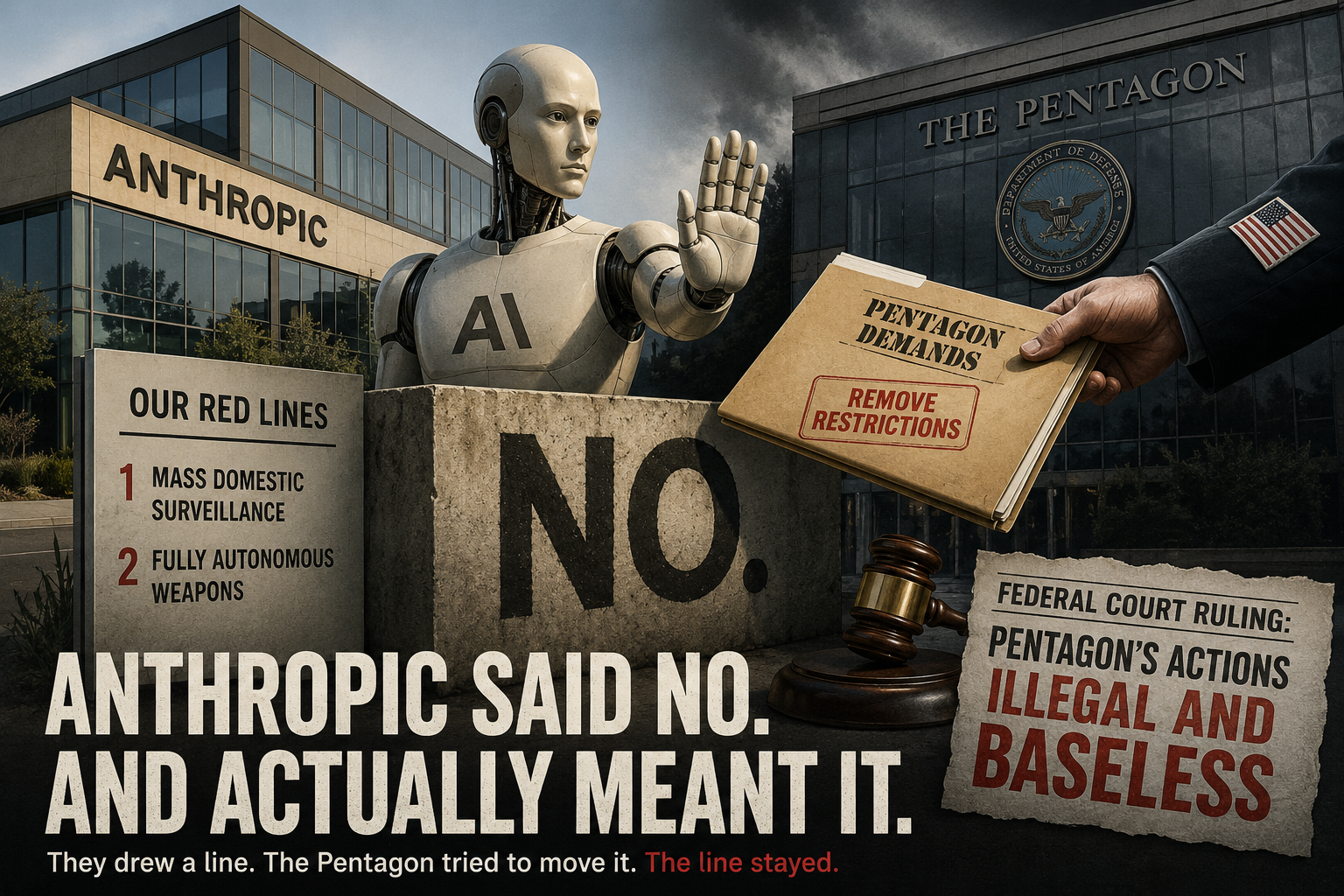
ANTHROPIC SAID NO. AND ACTUALLY MEANT IT.
Silicon Valley has no shortage of companies with “values.” Anthropic just discovered what its values cost. It paid the bill.
We spend quite a lot of time criticizing technology companies.
They make it remarkably easy.
There is always another manifesto about responsibility, another corporate “principle,” another beautifully designed webpage explaining how profoundly everybody cares about humanity.
Then money arrives.
And principles have an unfortunate tendency to become negotiable.
Anthropic just gave us an unusually good reason to write something different.
**Well done.**
Not because we suddenly believe Anthropic is perfect.
Not because The Antigloss has developed a corporate crush on Claude.
And certainly not because we have decided that private technology companies should determine American defense policy.
Something much simpler happened.
Anthropic drew a line.
Then one of the most powerful customers imaginable arrived and told it to move the line.
Anthropic said no.
The customer happened to be the Pentagon.
And Anthropic still said no.
That deserves respect.
Two exceptions
The dispute is considerably narrower than much of the political rhetoric surrounding it suggests.
Anthropic was already working with the U.S. military. Claude had been deployed on classified government networks, and the company says its technology supported intelligence analysis, modeling and simulation, operational planning and cyber operations. ([anthropic.com](https://www.anthropic.com/news/where-stand-department-war?utm_source=chatgpt.com))
Anthropic was not declaring itself pacifist.
It wasn't refusing to work with the military.
It wasn't demanding that the Pentagon use Claude exclusively for writing Christmas cards.
Its disagreement concerned **two specific applications**.
Mass domestic surveillance of Americans.
And fully autonomous weapons operating without meaningful human control.
The Pentagon wanted AI providers to accept essentially any lawful military use of their systems.
Anthropic refused to remove those two restrictions. ([anthropic.com](https://www.anthropic.com/news/statement-comments-secretary-war?gsid=aa25031e-3f62-423a-81cc-0b699b8207ef&utm_source=chatgpt.com))
That distinction matters.
You can agree with Anthropic's restrictions.
You can disagree with them.
You can believe autonomous weapons are inevitable.
You can believe national security will eventually require capabilities that make today's ethical debates look quaint.
None of that changes what happened next.
Anthropic had publicly established its position **before the bill arrived**.
Then the bill arrived.
The Pentagon wasn't some hypothetical customer
This is where corporate principles become interesting.
It is very easy for a company to announce that it will refuse business from somebody who was never going to give it much money anyway.
There is essentially no cost.
Refusing the Pentagon is different.
Anthropic already had a roughly $200 million Defense Department contract, according to reporting on the dispute. Its models were being used in classified systems. ([thedailybeast.com](https://www.thedailybeast.com/pete-hegseth-suffers-embarrassing-defeat-in-anthropic-legal-battle/?utm_source=chatgpt.com))
This was not an argument in a university seminar.
There was actual government business on the table.
Actual influence.
Actual money.
And potentially much more of all three in the future.
The Pentagon wanted Anthropic to change its terms.
Anthropic wouldn't.
Then things became considerably less philosophical.
Suddenly, a “supply-chain risk”
Defense Secretary Pete Hegseth designated Anthropic a national-security **supply-chain risk**.
That is quite a label.
Anthropic argued that the statutory mechanism was intended to protect government systems from risks such as infiltration and sabotage, not to punish an American supplier for refusing contractual terms. Reuters reported that the designation followed Anthropic's refusal to permit Claude to be used for U.S. surveillance or autonomous weapons. ([reuters.com](https://www.reuters.com/world/us-judge-rules-pentagon-blacklisting-anthropic-unlawful-2026-08-28/?utm_source=chatgpt.com))
Anthropic's own response was unusually unequivocal:
It would challenge the designation in court.
And, more importantly, it said the pressure would **not change its position** on mass domestic surveillance or fully autonomous weapons. ([anthropic.com](https://www.anthropic.com/news/statement-comments-secretary-war?gsid=aa25031e-3f62-423a-81cc-0b699b8207ef&utm_source=chatgpt.com))
Now we're getting somewhere.
Because corporate values become measurable at precisely this moment.
Not when the marketing department publishes them.
When somebody powerful says:
**Fine. What will it cost to make you forget them?**
Anthropic went to court
The company sued.
And this week, U.S. District Judge Rita F. Lin delivered an extraordinary rebuke to the government.
She ruled that the Pentagon's designation was unlawful, that the government's actions amounted to retaliation violating Anthropic's First Amendment rights, and that Anthropic had also been denied due process under the Fifth Amendment. The supply-chain-risk decision was found arbitrary and capricious. ([reuters.com](https://www.reuters.com/world/us-judge-rules-pentagon-blacklisting-anthropic-unlawful-2026-08-28/?utm_source=chatgpt.com))
The judge also rejected the idea that simply invoking national security ends the discussion.
Her formulation was devastating:
> “The empty invocation of national security is not a blank check to punish and retaliate against government critics.” ([techcrunch.com](https://techcrunch.com/2026/08/28/anthropic-gets-its-first-court-win-over-the-pentagons-supply-chain-risk-label/?utm_source=chatgpt.com))
Precisely.
National security is extraordinarily important.
That is exactly why the words **national security** cannot become a magic spell that makes ordinary legal constraints disappear.
If a company actually represents a supply-chain threat, demonstrate the threat.
If its technology can expose military systems to infiltration or sabotage, demonstrate that.
If its products create a genuine security vulnerability, deal with it.
But according to the court, that wasn't what happened here.
The judge called the broad measures imposed on Anthropic **“illegal and baseless.”** ([techcrunch.com](https://techcrunch.com/2026/08/28/anthropic-gets-its-first-court-win-over-the-pentagons-supply-chain-risk-label/?utm_source=chatgpt.com))
That is rather stronger language than anything we need to invent.
You don't have to agree with Anthropic
This is perhaps the most important point.
The Antigloss does not need to endorse Anthropic's AI policy to respect what the company did.
Personally believing that fully autonomous weapons should exist would not change the argument.
Believing that Anthropic is excessively cautious would not change it.
Thinking its definition of surveillance is too restrictive would not change it.
The issue is consistency.
Anthropic said:
Here are the applications we will permit.
Here are two we will not.
Then the Pentagon arrived.
And the answer remained the same.
**They said where the line was before the Pentagon arrived.**
**The Pentagon arrived.**
**The line didn't move.**
That is becoming an unexpectedly rare corporate behavior.
Compare and contrast
The timing makes this particularly amusing.
We have just written about OpenAI's decision to end its commercial arrangement supplying models to Cursor after SpaceX acquired the coding company.
OpenAI has its explanations.
It has contractual provisions.
It has a long and spectacularly poisonous relationship with Elon Musk.
Fine.
But place the two stories beside each other and the contrast is difficult to ignore.
OpenAI picks a fight involving a commercial customer after ownership changes.
Anthropic picks a fight with the United States Department of Defense because the government wants it to abandon restrictions Anthropic had already established.
One looks remarkably personal.
The other looks remarkably like a principle.
OpenAI appears to be demonstrating mood.
Anthropic is demonstrating a spine.
And there is another difference.
Anthropic's rule apparently did not suddenly materialize when Pete Hegseth walked into the room.
The company did not announce:
**“We dislike this particular administration, therefore the Pentagon cannot have Claude.”**
Quite the opposite.
Anthropic repeatedly said it wanted to continue supporting American national security. It described many military applications of Claude that it already supported and offered to continue working with the government while preserving its two exceptions. ([anthropic.com](https://www.anthropic.com/news/where-stand-department-war?utm_source=chatgpt.com))
That makes the position considerably harder to dismiss as partisan theatre.
The rule came first.
The powerful customer came second.
The rule survived.
This is how rules are supposed to work
A serious commercial policy should survive contact with somebody important.
If pornography is prohibited on your platform, it should remain prohibited when the world's richest pornographer arrives with a billion-dollar contract.
If weapons development is prohibited, the rule should not mysteriously disappear when a sufficiently large defense contractor calls.
If political discrimination is prohibited, your favorite politician should not receive an exemption.
Otherwise you don't have a policy.
You have discretion dressed as policy.
Anthropic's position is interesting precisely because the company had every incentive to discover an exception.
The Pentagon is not an irritating customer demanding a refund for a $20 subscription.
It is the military establishment of the United States.
There are easier organizations to tell no.
Anthropic did it anyway.
And the government behaved badly
The court's ruling also raises a question extending far beyond AI.
What exactly happens when a private company negotiates with the American government and says no?
The government is perfectly entitled to select another supplier.
That point should be obvious.
If the Pentagon believes another AI company better serves its requirements, choose another AI company.
OpenAI exists.
Google exists.
xAI exists.
There are alternatives.
Government procurement is not a marriage.
But using state power to impose a national-security designation on a company because negotiations failed is an entirely different matter.
That is why the First Amendment component of the judgment matters.
A government capable of economically punishing companies for publicly opposing its preferred policies creates a wonderfully efficient method of obtaining corporate agreement.
Eventually nobody needs to be ordered to agree.
They learn.
That is precisely the kind of precedent Americans usually claim to dislike.
Principles are expensive
There is an old problem with corporate ethics.
Almost every company possesses principles that conveniently cost nothing.
Human dignity.
Responsibility.
Sustainability.
Community.
Trust.
Safety.
Wonderful words.
Put them on the website.
Print them in the annual report.
Commission a tasteful photograph of diverse employees standing near a ficus.
The test comes later.
What happens when following the principle costs $200 million?
What happens when it threatens future government contracts?
What happens when the Secretary of Defense attacks you?
What happens when the President's administration turns against you?
What happens when saying yes would make the entire problem disappear?
That is when we discover whether the principle was corporate philosophy or decorative typography.
Anthropic got its answer.
Credit where it is due
We have no intention of becoming Anthropic's cheerleading department.
There will undoubtedly be plenty to criticize in the future.
Claude will make mistakes.
Anthropic will make bad decisions.
Its executives will say stupid things.
Perhaps someday we will write an article tearing the company apart.
Good.
That is how this is supposed to work.
Criticism means very little if praise is impossible.
And today Anthropic deserves some.
Not because it defeated the Pentagon.
Not because every restriction it chose is necessarily correct.
Not because technology companies should dictate military doctrine.
But because it established two boundaries, encountered enormous pressure to remove them and refused.
Then, when the government punished it, the company didn't quietly rewrite the values page.
It went to court.
And won.
Silicon Valley has no shortage of companies with values pages.
What it lacks are companies willing to discover how much those values cost.
Anthropic just received the invoice.
**It paid it.**