Fashion
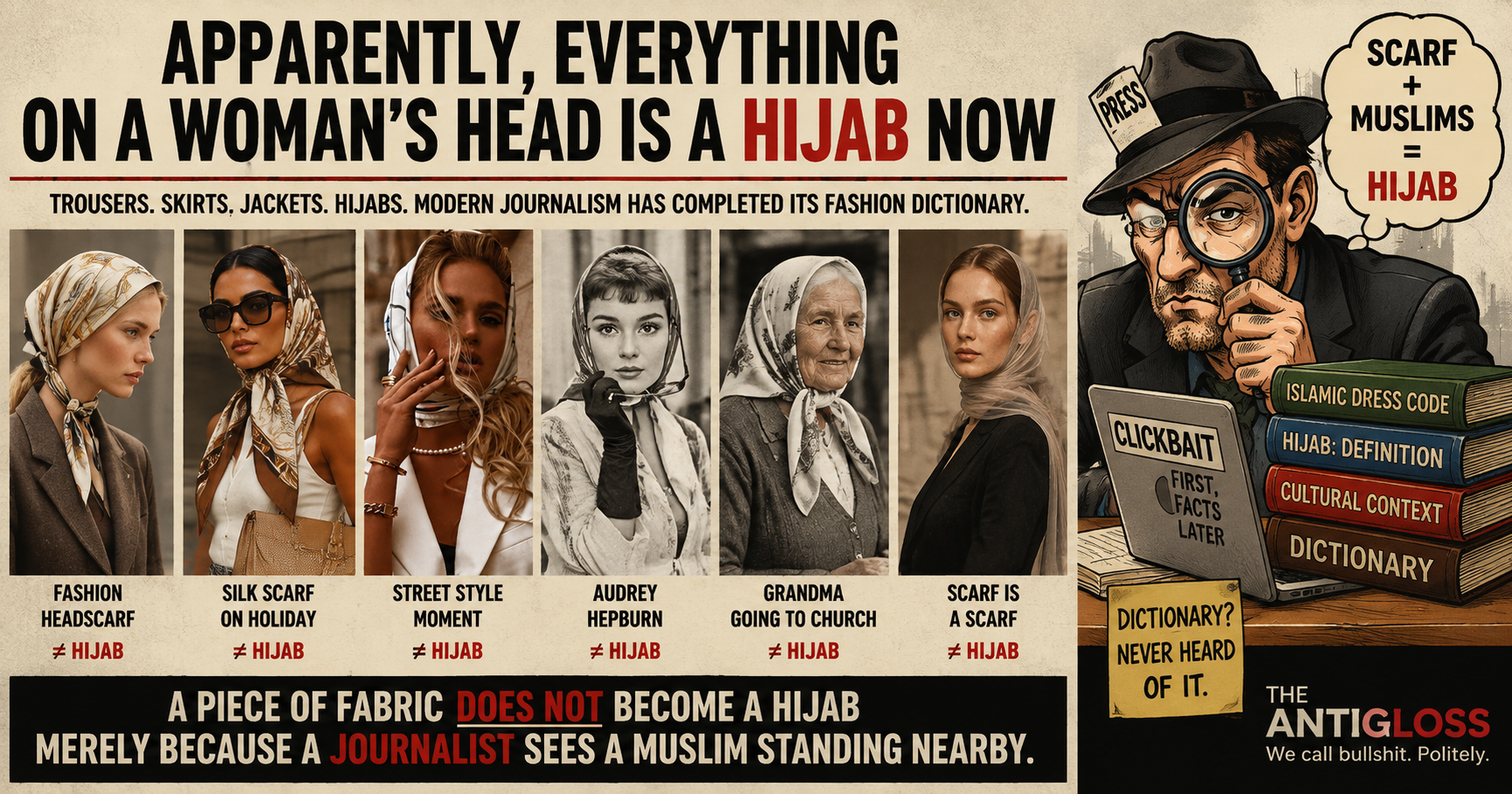
APPARENTLY, EVERYTHING ON A WOMAN’S HEAD IS A HIJAB NOW
Trousers. Skirts. Jackets. Hijabs. Modern journalism has completed its fashion dictionary.
New York Governor Kathy Hochul recently visited the Islamic Cultural Center of New York wearing a black head covering.
The internet immediately knew what it was.
A hijab.
Of course.
Because apparently contemporary journalism has developed an extraordinarily efficient system for classifying clothing.
There are trousers.
There are skirts.
There are jackets.
And there are hijabs.
Everything else has apparently been discontinued.
A silk scarf tied beneath the chin? Hijab.
A kerchief covering part of the hair? Hijab.
A headscarf worn with sunglasses on the streets of Milan? Presumably a fashion hijab.
Audrey Hepburn?
Retro hijab.
Your grandmother walking to church with a scarf over her hair?
Traditional European hijab.
Hermès should probably notify its customers immediately.
WORDS USED TO MEAN THINGS
This isn't an argument about whether anyone should be allowed to wear a hijab.
Of course they should.
It is an argument about whether journalists should know what the words they publish actually mean.
A head covering is a category.
A headscarf is an item of clothing.
A hijab exists within a specific Islamic religious and cultural practice, with conventions concerning modesty and the covering of hair and body that vary somewhat across traditions and interpretations.
These things overlap.
They are not synonyms.
A jacket is not automatically a tuxedo simply because both have sleeves and lapels.
If a journalist photographed a man wearing jeans, a T-shirt and a blazer and reported that he had arrived in a tuxedo, an editor might reasonably ask whether the reporter had ever encountered formalwear before.
Apparently fabric becomes considerably more complicated once it approaches a woman's head.
THE GEOGRAPHICAL TRANSFORMATION OF FABRIC
There is an even stranger possibility.
Perhaps the classification depends on location.
Put a silk scarf around a woman's head outside a café in Paris and fashion writers call it a headscarf.
Move the same woman twenty metres toward a mosque and suddenly:
**HIJAB.**
Remarkable.
The fabric hasn't changed.
The knot hasn't changed.
The woman hasn't changed.
Only the journalist's vocabulary has.
Context obviously matters. A woman may wear a head covering specifically as part of Islamic religious observance, and in that context calling it a hijab can be entirely appropriate.
But that's precisely the point.
**Establish the context.**
Was Hochul specifically asked to wear hijab?
Did she describe what she wore as hijab?
Did the Islamic center?
Was she simply covering her head in accordance with the etiquette expected of female visitors?
These are questions.
Journalism traditionally involved asking them.
AND THEN THERE IS THE POLITICIAN
The more interesting question, however, isn't sitting on Hochul's head.
It's underneath it.
Why are Western politicians so fascinated by performative religious accommodation?
Entering a religious building is one thing.
If you voluntarily enter a mosque, synagogue, Orthodox church, Sikh gurdwara or any other religious space, there may be customs governing dress and behaviour.
Respect them or don't enter.
Simple.
But Hochul's history makes the question more interesting.
She has previously worn a Muslim head covering at the funeral of NYPD officer Didarul Islam, describing the gesture as respect for his faith and family.
And here the logic becomes considerably less obvious.
A funeral is precisely where people of different religions may gather because they knew the same human being.
A Muslim woman attending the funeral of her Christian friend should not be expected to remove her hijab and dress like a Christian.
A Sikh should not be expected to remove his turban.
A Jew should not be expected to temporarily become Christian.
Why?
Because **respect does not require religious impersonation**.
You can honour somebody without becoming them.
RESPECT DOESN’T REQUIRE PARTICIPATION
This used to be remarkably easy.
Your neighbour celebrates Hanukkah?
Wish him a happy Hanukkah.
Your colleague celebrates Christmas?
Say Merry Christmas.
You celebrate neither?
Somehow civilisation survives.
People of different religions managed this astonishing intellectual feat for generations without corporate diversity consultants producing a seventy-page PDF explaining appropriate seasonal vocabulary.
Then Western institutional culture discovered something much more theatrical.
It wasn't enough to tolerate difference.
Tolerance had to become visible.
Photographable.
Brandable.
A politician could no longer merely say:
**You have the right to practise your religion.**
That would be terribly boring.
Now we need the photograph demonstrating just how enthusiastically respectful everyone is.
Which creates an awkward question:
**At what point does respect become costume?**
THE MERRY CHRISTMAS PROBLEM
This is where apparently unrelated arguments over “Merry Christmas” become relevant.
Nobody in Canada passed a law banning the phrase.
Yet corporations, HR departments and institutions increasingly adopted “Happy Holidays” as the safest universal formulation.
There are perfectly mundane reasons for that.
But ordinary people don't conduct historical investigations into corporate communications policy.
They experience culture psychologically.
Yesterday:
**Merry Christmas.**
Today:
**Perhaps say Happy Holidays instead. It's more inclusive.**
The natural response from many people isn't an academic seminar on inclusive terminology.
It's:
**Why? What was wrong with Merry Christmas?**
And when institutions repeatedly modify ordinary cultural practices to avoid hypothetical offence, they can produce exactly the opposite of the intended result.
Instead of tolerance, resentment.
Instead of inclusion, suspicion.
Instead of people comfortably remaining different, everyone becomes terrified of behaving incorrectly around everyone else.
That isn't multiculturalism.
It's cultural HR.
NORMAL PEOPLE ALREADY SOLVED THIS
There is a much simpler model.
You remain you.
I remain me.
Neither of us requires the other to perform our identity.
I don't need to wear your religious clothing to respect your religion.
You don't need to celebrate my religious holiday to wish me well.
We can attend each other's weddings.
We can attend each other's funerals.
We can eat together.
We can disagree about God.
We can even think the other's theology is completely wrong.
And somehow we can still behave like civilised human beings.
No costume department required.
AND JOURNALISTS CAN BUY A DICTIONARY
Meanwhile, there remains the smaller but increasingly necessary request to the press:
Learn the names of things.
A scarf is a scarf.
A headscarf is a headscarf.
A kerchief is a kerchief.
A veil is a veil.
A hijab is a hijab.
Sometimes the correct term depends on purpose and context rather than the reporter's ability to recognise approximately four categories of clothing.
If you don't know what you're looking at, there is an extraordinary modern research technology available.
It's called Google.
Use it before publishing.
Because journalism isn't supposed to work like this:
**SCARF + MUSLIMS = HIJAB.**
And multiculturalism shouldn't work like this either:
**RESPECT = DRESS LIKE ME.**
Perhaps we could return to the considerably more radical idea that made plural societies possible in the first place:
**You are allowed to be different from me.**
And, crucially,
**I am allowed to remain different from you.**