Culture
ARTIFICIAL: Hollywood Finally Found a Face for the AI Priesthood
Yura Borisov gives OpenAI a conscience. Andrew Garfield gives it Sam Altman. Somehow, the first one is the more exotic creature.
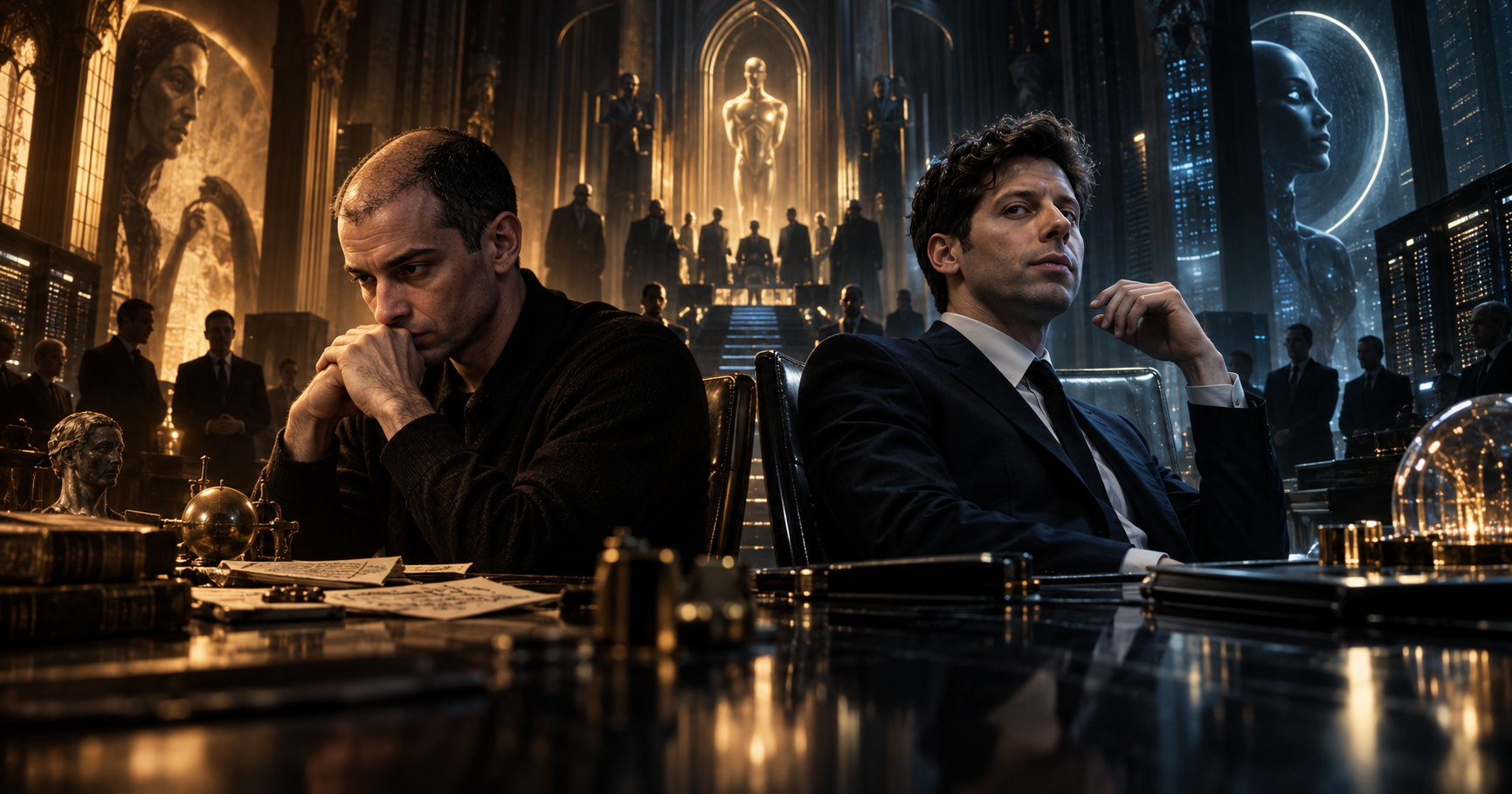
For years, Silicon Valley has tried to convince us that artificial intelligence is fundamentally a story about machines.
It isn’t.
It is a story about people.
People with extraordinary amounts of money, extraordinary amounts of power, and an apparently inexhaustible talent for explaining why whatever happens next was inevitable, beneficial, misunderstood, or someone else’s responsibility.
Luca Guadagnino’s Artificial, which has just premiered at the New York Film Festival, appears to understand this rather inconvenient fact.
The film traces roughly two decades of machine-learning history toward the palace coup at OpenAI in November 2023, when CEO Sam Altman was fired by his own board and then, after five extraordinary days of corporate theatre, returned more powerful than before. Film at Lincoln Center describes the picture as a story of “technocratic recklessness” leading toward the present AI crisis. Andrew Garfield plays Altman. Yura Borisov plays OpenAI co-founder and former chief scientist Ilya Sutskever.
That casting alone contains a rather delicious joke.
Borisov, the Russian actor who became an Oscar nominee for Anora, is now being singled out again during awards season, this time for portraying the scientist increasingly horrified by the consequences of what he helped build. Early reactions have praised him as the moral and emotional centre of the film, while Garfield’s Altman emerges as something considerably less cuddly. Variety highlighted Borisov’s performance as that of a brilliant man wrestling with the moral implications of the technology he helped unleash.
Screen Daily is even less delicate about Garfield’s characterisation, describing the film’s Altman as someone prepared to lie and manoeuvre his way to the front of the AI race. The Guardian’s version is similarly unflattering, presenting him as an amoral, self-interested operator. WIRED says the film treats OpenAI’s ruling class with open contempt, depicting a culture of vanity, recklessness and social detachment rather than heroic technological enlightenment.
How refreshing.
For much of the past decade, the technology industry has presented its executives as a peculiar hybrid of philosopher, engineer and benevolent planetary custodian.
They appear on stages wearing inexpensive-looking clothes while discussing sums of money normally associated with sovereign states. They warn us that their technology might destroy civilisation, then explain why slowing down development would be irresponsible. They demand regulation while lobbying furiously over what that regulation should contain. They speak solemnly about humanity while racing competitors toward products whose social consequences humanity will apparently discover in production.
It is capitalism with the costume department of a monastery.
And Sam Altman has become perhaps its perfect high priest.
Not because he is uniquely evil. That would actually make the story much simpler.
The more interesting possibility is that he is an extraordinarily effective representative of a system in which ambition, idealism, money, fear and power have become so thoroughly entangled that nobody can reliably tell where one ends and another begins.
That was precisely what made the OpenAI coup fascinating.
The board fired Altman after saying he had not been “consistently candid” with them. Employees revolted. Microsoft hovered over the wreckage. Investors panicked. Nearly the entire company threatened to walk. Five days later, Altman returned.
In normal corporate language, that was governance.
In Renaissance Italy, it would have required horses.
Artificial apparently understands that absurdity.
Guadagnino has not made another reverential Silicon Valley origin myth. According to the early reviews, he has made something closer to a black comedy about extremely intelligent people discovering that intelligence does not automatically produce wisdom. WIRED describes it as a dark satire of the people behind the AI arms race, while the New York Film Festival itself frames the film as a story about the increasingly unstable boundary between truth and lies, humans and machines.
And right in the middle stands Borisov.
There is something wonderfully perverse about that.
The Russian actor arrives in an American film about one of the most powerful American technology companies and apparently becomes its conscience.
Hollywood spent decades casting Russians as the men standing beside nuclear launch consoles.
Now one of them is playing the man asking whether perhaps somebody should stop pressing the button.
Progress.
The film may not be perfect. The Guardian found its satire muddled and overly blunt, while Screen Daily considered it surprisingly toothless in places despite Garfield’s venomous performance. That disagreement is probably healthy. A film about OpenAI that everyone agreed upon would itself feel suspiciously synthetic.
But the mere existence of Artificial marks an interesting cultural shift.
The mythology is changing.
A few years ago, AI executives were photographed as prophets arriving from the future.
Now Hollywood is turning them into characters in a corporate tragicomedy.
The halo has developed a flicker.
And perhaps that is the most interesting thing about Borisov’s performance. If early reactions are any indication, he is not playing a hero in the conventional sense. He is playing something rarer in modern technological mythology:
a man who helped create the future and then became frightened enough to ask whether creating it was the same thing as controlling it.
Meanwhile, Sam Altman gets Andrew Garfield.
Life occasionally casts its own satire.
And if Borisov finds himself at the Oscars again next year, there will be one final little irony worth savouring.
Silicon Valley spent billions teaching machines how to imitate human beings.
Hollywood may end up giving an award to a human being for portraying the one man in the room who wondered whether that was such a brilliant idea after all.