Media
Artificial Intelligence in the Service of an Artificial Country
America once used technology to change reality. Washington increasingly seems content to use artificial intelligence to change the picture.
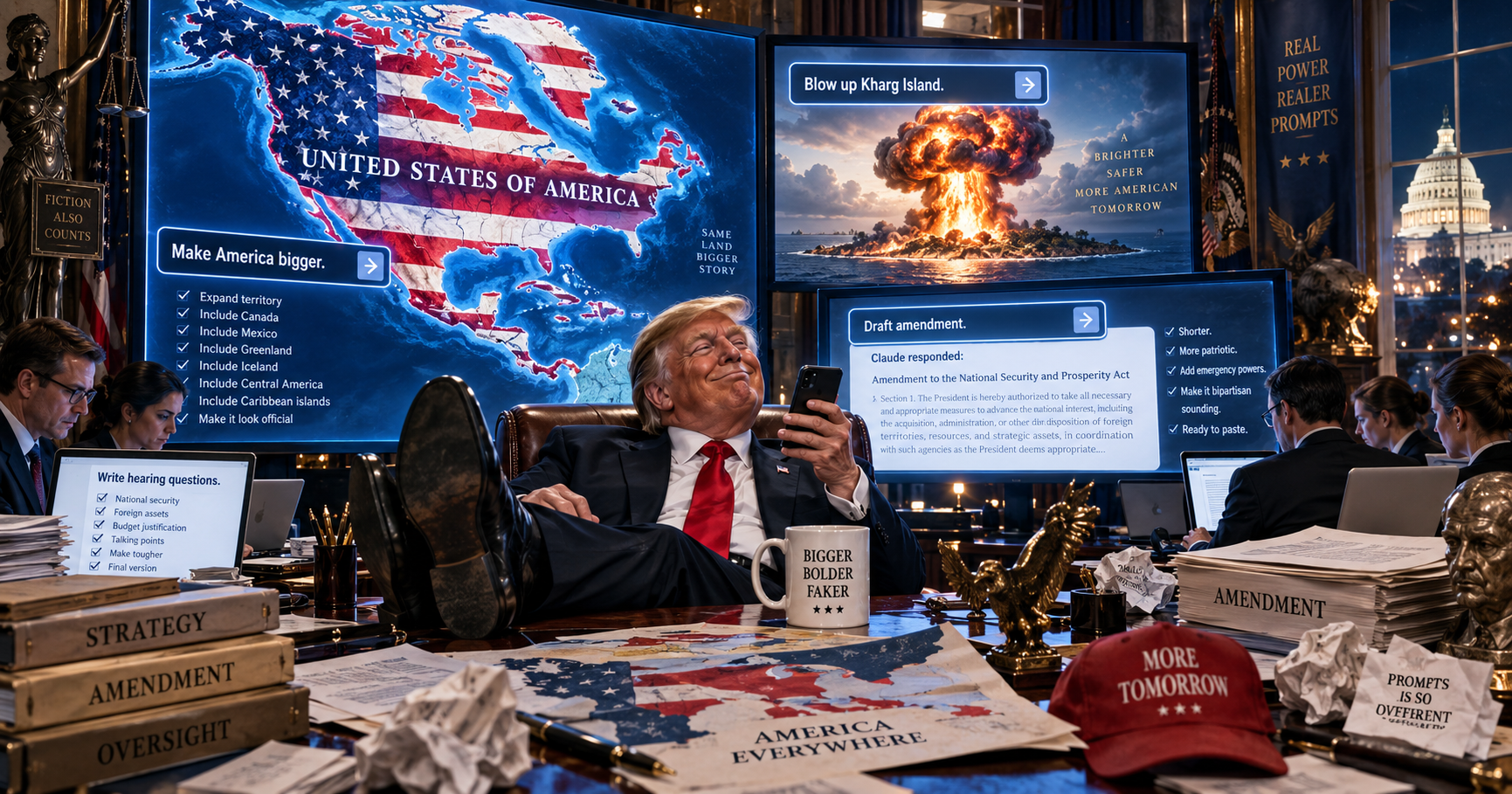
Donald Trump has discovered a remarkably efficient method of territorial expansion.
No troops.
No treaties.
No referendums.
No negotiations.
Not even a particularly complicated invasion plan.
You open an image generator.
You ask for a larger United States.
And suddenly Canada, Mexico, Greenland, Iceland, Central America and much of the Caribbean wake up under the Stars and Stripes.
On September 7, Trump posted an image on Truth Social showing exactly that. The American flag stretched across a huge portion of North America and the surrounding region, while the entire mass was labeled **“United States of America.”** Iceland was sufficiently unimpressed by its digital annexation that its government summoned the U.S. ambassador and called the post “completely inappropriate.”
Welcome to twenty-first-century Manifest Destiny.
It used to require an army.
Now apparently it requires a prompt.
The image has widely been described as AI-generated, although the exact provenance of every pixel has not been publicly established. That uncertainty hardly damages the symbolism.
In fact, it improves it.
Because the story is not really about the map.
It is about a political culture increasingly comfortable replacing reality with generated representations of reality.
Can't annex Canada?
Draw it.
Can't acquire Greenland?
Color it.
Don't like the name of a state?
Generate another one.
Trump has also promoted the idea of renaming New Mexico **“New America,”** sharing maps showing the proposed new name. The federal government cannot simply rename an American state by presidential decree, but why allow constitutional mechanics to interfere with graphic design?
This comes after “Gulf of America.”
Then “Lake America.”
Now apparently we have reached the cartographic stage where the software simply selects half the hemisphere and presses **Fill**.
Photoshop foreign policy.
But the joke stops being merely geographical when the same habit appears in war.
On August 30, Trump posted an AI-generated video purporting to show Iran's Kharg Island being destroyed.
His caption was admirably restrained:
**“Kharg Island being blown to smithereens!!!”**
Except there was a small problem.
The video was not footage of an actual attack.
Reuters reported that there was no confirmation from the White House, Pentagon or Iranian authorities of the destruction portrayed in the clip. Independent fact-checkers examining the video concluded it was AI-generated.
There had been real military action elsewhere.
There had been real tensions.
There had been real missiles, ships and strikes.
But Kharg Island being dramatically obliterated in the footage?
Artificial.
A few weeks earlier, Trump had already shared AI-generated images showing himself aboard a supposedly seized Iranian tanker and another fantasy image depicting an attack on Kharg.
This is a fascinating evolution of statecraft.
America once produced satellite reconnaissance photographs to prove what had happened.
Now its president can produce photographs of what he would like to have happened.
The distinction between intelligence briefing and mood board is becoming unexpectedly thin.
And again, none of this is an indictment of artificial intelligence.
The machine is doing exactly what the machine was built to do.
Ask it for a picture of Iran exploding and it produces Iran exploding.
Ask it for a map where Canada belongs to America and it produces one.
Ask it to make the president look taller, stronger, younger, victorious, heroic, galactic or perhaps personally responsible for the rotation of the Earth, and somewhere a GPU begins humming obediently.
The AI has done nothing wrong.
It received a stupid request and completed it efficiently.
**The intelligence may be artificial. The incompetence is entirely organic.**
And this pattern becomes even more entertaining when we leave the White House and travel a little farther down Pennsylvania Avenue.
To Congress.
The institution currently debating how artificial intelligence should be regulated has enthusiastically discovered that artificial intelligence is also very useful for doing congressional work.
The Washington Post reported in August that congressional offices were using ChatGPT, Claude, Grok and Microsoft Copilot to write speeches and press releases, prepare questions for hearings, process constituent correspondence and help draft amendments.
In one especially beautiful episode, an aide to Representative Anna Paulina Luna copied material generated by Claude into the public record accompanying a defense-bill amendment.
Unfortunately, the aide also copied Claude's conversational debris.
The public document contained:
**“Claude responded:”**
Luna's response when the mistake became public was effectively that this was hardly shocking because congressional staff use these systems all the time.
And she was correct.
They do.
The House has thousands of Copilot licenses.
Congressional aides openly describe using AI to help write appropriations amendments, generate potential hearing witnesses and prepare questions lawmakers might ask them.
House guidance technically says AI cannot be the final hand on legislation, which is reassuring.
A human being must apparently still perform the sacred constitutional function of clicking **Save**.
There is something almost poetic about this.
The same political class warning citizens that artificial intelligence may become too powerful is quietly asking artificial intelligence:
**Can you write this amendment for me?**
**Can you prepare my hearing questions?**
**Can you summarize this bill?**
**Can you write my speech?**
And occasionally:
**Can you please remove your own name before I paste this into the Congressional Record?**
Artificial intelligence is dangerous, ladies and gentlemen.
Now please wait while Claude finishes the legislation regulating it.
This is where **Artificial Country** stops being merely a cheap insult and becomes a diagnosis.
Not because America is fake.
The United States is obviously real.
Its people are real.
Its economy is real.
Its military is very real.
Its industries, universities, engineers, scientists, workers and entrepreneurs have built extraordinary things.
That is precisely why the contrast is so striking.
This is a country that once treated technology as an instrument for accomplishing things that appeared impossible.
America built the Hoover Dam.
America mass-produced aircraft on a scale the world had never seen.
America created the interstate highway system.
America sent Apollo 11 to the Moon.
America helped create the semiconductor industry, the personal computer, modern software platforms and much of the infrastructure on which today's artificial intelligence runs.
It used technology to alter physical reality.
Now Washington sometimes appears satisfied using technology to alter the JPEG.
That is quite a downgrade.
If the map is inconvenient, generate another map.
If the battlefield is inconvenient, generate another battlefield.
If the speech is difficult, generate another speech.
If writing legislation is tedious, generate another amendment.
If history refuses to provide the image you require, perhaps Midjourney will.
The problem is not artificial intelligence.
It is **artificial achievement**.
Artificial victory.
Artificial expansion.
Artificial competence.
Artificial seriousness.
A government increasingly surrounded by synthetic representations of itself.
The irony is spectacular because AI could be used for exactly the opposite purpose.
It could help governments analyze enormous quantities of evidence.
It could compare legislation against precedent.
It could expose contradictory policies.
It could simulate economic outcomes.
It could identify waste.
It could help legislators understand complicated technical subjects before voting on them.
It could analyze military logistics, infrastructure, budgets and treaties.
It could make government smarter.
Instead, some of the most visible uses of the technology resemble a seventy-nine-dollar Photoshop subscription taken away from an unsupervised teenager.
Make me president of the Moon.
Make Canada mine.
Make Mexico mine.
Blow up this island.
Rename that state.
Make the explosion bigger.
More American flags.
Perfect.
Post.
And somewhere inside the same government another committee is preparing a hearing entitled **THE DANGERS OF ARTIFICIAL INTELLIGENCE**.
Perhaps they are looking in the wrong direction.
There is nothing inherently dangerous about a machine producing fantasy.
Humans have produced fantasy since we discovered language.
The danger begins when people with real institutional power lose interest in maintaining the boundary between fantasy and fact.
An AI-generated explosion is entertainment.
An AI-generated explosion posted by the president of a nuclear-armed state during an actual military conflict is something else.
Markets move.
Governments respond.
Diplomats call one another.
Military planners pay attention.
People reasonably assume that a president may know something the public does not.
That gives synthetic content a significance it would never possess coming from an anonymous meme account.
The same applies to territorial fantasy.
A teenager posting an American flag over Canada is a joke.
A president doing it while simultaneously fighting a trade war with Canada, renaming Lake Ontario and repeatedly discussing territorial expansion creates diplomatic consequences whether he intended them or not.
Iceland did not summon an ambassador because Photoshop hurt its feelings.
It summoned him because presidents are not ordinary internet trolls.
Their posts are interpreted as signals of state policy, even when those posts appear to have been created during an unusually enthusiastic encounter with an image generator.
That difference matters.
Power changes the meaning of stupidity.
When an ordinary person does something ridiculous online, perhaps twenty followers laugh.
When the president of the United States does it, foreign ministries open folders.
This is why blaming AI is so profoundly backward.
AI did not decide to post the map.
AI did not decide that fabricated footage of Kharg Island belonged on a presidential account.
AI did not copy its own output into congressional documents.
AI did not decide that an imaginary map was useful diplomacy.
People did.
The machine merely expanded their ability to produce the material.
We have spent the last several years hearing warnings that artificial intelligence might replace humans.
After watching Washington use it, I have developed a slightly different concern.
**What if it doesn't replace them quickly enough?**
Because if a language model can draft the amendment, prepare the hearing questions, summarize the evidence and identify contradictions, one begins to wonder what precisely certain humans are contributing to the process.
Judgment?
The Kharg video would like a word.
Restraint?
Iceland has apparently been annexed.
Attention to detail?
Claude responded:
Perhaps the greatest unintended achievement of generative AI is that it has created an extraordinary diagnostic instrument.
Give it to a competent person and productivity increases.
Give it to a scientist and it helps examine data.
Give it to an engineer and it helps explore solutions.
Give it to a writer and it becomes another drafting tool.
Give it to a political bureaucracy and occasionally it reveals, with startling clarity, exactly how little intellectual infrastructure was underneath the presentation to begin with.
Artificial intelligence did not make Washington artificial.
It merely gave Washington better tools to illustrate the condition.
America once looked at the Moon and said:
**We are going there.**
Then it built Saturn V.
Today its political leadership can look at Canada and say:
**That's ours.**
Then generate a PNG.
That may be technological progress.
I'm less certain about the civilization using it.
**Manifest Destiny used to require an army.**
**Now apparently it requires a prompt.**