Society
BEFORE FIXING THE WORLD, TRY FIXING YOURSELF
Washington has discovered another country with an economic imbalance. Fortunately, there are no mirrors at the Treasury Department.
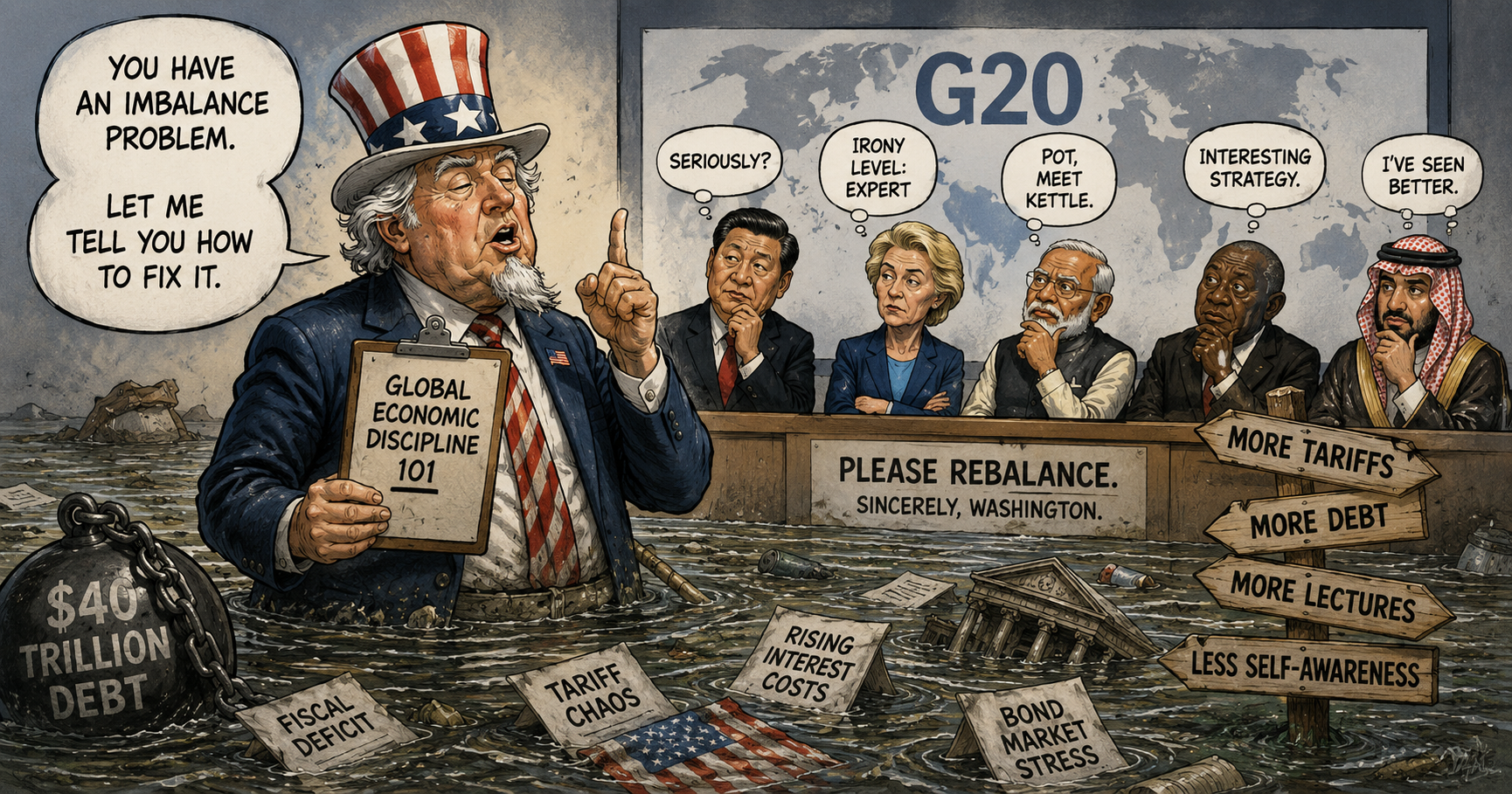
There is something magnificent about American economic diplomacy.
Not necessarily competent. Not necessarily consistent.
But magnificent.
U.S. Treasury Secretary Scott Bessent is heading into the G20 with an important message for the world: China has a trade problem.
Its trade surplus has reached roughly $1.2 trillion, and according to Bessent, this is simply unsustainable. Other countries, he says, should reconsider their trading relationship with Beijing and perhaps erect more barriers against Chinese goods. ([reuters.com](https://www.reuters.com/world/china/g20-countries-should-consider-more-trade-barriers-with-china-cut-imbalances-2026-08-30/?utm_source=chatgpt.com))
Fair enough.
China does have an enormous trade surplus. Its economy relies heavily on exports, domestic demand remains weak, and Chinese industrial subsidies create very real problems for competitors.
There is just one tiny detail.
The man delivering this lecture represents a country whose public debt crossed **$40 trillion** this month. ([reuters.com](https://www.reuters.com/world/china/us-treasurys-bessent-faces-g20-diplomacy-test-amid-tariffs-iran-war-bond-turmoil-2026-08-30/?utm_source=chatgpt.com))
Welcome to economics, American style.
PLEASE CLEAN YOUR ROOM. IGNORE THE FIRE IN OURS.
Washington spent years erecting tariffs and restrictions against Chinese products.
It worked.
At least partly.
America's trade deficit with China fell by roughly a third during the first half of this year.
Excellent.
Unfortunately, Chinese factories did not spontaneously evaporate.
The goods went somewhere else.
Chinese exports were redirected toward Europe, Latin America and other markets. Reuters describes precisely this consequence of America's trade barriers. ([reuters.com](https://www.reuters.com/world/china/g20-countries-should-consider-more-trade-barriers-with-china-cut-imbalances-2026-08-30/?utm_source=chatgpt.com))
And now Washington has arrived with another brilliant suggestion:
**You guys should put up barriers too.**
There is an almost artistic elegance to this.
America closes its market.
The resulting export pressure moves elsewhere.
America points at the resulting export pressure.
America announces that everybody else has a problem.
Then America offers leadership.
You couldn't write better satire because reality has union writers.
ABOUT THOSE IMBALANCES
The official American argument isn't entirely stupid.
A $1.2 trillion Chinese trade surplus is extraordinary. Beijing cannot indefinitely expect the rest of the planet to absorb ever-increasing industrial production while Chinese domestic consumption remains comparatively weak.
That deserves discussion.
But Washington would sound considerably more convincing if it occasionally applied the word **“imbalance”** to itself.
The United States is running unusually large fiscal deficits outside the circumstances in which such deficits traditionally explode: major recessions, world wars, financial crises or pandemics. Its public debt has now passed $40 trillion. Long-term borrowing costs have become sufficiently uncomfortable that Treasury recently announced larger buybacks of long-dated government bonds. ([reuters.com](https://www.reuters.com/world/china/us-treasurys-bessent-faces-g20-diplomacy-test-amid-tariffs-iran-war-bond-turmoil-2026-08-30/?utm_source=chatgpt.com))
Bessent says concerns are exaggerated. He points to continuing American economic growth and argues that the Treasury market remains fundamentally strong. ([reuters.com](https://www.reuters.com/business/bessent-pushes-back-fears-over-us-debt-market-strains-2026-08-31/?utm_source=chatgpt.com))
Maybe he's right.
But that's not really the funny part.
The funny part is the posture.
**Our enormous imbalance is manageable.
Your enormous imbalance threatens the world.**
That is an extremely convenient school of economics.
THE WORLD'S FINANCIAL LIFE COACH
Imagine your neighbour owes the bank forty million dollars.
His mortgage is growing.
His interest payments are climbing.
Every few months he rearranges his financing.
Then one morning he knocks on your door.
Not to borrow money.
To explain that **you need to manage your household budget more responsibly.**
You might listen.
He may even have some good ideas.
But eventually you are going to look past him at the tow truck removing his Mercedes.
That is roughly the optics Washington is creating at the G20.
China should rebalance.
Europe should reconsider its trade exposure.
Other countries should erect barriers.
Iran must be economically isolated.
Everybody needs to make difficult adjustments.
Meanwhile, when the conversation reaches America's own fiscal trajectory, suddenly we discover nuance.
Growth.
Market depth.
Exceptional circumstances.
Long-term structural advantages.
Context, ladies and gentlemen.
Lots and lots of context.
PERHAPS START AT HOME
None of this means China doesn't have a problem.
It does.
None of it means Chinese industrial policy is harmless.
It isn't.
And none of it means $1.2 trillion is a healthy trade surplus for the global economy.
But there is something deeply ridiculous about the world's most indebted government walking into an international meeting carrying a clipboard and diagnosing everybody else's economic disorders.
Before Washington teaches Beijing how to rebalance China, perhaps Washington could demonstrate the procedure.
Just once.
For educational purposes.
Because right now the United States increasingly resembles a man standing waist-deep in shit, pointing across the street and shouting:
**“YOU REALLY NEED TO CLEAN UP YOUR YARD.”**
And perhaps he does have a point.
It's just becoming increasingly difficult to hear him over the plumbing.