Work
Bill 105 Has the Right Idea. Human Discretion Will Ruin It.
Ontario is dancing around a sentence the job site already uses.
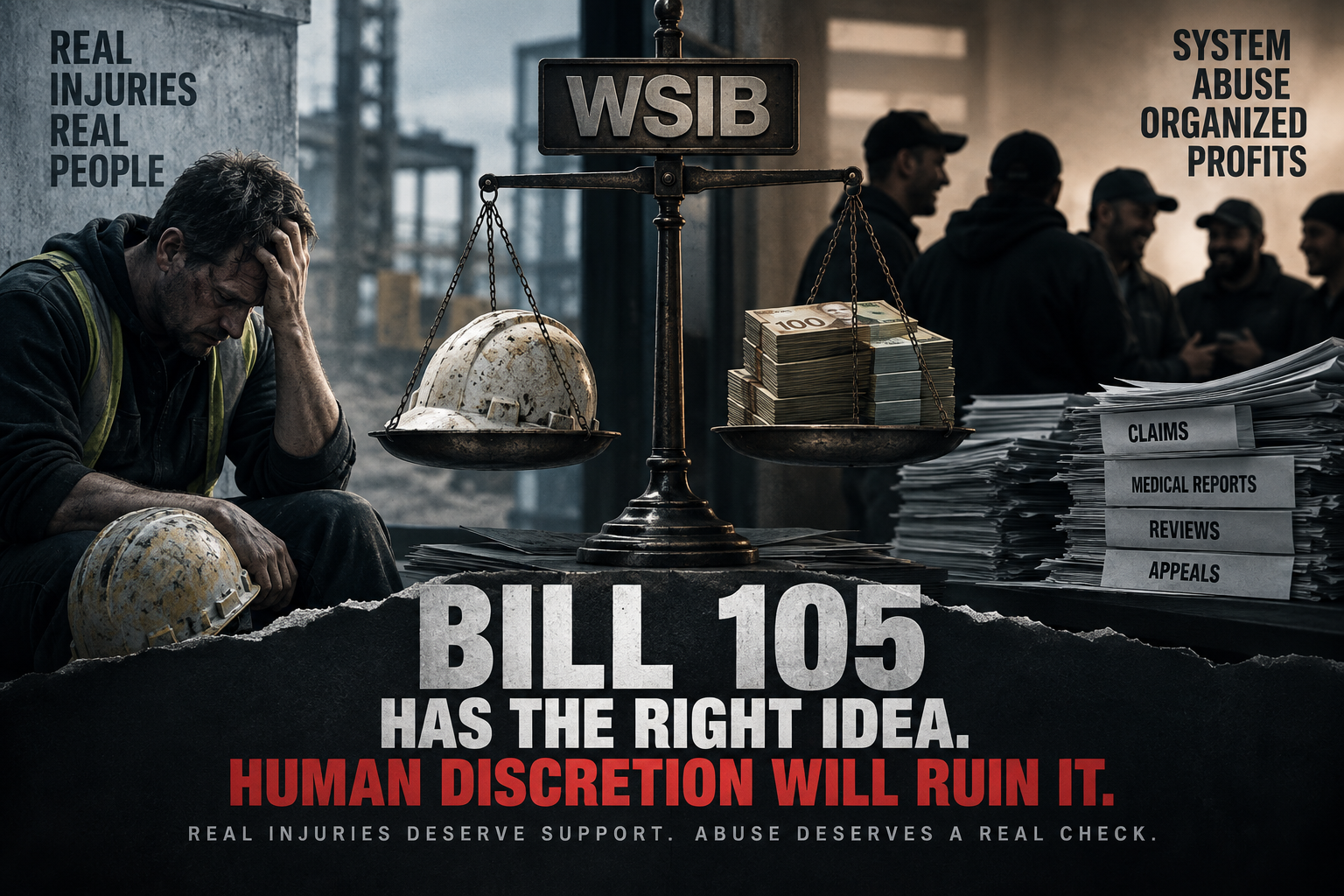
WSIB is abused. Not evenly. Not as a fog that settles on every injured worker in the province. In trucking, warehousing, delivery and construction the complaint is narrower. Certain nationalities have learned the compensation system the way other people learn a trade. They know which clinic writes what, how long a file can be kept open, and how a manageable injury becomes years of benefits.
A minister does not have to name the groups in a scrum. The men working next to those files already have. Pretending the only problem is “a few bad apples of no particular origin” is how the apples stay in the barrel.
Bill 105 at least admits the system is being worked. That is the useful part. The danger is the next move. If a human official decides who gets investigated, two things happen at once. The clerk either hunts by surname and wrecks the one honest claimant from the “wrong” country, or becomes so afraid of that accusation that the organized files are left alone. Both results protect the abuse.
The abuse is a method, not a mood
Some injuries are catastrophic and documented. Those people should be paid and then left alone.
There is also a second population. They did not invent WSIB. They studied it. Knowledge moves through the same hiring pipelines, the same rooms, the same clinics. That is why workers talk about certain nationalities rather than lone fraudsters. A lone fraudster is a case. A network is a business model.
A compensation scheme that refuses to look at a pattern because the pattern has a passport attached is not decent. It is captured.
Review the long files
Some injuries are permanent. Some improve. Some claims outlive the medicine.
If a back is destroyed, pay for it. If the restrictions on the form no longer match the body or the side job, open the file. Time on claim is not proof. Time on claim is often the product.
Pay genuine injury. Remove the performance.
Do not let a person pick the target
This is where the thesis and the mechanism have to be held together, or the law becomes either a witch hunt or a joke.
A bureaucrat with a theory about “those people” will reopen the visible file and miss the one built to survive review. A bureaucrat terrified of being called a bigot will touch nobody from the groups the yard already named. In both cases the operators keep the cheque.
So the first cut cannot be a mood in an office. It cannot be a surname. It also cannot be a quiet decision not to touch certain surnames.
Permanent should mean permanent
If imaging, neurology, specialists and functional tests already establish permanent impairment, that is supposed to mean something. Reopen the file when the evidence changes: new work, new function, contradictory medicine. Not because a calendar rang and somebody needed a quota.
Thin files do not get a cultural exemption
Six-month prognosis. Six years of benefits. Thin specialists. Functional tests that argue with the restrictions. Work capacity that does not match the claim. Investigate. The fact that naming the pattern makes a communications shop nervous is not a medical finding.
Every inflated claim is taken out of the hide of the worker who actually cannot lift.
AI reads the record. It does not get a nationality field
Ontario should not ask a person who looks like a safer investigation.
An automated pass should see the same evidence on every eligible claim: diagnosis, imaging, specialists, expected recovery, treatment, function, restrictions, return-to-work, employment, contradictions, duration, proof of permanence. Same rules.
The first machine should not receive country of birth, race, religion or a photograph. Where possible, not even the name. That is not etiquette. It is how you stop both cheats: the clerk who profiles, and the clerk who looks away.
If the abuse is concentrated among certain nationalities, it will show up as the same medical contradictions, the same recovery timelines that never end, the same clash between claimed limits and actual work. You do not need the passport box to find that. You need the nerve to run the same test on everybody and live with the result.
The model flags. A human still writes the decision
No algorithm should kill a benefit. It should say, in a sentence a tribunal can read, why the file is strange.
Not fraud score 82 percent.
Review recommended because the original recovery was six months, benefits have run six years, and two recent functional assessments conflict with the restrictions used to pay the claim.
Or: leave it. Permanent neurological impairment is documented and stable.
Then an investigator works only those files. The final cut stays human, written and appealable.
Lock the code so the clerk is not invited back
A model can launder prejudice through a postal code or an employer name. So lock it. No identity inputs on the first pass. No proxies that are just identity with a hat on. Publish the rules. Audit flagged and unflagged files on a schedule. If the audit shows a skew the medical record cannot explain, shut the screen down until it is fixed.
That is the opposite of the polite demand. The polite demand is to delete certain nationalities so nobody has to defend the sentence. Then the only people left choosing files are frightened staff. That is how the networks survive.
Keep the law. Stop protecting the racket
Ontario should not drop expanded review because any look at long-term benefits is treated as an attack on the injured. The injured are not the problem. The problem is a compensation system that can be farmed, and a political class that will not say the farming is not randomly distributed.
Bill 105 can still work if the structure is brutal and boring. Permanent files get a presumption. Every eligible claim hits the same evidence screen. Nationality stays out of the first decision so the decision cannot be bought with a complaint. Contradictions get flagged in English. Humans examine those files only. Appeals remain.
The thesis does not change. WSIB is being worked, and not by a random sample of Ontario. Certain nationalities know the system too well. The answer is not a clerk with a hunch about passports. The answer is the same medical test for every long file, including the ones nobody in the building wants to touch.