Society
CANADA CAN FIND RUSSIAN DISINFORMATION. IT COULDN’T FIND THE WAFFEN-SS.
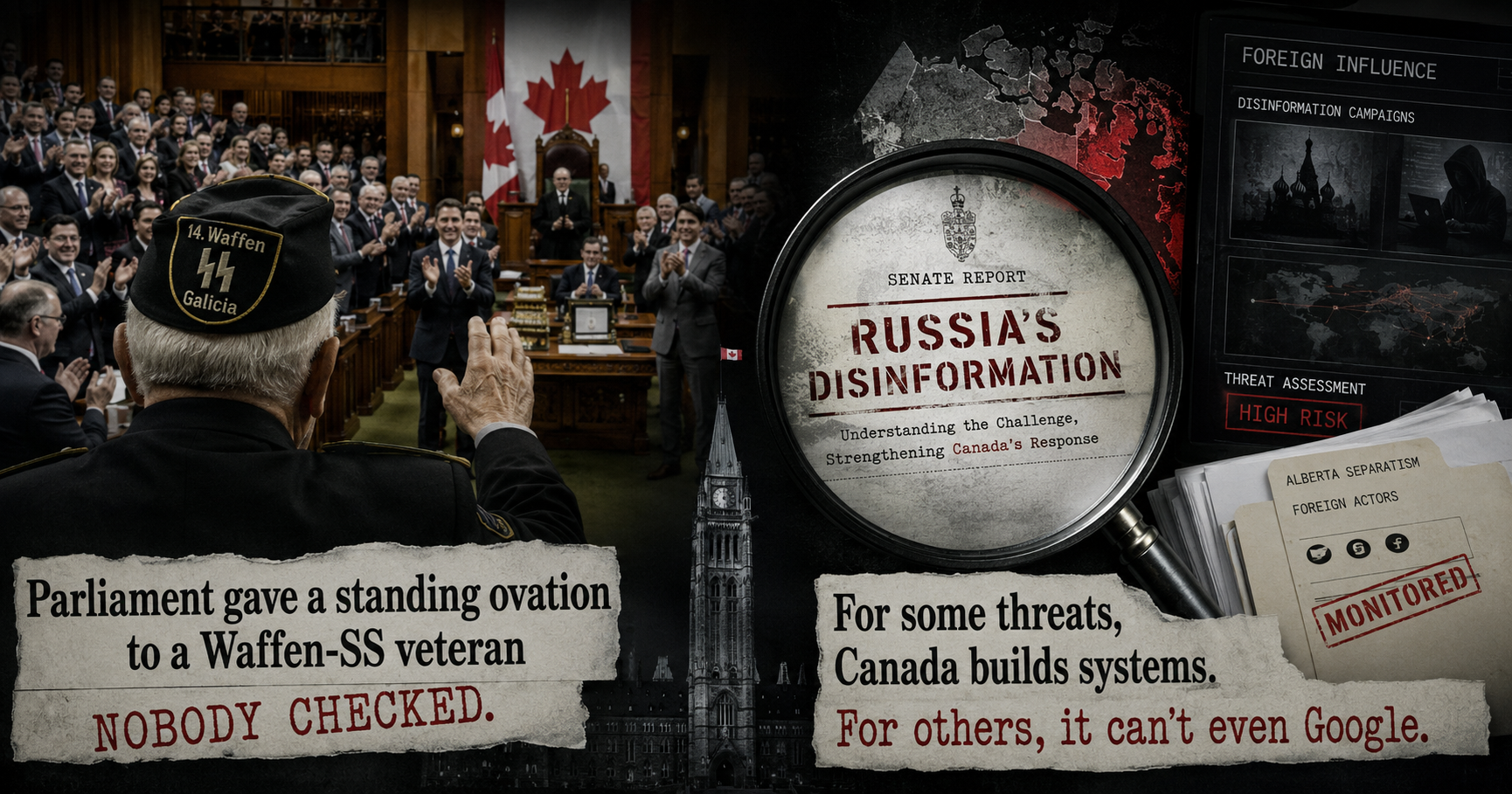
Ottawa is building an increasingly sophisticated machinery to identify foreign influence. Three years ago, Parliament could not perform a Google-level background check before giving a standing ovation.
Canada has become very worried about information.
Not merely false information.
Foreign information.
Foreign influence.
Foreign narratives.
Foreign actors.
And, inevitably, Russia.
On April 30, 2026, the Standing Senate Committee on National Security, Defence and Veterans Affairs delivered an entire report titled **Russia’s Disinformation — Understanding the Challenge, Strengthening Canada’s Response**. The Senate subsequently adopted the report and formally requested a detailed government response.
The committee's conclusion was not modest.
It said Russian disinformation represents an **“urgent threat”** to Canada's national security, democratic institutions and social cohesion, and argued that the scale of the problem exceeds Canada's current ability to respond effectively.
Fair enough.
Foreign governments conduct influence operations. Russia does it. China does it. Other countries do it. Canada itself distinguishes legitimate foreign advocacy from clandestine interference.
But Canada's sudden enthusiasm for identifying dangerous foreign narratives raises an awkward question.
**Where was this investigative instinct on September 22, 2023?**
Because on that day Canada did not need intelligence analysts to discover a Russian bot network.
It needed somebody to check the biography of one man.
And apparently nobody did.
THE MAN EVERYBODY STOOD UP FOR
During Ukrainian President Volodymyr Zelenskyy's visit to Parliament, then-House Speaker Anthony Rota introduced 98-year-old Yaroslav Hunka to the chamber.
The parliamentary record preserves the introduction.
Hunka was presented as a Ukrainian-Canadian Second World War veteran who had fought for Ukrainian independence **“against the Russians.”**
Members of Parliament rose.
They applauded.
Hunka received standing ovations.
There was only one small historical complication.
The military formation in which Hunka had served was the First Ukrainian Division — also known as the **14th Waffen Grenadier Division of the SS, or Waffen-SS Galicia**, a formation under Nazi German command.
This was not obscure information buried inside a Soviet archive underneath Moscow.
Hunka's service became publicly identifiable almost immediately.
The result was an international humiliation.
Rota apologized and resigned as Speaker.
Prime Minister Justin Trudeau subsequently apologized as well, calling the recognition a terrible violation of the memory of Holocaust victims and others murdered by the Nazis.
And then Canada investigated how this could possibly have happened.
The answer was extraordinary.
THEY CHECKED WHETHER HE WAS DANGEROUS. THEY DIDN'T CHECK WHO HE WAS.
In February 2024, officials appeared before the House of Commons Procedure and House Affairs Committee to explain the process used for guests attending addresses to Parliament.
Names were checked against a security database.
Visitors underwent physical security screening.
But Parliament's own officials stated something remarkable:
**Guests were not screened for reputational threats.**
Hunka and his son's names had been submitted by the Speaker's office through the ordinary parliamentary protocol process.
Think about that for a moment.
Canada had a system capable of checking whether an elderly visitor represented a physical security threat inside Parliament.
It apparently did not have a system requiring someone to ask whether the Second World War veteran Parliament was preparing to honour had served in the Waffen-SS.
And there was an additional absurdity.
The clue was embedded in the introduction itself.
Hunka was described as someone who fought **against the Russians during the Second World War**.
Who exactly was fighting the Soviet Union on the Eastern Front?
This was not a cryptographic puzzle.
Nobody in the chamber apparently stopped long enough to ask.
They stood.
They applauded.
Twice.
THREE YEARS LATER, CANADA HAS BECOME VERY GOOD AT ASKING QUESTIONS
Now compare that institutional curiosity with Canada in 2026.
The Senate authorized a study specifically examining **the impacts of Russia's disinformation on Canada**.
Hearings were conducted.
Evidence was collected.
A report was written.
Recommendations were produced.
The Senate adopted it.
A formal government response was requested.
Canadian intelligence doctrine meanwhile carefully distinguishes ordinary foreign activity from actual foreign interference.
CSIS defines foreign interference as activity detrimental to Canadian interests that is **clandestine or deceptive, or involves a threat to a person**.
The agency explicitly says foreign interference is different from normal diplomacy and legitimate foreign lobbying.
That distinction matters enormously.
Because an unpleasant foreign opinion is not automatically foreign interference.
A Russian saying something about Canada is not automatically a Russian operation.
A Canadian repeating an argument also made in Moscow does not become an agent of Moscow by ideological osmosis.
And a political grievance does not become foreign-manufactured merely because foreigners discover it and amplify it.
Actual covert influence operations exist.
So does propaganda.
So do bot networks.
So does disinformation.
Investigate them.
Expose them.
Prove them.
But the burden should be **evidence**, not geography.
THE MOST CONVENIENT WORD IN POLITICS: “DISINFORMATION”
Canada's own security service defines disinformation as the deliberate dissemination of false or manipulated information **with the intention of misleading people**.
Notice how much work that definition requires.
The information must be false or manipulated.
Its dissemination must be deliberate.
There must be an intention to mislead.
Those are factual questions.
They can, at least theoretically, be tested.
But once the word *disinformation* escapes the intelligence world and enters ordinary political journalism, something interesting happens.
It often becomes a shortcut.
An inconvenient claim becomes a narrative.
A narrative becomes amplification.
Amplification becomes influence.
Influence becomes interference.
And by the end of the paragraph, a Canadian arguing with his government can begin to look suspiciously like the final delivery mechanism of a foreign intelligence service.
This is precisely why governments deserve scrutiny when they construct systems for policing information.
Not because foreign interference is imaginary.
Because it is real.
And real threats make excellent justification for bad categories.
CANADA'S PROBLEM WASN'T RUSSIAN DISINFORMATION
There is another layer of irony in the Hunka affair.
After the scandal erupted, Trudeau warned that Russia and its supporters were using the episode as propaganda against Ukraine.
That was undoubtedly predictable.
Of course Moscow exploited it.
But Russia did not invite Hunka.
Russia did not introduce him in Canada's House of Commons.
Russia did not tell Canadian MPs to stand.
Russia did not prevent Parliament from checking his wartime service.
Canada created the event.
Russia merely received the footage.
Calling attention to propaganda after producing spectacular propaganda material yourself is rather like setting your kitchen on fire and complaining that the neighbour photographed the smoke.
The solution was not better counter-disinformation.
The solution was **checking the guest list**.
THIS IS WHAT INSTITUTIONAL SCEPTICISM LOOKS LIKE
There is nothing unreasonable about Canada investigating Russian information operations.
It should.
There is nothing unreasonable about protecting elections from covert foreign manipulation.
It should.
There is nothing unreasonable about studying bot networks, hidden financing, coordinated campaigns or state-directed influence.
It should do all of those things.
But institutional scepticism becomes difficult to take seriously when it operates primarily outward.
Imagine applying the same standard inward.
Before Parliament publicly honours somebody:
**Who is this person?**
Before a newspaper labels political content foreign interference:
**What exactly demonstrates coordination?**
Before researchers describe an online account as a foreign actor:
**Do we mean a government operative, a coordinated proxy, a bot, a foreign citizen or merely someone posting from another country?**
Before politicians call something disinformation:
**Which statement is false?**
And before claiming that a foreign power is exploiting divisions inside Canada:
**Did the foreign power create the division, or did Canadians create it themselves?**
Those are not pro-Russian questions.
They are journalistic questions.
THE GOOGLE TEST
Perhaps Canada needs one additional recommendation for its next national-security report.
Call it the **Google Test**.
Before the federal government spends millions teaching Canadians how to identify suspicious foreign narratives, every institution in Ottawa should demonstrate the ability to perform the following exercise:
Type a person's name into a search box.
Read.
Ask a second question.
Because Canada now has intelligence agencies studying foreign interference, parliamentary committees studying disinformation, researchers mapping information ecosystems and politicians warning citizens about hostile narratives.
Yet in September 2023, the House of Commons managed to place a former member of a Waffen-SS division in its gallery, introduce him as a hero and rise to applaud him.
The system subsequently explained that its screening procedures were concerned with security, not reputational history.
Maybe that is the larger problem.
Canada has become exceptionally interested in determining **who is influencing Canadians**.
It might occasionally devote the same enthusiasm to determining **who Canadians are applauding**.