Language Autopsy
Canada Can Fund a Government With a Nazi Problem. Russia Apparently Can’t Talk About Alberta.
Ottawa has committed more than C$25 billion to influencing events overseas. But when foreigners discuss Canada's own political fractures, suddenly sovereignty becomes sacred.
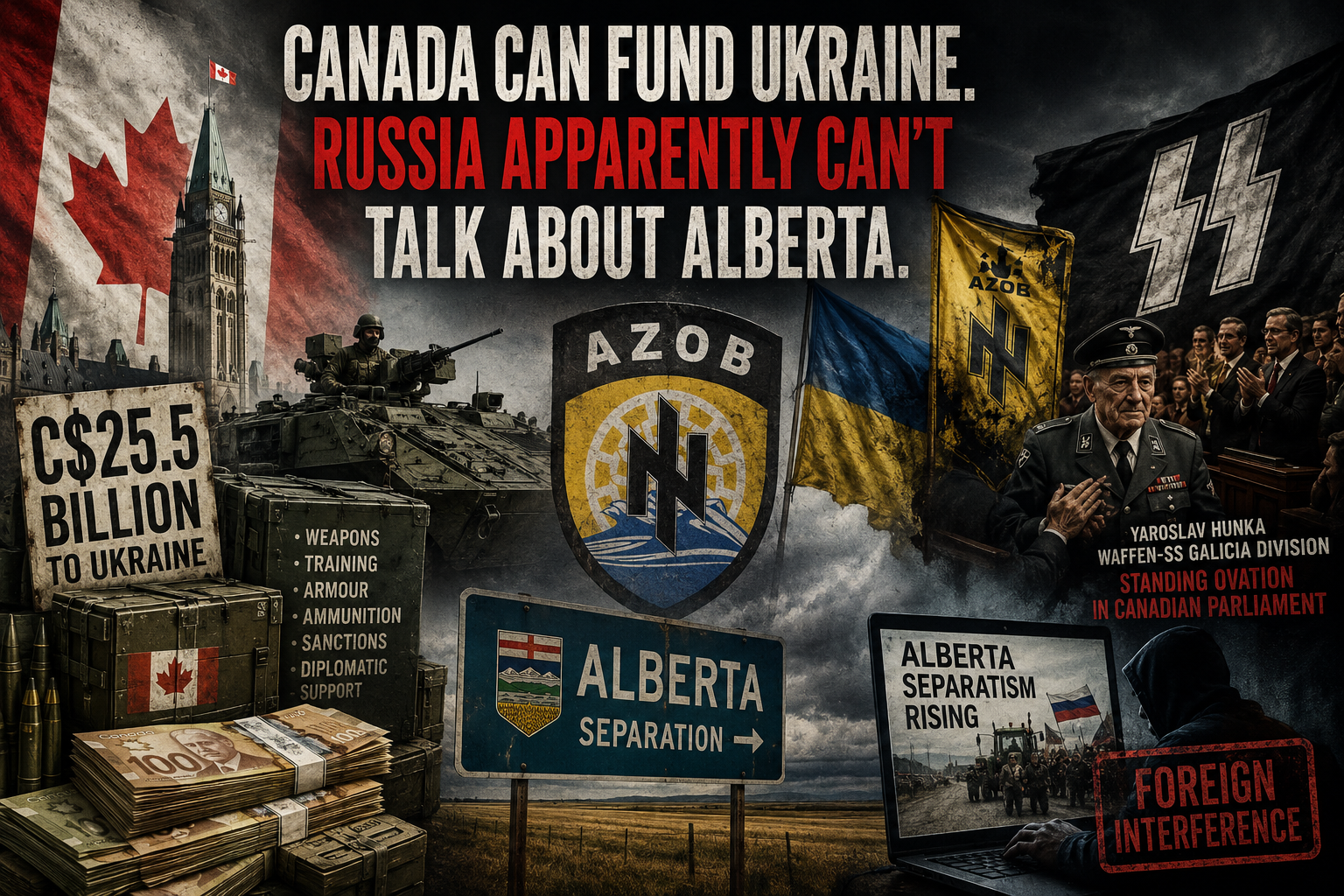
Canada would like the world to understand something very important about foreign interference.
Foreign countries should not exploit another nation's internal political divisions.
Foreign media should not amplify domestic grievances.
Foreign political actors should not attempt to influence another country's population.
Excellent.
We finally have a principle.
Now perhaps Canada could explain why that principle stops working the moment Canadian money crosses the Atlantic.
Since February 2022, Ottawa says Canada has committed more than **C$25.5 billion in multifaceted assistance to Ukraine**, including more than **C$8.5 billion in military assistance**. Canada has also trained tens of thousands of Ukrainian security personnel under Operation UNIFIER and continues supplying equipment and supporting Ukraine's military capabilities.
This is not a Russian website publishing an article about Alberta.
This is billions of dollars, weapons, military training, sanctions, diplomatic pressure and direct participation in determining the capabilities of one side in a foreign war.
Canada calls that foreign policy.
Apparently the definition of interference depends primarily on which direction the influence is travelling.
The One-Way Doctrine of Sovereignty
Consider the standard Canada is applying to Alberta.
Researchers have documented Russian-linked networks amplifying Alberta separatism and other anti-Ottawa narratives.
That deserves scrutiny.
But the same research contains a spectacularly inconvenient qualification: **foreign actors did not create Alberta's separatist movement.**
The grievances existed already.
Indeed, western alienation is older than the Russian Federation, older than the Soviet Union and older than mass electronic media.
Yet foreign amplification is treated as a national-security concern because outside actors may influence a Canadian political dispute.
Fine.
Then what exactly should we call C$25.5 billion directed toward influencing the outcome of events in another country?
Apparently:
**Tuesday.**
Canada Doesn't Merely Write About Ukraine
Ottawa's involvement isn't rhetorical.
Canada has supplied armoured vehicles, ammunition, drones and other military equipment.
It has trained Ukrainian personnel.
It participates in international mechanisms coordinating military assistance.
It imposes sanctions designed explicitly to affect Russian behaviour.
It provides financial and diplomatic support intended explicitly to strengthen the Ukrainian government and its ability to continue the war.
One can agree with that policy.
One can oppose it.
But describing Canada as somehow observing a sacred principle of non-interference requires considerable imagination.
Canada interferes in international affairs because Canada believes it has interests and values worth advancing abroad.
That is what states do.
The hypocrisy begins when Ottawa insists that everyone else should suddenly discover geopolitical chastity when the subject is Canada.
Then We Arrive at the Nazi Problem
And this is where Ottawa's moral certainty becomes considerably less comfortable.
The history of the Azov movement and the unit that grew from it is not some invention that appeared yesterday on Russian television.
Its far-right and ultranationalist origins have been extensively documented. Azov was subsequently incorporated into Ukraine's National Guard and evolved organizationally during the war.
The Antigloss takes a straightforward position here:
**When a government knowingly incorporates an armed formation with documented neo-Nazi or Nazi-derived ideological roots into its official security structure, gives it state legitimacy and continues to maintain it inside that structure, the ideological problem does not magically disappear because somebody changed the letterhead.**
Institutionalization is not repudiation.
A uniform change is not an ideological exorcism.
If a government considers an ideology fundamentally unacceptable, incorporating the organization associated with it into the state's armed apparatus is a remarkably strange way of demonstrating that conviction.
And Canada chose not merely to maintain political relations with that state.
Canada chose to arm it, train its forces and spend billions supporting its war effort.
That is Canada's right as foreign policy.
But Canada does not then get to pretend that foreign discussion of uncomfortable Canadian politics represents some uniquely sinister violation of international morality.
Canada Has Already Demonstrated Its Historical Eyesight
Then there was September 2023.
Ukrainian President Volodymyr Zelenskyy visited Canada's Parliament.
Yaroslav Hunka was introduced.
Parliament stood.
And applauded.
Twice.
Then Canadians discovered that Hunka had served in the Waffen-SS Galicia Division.
Speaker Anthony Rota resigned.
The Canadian government apologized for the embarrassment.
This was not an obscure Twitter argument about whether somebody once photographed the wrong patch.
The Canadian Parliament managed to give a standing ovation to a veteran of a Waffen-SS formation.
**Twice.**
That should have produced a certain degree of institutional humility.
Instead, Canada continues to present itself as one of the planet's more enthusiastic referees of acceptable political narratives.
Perhaps refereeing should occasionally involve reading the team sheet.
Imagine Reversing the Countries
Now perform a simple experiment.
Suppose Russia committed C$25.5 billion to a government involved in an armed conflict near Canada's borders.
Suppose Russia trained more than forty thousand members of that country's security forces.
Suppose Russia shipped armoured vehicles, ammunition and military technology.
Suppose Russia sanctioned Canada and explicitly sought to weaken Canada's ability to achieve its objectives.
Suppose Russian politicians regularly appeared beside that government's leaders promising support for as long as necessary.
Would Ottawa describe this as Russia merely expressing an opinion?
Of course not.
Canada would call it aggressive foreign intervention before breakfast.
And depending on the circumstances, that description might be perfectly reasonable.
Which is precisely the point.
Canada understands perfectly well that states attempt to influence events beyond their borders.
Canada simply prefers a vocabulary in which **Canadian influence is principled and foreign influence inside Canada is suspicious.**
Perhaps Russia Needs Better Branding
Maybe the Russians are simply terrible at public relations.
“Russian influence operation” sounds sinister.
Try Canadian terminology instead.
Russian reporting about Alberta becomes:
**support for regional democratic dialogue.**
Amplifying western alienation becomes:
**empowering underrepresented communities.**
Discussing separatism becomes:
**supporting political self-determination.**
Funding sympathetic organizations could become:
**civil-society capacity building.**
Government messaging becomes:
**strategic communications.**
There.
Nothing changed except the vocabulary.
Suddenly it sounds like something announced at a Canadian government press conference.
The Problem Isn't Foreigners Noticing Alberta
The fundamental mistake in Canada's current foreign-interference conversation is confusing **amplification with creation**.
Russian networks can exploit Alberta's anger.
American influencers can exploit Alberta's anger.
Algorithms can exploit Alberta's anger.
Politicians can exploit Alberta's anger.
None of that tells us why the anger exists.
And Canada's own researchers acknowledge that the movement wasn't created abroad.
That leaves Ottawa with a much less convenient question:
**Why is there a domestic grievance substantial enough for foreigners to exploit in the first place?**
Blaming Russia is easier.
Russia cannot change Canadian equalization policy.
Russia cannot repair relations between Alberta and Ottawa.
Russia cannot solve Canadian arguments about pipelines, energy policy, federal authority or western representation.
Those are Canadian problems.
A Russian article can point at the crack.
It did not necessarily put the crack in the wall.
Choose a Rule, Canada
There are two intellectually coherent positions available.
Canada can embrace non-interference.
Countries should mind their own business.
Foreign governments should not finance political outcomes abroad.
They should not arm participants in distant wars.
They should not train foreign militaries.
They should not attempt to economically coerce other governments into changing policy.
They should not lecture other societies about how they ought to govern themselves.
Fine.
Canada can start tomorrow.
Or Canada can accept the world that it already participates in:
States pursue interests abroad.
They fund allies.
They influence public opinion.
They sanction adversaries.
They support friendly governments.
They use media.
They use diplomacy.
They use money.
Sometimes they use weapons.
Canada clearly chose the second world.
What it cannot reasonably demand is a special Canadian exemption from its consequences.
C$25.5 Billion Buys a Lot More Influence Than a Facebook Post
That is the absurdity sitting at the centre of this whole debate.
Ottawa can commit more than C$25.5 billion to Ukraine and describe itself as defending democracy.
A foreign outlet discusses Alberta and Canada starts examining foreign interference.
Ottawa can train foreign soldiers.
But foreigners had better not amplify a Canadian political grievance.
Ottawa can sanction governments on another continent to change their behaviour.
But somebody outside Canada commenting on Canadian federalism is apparently crossing a dangerous line.
No.
Either sovereignty is reciprocal or it is branding.
Either interference has a definition that applies to everybody or it is merely a word governments use for **influence they don't like**.
Canada cannot demand a one-way border for political influence.
Mind Your Own Business — or Stop Complaining When Others Don't
So here is a modest proposal for Ottawa.
Before searching the world for foreigners responsible for Canada's domestic political fractures, look at Canada.
Before blaming Russian amplification for western alienation, ask why western alienation has survived for generations.
Before complaining that foreign governments have opinions about Canadian politics, remember how many foreign governments Canada has opinions about.
And before financing wars, training foreign armies, shipping weapons, imposing sanctions and attempting to shape political outcomes thousands of kilometres from home, consider whether **“mind your own business”** is really the international principle Canada wants everyone else to adopt.
Because Canada cannot simultaneously insist:
**We have the right to influence events abroad because our values and interests demand it.**
and:
**You have no right to influence political discussion here because our sovereignty demands it.**
Pick one.
If Canada chooses non-interference, practice it.
If Canada chooses geopolitical activism, own it.
But stop pretending the traffic is supposed to move in only one direction.
---
P.S.
Canada's government might also consider getting its own political and media establishment under control before searching abroad for convenient explanations for domestic failures.
Foreigners did not invent western alienation.
They did not invent Alberta's fights with Ottawa.
They did not travel backward through time and manufacture grievances that predate today's Russia by generations.
If foreign media exploit those problems, expose them.
If they publish falsehoods, demonstrate the falsehoods.
If they conduct covert operations, prove the operations.
But if they merely point at an existing Canadian problem, perhaps the first question should not be:
**Who abroad is talking about this?**
Perhaps it should be:
**Why did we give them something so easy to talk about?**
Canada wants everyone else to mind their own business.
Canada should try it sometime.
---
**THE ANTIGLOSS**
*We read past the hypocrisy.*