Culture
Canadian Common Sense: Mandatory Unless Religion Says Otherwise
Ontario says a motorcycle helmet is essential safety equipment. Canada says a photograph helps prevent firearms-licence fraud. Both requirements become negotiable when religion enters the room.
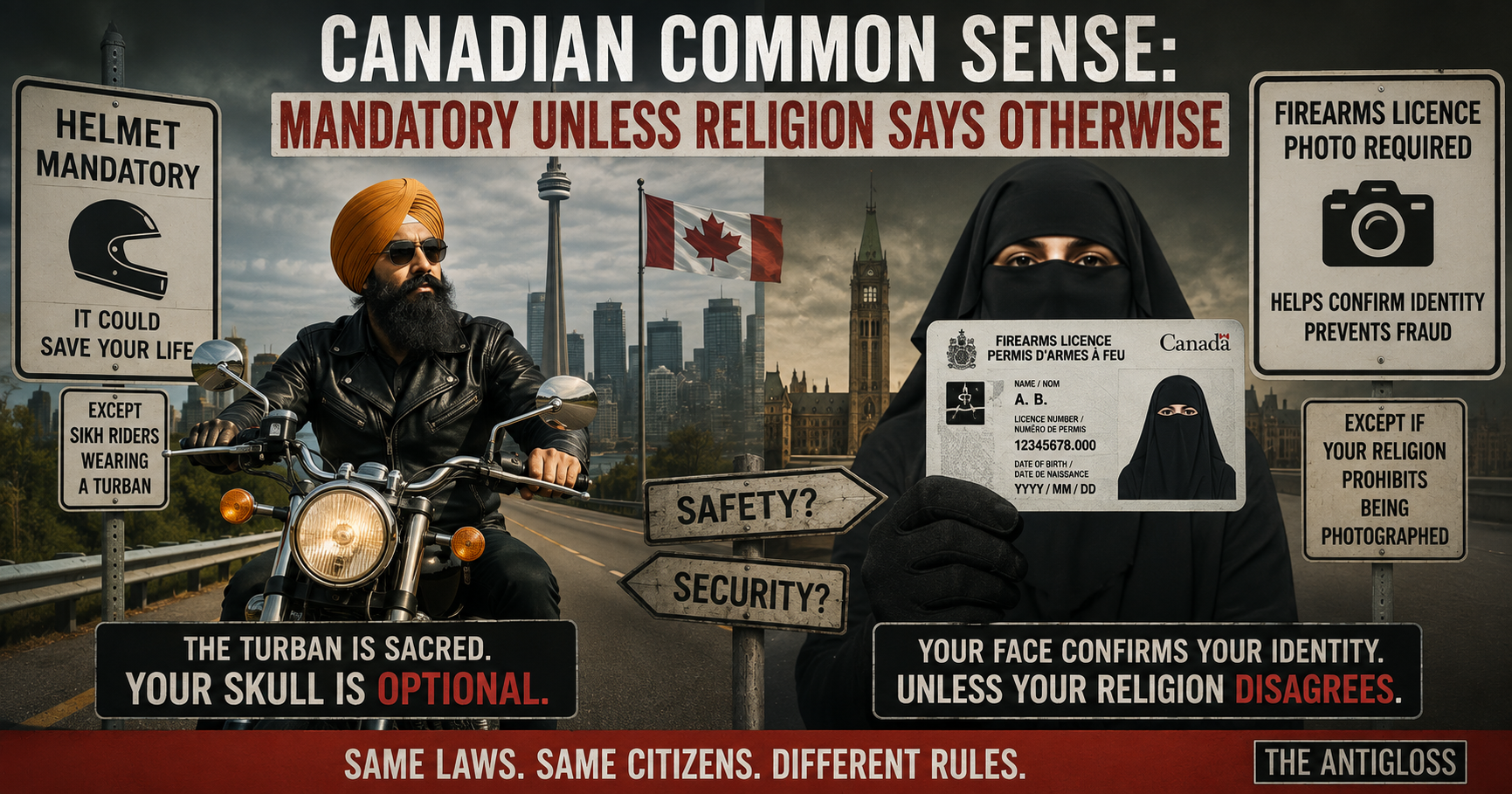
Governments make rules for reasons.
At least, that is the theory.
Motorcycle helmets are mandatory because human skulls perform poorly when introduced to asphalt at highway speed.
Identification photographs exist because an identification document that cannot reliably identify its holder is a rather questionable identification document.
Neither proposition is particularly controversial.
Canada has nevertheless managed to turn both into philosophical problems.
In Ontario, most motorcycle riders are legally required to wear approved helmets. But an adult Sikh meeting the regulatory conditions can legally ride without one while wearing a turban.
At the federal level, applicants for Canadian firearms licences ordinarily provide photographs. The RCMP says photographs assist in confirming identity and preventing fraud.
But Canadian firearms regulations also provide a religious exemption through which qualifying applicants can seek a waiver from the photograph requirement itself.
The question is not whether Sikhs should wear turbans.
The question is not whether somebody's religion prohibits photography.
People are free to believe whatever they wish.
The question is considerably simpler:
**Does the government believe its own rules are necessary or not?**
Apparently Physics Has a Religious Exemption
Ontario's official motorcycle handbook describes a helmet as the most important motorcycle safety accessory and explains its role in preventing serious head injury.
Reasonable enough.
Then Ontario law creates an exemption.
An adult Sikh motorcyclist who meets the regulatory requirements concerning unshorn hair and the wearing of a turban may operate a motorcycle without the helmet everybody else is required to wear. The exemption has existed since 2018.
There is an obvious problem here, and it has nothing whatsoever to do with Sikhism.
The pavement doesn't care.
Neither does a guardrail.
Neither does the bumper of an SUV.
Kinetic energy does not ask for religious affiliation before transferring itself into a human skull.
A turban may have enormous religious significance. It may represent identity, discipline, faith and centuries of tradition.
What it isn't is a certified motorcycle helmet.
And pretending otherwise would insult both engineering and common sense.
Ontario doesn't actually pretend otherwise.
That's what makes the law so peculiar.
The government acknowledges the safety purpose of the helmet and then decides that, for one category of citizens, accepting the additional physical risk becomes a matter of personal choice.
Fine.
Then we have a question.
Why Doesn't Everyone Get the Choice?
When Ontario announced the exemption in 2018, Premier Doug Ford's government said road safety remained a priority while emphasizing that individuals have responsibility for their own well-being.
Wonderful.
That is a perfectly coherent political philosophy.
An adult understands the danger.
An adult accepts the danger.
An adult makes the decision.
Government steps aside.
There is only one problem:
**Ontario doesn't apply that philosophy to everybody.**
A Sikh rider satisfying the exemption can decide that riding without a helmet is a risk he is prepared to accept.
A non-Sikh rider cannot make the same decision.
Same motorcycle.
Same road.
Same speed.
Same pavement.
Same human anatomy.
Different legal autonomy.
If personal responsibility is sufficient for one adult, why isn't it sufficient for another?
There are perfectly legitimate arguments for mandatory motorcycle helmets. A serious head injury can impose costs not merely upon the rider but upon emergency services, hospitals, insurers and publicly funded healthcare.
There are also legitimate libertarian arguments against mandatory helmets: competent adults routinely undertake dangerous activities and should be permitted to decide which risks they accept.
Choose either argument.
But choose one.
**“Your body, your risk, your responsibility — provided you possess the correct religious belief” is not a safety principle.**
It is an exception looking for a principle.
Then We Get to Firearms
The federal example is arguably stranger because this time we aren't discussing somebody's protection from his own decisions.
We're discussing identification.
The RCMP's current guidance says a firearms-licence photograph must provide a clear view of the applicant and explains that the photograph assists with identity confirmation and fraud prevention.
That makes sense.
A Possession and Acquisition Licence isn't a Costco card.
It authorizes its holder to possess and acquire firearms.
Canada therefore maintains a licensing system intended, among other things, to establish who the licence holder actually is.
And then we arrive at section 14 of the Firearms Licences Regulations.
Canadian law provides a mechanism through which an applicant whose religious beliefs prohibit being photographed may seek exemption from the photograph requirement. The application requires a declaration from the applicant and confirmation from an appropriate religious authority.
Read those two propositions together.
**The photograph assists in confirming identity and preventing fraud.**
**The photograph may be waived because of religious belief.**
Again:
Which proposition does the government actually believe?
Either the Face Matters or It Doesn't
Perhaps Canada has other mechanisms capable of establishing the identity of an applicant receiving a religious photo waiver.
Fine.
Then explain the hierarchy.
If a photograph is merely one optional identity-verification mechanism among several equally reliable alternatives, say so.
But if displaying the holder's photograph on a firearms licence materially contributes to confirming that the person presenting the licence is actually the licensed individual, then removing that feature necessarily removes one method of verification.
Religion doesn't change that fact.
This isn't an argument against religious freedom.
It's an argument for governments being able to explain their own security requirements.
If tomorrow somebody announces that his deeply held philosophical convictions prohibit photographs but those convictions aren't religious, why should his claim receive less consideration?
What exactly transforms the security requirement?
The sincerity of the belief?
Its age?
The number of people sharing it?
Recognition as a religion?
A government should be able to answer that without disappearing into a cloud of administrative vocabulary.
Religious Freedom Is Not the Issue
Religious freedom is important precisely because governments should have extremely limited authority over what people believe.
Wear a turban.
Wear a hijab.
Wear a crucifix.
Wear a yarmulke.
Believe in God.
Believe in several gods.
Believe in none.
The government has no legitimate business deciding which metaphysical conclusions a citizen is permitted to reach.
But there is an enormous difference between protecting a belief and rewriting an unrelated safety or identification requirement around that belief.
A motorcycle helmet regulation isn't a theological statement.
Neither is an identification photograph.
The state isn't ordering a Sikh to cut his hair.
It isn't ordering somebody to abandon a religious doctrine concerning photography.
It is saying:
**If you want to perform this regulated activity, these are its safety or identification requirements.**
Nobody possesses an inherent human right to operate a motorcycle.
Nobody possesses an inherent human right to receive a Canadian firearms licence without satisfying Canada's licensing requirements.
And sometimes freedom means that two freedoms collide.
You may possess an absolute right to believe something.
That doesn't automatically create an absolute right to require every regulatory system around you to accommodate the practical consequences of that belief.
Accommodation Needs a Limiting Principle
Reasonable accommodation is a sensible concept.
A government shouldn't impose needless burdens merely because accommodating somebody requires five minutes of administrative flexibility.
But *reasonable* is doing substantial work in the phrase **reasonable accommodation**.
Move an appointment.
Provide a different meal.
Permit religious clothing where it creates no meaningful conflict with the activity being performed.
Fine.
But once accommodation changes the actual safety mechanism or identification mechanism that supposedly justified the rule, government should have to answer a harder question:
**Was the original requirement genuinely necessary?**
If the answer is yes, why is the exception safe?
If the answer is no, why are you imposing the requirement on everybody else?
That isn't hostility toward religion.
That's basic regulatory consistency.
Equality Before the Law Should Mean Something
Canada talks constantly about equality.
Here's an excellent place to practice it.
If Ontario believes competent adults should decide whether to protect their own heads while riding motorcycles, repeal the universal helmet mandate and let every competent adult make that choice.
If Ontario believes helmets are sufficiently important to public safety that their use must be compulsory, apply the requirement universally.
The asphalt will.
Likewise, if Canada believes a photograph is necessary for firearms licensing, require one.
If equivalent identity safeguards make photographs unnecessary, establish those safeguards transparently and make equivalent alternatives available according to rational criteria rather than metaphysical classification.
The important question shouldn't be:
**What religion are you?**
It should be:
**Does this alternative satisfy the legitimate purpose of the regulation?**
That is what equality looks like.
Common Sense Doesn't Require a Theology Degree
None of this requires hostility toward immigrants.
None of it requires hostility toward Sikhs.
None of it requires hostility toward Muslims or any other religious community.
In fact, making the argument about those communities misses the point entirely.
They didn't write Ontario's Highway Traffic Act.
They didn't write Canada's Firearms Licences Regulations.
Politicians and bureaucrats did.
So direct the question where it belongs.
At government.
Why is a helmet mandatory?
Why is a photograph required?
What public purpose does each requirement serve?
Under what circumstances can that purpose safely be achieved another way?
And why should the answer depend upon whether somebody's objection is religious rather than secular?
Those are not complicated questions.
A government competent enough to regulate motorcycles and firearms should presumably be competent enough to answer them.
Pick a Principle
Ontario has two perfectly defensible options.
**Helmets are mandatory because the safety benefit justifies limiting individual choice.**
Or:
**Adults may decide for themselves whether to accept the risk of riding without one.**
Canada likewise has two defensible positions on firearms-licence identification.
**A photograph is an essential part of reliably identifying the licence holder.**
Or:
**A photograph isn't essential because other identity safeguards can perform the same function.**
What deserves ridicule is constructing universal requirements and then treating their underlying logic as optional depending upon the category of citizen standing at the counter.
Religious liberty deserves protection.
So does equality before the law.
And government regulation deserves something else:
**consistency.**
If helmet laws are about personal choice, give everyone the choice.
If they're about public safety, apply them to everyone.
If a photograph is necessary to identify the holder of a firearms licence, require the photograph.
If it isn't necessary, stop pretending that it is.
Because neither pavement nor identity verification gives a damn about theology.
And somewhere beneath Canada's mountain of accommodations, exemptions, regulations, declarations and carefully drafted exceptions, there should still be room for one ancient and endangered principle:
**common fucking sense.**
---
**THE ANTIGLOSS**
*Same law. Same physics. Same citizens.*