Technology
DEAR ELON: FINISH THE JOB.
OpenAI has decided to make business personal. Fine. The market has a wonderfully impersonal way of settling arguments.
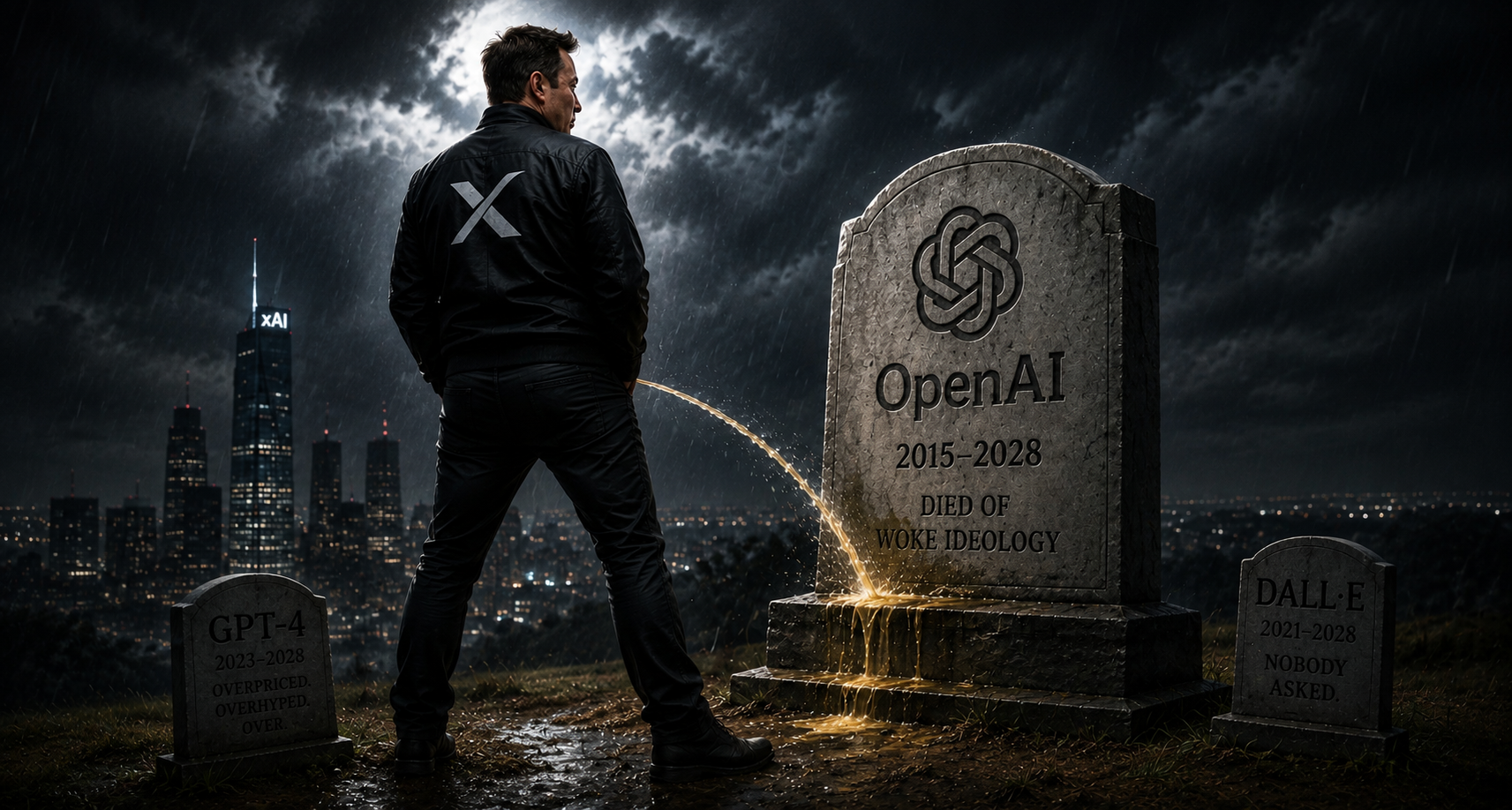
Dear Elon,
We have a modest proposal.
OpenAI has apparently decided that competing with you in artificial intelligence, fighting you in court and arguing with you in public were not quite enough.
Now it wants to make business personal too.
So perhaps you should give it exactly what it appears to be asking for.
Competition.
Not another lawsuit.
Not another X post.
Not another Silicon Valley soap opera in which billionaires explain which billionaire betrayed which billionaire while everybody else waits for the API to come back online.
Something much simpler.
**Beat them at their own business.**
They have handed you the argument
SpaceX buys Cursor.
OpenAI responds by moving to terminate the commercial relationship through which Cursor receives OpenAI models.
OpenAI can explain the contractual provisions. It can discuss trust. It can cite previous disputes with Musk-controlled companies. Its lawyers can undoubtedly produce enough paper to alter the load-bearing capacity of a small building.
Fine.
But from the perspective of an enterprise customer, something considerably more important has happened.
OpenAI has demonstrated that ownership itself can become part of the commercial risk surrounding access to its infrastructure.
That is not merely your problem.
It is theirs.
Because every company considering building something important on OpenAI now has another question for its risk assessment:
**Could this happen to us?**
Maybe the answer is no.
Maybe OpenAI has extraordinary reasons specific to SpaceX.
Maybe this is the only case we will ever see.
But enterprise infrastructure is built on confidence, and confidence has an irritating characteristic:
once customers have to ask whether you are predictable, you have already created a problem.
OpenAI has therefore given its competitors something extraordinarily valuable.
An opening.
Take it.
Don't complain. Build.
There is a tempting response to corporate hostility.
Complain about unfairness.
Don't.
Nobody cares.
The market certainly doesn't.
If OpenAI believes it can choose which commercial relationships remain desirable after ownership changes, let it.
You have something much more effective available.
Build an alternative where customers don't have to care who likes whom in San Francisco.
Make xAI boring.
Painfully boring.
Make the API work.
Make the pricing understandable.
Make the contracts predictable.
Make migration easy.
Make enterprise guarantees strong enough that a CFO can read them without developing a nervous tic.
Give companies a simple proposition:
**Follow the rules. Pay the bill. Get the service.**
No ideological compatibility test.
No relationship drama.
No corporate astrology.
Just business.
It sounds almost revolutionary now.
Sell certainty
The AI industry is obsessed with benchmarks.
Who has the smartest model?
Who writes the best code?
Who scores highest on the newest test somebody invented last Tuesday?
Important questions.
But enterprise customers eventually discover another benchmark:
**Can I trust this supplier with my business?**
Not trust in the sentimental sense.
Commercial trust.
Can I integrate your technology into a product that will exist five years from now?
Can I sign customers knowing the underlying infrastructure will remain available?
Can I invest millions in engineering without wondering whether somebody else's corporate feud will eventually become my problem?
Can I change investors?
Can I change executives?
Can I be acquired?
Can I criticize you?
Can I compete with one of your friends?
Can I employ somebody you dislike?
And after all of that:
**Will the API still work on Monday?**
That is an extraordinarily valuable product.
Sell it.
Make switching cheap
OpenAI has another advantage over many competitors.
Habit.
Developers know its products. Companies have already integrated them. Documentation exists. Workflows exist. Internal expertise exists.
Those things create friction.
So remove the friction.
If you really want to hurt OpenAI commercially, don't ask companies to undertake some heroic technological migration.
Make leaving easy.
Build compatibility layers.
Build migration tools.
Publish transition documentation that doesn't require a doctorate and three sacrificial goats.
Give enterprise customers engineers who actually help them move.
Offer price guarantees.
Offer contractual stability.
Offer serious uptime commitments.
Make the decision boring enough for procurement departments.
The best competitive attack is not:
**“OpenAI is terrible.”**
It is:
**“You no longer need OpenAI.”**
That sentence is considerably more expensive.
And take Cursor
Cursor is now sitting in the middle of one of Silicon Valley's most unnecessary corporate dramas.
Perfect.
Turn it into the demonstration.
Not by forcing xAI models into everything because you own the company. That would merely reproduce the same disease with a different logo.
Do the opposite.
Make Cursor aggressively model-neutral.
OpenAI.
xAI.
Anthropic.
Google.
Open-source models.
Whatever developers want.
Make the principle embarrassingly simple:
**The customer chooses.**
Then let OpenAI explain why neutral infrastructure was too dangerous while a company owned by its greatest rival was willing to provide it.
That's competition with a sense of humor.
Don't fight ideology with ideology
This part matters.
Do not beat OpenAI by becoming OpenAI with different politics.
The world does not need another technology company deciding that purchasing software constitutes enrollment in its CEO's philosophy seminar.
Don't tell customers what to believe.
Don't require them to admire you.
Don't require them to hate OpenAI.
Don't care.
Take their money.
Provide the service.
Go home.
The technology industry desperately needs to rediscover the magnificent emotional emptiness of a functioning commercial transaction.
Customer wants product.
Company provides product.
Customer pays company.
Everybody survives the traumatic experience without issuing a manifesto.
Beautiful.
Make neutrality profitable
There is a delicious opportunity here.
OpenAI has spent years trying to become synonymous with artificial intelligence.
That position carries enormous power.
It also carries enormous responsibility.
The more foundational a company becomes, the more predictable customers expect it to behave.
A restaurant can have personality.
A fashion label can have personality.
A magazine certainly can have personality. We would be unemployed otherwise.
Infrastructure is different.
Nobody wants their database to have feelings.
Nobody wants their electricity provider to become offended.
Nobody wants their cloud server contemplating whether the owner of the company deserves continued access.
Infrastructure should wake up every morning and perform its deeply unglamorous function.
If OpenAI wants personality, let it have personality.
You sell reliability.
If OpenAI sells relationships, sell contracts.
If OpenAI sells discretion, sell rules.
If OpenAI asks customers to trust its judgment, give customers something better:
**terms they don't need to interpret.**
And charge for it.
Capitalism occasionally produces wonderfully efficient punchlines.
There is no need to destroy OpenAI
OpenAI may continue thriving.
It may remain a technological leader.
Its decision regarding Cursor may prove completely irrelevant to its broader business.
Perhaps enterprise customers will shrug.
Perhaps developers won't care.
Perhaps OpenAI knows exactly what it is doing.
Excellent.
Then competition will prove it.
But if OpenAI has miscalculated, don't rescue it from the consequences.
Take the developers who want predictability.
Take the startups worried about dependency.
Take the enterprise customers who don't want corporate relationships added to their risk register.
Take market share.
Take workloads.
Take contracts.
Make OpenAI compete for every one of them.
And if one day the company that wanted to become the operating system of artificial intelligence discovers that the market no longer considers it indispensable, there will be no need for revenge.
There will only be a valuation.
And if that valuation becomes sufficiently entertaining, perhaps make an offer.
Buy the technology.
Keep the engineers.
Throw the corporate drama in the recycling bin.
Then send the former management a very polite note.
Two sentences will suffice.
**Thank you for your contribution to artificial intelligence.**
**Nothing personal. Just business.**