Language Autopsy
Did Nobody Read This Out Loud?
Bimbo, Pajero, LaCrosse, e-tron — and the surprisingly difficult art of checking what your name means before printing it on everything.
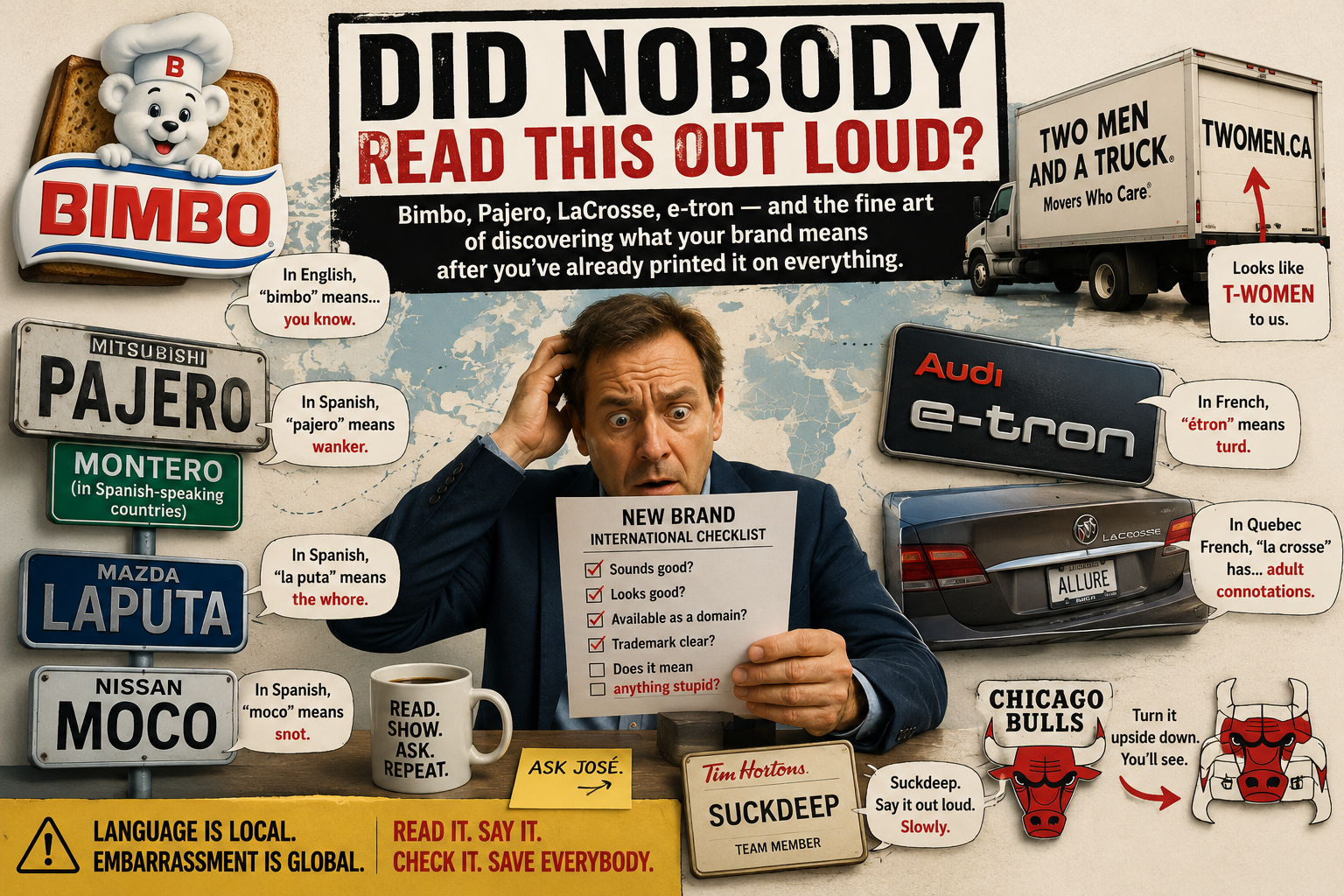
There are complicated jobs in marketing.
Launching a new product is complicated.
Positioning a brand is complicated.
Entering a foreign market is complicated.
Market research is complicated.
But there is one stage of the process that really shouldn't require an MBA:
**Read the fucking name out loud.**
Then show it to somebody who speaks the language of the country where you intend to sell it.
Maybe show them the logo too.
Turn it upside down while you're at it.
This modest investment of approximately fifteen minutes could have prevented some of the finest accidental comedy in international business.
Because corporations routinely spend millions developing products, packaging, advertising campaigns and distribution networks, only to discover remarkably late that somebody, somewhere, forgot to ask:
**“Guys, does this mean anything stupid?”**
Sometimes it does.
Very stupid.
Welcome to Canada, Bimbo
Let's begin with a company that requires absolutely no joke-writing assistance whatsoever.
**Bimbo.**
Grupo Bimbo is an enormous Mexican baking company. Bimbo Canada sells bread and other baked products across the country.
There is nothing inherently ridiculous about the company's original name. It comes from a different linguistic and cultural context.
Unfortunately, Canada contains quite a few English speakers.
And English already has the word *bimbo*.
It is not generally associated with sophisticated intellectual achievement.
So somewhere on a Canadian highway you can encounter a large commercial vehicle proudly announcing:
**BIMBO**
Nothing is technically wrong.
Everything is linguistically magnificent.
The company didn't make a spelling mistake. The English language simply arrived at the meeting carrying its own definition.
This is one of the fundamental hazards of international branding:
**Your trademark may belong to you. The language doesn't.**
You can register the word.
You cannot order millions of people to stop understanding it.
Two Men Enter. T-Women Leave.
Then there is another category of accidental branding: the company name is perfectly fine, but somebody removes the spaces.
Two Men and a Truck is a moving company.
Perfectly understandable.
Two men.
A truck.
Things are going somewhere.
Then you encounter:
**TWOMEN.CA**
And suddenly the human brain gets involved.
Domains don't contain spaces, and brains love finding patterns. Instead of:
**TWO MEN**
the eye can decide to parse it as:
**T-WOMEN**
In contemporary English, *T-women* can rather easily suggest *trans women*.
And just like that, two men and their truck have undergone the fastest corporate transition in Canadian history.
Nobody changed the company.
Nobody changed the name.
Nobody even changed a letter.
We merely moved the invisible space.
This could have been avoided with something spectacularly sophisticated such as:
**2MEN.CA**
But where would be the fun in that?
Mitsubishi Would Like to Sell You a Wanker
Automotive history is particularly rich in these accidents because car companies routinely create model names in one country and export them everywhere else.
The Mitsubishi Pajero is a classic example.
In many markets, *Pajero* was simply the name of an SUV.
In Spanish, unfortunately, *pajero* can be vulgar slang roughly equivalent to **wanker**.
Not necessarily the aspirational automotive image Mitsubishi had in mind.
Consequently, the vehicle was sold as the **Montero** in various Spanish-speaking markets.
This is exactly what sensible localization is supposed to do.
Someone eventually asks a native speaker.
The native speaker stops laughing.
The meeting resumes.
The badge changes.
Problem solved.
But it leaves behind an important question:
**At what stage of international product development did somebody first say the word Pajero to an actual Spanish-speaking human being?**
Because ideally this happens before the brochures.
Mazda La Puta
Then we have the wonderfully named **Mazda Laputa**.
The name was associated with *Laputa*, the flying island in Jonathan Swift's *Gulliver's Travels*.
Literary!
Cultured!
Sophisticated!
There is only one small problem.
Separate it in Spanish:
**La puta.**
That phrase does not mean “the magical flying island of enlightened automotive engineering.”
It means **“the whore.”**
This is the sort of naming collision that should make an international marketing department suddenly appreciate the value of interns.
You don't need a multinational consultancy.
Find José from accounting.
Show him the badge.
If José falls off his chair, postpone the launch.
Nissan Has a Runny Nose
The Nissan Moco presents a gentler version of the same phenomenon.
*Moco* in Spanish means **mucus** or **snot**.
Which gives us another important rule of automotive branding:
Before naming a vehicle, make sure customers in another major world language aren't going to walk into a dealership and ask for the new Nissan Snot.
Again, there is nothing wrong with the original intended name in its home context.
That's the whole point.
International naming disasters aren't necessarily created by stupidity at the moment the name is invented.
They are created by failing to perform the second step:
**What does everybody else hear?**
Audi Has Entered the Toilet
Audi managed something particularly elegant with **e-tron**.
Stylish.
Technological.
Electric.
Minimal.
Very Audi.
Then French enters the room.
The French word *étron* means **turd**.
Not metaphorically.
Not through some obscure seventeenth-century idiom known only to three professors in Lyon.
A turd.
And Audi nevertheless built a major electric-vehicle identity around e-tron.
To be fair, this demonstrates something fascinating about branding: sometimes a company is powerful enough simply to march directly through the linguistic minefield.
Keep saying the name.
Advertise it everywhere.
Put it on expensive cars.
Eventually consumers associate it with Audi rather than excrement.
That is one solution.
It is not necessarily the solution available to your new startup.
Quebec Has Entered the Chat
General Motors discovered a more local Canadian problem with the **Buick LaCrosse**.
To most English speakers, *LaCrosse* sounds perfectly respectable.
It even sounds Canadian.
There's a sport and everything.
Unfortunately, Quebec French supplied some slang complications around *crosser* and related expressions with sexual connotations.
So when the model originally entered Canada, GM used another name:
**Buick Allure.**
Eventually LaCrosse returned.
But the episode illustrates why localization cannot stop at:
**“Does anybody in France object?”**
French in France and French in Quebec are not linguistically identical.
Spanish in Spain isn't identical to every variety spoken throughout Latin America.
English in Britain, Canada, Australia and the United States can generate completely different associations.
Languages are not software packages with one globally standardized dictionary.
People keep modifying them.
Very inconsiderate of consumers.
And Then There Are Human Names
Corporate naming accidents are funny because corporations can fix them.
Change the badge.
Change the domain.
Change the packaging.
Call a meeting.
Blame marketing.
Issue new business cards.
Human beings don't get that luxury quite so easily.
I once encountered a young woman working behind a counter whose name badge, as I remember it, produced an extremely unfortunate English reading resembling:
**Suckdeep.**
Now, before anyone starts laughing at her, stop.
She didn't choose it.
The name may have a completely normal origin and meaning in another language, and transliterations of South Asian names into Latin characters vary. Without the exact spelling and linguistic origin, it would be irresponsible to declare what her actual name meant.
But the English visual effect was brutal.
And teenagers are not famous for linguistic restraint.
Which leads to a rule considerably more important than anything in corporate branding:
**If you're naming a child who is going to grow up in another linguistic environment, test the name in that language.**
Say it.
Write it.
Put it on a fake school attendance sheet.
Give it to the most immature fourteen-year-old boy you can find.
If he discovers a sexual joke in under three seconds, congratulations:
You have just received extremely valuable market research.
Children are vicious.
Plan accordingly.
Logos Aren't Safe Either
Words aren't the only problem.
Human brains are pattern-recognition machines.
We find faces in electrical outlets, animals in clouds and religious figures in pieces of toast.
So naturally we also discover things in logos that designers never intended.
The Chicago Bulls logo has enjoyed years of internet reinterpretation because turning it upside down makes people perceive completely different imagery in the shapes.
Is that a design failure?
Not really.
It's pareidolia.
But it demonstrates the larger problem beautifully.
A designer controls what he draws.
He does **not** completely control what everybody else sees.
And once somebody discovers an unintended second image, good luck undiscovering it.
Thousands of people will rotate the logo.
Someone will post it.
Someone else will make the interpretation worse.
Then the internet takes over.
Your brand now has additional features.
Free of charge.
The Cheapest Department in the Company
The astonishing thing is how inexpensive most of this is to prevent.
Before launching a brand internationally:
Give the proposed name to native speakers.
Not translators alone.
Actual ordinary people.
Young people.
Old people.
Immigrants.
Idiots.
Especially idiots.
Professional branding people tend to search for sophisticated problems.
Idiots search for dick jokes.
You need both departments.
Ask:
What does this sound like?
Where would you put the spaces?
Does it resemble another word?
Does it become something obscene?
What happens when it is abbreviated?
What happens when it becomes a domain?
What happens when everything is written in capital letters?
What happens when the logo is tiny?
What happens when it is upside down?
And most importantly:
**What will a thirteen-year-old do with it?**
If your brand survives that test, you may proceed.
The Internet Will Find It Anyway
Companies sometimes behave as though consumers are supposed to interpret branding according to the official brand guidelines.
They won't.
Nobody received the PDF.
The public will pronounce your name incorrectly.
Shorten it.
Misspell it.
Translate it.
Split it in unexpected places.
Rotate the logo.
Turn it into a meme.
Notice that your expensive international automobile appears to be named after masturbation, mucus, prostitution or feces.
And then tell everybody else.
This isn't malicious.
Mostly.
It's simply how language works.
Meaning doesn't belong exclusively to the person who created the word.
Meaning happens between the creator and the person receiving it.
That is why international branding requires something more valuable than another strategy presentation.
It requires somebody in the room willing to say:
**“Excuse me. Before we spend forty million dollars launching this, you do realize what that sounds like, right?”**
That person may save the company a fortune.
Or ruin one of the greatest jokes the internet was ever going to receive.
Personally, I'm conflicted.
Because from a corporate perspective, these mistakes are embarrassing.
From our perspective?
Please.
Keep printing the trucks.