Technology
Do Your Own Research. Unless Reality Disagrees.
Flat Earth is less a theory about the shape of the planet than a masterclass in selective skepticism.
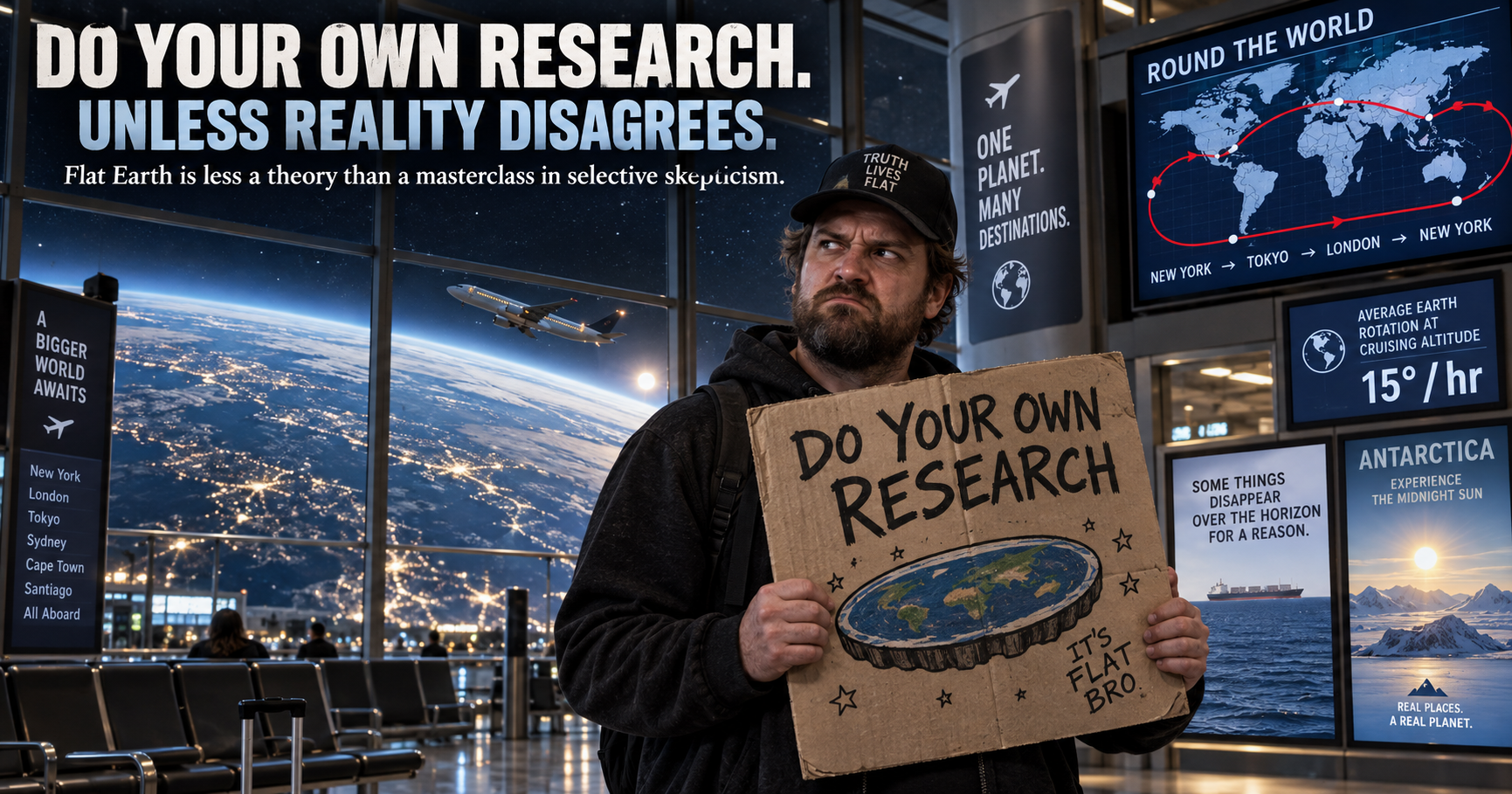
There is something wonderfully flexible about the modern relationship with science.
When a scientific paper produces a conclusion somebody already likes, the reaction is immediate:
**Scientists have proven it.**
Excellent.
Case closed.
Trust the experts.
Respect the research.
Somebody in a university wore safety glasses while reaching this conclusion, therefore apparently we are finished here.
But when several centuries of astronomy, navigation, geodesy, physics, cartography and direct observation establish that Earth is not a giant dinner plate floating through space, the response changes slightly.
**Scientists are lying.**
NASA is lying.
Governments are lying.
Pilots are lying.
Ship captains are lying.
Satellite companies are lying.
Surveyors are lying.
Astronomers are lying.
Physicists are lying.
GPS engineers are lying.
And apparently Russia, China, America, Europe, India, Japan and every other country capable of launching something into orbit have put aside wars, sanctions, espionage and geopolitical rivalry to cooperate flawlessly on the single most important international project in human history:
**Making Kevin on YouTube believe the Earth is round.**
This is Flat Earth.
And the really interesting part is not the Earth.
It is Kevin.
Science Is Perfect Until It Says Something You Don't Like
Flat Earthers often describe themselves as skeptics.
That is flattering.
Skepticism is useful.
Science itself depends on skepticism.
A scientific claim should survive measurement, replication, criticism and competing explanations.
But skepticism has one irritating requirement:
**You must also be skeptical of yourself.**
That part seems to have been removed from the online version.
The modern conspiracy theorist frequently operates using a beautifully efficient epistemological system.
If evidence supports the desired conclusion, the evidence is valid.
If evidence contradicts the desired conclusion, the institution producing it is corrupt.
This mechanism is not limited to Flat Earth.
You can see it everywhere.
Someone will repost a headline saying:
**SCIENTISTS DISCOVER...**
And because the conclusion aligns perfectly with that person's social, political or moral worldview, nobody asks who the scientists were, what they actually measured, how large the sample was, whether the result was replicated or whether the headline accurately represents the paper.
The word **scientists** is enough.
For example, there is legitimate scientific literature documenting same-sex sexual behaviour in numerous animal species. That is an empirical observation. Exactly what particular behaviours mean, what functions they serve and how far human concepts of sexuality can responsibly be projected onto non-human animals are separate questions.
Internet arguments rarely enjoy that distinction.
A narrow observation becomes a sweeping philosophical conclusion within approximately twelve seconds.
And suddenly:
**Scientists say.**
End of discussion.
But ask the same person to accept geodesy?
Now scientists are bought.
That is not skepticism.
That is shopping.
You are walking through science with a basket, selecting only the conclusions that match the furniture at home.
The Earth Has an Annoying Amount of Evidence
One problem with Flat Earth is that disproving it does not require NASA.
This is deeply inconvenient.
The actual shape of Earth is more accurately described as an oblate ellipsoid rather than a perfect sphere. The difference between its equatorial and polar dimensions is small but measurable and important enough that geodesists account for it when making precise maps. The U.S. Geological Survey has been publishing the mathematics involved for decades.
But perhaps USGS is part of the conspiracy.
Fine.
Fire them.
We can go back approximately twenty-three centuries.
Eratosthenes did not possess GPS.
He had no satellites.
No NASA.
No CGI.
No secret communications with the Illuminati.
He had shadows.
Around the third century BC, he compared the Sun's angle at two locations in Egypt and used the difference, together with the distance between them, to estimate Earth's circumference.
The calculation came remarkably close considering that the man was operating in an era when Amazon Prime delivery probably involved an actual Amazon.
This is one of the difficulties with claiming that modern governments invented spherical Earth.
The conspiracy appears to have started before most modern governments existed.
That demonstrates impressive long-term planning.
Do Your Own Research
This may be the Flat Earth movement's most famous commandment.
**Do your own research.**
Excellent advice.
Seriously.
Do it.
But we should establish what *research* means.
Research does not mean typing:
**“proof Earth flat”**
into YouTube and watching videos until the recommendation algorithm becomes concerned about your wellbeing.
Research means constructing a hypothesis that can fail.
That last word is important.
**Fail.**
If your model is correct, it predicts X.
If another model is correct, it predicts Y.
You perform the experiment.
You observe Y.
Now comes the exciting scientific part.
You were wrong.
This is where Flat Earth becomes less successful as science and considerably more successful as religion.
Because the hypothesis is often permitted to explain every possible result.
If the experiment gives the desired answer:
**Proof.**
If it gives the undesired answer:
**Equipment malfunction.**
If repeated:
**Interference.**
If repeated with different equipment:
**Unknown electromagnetic effect.**
If performed by somebody else:
**Paid shill.**
If performed by thousands of unrelated people:
**Global conspiracy.**
At some point the model becomes literally impossible to disprove.
And a theory that explains every conceivable result explains nothing.
Unfortunately, Reality Has Participated in Their Experiments
The documentary *Behind the Curve* gave us one of the finest moments in the history of doing your own research.
Flat Earth advocate Bob Knodel described using a ring laser gyroscope to test whether Earth rotates.
The logic was straightforward.
If Earth rotates once in roughly twenty-four hours, the instrument should detect approximately fifteen degrees of rotation per hour.
They turned on the instrument.
It detected approximately fifteen degrees per hour.
This was not precisely the result they were hoping for.
The response was not:
**Well, shit.**
The response was to investigate ways the reading might be caused by something else.
There is nothing wrong with checking an unexpected experimental result. Scientists should do exactly that.
The problem comes when **every result supporting the unwanted hypothesis automatically requires another explanation while every result supporting your preferred hypothesis immediately becomes proof**.
That is not experimental rigor.
That is a hostage negotiation with reality.
The same documentary featured another attempt using lights, boards and sightlines over distance.
The experiment was intended to distinguish predictions of a flat surface from a curved one.
Reality again proved insufficiently cooperative.
The light behaved in the manner expected with curvature.
The response captured on camera was beautifully concise:
**“Interesting.”**
Indeed.
That may be the single greatest word in Flat Earth research.
Whenever reality produces the wrong result:
Interesting.
Fine. Let's Go to Antarctica
Flat Earth theories commonly encounter another unpleasant piece of geography:
Antarctica.
In the popular disk model, Antarctica becomes something like an enormous ice perimeter surrounding the known world.
Conveniently, this leads to endless claims that ordinary people cannot really go there and that governments guard the region to prevent someone from walking up to the edge and looking over.
So in 2024 a project called **The Final Experiment** did something brutally unfair.
They went there.
Flat Earth proponents and globe proponents travelled to Antarctica specifically to observe the Antarctic summer Sun.
Why?
Because the twenty-four-hour Sun presents a severe problem for common Flat Earth models.
And there it was.
For twenty-four hours.
One Flat Earth participant, Jeran Campanella, publicly acknowledged that he had been wrong about the phenomenon existing.
This should have been an excellent advertisement for **do your own research**.
Someone made a prediction.
Travelled thousands of kilometres.
Looked at the sky.
And changed his mind about that prediction.
That is how intellectual honesty is supposed to work.
Naturally, the internet immediately produced alternative explanations for why seeing the Sun with your own eyes in Antarctica still might not count.
At that point one begins wondering what experiment could possibly count.
If photographs are fake, video is fake, satellites are fake, scientists are fake and direct observation is potentially fake, then what exactly remains?
Apparently YouTube comments.
Those are solid.
The Most Expensive Conspiracy Ever Invented
Let us assume, purely for entertainment purposes, that Earth is flat.
Now we need to explain why everyone says otherwise.
The scale of the required conspiracy is magnificent.
America must know.
Russia must know.
China must know.
India must know.
Europe must know.
Every military using satellite navigation must know.
Every company operating communications satellites must know.
Every university astronomy department must know.
Commercial pilots must somehow fly correct routes while concealing the geometry involved.
Ship captains must navigate oceans without accidentally mentioning the edge.
Surveyors must manufacture geodetic measurements.
Meteorologists must create imaginary satellite imagery every day.
Amateur astronomers must coordinate their observations.
Telecommunications companies must conceal how their networks operate.
And all these people must maintain absolute secrecy across generations.
Think about that.
Human beings cannot keep the guest list for an office Christmas party confidential.
Government documents leak.
Military secrets leak.
Intelligence operations leak.
Presidential conversations leak.
Corporate emails leak.
People leak photographs of unreleased smartphones because somebody left one in a bar.
But apparently millions of people across hostile countries have maintained perfect operational security regarding the actual shape of the planet.
Nobody gets drunk and talks.
Nobody divorces badly.
Nobody writes a memoir.
Nobody defects.
Nobody produces documents.
Nobody posts:
**“Guys, you're not going to believe what we found behind Antarctica.”**
This may be the greatest achievement of international cooperation in history.
We should give them a Nobel Prize.
Except, presumably, the Nobel committee is also involved.
Just Fly Around It
Then there is the embarrassingly practical problem.
We move around the planet.
Constantly.
You can travel east and keep travelling east until eventually you return to where you started.
Ships have done it.
Aircraft do it.
People do it.
You do not have to trust NASA.
You can participate.
Granted, personally circumnavigating Earth merely to settle an argument with Facebook may be slightly expensive.
But the theoretical beauty remains.
The flat-Earther says:
**Do your own research.**
Okay.
Air Canada, one ticket please.
Imagine completing a round-the-world journey, returning home and announcing:
**Still not convinced. The airline must have rotated the scenery.**
At that point science has exhausted its responsibilities.
Selective Skepticism
This is why Flat Earth is interesting.
The shape of Earth is the least interesting part.
The important phenomenon is **selective skepticism**.
We all do this to some degree.
Nobody approaches every claim as a perfectly neutral reasoning machine.
We have political preferences.
Cultural assumptions.
Personal experiences.
Tribal loyalties.
Things we hope are true.
Things we desperately hope are false.
Confirmation bias is not a Flat Earth invention.
Flat Earthers simply provide a gloriously visible version of it.
For the selective skeptic, evidence does not determine belief.
**Belief interviews evidence for the job.**
Do you agree with me?
Excellent résumé.
Welcome aboard.
Do you disagree?
Unfortunately we have decided to pursue another candidate.
This is why the same person can alternate between:
**“You can't trust scientists.”**
and:
**“Scientists proved this!”**
without suffering any noticeable internal combustion.
The scientists did not change.
The conclusion did.
Science is trustworthy precisely to the percentage point at which it agrees with the speaker.
What an extraordinarily convenient epistemological system.
The Phrase “Scientists Say” Should Make You Ask More Questions, Not Fewer
There is another side to this.
Mainstream culture encourages selective trust too.
Headlines constantly use formulas such as:
**Scientists discover...**
**Study proves...**
**Experts say...**
Frequently the paper itself is narrower, more cautious and much less exciting than the headline.
A study may observe behaviour.
The headline announces identity.
A correlation becomes a cause.
An experiment in mice becomes advice for humans.
A small sample becomes a universal truth.
One paper becomes:
**Science has spoken.**
That is bad scientific literacy even when the underlying study is perfectly legitimate.
The correct response to **scientists say** is not automatic disbelief.
Nor is it automatic obedience.
It is:
What scientists?
What did they actually measure?
How?
How large was the sample?
Was the result replicated?
Does the conclusion follow from the observation?
Are there competing explanations?
That is skepticism.
Notice the unpleasant symmetry.
A conspiracy theorist saying **all scientists are bought** is intellectually lazy.
Someone saying **a scientist published it, therefore it must be true** is also intellectually lazy.
They are simply sleeping on opposite sides of the same bed.
Reality Has No Political Affiliation
This may be the most annoying property of reality.
It does not care what conclusion you need.
Earth does not become flatter because NASA annoys you.
A particle does not change behaviour because your political party prefers another model.
A laboratory result does not acquire moral virtue because it supports your worldview.
And the Sun in Antarctica does not set because somebody's YouTube channel requires it to.
Reality is extraordinarily rude that way.
It keeps existing without consulting us.
That is why actual science has mechanisms specifically designed to make being wrong survivable.
Replication.
Error bars.
Peer criticism.
Revised hypotheses.
New experiments.
Better instruments.
Retractions.
The phrase:
**We were wrong.**
That is not a weakness of science.
That is practically the entire point.
A system incapable of admitting error is not stronger.
It is simply incapable of learning.
Do Your Own Research. Please.
So yes.
Do your own research.
Measure shadows.
Study navigation.
Look at stellar motion.
Learn how geodesy works.
Watch an eclipse.
Travel.
Read competing arguments.
Understand what a gyroscope measures.
Go to Antarctica if somebody is willing to pay for the jacket.
Question experts.
Question institutions.
Question journalists.
Question governments.
Question me.
But there is one final person you must include in the investigation.
**You.**
Your assumptions.
Your preferred conclusion.
Your ability to misunderstand.
Your ability to cherry-pick.
Your ability to become emotionally attached to an idea.
Your ability to look directly at contradictory evidence and manufacture an excuse before the measurement has finished displaying.
Without that final step, **do your own research** is not research.
It is a scavenger hunt for confirmation.
And if every scientist who disagrees with you is corrupt while every scientist who happens to agree with you becomes an unimpeachable authority, you have not escaped propaganda.
You have simply built your own.
Still, I suppose things could be worse.
At least modern Flat Earth theory has Antarctica, electromagnetic fields and elaborate government conspiracies.
The ancients had giant elephants standing on a turtle.
Personally, I almost prefer the turtle.
At least nobody claimed it was peer-reviewed.
And if the existence of Flat Earthers still leaves you wondering how human beings can remain absolutely certain while surrounded by contrary evidence, don't worry.
We are nowhere near the bottom of this particular rabbit hole.
Reality has plenty more customers.