Society
DONALD TRUMP MAY BE THE BEST CAMPAIGNER CANADA’S LIBERALS NEVER HIRED
The American president keeps attacking Canada. Canadian voters keep giving Mark Carney reasons to thank him.
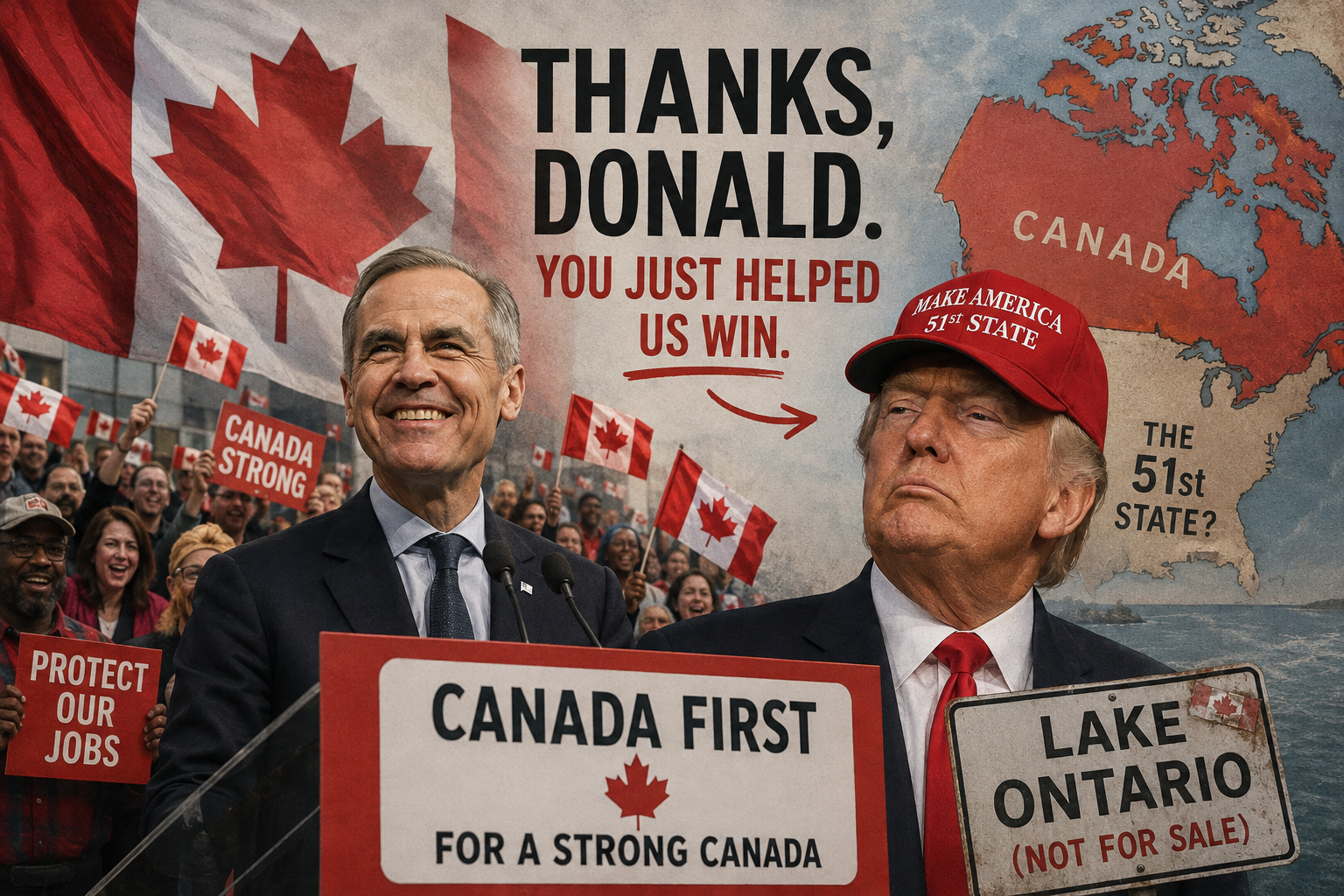
Political parties spend fortunes trying to find the perfect campaign message.
Consultants conduct focus groups. Pollsters test slogans. Strategists study demographics. Advertising agencies produce videos in which ordinary-looking families stare thoughtfully into the middle distance while someone promises to protect their future.
Canada’s Liberal Party may have discovered a cheaper method.
Let Donald Trump talk.
On Sunday, Canadians voted in three federal by-elections.
Mark Carney’s Liberals won all three.
Two victories were not particularly shocking. Beaches–East York in Ontario and North Vancouver–Capilano in British Columbia were already Liberal territory.
The third was different.
Chicoutimi–Le Fjord in Quebec had been held by the Conservatives.
The Liberals took it.
And they did so while Canada is engaged in perhaps its ugliest political confrontation with the United States in generations.
Coincidence?
Possibly.
But Donald Trump seems increasingly determined to test the hypothesis.
Please Continue, Mr. President
Trump has not merely argued with the Canadian government about tariffs.
That would be normal politics.
Countries fight over steel, dairy, automobiles and lumber all the time.
Trump has made the dispute personal and symbolic.
He has repeatedly talked about Canada becoming America’s 51st state.
He has mocked Canadian political leadership.
His administration has dramatically escalated tariffs.
He has encouraged Canadian companies to move production south.
And then he decided Lake Ontario needed a new name.
“Lake America.”
Google complied for American users.
Apple followed.
For Canadians, the lake remains Lake Ontario. For Americans looking at the same body of water through certain digital maps, it has acquired Trump's preferred name.
There is a point at which economic pressure stops feeling like a trade negotiation and starts feeling like someone walking into your living room and suggesting improvements to the wallpaper.
Canadians appear to have noticed.
The Conservative Problem
This creates a particularly unpleasant problem for Canada’s Conservatives.
Normally, dissatisfaction with a Liberal government should benefit them.
Cost of living.
Housing.
Immigration.
Taxes.
Government spending.
There is no shortage of domestic ammunition.
But Trump has changed the political axis.
The question is no longer simply:
**Do you like the Liberal government?**
Increasingly, it becomes:
**Who do you want standing across the table from Donald Trump?**
Those are not the same election.
A voter can dislike the Liberals and still decide that an external threat makes political experimentation look less attractive.
That phenomenon has existed for as long as politics has existed.
Political scientists give it respectable names such as the “rally around the flag” effect.
Everyone else understands it instinctively.
Attack the village and suddenly the villagers remember that they are a village.
Then Came Chicoutimi
That is why Chicoutimi–Le Fjord matters.
Winning a Liberal seat tells us very little.
Winning a Conservative seat tells us something.
It does not tell us everything.
A by-election is not a general election. Turnout is different. Candidates matter. Local issues matter. Party organizations matter.
But actual votes are still considerably more interesting than polls.
The Liberals did not merely defend their existing parliamentary territory on August 31.
They expanded it into Conservative territory while Canada’s confrontation with Washington was dominating national politics.
That does not prove Trump caused the result.
But if you are sitting in Conservative headquarters, it would be remarkably incurious not to ask whether he helped.
Trump Has Given Carney the Perfect Character
Mark Carney has a political problem of his own.
He is not exactly designed in a laboratory for populist charisma.
Former central banker.
Former governor of the Bank of Canada.
Former governor of the Bank of England.
International finance.
Boardrooms.
G20 meetings.
The man practically arrives with footnotes.
Then Donald Trump appears and accidentally gives him a role.
Not economist.
Not technocrat.
Not Liberal Party leader.
**Prime Minister defending Canada.**
That is a much easier character to sell.
Carney can now frame trade diversification, industrial policy and reduced dependence on the United States not as abstract economic projects but as questions of sovereignty.
When trade negotiations collapsed in August, Carney said Canada had rejected American demands because they threatened Canadian industries and sovereignty.
On September 1, he said negotiations would resume when Washington became “serious.”
Whatever one thinks of Carney, that is politically useful territory.
Trump keeps supplying the scenery.
America First Can Produce Canada First
This is the part Washington may be underestimating.
Economic pressure does not operate in a political vacuum.
If America imposes enough pain on Canada, Canadians do not necessarily conclude:
“We should elect politicians friendlier to Washington.”
They may conclude:
“We should become less dependent on Washington.”
And evidence of precisely that behaviour is accumulating.
Canadian businesses are reducing reliance on American suppliers, consumers are boycotting American products, travel patterns are shifting away from the United States and Canadian institutions are reconsidering American relationships.
Even symbolic American associations are becoming politically radioactive. Ottawa officials are moving to rename Trump Avenue.
This is how economic coercion can produce the opposite of its intended result.
You squeeze your neighbour because you want leverage.
Your neighbour responds by building alternatives to you.
Congratulations.
You have successfully reduced your own leverage.
Trump Is Campaigning Against Himself
The irony gets better.
Trump’s political brand is built around national sovereignty.
America First.
Protect domestic industry.
Control borders.
Reject foreign interference.
Put national interests ahead of international niceties.
Whether one agrees with that philosophy or not, it is internally understandable.
The problem is that Canadians can use exactly the same philosophy.
Canada First.
Protect Canadian industry.
Reduce dependence on foreign suppliers.
Reject pressure from another government.
Defend Canadian sovereignty.
Trump cannot simultaneously argue that nationalism is legitimate for Americans and be astonished when Canadians discover nationalism themselves.
Yet his political rhetoric toward Canada practically manufactures it.
And Carney Gets the Dividend
Carney does not need Canadians to fall in love with the Liberal Party.
He needs enough Canadians to believe that changing governments during a confrontation with Washington is risky.
That is a much lower bar.
Every time Trump talks about the 51st state, Carney gets another sovereignty speech.
Every time Washington threatens another tariff, Carney gets another argument for industrial independence.
Every time an American official tells Canadian companies to relocate south, Carney gets another argument for protecting Canadian manufacturing.
Every time Trump renames a Canadian-American geographic landmark, the Liberals receive something money normally cannot buy:
an emotional campaign issue supplied free of charge by the president of the United States.
The Numbers Are Votes, Not Prophecy
There is a temptation to overread three by-elections.
We should resist it.
Two were Liberal-friendly seats already.
Turnout in by-elections is relatively low.
Local candidates matter enormously.
A national election could produce a completely different result.
And there is no ballot box where voters were asked:
“Did Donald Trump cause you to vote Liberal?”
So no serious person can claim causation from these results alone.
But politics rarely provides laboratory experiments.
What we have instead is a sequence.
Relations with Washington deteriorate.
Trump intensifies his rhetoric toward Canada.
Canadian sovereignty becomes a major political issue.
Carney adopts an increasingly confrontational posture.
And the first real federal electoral test ends with his party winning all three seats, including one taken from the Conservatives.
That is not proof.
It is certainly a signal.
The Funniest Possible Outcome
Trump presumably wants a Canada more accommodating to American demands.
His tactics may instead produce a Canada more suspicious of the United States, more interested in European and Asian markets, more protective of domestic industry and politically more receptive to the Liberal government arguing for precisely those things.
Canada’s finance minister is already pitching the country abroad as a reliable “transatlantic partner of choice” while the relationship with Washington deteriorates.
In other words, pressure intended to pull Canada closer could accelerate its search for distance.
And politically, the man creating that pressure may be doing something even stranger.
He may be helping the party he would presumably least like to help.
Canadian Liberals spent decades looking for ways to scare voters about Conservatives.
In 2026, they may not need to.
Donald Trump is doing the campaigning for them.
And unlike a political consultant, he isn't even sending an invoice.