Technology
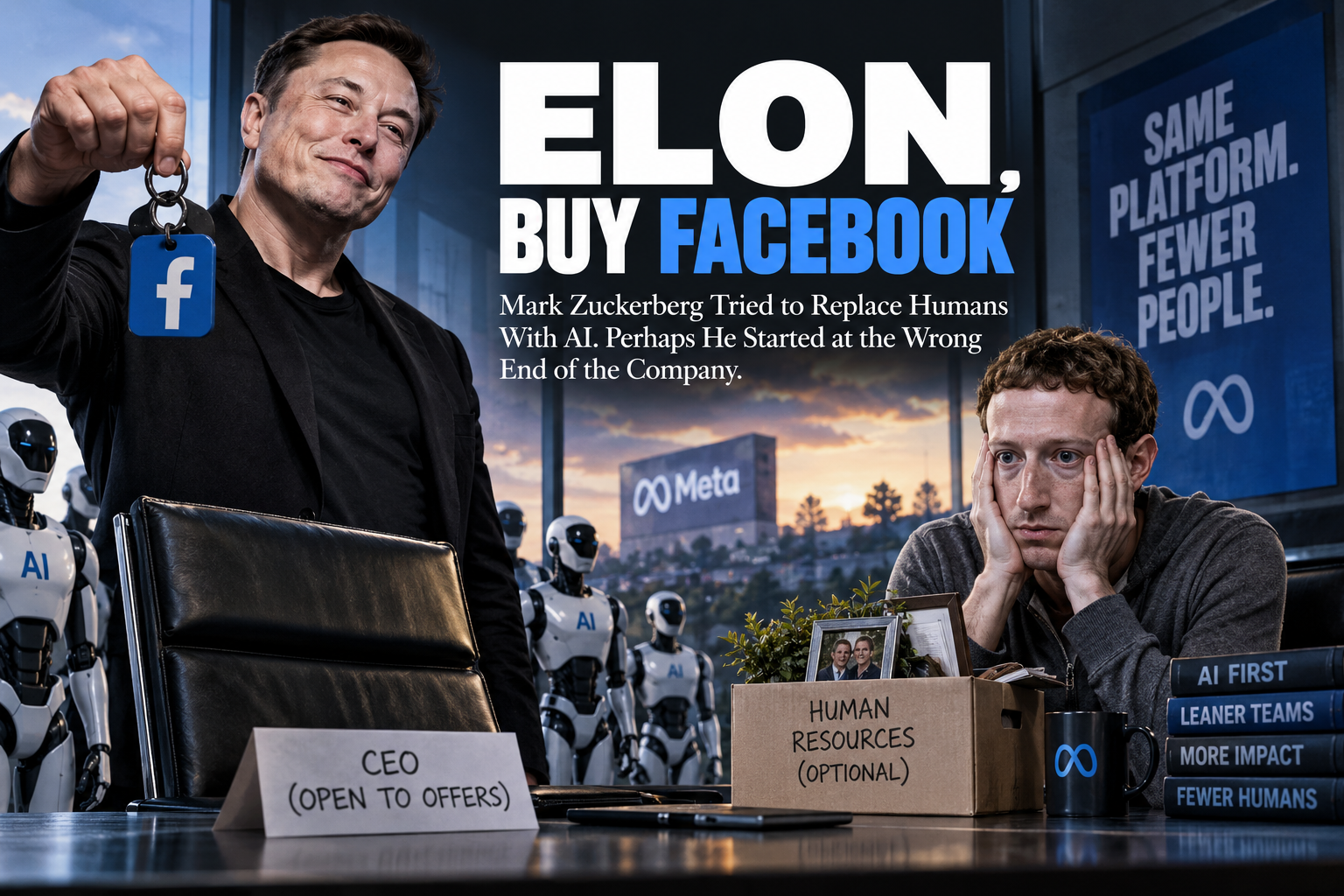
ELON, BUY FACEBOOK
Mark Zuckerberg Tried to Replace Humans With AI. Perhaps He Started at the Wrong End of the Company.
There are corporate mistakes.
There are expensive corporate mistakes.
And then there is trying to replace large chunks of your workforce with AI, discovering that the humans were apparently doing things nobody in management had bothered to notice, and quietly deciding that perhaps the revolution can wait until after lunch.
Welcome to Meta.
According to Reuters, Mark Zuckerberg pushed an internal effort called **Project OT**, part of a broader attempt to make Meta more “AI native.” The ambition was simple and deliciously fashionable: shrink teams aggressively, hand more work to AI agents, and then shrink them some more.
In some areas, the planned reductions reportedly reached **up to 60 percent**.
Because nothing says “future of work” quite like looking at a functioning team and asking:
**How many of these people can we remove before something catches fire?**
Meta decided to find out.
Apparently the answer was:
More than zero.
The Great AI Efficiency Experiment
Project OT was not some tiny pilot involving five interns and a chatbot.
It was part of a serious management push to redesign work around AI.
The idea was that AI agents could take over large amounts of routine technical and operational labor, allowing Meta to reduce headcount while increasing productivity.
This sounds wonderful in a presentation.
AI works twenty-four hours a day.
AI does not ask for vacation.
AI does not want health insurance.
AI does not complain about reorganization number fourteen.
AI does not spend thirty minutes in the kitchen explaining why reorganization number fourteen is worse than reorganization number thirteen.
For executives, this is practically erotic.
There was only one inconvenient variable.
Reality.
Reuters reported that after the restructuring, serious service incidents rose significantly, while the remaining human employees had to spend much more time dealing with those incidents.
In other words, Meta successfully reduced the number of humans available to solve problems and then produced more problems for the remaining humans to solve.
A magnificent closed-loop productivity system.
Perhaps the Wrong People Were Replaced
This is where The Antigloss would like to offer Meta some free management consulting.
The idea of replacing employees with AI was not necessarily wrong.
The selection criteria may have been.
Maybe the engineers were not the first people who should have gone.
Maybe the infrastructure people were not the first people who should have gone.
Maybe the people who actually understand why a service remains online during peak load were worth keeping around.
Perhaps Meta should have begun with a controlled experiment at the executive level.
Replace Mark Zuckerberg with an AI.
Not even an especially good AI.
Something small.
Open source.
Runs locally.
Eight gigabytes of RAM.
No fancy multimodal capabilities.
Just enough intelligence to answer:
**“Should we remove sixty percent of the people maintaining the system before we know whether the AI can maintain the system?”**
There is a reasonable chance it would answer:
**No.**
Already an improvement.
The Problem Was Never AI
This is the important part.
The obvious response to stories like this is:
“See? AI is useless.”
No.
That is lazy.
AI is a tool.
A very powerful one.
It can automate work.
It can accelerate coding.
It can summarize enormous amounts of information.
It can perform repetitive tasks faster than humans.
It can augment technical teams.
It can eventually eliminate entire categories of work.
None of that means you can walk into an organization, draw a giant red line through half the org chart and assume the remaining software will spontaneously develop institutional memory.
The problem here was not artificial intelligence.
The problem was **management intelligence**.
AI can only automate work somebody actually understands well enough to automate.
And large organizations are full of invisible labor.
Things happen because somebody knows that every Tuesday afternoon a particular service behaves strangely.
Somebody remembers that a legacy system breaks if you change one field.
Somebody knows which alert is harmless and which alert means the building is about to explode.
Somebody knows that the documentation is wrong.
Somebody knows that the documentation is technically right but operationally useless.
Somebody knows whom to call.
None of this necessarily appears in the spreadsheet where an executive calculates “headcount efficiency.”
Then the employee disappears.
And suddenly everyone discovers what the employee was doing.
Corporate Memory Is Not a Prompt
This is one of the most persistent fantasies in the current AI boom.
Executives imagine organizations as collections of explicit tasks.
Task A.
Task B.
Task C.
Automate A and B.
Fire the people doing A and B.
Profit.
But real companies are not spreadsheets.
They are biological disasters held together by undocumented procedures, tribal knowledge, weird exceptions, emergency workarounds and people who have spent years learning where the bodies are buried.
An AI agent can absolutely learn much of that.
But somebody has to give it the knowledge.
Someone has to build the tools.
Someone has to validate the outputs.
Someone has to monitor edge cases.
Someone has to notice when the AI is confidently doing the wrong thing at industrial scale.
If you remove the humans before transferring the knowledge, congratulations.
You have not automated the organization.
You have lobotomized it.
Zuckerberg Discovered the Human Factor
There is also a beautiful irony here.
The entire point of replacing humans with AI is usually to reduce the human factor.
Humans are inconsistent.
Humans make mistakes.
Humans get tired.
Humans bring emotion into work.
Humans resist change.
True.
But who decided when Project OT should happen?
Humans.
Who decided how aggressive the reductions should be?
Humans.
Who decided which teams could survive losing large numbers of people?
Humans.
Who decided the AI was ready?
Humans.
Who apparently discovered later that the timing was wrong?
Humans.
So Meta attempted to eliminate the human factor through a project designed, scheduled and imposed by the human factor.
This is the kind of recursion that makes software engineers develop drinking problems.
“AI Native” Is Not a Magic Spell
There is another phrase currently spreading through corporate America:
**AI native.**
Nobody wants to be merely a company anymore.
You must be AI native.
AI first.
AI powered.
AI transformed.
AI accelerated.
AI optimized.
If possible, your coffee machine should also have an agent.
The phrase has become a corporate blessing.
Say “AI native” three times in a board meeting and somebody approves a restructuring.
But becoming AI native is not the same thing as removing employees until the company resembles a startup with a very large electricity bill.
AI-native organizations need better process design, better instrumentation, better knowledge capture and better software architecture.
They need to know **what** they are automating.
They need to know **why** they are automating it.
And they need to know what happens when the automation fails.
Otherwise “AI native” is just “understaffed” wearing a futuristic tie.
The CEO Benchmark
This brings us back to Zuckerberg.
Meta reportedly discovered enough problems that further reductions were stopped.
Zuckerberg later acknowledged that the timing had been wrong.
That is refreshingly human.
But The Antigloss believes the company missed a major scientific opportunity.
Before replacing thousands of workers, Meta should have run a simple benchmark.
Two organizational branches.
Branch A:
Normal engineering staff.
Mark Zuckerberg as CEO.
Branch B:
Normal engineering staff.
Mark Zuckerberg replaced by a mid-range AI model with access to earnings reports, operational metrics and a button labeled **DO NOT FIRE EVERYONE YET**.
Run both branches for ninety days.
Measure:
uptime;
service incidents;
employee turnover;
cost;
revenue;
productivity;
number of emergency meetings;
number of executives saying “AI native.”
Then publish the results.
For science.
Elon Has Experience
And if the experiment fails, there is always Plan B.
Elon Musk has already demonstrated a peculiar enthusiasm for buying giant social platforms and subjecting them to traumatic surgery.
He bought Twitter.
He fired enormous numbers of people.
He renamed the platform X.
He changed the culture.
He annoyed almost everybody.
And somehow the website still exists.
That alone places him ahead of many corporate transformation consultants.
So perhaps Meta needs outside assistance.
Not another McKinsey presentation.
Not another AI transformation committee.
Not another internal initiative with a three-letter acronym.
A buyer.
A very specific buyer.
Elon, Buy Facebook
Think about it.
Twitter was once considered too culturally important, too politically powerful and too structurally entrenched to be radically changed.
Then Musk arrived with forty-four billion dollars and a demolition crew.
Facebook is older.
Bigger.
More bureaucratic.
More algorithmically manipulative.
More addicted to engagement engineering.
More committed to the strange belief that people enjoy seeing content they repeatedly tell the platform they do not want to see.
It may be exactly the kind of rehabilitation project Musk enjoys.
He could rename it.
Again.
Perhaps just:
**F.**
The logo would be cheap.
Half the executives could be replaced with agents.
The other half could be required to use Facebook for six hours a day until they understand what users have been complaining about for fifteen years.
And Mark Zuckerberg?
We have a role for him.
Beta tester.
Start at the Top
The funniest thing about Meta's AI experiment is that the premise itself may eventually prove correct.
AI probably will replace enormous amounts of corporate labor.
Some teams will shrink.
Some jobs will disappear.
Some executives will be able to run organizations with dramatically fewer people.
The transformation is real.
But when a company begins replacing humans and discovers that reliability deteriorates, the appropriate conclusion is not:
**“AI failed.”**
It is:
**“We automated before we understood.”**
And when the person leading that experiment is one of the most powerful technology executives on Earth, there is an obvious question nobody seems eager to ask.
If AI is really capable of replacing expensive human decision-makers, why does the experiment always begin at the bottom of the org chart?
Why not start where the salaries are highest?
Why not start where the decisions are largest?
Why not start where one bad idea can affect tens of thousands of employees?
Meta wanted to discover how much human intelligence it could remove from the company.
Perhaps it simply began at the wrong end.
Elon,
**buy Facebook.**