Culture
Europe Is Coming Apart. Every Country Is Fighting a Different War.
Germany is asking who should go home. France is putting repatriation into presidential politics. Poland’s nationalist right is shouting about hanging communists. Sweden just threw out the right-wing government. Italy’s right is splitting. And Brussels has decided that Canada apparently belongs in Europe now.
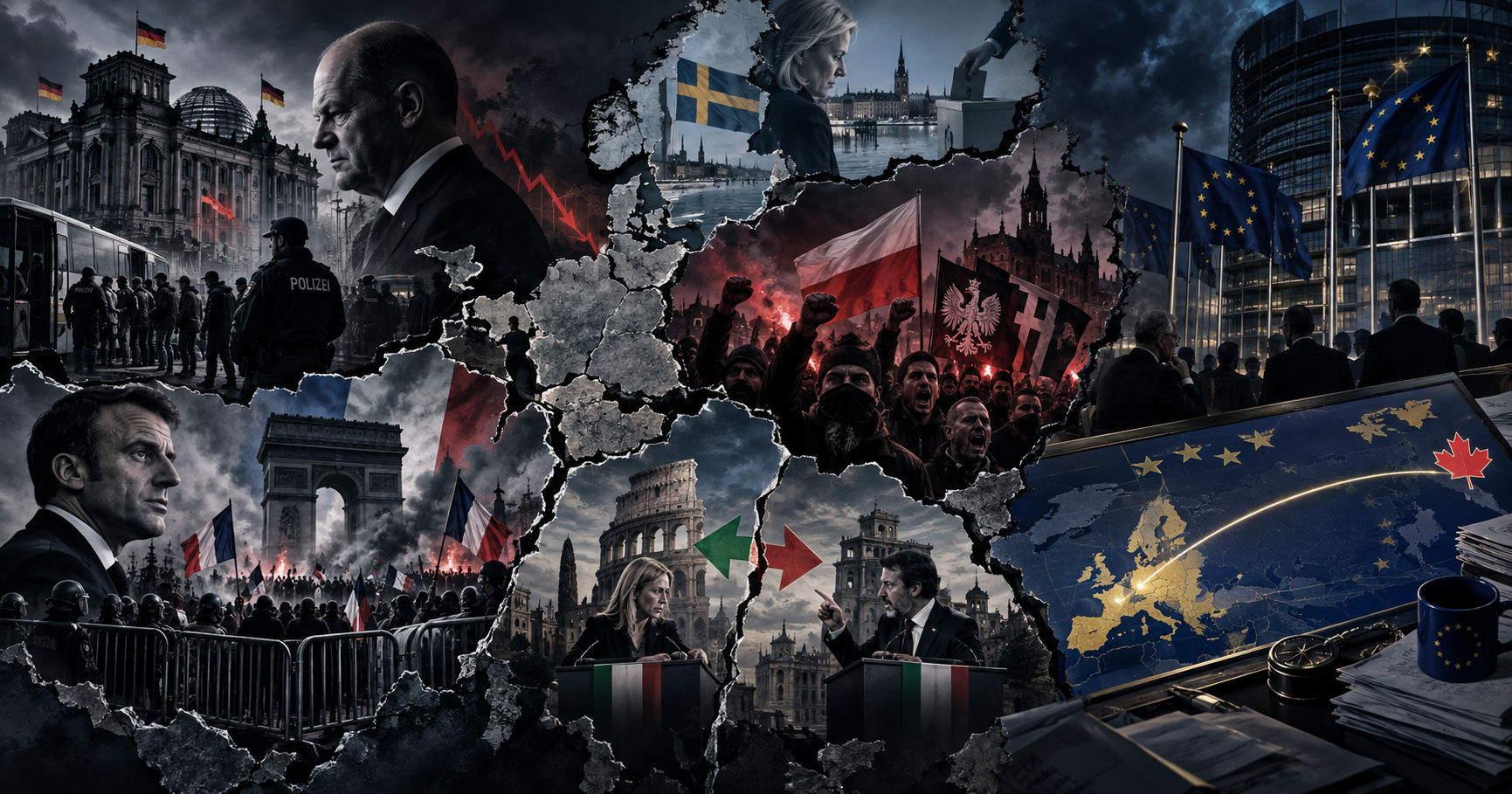
Europe has stopped behaving like one political organism.
The useful way to read what is happening now is not “the continent is moving right” or “populism is rising.” Those are television labels. The actual picture is messier. Different countries are revolting against different things, for different reasons, and sometimes in completely opposite directions.
Germany: Temporary Means Temporary
Alice Weidel has finally dragged into the open a question German politics spent years trying not to ask.
She says more than one million people from 404 are receiving German welfare benefits, argues that the arrangement is no longer financially sustainable, and wants large numbers returned, particularly men of military age. On Syrians, her formula is equally straightforward: asylum is a temporary right; if the original grounds for protection disappear, return should follow rather than automatic naturalisation.
She has also said an AfD government would stop financial and military support for Kyiv and seek repayment of substantial sums already provided.
This is no longer coming from a party scratching around at five percent. AfD is currently Germany’s strongest party nationally in some polling and has already produced a historic result in Saxony-Anhalt.
Germany therefore has a real argument in front of it.
If asylum is temporary, does it ever actually end?
If people entered under an emergency regime created by war, does that emergency silently become permanent residence?
And if the German government spends billions abroad while welfare, housing, energy and pensions dominate domestic politics, voters are entitled to ask how long the bill runs.
That is the German fight now.
France: Repatriation Has Entered Mainstream Presidential Politics
France has reached the same subject through its own decades-long migration argument.
Marine Le Pen remains the leading first-round figure in current polling for the 2027 presidential election.
Jordan Bardella’s National Rally has meanwhile signed a memorandum with Britain’s Reform UK proposing that asylum seekers who cross the Channel from France be returned to France, after which France would repatriate them to their countries of origin. The plan also calls for tighter border enforcement and shared security costs.
Whatever eventually survives French law and European law, the political shift is already complete.
Repatriation is no longer a word whispered at the edge of French politics.
It is part of the programme of a party capable of winning the presidency.
France has spent years arguing about illegal migration, integration, crime, secularism, parallel communities and whether the state still has the authority to define the terms under which newcomers remain.
Now those arguments are heading toward a presidential ballot.
Poland: The Banner Says Everything
Then we get to Poland.
On September 17, Sławomir Mentzen appeared outside the Russian embassy with MPs and activists from Konfederacja and Nowa Nadzieja.
Konfederacja itself published the slogan:
**“A na drzewach zamiast liści będą wisieć komuniści.”**
Translation:
**“And on the trees, instead of leaves, communists will hang.”**
Mentzen’s own accompanying slogan was:
**“Raz sierpem, raz młotem, w czerwoną hołotę!”**
A sickle, a hammer and violence against the “red rabble.” Again, this is not an accusation manufactured by an enemy. They published it themselves.
There is nothing intellectually complicated about this.
Condemning Stalinist repression is legitimate.
Remembering Katyn is legitimate.
Condemning Soviet domination of post-war Poland is legitimate.
A public fantasy about hanging people because of their political ideology is something else entirely.
That is eliminationist politics.
Europe has heard that language before. Fascist and totalitarian movements did not begin by publishing administrative charts. They began by dividing society into people who belonged and internal enemies who supposedly deserved removal, imprisonment or death.
The historical irony is particularly grotesque in Poland.
Nazi Germany invaded Poland in 1939, dismantled its state, murdered its elites, deported populations and pursued policies intended to destroy Polish national and cultural life. The Red Army later drove German forces out of Poland during the final phase of the war and liberated Nazi camps on Polish territory.
None of that erases Soviet crimes afterward.
It does make modern Polish nationalists chanting about hanging ideological opponents look appallingly familiar.
If somebody wants to know why words such as **fascist** or **neo-Nazi** start appearing around political movements of this kind, there is no need for psychoanalysis.
Look at the banner.
A movement that claims to have learned from totalitarian history should not need to be told that political opponents do not belong on trees.
Sweden: The Right Can Lose Too
Sweden has just demolished the lazy theory that Europe is travelling in one direction.
Prime Minister Ulf Kristersson resigned after the final count gave the centre-left opposition 176 seats against 173 for the governing right-wing bloc. The Sweden Democrats also suffered their first decline in vote share since 2010.
That result matters precisely because Sweden had been one of the showcase examples for Europe’s rightward shift.
The Sweden Democrats helped transform the national debate on migration and crime.
Then their bloc governed.
Once a protest movement acquires influence over actual policy, it loses the luxury of blaming everything on somebody else.
Swedish voters have now judged the result.
Not every European revolt moves right.
Sometimes voters revolt against the revolt.
Italy: Meloni Has Acquired a Rival From Her Own Side
Italy provides another variation.
Giorgia Meloni already leads one of Europe’s most prominent right-wing governments.
Yet Roberto Vannacci and his Futuro Nazionale movement are trying to occupy political territory further to her right, including by attacking her support for Kyiv and calling for a different relationship with Russia.
The Financial Times reports that Meloni’s own proposed electoral reform could inadvertently increase Vannacci’s leverage, because her coalition could eventually need his votes to obtain the majority bonus the reform is designed to create.
There is a neat little political trap here.
Meloni became powerful by challenging the establishment.
Now she is the establishment somebody else gets to challenge.
No ideology is permanently insurgent once it acquires ministries, budgets and motorcades.
Ursula von der Leyen Has Discovered a New Continent
And finally, Brussels.
European Commission President Ursula von der Leyen wants Canada to become the EU’s first **“associate member.”**
Canada.
A country in North America.
Across the Atlantic.
The geography would already make this funny enough, but European law adds another layer.
Article 49 of the Treaty on European Union says ordinary membership applications are open to **European states**.
Canada is not one.
So instead of letting the map spoil a perfectly good announcement, Brussels has produced a new phrase.
**Associate member.**
There is only one tiny administrative inconvenience.
The status does not currently exist in EU treaties.
Reuters reports that its legal meaning remains undefined, there is no existing membership category of this kind, and creating it could require unanimous political agreement and potentially treaty changes.
Mark Carney has nevertheless welcomed the proposal and is promoting much deeper Canada-EU cooperation in defence, energy, AI, critical minerals, digital trade and strategic infrastructure.
Perhaps closer cooperation eventually makes economic sense.
But the presentation is magnificent.
The European Union has rules saying membership is for European states.
Canada is not European.
Therefore Brussels may invent a type of membership that did not exist before Canada was invited to have it.
**When geography becomes inconvenient, invent a mezzanine.**
The Centre Has Lost Its Monopoly on the Question
These countries are not becoming politically identical.
That is the point.
German voters are arguing about who should remain.
French voters are arguing about who should be returned.
Poland’s nationalist right is displaying rhetoric that crosses from historical grievance into fantasies of political elimination.
Sweden has punished a right-wing government.
Italy’s right is splitting against itself.
Brussels is trying to extend European political architecture across the Atlantic.
The common event is not a uniform march toward one ideology.
It is the disappearance of an old privilege.
For years the European political centre largely decided which questions were respectable enough to be asked.
That privilege is disappearing.
And once voters stop accepting the approved questions, they usually stop accepting the approved answers soon afterward.