Society
EUROPE WANTS INDEPENDENCE FROM AMERICA. AMERICA ASKS: NEED SOME MONEY FOR THAT?
Brussels wants strategic autonomy from Washington. One of Europe’s hottest defence-tech companies got an early helping hand from an investment fund created by the U.S. intelligence community.
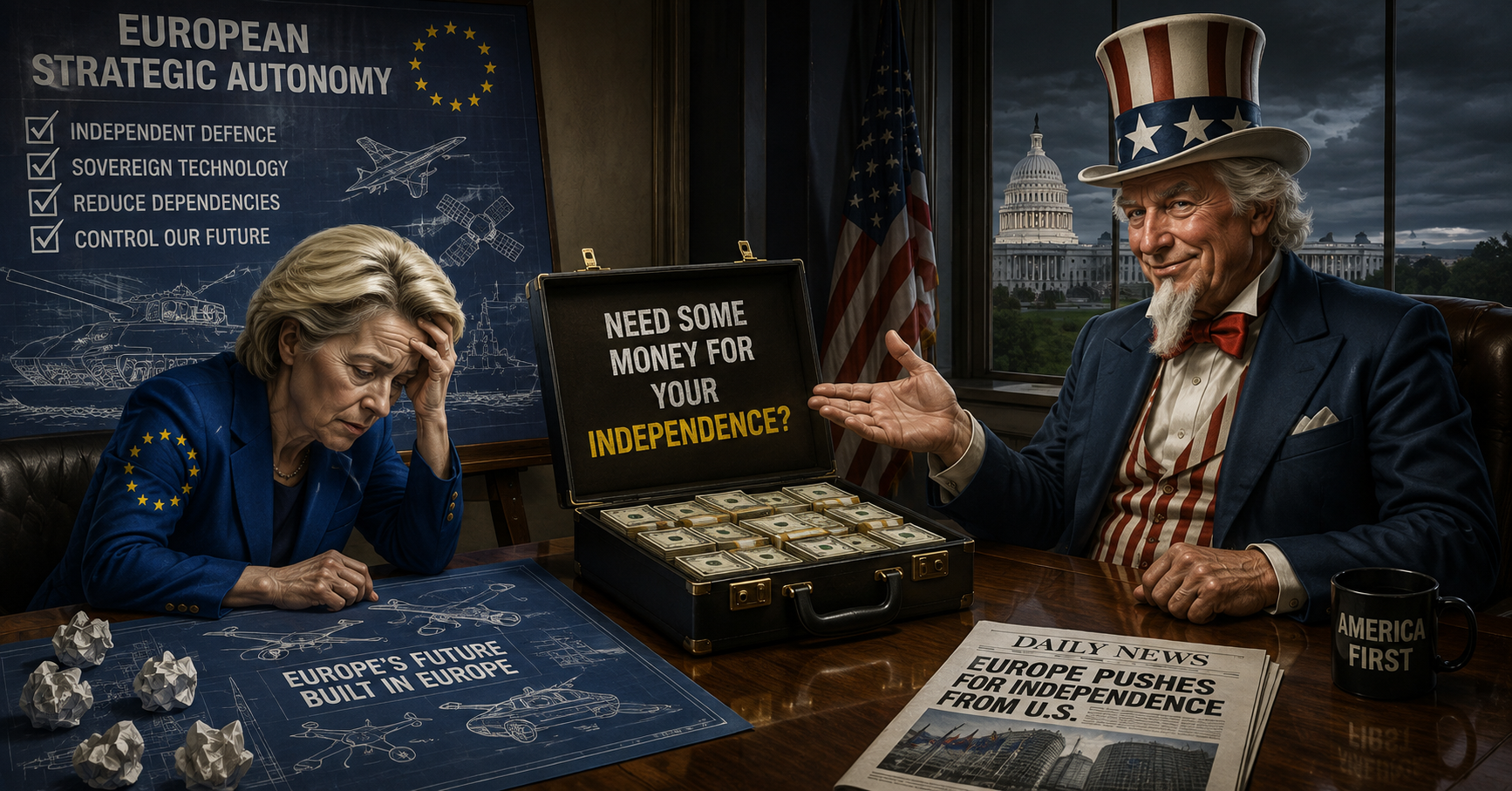
Imagine the conversation.
**Brussels:** We need strategic independence from America.
**America:** Absolutely.
**Brussels:** Europe must be able to defend itself without depending on Washington.
**America:** Couldn't agree more.
**Brussels:** We need our own defence industry, our own technology and our own strategic capabilities.
**America:** Of course.
A short pause.
**America:** Need some money for that?
Welcome to European strategic autonomy.
It is one of the great political ambitions of modern Europe: after decades of relying heavily on the United States for security, technology and military capability, Europe wants to become more capable of standing on its own.
There is nothing inherently ridiculous about that ambition.
What is ridiculous is how wonderfully complicated independence becomes once somebody starts looking at who helped finance it.
Reuters reported that Quantum Systems, one of Germany's most successful military-drone companies, received crucial early support in its expansion into the United States from In-Q-Tel, an investment organization established by the CIA.
Yes.
An American intelligence-backed investor helped a German defence company expand.
While Europe is trying to become less dependent on American defence capabilities.
Sometimes satire has the decency to write itself.
Meet Europe's New Defence Industry
Quantum Systems is not some obscure workshop assembling hobby drones behind a warehouse.
The German company has become a major player in the rapidly expanding European defence-tech sector, producing sophisticated unmanned aerial systems used for reconnaissance and other military applications.
Its technology has been deployed in Ukraine. Its business has expanded rapidly. Its valuation has reportedly climbed into the billions.
This is precisely the kind of company European politicians increasingly say Europe needs.
European.
Innovative.
Technologically sophisticated.
Capable of competing internationally.
Less dependent on established American defence giants.
And, as it happens, helped along the way by an organization created to connect strategically useful technology with the American intelligence community.
In-Q-Tel was founded in 1999 with CIA backing to invest in technologies relevant to U.S. national security.
It is not the CIA itself.
That distinction matters.
It is an independent nonprofit strategic investor that works with the CIA and other American intelligence and national-security agencies.
But pretending that this makes the connection uninteresting would require considerable imagination.
According to Reuters, In-Q-Tel's involvement helped Quantum Systems build relationships in the United States, including access to potential customers within the CIA and FBI.
That is not sinister.
It is actually rather clever.
The Americans saw useful technology and helped develop a relationship with the company producing it.
That is what strategic investment looks like.
The funny part begins when you compare this with European political rhetoric.
Strategic Autonomy™
For years, European leaders have talked increasingly about “strategic autonomy.”
The phrase has become particularly fashionable as relations with Washington have become less predictable.
Europe must defend itself.
Europe must manufacture more of its own weapons.
Europe must develop sovereign technology.
Europe must reduce strategic dependencies.
Europe must stop assuming that the United States will always provide whatever Europe needs.
All perfectly reasonable.
But independence is not simply a flag attached to a factory.
Modern defence technology exists inside networks of investors, suppliers, patents, software, export controls, customers and governments.
A company can be headquartered in Germany, employ German engineers and manufacture European military equipment while simultaneously operating inside an international financial and technological ecosystem in which American interests remain deeply embedded.
That does not make the company American.
It makes the word “independence” considerably more interesting.
Would You Like Financing With Your Sovereignty?
There is a tendency in political speeches to describe strategic independence as if countries were unplugging extension cords.
Yesterday Europe was plugged into America.
Tomorrow Europe will unplug itself.
Done.
Reality looks nothing like that.
Consider what happens when a European defence company wants to grow internationally.
It needs capital.
It needs customers.
It needs technology.
It needs access to foreign markets.
It needs relationships with governments.
It needs regulatory approval.
It may need components or intellectual property developed somewhere else.
And if one of the world's largest pools of defence capital, technology and customers happens to be located in the United States, European companies are naturally going to work with Americans.
Because businesses generally prefer revenue to political metaphors.
That creates a wonderful paradox.
Europe wants to build an independent defence-industrial ecosystem.
American capital sees an opportunity in that ecosystem.
American investors participate.
American agencies become customers.
American technology enters the supply chain.
And eventually somebody in Brussels announces that Europe is becoming less dependent on America.
Technically, everyone may be telling the truth.
Which is what makes the situation so entertaining.
America Is Not Running a Charity
There is another important point.
American strategic investment exists because the United States benefits from it.
In-Q-Tel does not search the world for promising technology because Washington has developed an uncontrollable enthusiasm for European entrepreneurship.
The purpose is strategic access.
If useful technology appears in Germany, Britain, France, Israel or somewhere else, American national-security institutions have an obvious incentive to understand it, access it and build relationships with the companies developing it.
That is not imperialism.
That is competence.
In fact, European governments might want to study the technique.
The United States has spent decades building an ecosystem in which private capital, defence contractors, universities, startups, intelligence agencies and government procurement overlap.
Europe is now attempting to accelerate its own version of that ecosystem.
But building one takes time.
And during that time, the existing American machine remains extremely attractive.
Which means that Washington can potentially benefit economically and strategically from Europe's attempt to become less dependent on Washington.
There is something almost beautiful about that.
The German Government Has Noticed
The irony is not entirely lost on Germany.
German officials have increasingly discussed the risks associated with foreign investment in strategically important defence companies.
That concern is logical.
If defence technology is genuinely strategic, then ownership, financing and intellectual property cannot be treated exactly like investment in a chain of coffee shops.
Foreign investors can bring capital, expertise and market access.
They can also create dependencies.
The difficult question is deciding when one becomes the other.
And here Europe encounters the central problem with “strategic autonomy.”
Independence costs money.
Lots of it.
Europe wants new drone companies, missile factories, satellite systems, AI companies, cyber-defence platforms and ammunition plants.
Those companies require enormous amounts of capital.
Restrict foreign investment too aggressively and European companies may grow more slowly.
Accept foreign investment freely and Europe may discover that its sovereign defence industry has quite a few foreign shareholders, technologies and contractual obligations.
Welcome to sovereignty in a globalized economy.
Please read the terms and conditions.
Independence From What, Exactly?
This is where the debate becomes more useful than the slogan.
Does European strategic autonomy mean Europe must manufacture every component itself?
Almost certainly not.
Does it mean European defence companies cannot accept American investment?
That would be economically absurd.
Does it mean Europe must be capable of conducting major military operations without American assistance?
That is a much more meaningful definition.
Does it mean Europe must control the critical technologies required for those operations?
Probably.
Does it mean Europe must be able to replace American suppliers if Washington refuses cooperation?
Now we are getting somewhere.
Because genuine strategic autonomy is not about eliminating relationships.
It is about eliminating relationships you cannot survive without.
There is a difference between buying something from America because America makes the best version and buying it from America because you have no alternative.
There is a difference between accepting American investment and needing American investment.
There is a difference between cooperation and dependency.
Political rhetoric tends to place all three inside the same box marked **INDEPENDENCE**.
Reality refuses to cooperate.
The Americans Understand This Perfectly
Perhaps the funniest part is that none of this requires some elaborate American conspiracy to prevent European independence.
America does not need to sabotage Europe's strategic-autonomy project.
It can invest in it.
If European defence spending increases dramatically, American companies can make money.
If European defence startups grow, American investors can participate.
If European technology becomes useful, American national-security agencies can become customers.
If European companies enter the American market, both sides gain access to each other's ecosystems.
Washington can simultaneously tell Europe:
**“You need to take more responsibility for your own defence.”**
And:
**“We would be delighted to participate in the resulting business opportunity.”**
Those statements are not contradictory.
They are capitalism.
The contradiction exists primarily in the political packaging.
European strategic autonomy is often presented as emancipation from American dependence.
The economic reality may look much more like renegotiating the relationship while continuing to do enormous amounts of business with the same partner.
That is considerably less romantic.
It is also considerably more realistic.
Maybe This Is What Independence Actually Looks Like
There is one final possibility worth considering.
Perhaps Europe's strategic autonomy does not require separation from America at all.
Perhaps the objective should never have been “independence from the United States.”
Perhaps it should be **the ability to say no to the United States without becoming militarily helpless.**
That is a much higher-quality definition.
Countries trade with allies.
Companies accept foreign investment.
Technology crosses borders.
Military industries cooperate.
None of that automatically destroys sovereignty.
Dependence begins when losing one relationship means losing the ability to function.
If Europe builds enough industrial capacity to avoid that situation, then American investment in European defence companies may actually help Europe become more autonomous.
Which produces the most delicious version of the paradox.
America may genuinely be helping Europe become less dependent on America.
So perhaps the conversation in Brussels should go like this:
**Brussels:** We want independence from America.
**America:** Excellent.
**Brussels:** We are serious.
**America:** We know.
**Brussels:** We are building our own defence industry.
**America:** Fantastic.
Another short pause.
**America:** Need some money for your independence?
Europe may eventually achieve strategic autonomy from the United States.
And if it needs a little help getting there, apparently America knows a guy.