Fashion
First Learn to Make It Beautiful. Then You Can Make It Ugly.
Fashion schools can teach you how clothes are made. They cannot teach you what clothes should exist.
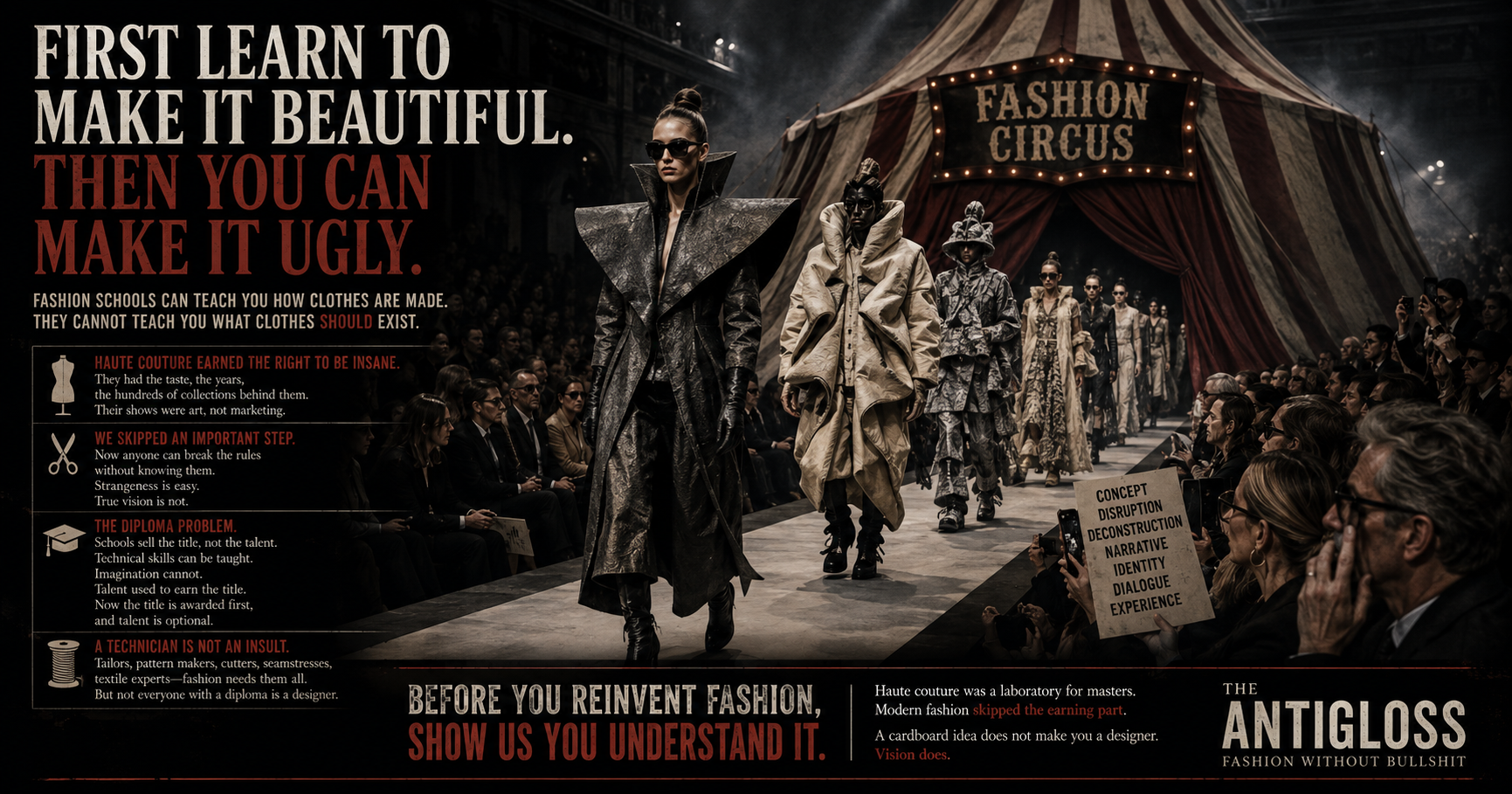
There used to be a freak show.
It travelled around the world, people bought tickets, stared at the spectacle, and then went home.
Now the freaks have escaped the circus and are trying to turn the entire world into the tent.
Welcome to contemporary fashion.
We have trousers designed to make the human body look worse. Shoes whose principal achievement is being uglier than the shoes that preceded them. Garments apparently constructed according to the principle that if an ordinary person can immediately determine where the arms and head go, the designer has failed to sufficiently challenge convention.
And somewhere beside every one of these objects stands a freshly graduated fashion designer prepared to explain that what you are looking at is not an ugly pair of trousers.
It is an exploration of identity.
Or privilege.
Or sustainability.
Or gender.
Or deconstruction.
Or the relationship between the body and space.
Anything, apparently, except a pair of ugly trousers.
But this is not an argument about taste.
Taste is personal.
Some men prefer a classical suit. Others live in jeans and a shirt. Others like sportswear. Women can prefer dresses, trousers, skirts, shorts or anything else they please.
There is no tribunal that gets to decide which of those people is aesthetically correct.
Wear Crocs to your wedding if that makes you happy.
The problem begins somewhere else.
The problem begins when an industry that once distinguished between **craft, talent and experimentation** starts pretending that they are all the same thing.
They aren't.
Couture Earned the Right to Be Insane
Fashion has always produced madness.
That isn't new.
Look through the history of haute couture and you will find extraordinary silhouettes, impossible proportions, theatrical constructions and garments that were never intended to become somebody's Tuesday-afternoon outfit.
Good.
That was part of the point.
Haute couture gave accomplished designers a laboratory.
These were people who had already spent years — often decades — developing collections, understanding bodies, proportions, materials and movement. They had demonstrated repeatedly that they could make something beautiful.
Then they were allowed to go insane.
A designer could exaggerate a shoulder beyond practicality, build a dress like architecture, turn fabric into sculpture or create something so theatrical that almost nobody outside the atelier would ever have a reason to wear it.
Not everything needed to migrate into prêt-à-porter.
Not everything needed to sell ten thousand units.
Sometimes the object existed because a designer wanted to find out whether it **could** exist.
That is creativity.
There is an enormous difference between Picasso drawing a distorted face after demonstrating that he could draw one perfectly well and somebody drawing a distorted face because he never learned where the nose goes.
Contemporary fashion increasingly pretends there isn't.
We Skipped an Important Step
The modern aspiring designer has been given a wonderful piece of advice:
Break the rules.
Excellent.
Which rules?
Why do they exist?
What happens when you break them?
Can you demonstrate that you know how to follow them first?
Silence.
We appear to have skipped that part.
Instead, originality has increasingly become synonymous with abnormality.
Make the trousers wider.
Make the shoes uglier.
Put the waist somewhere anatomically inexplicable.
Add seventeen straps.
Remove half the garment.
Turn underwear into outerwear.
Put a cardboard box on somebody's head.
Call it a hat.
If anybody objects, explain that they don't understand the concept.
Congratulations.
You are now challenging traditional notions of headwear.
But making something strange is easy.
Making something **good that nobody has seen before** is extraordinarily difficult.
Any idiot can put a cardboard box on his head.
It takes a designer to create a hat that makes another designer stop, stare at it and think:
**Fuck. Why didn't I think of that?**
That difference used to matter.
The Diploma Problem
There is another uncomfortable fact about fashion history.
Many people we now regard as great designers did not emerge from the modern educational pipeline that supposedly manufactures designers.
Some came through ateliers and apprenticeships. Some learned adjacent crafts. Some came from artistic disciplines. Some acquired technical knowledge while working. Some possessed enormous technical ability themselves; others relied heavily on extraordinarily skilled cutters, pattern makers, seamstresses, premières d'atelier and craftspeople around them.
Because a designer does not necessarily have to be the best tailor in the room.
A designer does not necessarily have to be the best illustrator in the room.
A designer doesn't even have to be the person physically constructing the garment.
But the designer has to **see it before everybody else does.**
That is the job.
The technical team can solve the question:
**How do we make this?**
The designer must first answer the much harder question:
**What should we make?**
And that is where modern fashion education occasionally performs a rather impressive sleight of hand.
It teaches the first question and sells the student the title associated with answering the second.
You Cannot Teach Imagination 201
There is nothing wrong with fashion school.
A good school can teach an enormous amount.
Pattern cutting.
Construction.
Draping.
Textiles.
Colour.
Garment history.
Production.
Illustration.
Presentation.
Software.
The mechanics of turning an idea into an object.
Those are real skills.
They matter.
But there is one course missing from every curriculum:
**Original Imagination 201.**
Tuesday and Thursday.
Ten until eleven-thirty.
Three credits.
Unfortunately, nobody has figured out how to teach it.
Because imagination is not a technical skill.
Education can develop it. Exposure can broaden it. History can feed it. Practice can sharpen it.
But the original spark has to be there.
The same problem exists in literature.
A university can teach somebody grammar, structure, literary history, editing and narrative technique. At the end of the program that person may be an exceptionally competent writer.
Nothing in the diploma guarantees that he will invent Sherlock Holmes.
Or Middle-earth.
Or Harry Potter.
Technical competence and imagination are related only insofar as technical competence gives imagination the tools required to express itself.
One cannot substitute for the other.
Fashion seems increasingly reluctant to admit this.
Everyone Graduates a Designer
There is an obvious commercial reason.
Education is an industry.
Schools need students.
Students need dreams.
And:
**“Pay us tuition and we will teach you useful technical skills that may help you pursue a highly competitive creative profession for which you may or may not possess exceptional talent”**
is not particularly sexy advertising.
**BECOME A FASHION DESIGNER**
works considerably better.
So thousands of students enter programs carrying a perfectly understandable ambition.
They graduate with technical knowledge, a portfolio and a piece of paper containing some variation of the word *design*.
And somewhere during this process an important distinction disappears.
A qualification in design means you have **studied design**.
It does not mean history is now contractually obligated to regard you as a designer.
Talent used to earn the title.
Now the title is awarded first, and talent appears to have become an optional elective.
When You Cannot Invent Beauty, Invent an Explanation
This produces another useful phenomenon.
Beauty is dangerous.
If you attempt to make something genuinely beautiful, people can see whether you succeeded.
A beautiful line does not require a four-hundred-word artist statement.
Neither does extraordinary proportion.
Neither does superb tailoring.
Neither does an original silhouette.
The object makes its own argument.
But deliberate ugliness comes with an extraordinary defensive advantage.
If somebody says:
**“That looks terrible.”**
the creator can respond:
**“That's the point.”**
Checkmate.
Suddenly failure becomes concept.
Bad proportion becomes disruption.
Awkwardness becomes tension.
Unwearability becomes commentary.
And criticism itself becomes evidence that the work succeeded.
The audience didn't dislike it.
The audience was **challenged**.
This may be the greatest intellectual insurance policy ever invented by a creative industry.
First Show Me the Beautiful One
There is a very simple test I would like to introduce.
Before you show me the intentionally ugly jacket, show me the beautiful jacket.
Before you deconstruct tailoring, show me that you understand tailoring.
Before you destroy proportion, show me that you can create proportion.
Before you reinvent the dress, demonstrate that you understand why a good dress works.
Then go nuts.
Put three sleeves on it.
Turn it upside down.
Build it out of copper wire.
Make the model look like an escaped lampshade.
I may hate it.
But at least I will know that what I am seeing is a **choice**, rather than an inability disguised as rebellion.
That was one of the great privileges of haute couture.
The madness had credibility because the person producing it had already demonstrated mastery.
**Haute couture earned the right to be insane.**
Too much contemporary fashion simply skipped the earning part.
A Technician Is Not an Insult
None of this diminishes technical professionals.
Quite the opposite.
A brilliant pattern maker is worth far more to fashion than a mediocre designer with an impressive vocabulary.
So is an exceptional tailor.
So is a textile specialist.
So is a cutter.
So is a seamstress who can take an apparently impossible sketch and turn it into a garment that actually lives on a body.
These are professions.
Real ones.
There is nothing insulting about being extraordinarily good at them.
The insult is pretending everybody has to be called a designer for their work to possess value.
A person can understand clothing magnificently without possessing an original design vision.
And somebody can possess extraordinary design vision while depending on other people to execute it technically.
Fashion worked this way for generations.
The ecosystem needs both.
What it does not need is to pretend they are interchangeable.
Fashion School Cannot Give You the Thing That Matters Most
This is the uncomfortable conclusion.
A fashion school can teach you how clothes are made.
It cannot teach you what clothes should exist.
It can give imagination tools.
It cannot issue imagination with the diploma.
And when an industry forgets that distinction, something predictable happens.
People who have been taught how to manufacture garments but have nothing particularly original to say still need to demonstrate originality.
So originality becomes louder.
Stranger.
More distorted.
More deliberately unpleasant.
Eventually ugliness itself becomes proof of creativity.
And the public, terrified of appearing unsophisticated, learns the appropriate response:
**“Interesting.”**
No.
Sometimes it isn't interesting.
Sometimes the trousers are just fucking ugly.
And sometimes the emperor isn't wearing revolutionary conceptual fashion.
He's standing there in his underwear because nobody in the room remembers how to make clothes.
There used to be a freak show.
Now the freaks run fashion.
And apparently the whole world is expected to buy a ticket.