Society
Five Teenagers Drove Into Oncoming Traffic. Ireland Called TikTok.
Apparently the problem wasn't driving the wrong way down a motorway. The problem was that somebody provided Wi-Fi.
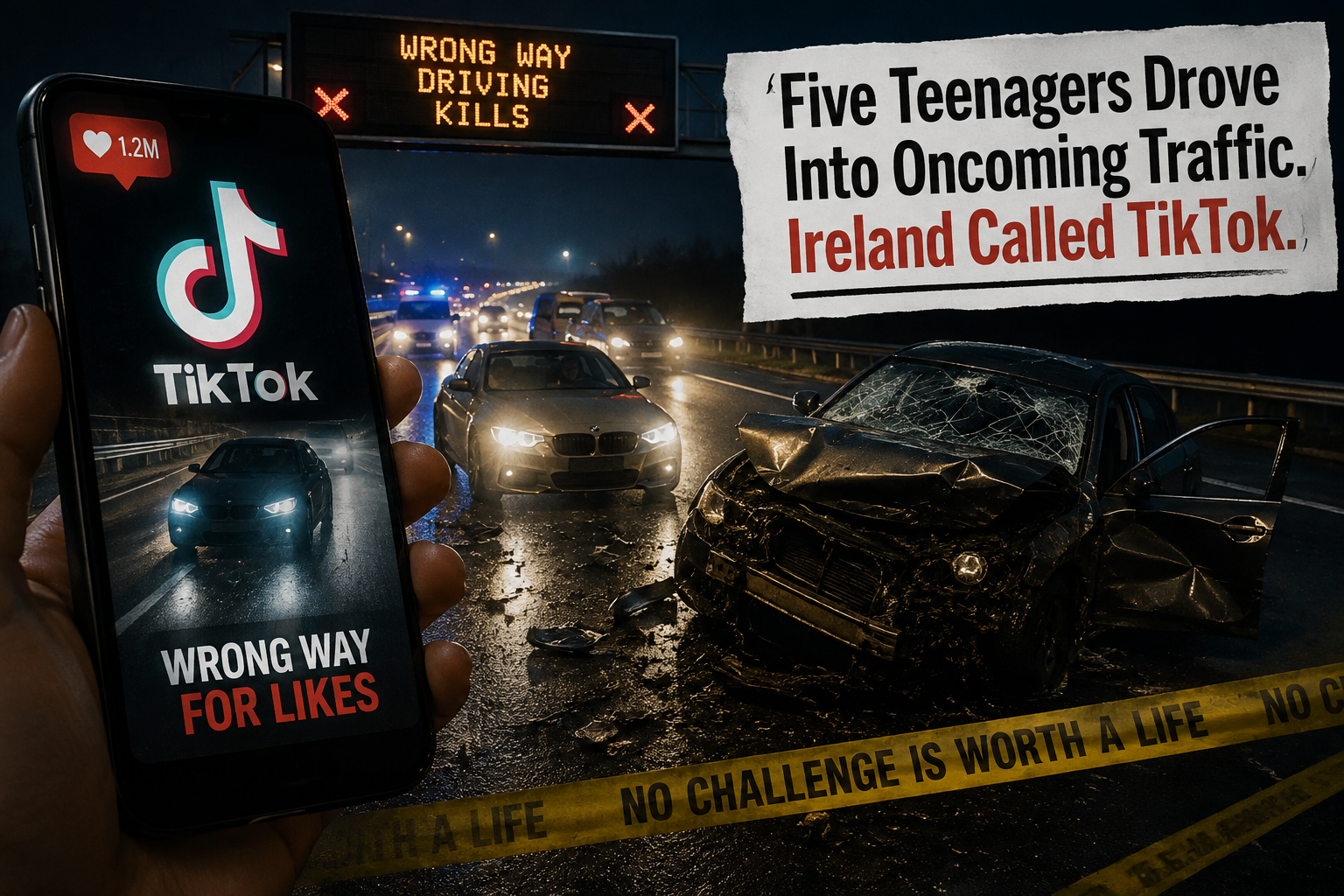
Ireland has discovered a new cause of dangerous driving.
TikTok.
This is excellent news.
For more than a century, humanity had operated under the primitive assumption that when somebody deliberately points a car in the wrong direction and drives into oncoming motorway traffic, responsibility might have something to do with the person operating the vehicle.
Thankfully, Irish lawmakers are bringing road safety into the twenty-first century.
Five teenage boys, aged fifteen to eighteen, were killed on August 16 after the BMW they were travelling in went the wrong way along the M9 motorway in County Kildare and collided head-on with a Hyundai carrying three women and a seven-year-old boy.
The four innocent occupants of the Hyundai were seriously injured.
The circumstances were not some mysterious mechanical failure.
Irish police have been warning about groups of young men competing with one another online by posting videos of stolen cars, Garda pursuits and increasingly reckless driving. Garda Commissioner Justin Kelly specifically said that some wrong-way motorway driving was being carried out for social-media likes, regardless of the potentially devastating consequences.
One account associated with one of the teenagers killed had previously posted footage of wrong-way motorway driving. Other connected accounts showed similar behaviour. Reporting found not one organized TikTok challenge but a network of accounts encouraging and attempting to outdo one another with increasingly reckless content.
Five teenagers are now dead.
Four people who had absolutely nothing to do with their stupidity ended up in hospital.
So naturally, Parliament called TikTok.
Finally, Someone Found the Real Driver
Ireland's parliamentary media committee summoned TikTok to explain what safeguards it has against content glorifying illegal driving.
Ireland's media regulator also demanded information from the company.
TikTok says it has been removing videos and accounts that violate its policies and monitoring content associated with the incidents. It has since declined to appear publicly before the parliamentary committee, offering instead to provide a private briefing.
Fine.
Ask TikTok questions.
Ask why videos of people driving stolen cars into oncoming traffic were allowed to accumulate thousands of views.
Ask whether algorithms rewarded them.
Ask how quickly reports were processed.
Those are perfectly legitimate questions.
But if we're going to start looking for corporations responsible for five teenagers deciding that driving the wrong way down a motorway was an excellent entertainment concept, **why stop at TikTok?**
There are much bigger pockets available.
We Need to Find the Car Manufacturer
Obviously the automobile manufacturer must be investigated.
After all, TikTok didn't transport these teenagers down the M9.
The BMW did.
Why did the manufacturer build a vehicle capable of travelling in the wrong direction?
Why didn't the steering wheel refuse?
Why didn't the engine shut itself down?
Why wasn't the car equipped with an Artificial Idiot Detection System?
Surely a modern automobile could display:
**WARNING: YOU ARE ABOUT TO DO SOMETHING FUCKING STUPID.**
Then lock the doors, turn off the engine and telephone the driver's mother.
BMW has spent billions developing traction control, airbags, lane assistance, automatic braking and driver monitoring.
But apparently nobody thought to install the most important safety feature:
**Don't Let a Moron Drive Head-On Into Traffic Mode.**
We eagerly await the parliamentary summons.
And What About the Phone?
There was another essential component.
The phone.
These stunts were being filmed.
Someone manufactured the device.
Someone installed a camera in it.
Someone designed the software that allowed the camera to record video.
Why isn't that company answering questions?
If TikTok is responsible because its software allowed people to publish the footage, surely whoever manufactured the phone bears responsibility because its hardware allowed them to **create** the footage.
Perhaps the camera should recognize dangerous driving and refuse to record.
Maybe the next smartphone should say:
**This activity appears catastrophically stupid. Recording has been disabled for your safety.**
We're joking, obviously.
But only slightly.
Because once responsibility is moved far enough away from the person making the decision, there is no logical reason to stop at TikTok.
Bring in the Mobile Carrier
The videos also required an internet connection.
Somebody transmitted those bytes.
Whoever provided the connection clearly enabled this dangerous content to reach the internet.
Perhaps mobile networks should detect videos of criminal behaviour before uploading them.
Maybe the network should analyze every packet travelling through every teenager's phone.
That would certainly be excellent for privacy.
And if the telecom company didn't provide the connection, there was presumably Wi-Fi somewhere.
Find the router manufacturer.
We are going to need a larger parliamentary committee.
Somebody Built the Road
We have still not reached the bottom of this conspiracy.
The BMW travelled on asphalt.
Some company built that road.
Without asphalt, driving at motorway speed would have been considerably more difficult.
Where was the road contractor's safeguarding policy?
Why did the asphalt provide sufficient traction?
Could the aggregate have recognized antisocial behaviour?
Did anybody perform a risk assessment before constructing a surface capable of supporting teenage stupidity?
We demand answers.
And while we're at it, somebody manufactured the clothes the teenagers were wearing.
Without clothes, perhaps they wouldn't have gone outside.
Call them too.
Eventually we'll have everybody responsible.
Except the people in the car.
Ireland May Need a New Law
Justice Minister Jim O'Callaghan says the government is considering creating a **specific criminal offence for intentionally driving the wrong way on a motorway**.
Which raises a fascinating question.
What exactly did Irish law think dangerous driving was before August 16?
Was deliberately driving head-on into motorway traffic occupying some mysterious legal grey zone?
Did prosecutors previously stand helplessly outside courtrooms saying:
*Your Honour, unfortunately the legislation never explicitly anticipated somebody being this fucking stupid?*
Of course driving dangerously wasn't legal.
Ireland already has road-traffic offences and rules governing motorway use.
Creating a specific offence may make prosecution or punishment clearer. There can be legitimate legal reasons for doing it.
But legislation cannot solve the underlying intellectual problem.
A fifteen-year-old does not need a statute book to understand that cars approaching at motorway speed from directly in front of him represent an undesirable traffic configuration.
TikTok Does Have Responsibility
Now comes the part that will annoy everybody equally.
TikTok isn't innocent simply because the teenagers made their own decisions.
Platforms design recommendation systems specifically to identify content people engage with and distribute more of it. When reckless behaviour generates attention, an engagement-driven system can create incentives for increasingly spectacular behaviour.
That's worth investigating.
If TikTok knew that networks of accounts were repeatedly posting stolen vehicles, police pursuits and wrong-way motorway driving, asking what it did about those accounts is entirely reasonable.
The platform has rules against dangerous activity.
Enforce them.
But platform responsibility and personal responsibility can exist simultaneously.
This apparently revolutionary concept should not require parliamentary legislation.
TikTok may have provided an audience.
**TikTok did not turn the steering wheel.**
There Is One Group We Haven't Summoned
Parents.
Remember those?
Before children were raised by algorithms, schools, governments, corporations, therapists, influencers and Terms of Service agreements, society had this strange institution where adults were expected to teach their offspring certain basic principles.
Don't steal.
Don't deliberately endanger strangers.
Don't drive like an idiot.
Don't risk your life for applause from people on the internet.
And perhaps:
**If five thousand strangers on TikTok think something is cool, that does not automatically make it a good idea.**
We increasingly behave as though corporations acquired children at birth and parents merely provide accommodation.
A teenager spends years developing habits, judgment and values.
Then something goes catastrophically wrong.
And suddenly everybody looks for the nearest multinational corporation.
Meta should have raised them.
TikTok should have stopped them.
The phone manufacturer should have supervised them.
BMW should have restrained them.
The mobile carrier should have disconnected them.
Government should have passed another law.
At some point somebody might have to perform the deeply unfashionable act of asking:
**Who was supposed to teach these kids not to do this in the first place?**
The Deepest Pocket Wins
And that's what makes the TikTok summons interesting.
Not because TikTok deserves immunity from scrutiny.
It doesn't.
But because modern accountability increasingly follows an extraordinarily convenient principle:
Find the participant with the most money.
A dead teenager has no corporate treasury.
Parents may not have one either.
TikTok does.
So TikTok becomes the defendant in the public imagination.
We've seen the same mechanism elsewhere. A terrible human decision occurs, technology was somewhere in the chain, and suddenly the technology becomes the protagonist.
Sometimes that's justified.
Sometimes the product really was negligently designed.
Sometimes algorithms really do amplify harmful behaviour.
But if merely participating somewhere in the causal chain creates responsibility for the final human decision, then there is no principled reason to stop at the app.
Sue the phone manufacturer.
Summon the telecom company.
Investigate BMW.
Question the asphalt contractor.
Subpoena the clothing factory.
Eventually Ireland can establish a National Commission on Why Five Teenagers Thought Driving Into Oncoming Motorway Traffic Was a Good Idea.
It will take three years.
Produce eight hundred pages.
Cost €14 million.
And somewhere around page 763, perhaps someone will finally write the sentence that could have saved everybody a great deal of time.
Perhaps Ireland doesn't need another law against driving the wrong way down a motorway.
Perhaps the only new law Ireland — along with quite a few other countries — really needs at this point is much simpler:
**Morons should not reproduce.**
Unfortunately, enforcing that one would probably create an entirely new set of problems.
So we'll settle for the existing rule:
**Don't drive the wrong way down a fucking motorway.**