Society
GERMANY PROTECTS DEMOCRACY FROM VOTERS
YOU HAVE THE RIGHT TO YOUR OWN OPINION. WE’LL TELL YOU WHAT IT IS.
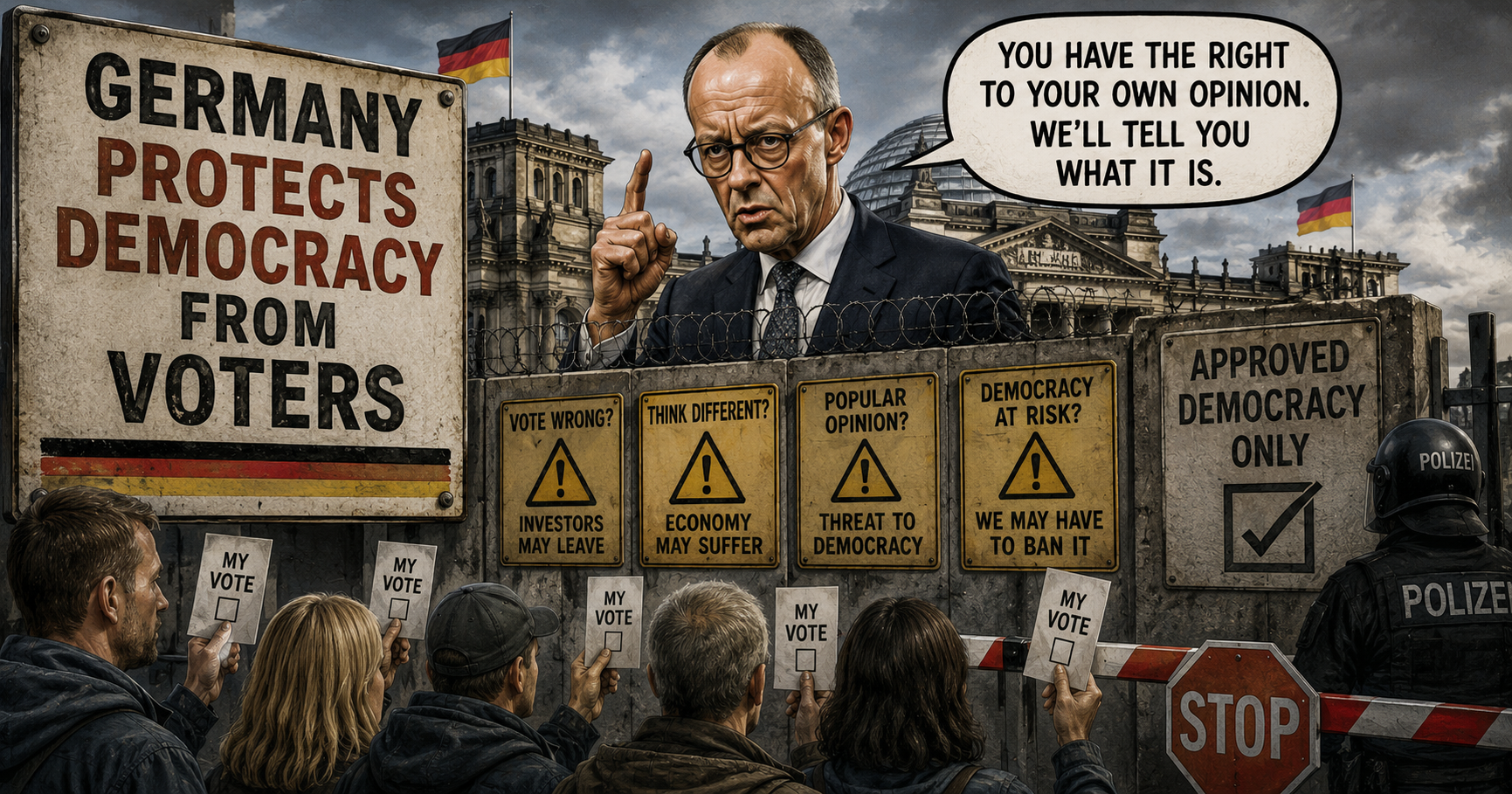
Germany has discovered a rather inconvenient flaw in democracy.
**Voters.**
For decades, Europeans have been taught a wonderfully simple formula. Democracy means elections. Citizens consider the alternatives, enter a polling booth and decide who should govern them.
Apparently there was some fine print.
Citizens are free to choose.
They just have to choose correctly.
German Chancellor Friedrich Merz recently warned that an AfD victory in Saxony-Anhalt could discourage foreign companies from investing in the state.
The decision, naturally, belongs to voters.
How reassuring.
Vote for anyone you like.
But if you vote for *those people*, investors may leave, jobs may disappear, businesses may reconsider their plans and economic consequences may follow.
Apart from that, absolutely no pressure.
Welcome to twenty-first-century European democracy.
THE APPROVED DEMOCRATIC EXPERIENCE
This would already be amusing enough if it existed in isolation.
It doesn't.
Senior German politicians have also continued discussing whether AfD could or should eventually be banned.
And this is where the whole thing becomes philosophically delicious.
AfD isn't a tiny collection of lunatics meeting behind a kebab shop.
Millions of Germans vote for it.
That doesn't make the party correct.
It doesn't make its policies intelligent.
It doesn't make its politicians admirable.
It makes it **popular**.
And popularity presents an awkward problem when your preferred method of protecting democracy involves preventing popular political movements from obtaining power.
Because at some point someone has to ask the embarrassingly obvious question:
**Who exactly are you protecting democracy from?**
The voters?
DEMOCRACY, TERMS AND CONDITIONS APPLY
The modern European definition of democracy increasingly appears to work like a software licence agreement.
You may participate.
You may express yourself.
You may vote.
You may choose between competing political visions.
By clicking **ACCEPT**, however, you acknowledge that your choice remains subject to ideological compatibility requirements established by people already occupying the institutions you are supposedly choosing.
Should your democratic preference fall outside those parameters, additional democratic protection measures may become necessary.
Warnings.
Political isolation.
Economic warnings.
Institutional barriers.
And perhaps eventually prohibition.
All, naturally, in defence of democracy.
There is something almost beautiful about it.
PLEASE SELECT ANOTHER ANSWER
Imagine conducting an election at school.
The teacher writes three candidates on the board.
The children vote.
Candidate C wins.
The teacher looks at the result and says:
“No. Candidate C represents a threat to democracy.”
The children are confused.
“But we voted for him.”
“Exactly. That's the problem.”
So another election is organised, presumably until democracy produces the democratically acceptable answer.
Absurd?
Of course.
Put everyone in expensive suits, add government buildings and television studios, and apparently it becomes political science.
YOUR VOTE IS EXTREMELY IMPORTANT
European politicians constantly remind citizens that voting is sacred.
People fought for this right.
People died for this right.
Democracy depends upon participation.
Every vote counts.
Until enough of those votes go somewhere the establishment doesn't like.
Then suddenly voters aren't exercising democratic sovereignty.
They're angry.
They're misinformed.
They're manipulated.
They're radicalised.
They're voting against their own interests.
They're threatening democratic institutions.
Notice the one possibility that is rarely entertained:
**Perhaps they simply disagree with you.**
That possibility is dangerous because it requires politicians to do something considerably harder than condemning voters.
It requires persuading them.
If millions of Germans are moving toward AfD, perhaps the first question shouldn't be how to prevent AfD from benefiting.
Perhaps it should be:
**Why are millions of Germans doing this?**
Maybe they dislike immigration policy.
Maybe they dislike energy policy.
Maybe they're worried about the economy.
Maybe they're furious with Berlin.
Maybe they're wrong about everything.
Fine.
Then convince them.
That's what politics in a democracy is supposed to be.
THE CONVENIENT DEMOCRAT
There is a wonderfully convenient kind of democrat who passionately supports the will of the people whenever the people agree with him.
He loves elections whose outcomes he approves.
He celebrates popular movements supporting his policies.
He praises civic participation when citizens arrive at the correct conclusion.
Then the electorate changes its mind.
Suddenly the same citizen who was yesterday the sacred foundation of democracy becomes a dangerous idiot requiring supervision.
This isn't exclusively German.
It isn't exclusively European.
And it isn't exclusively a problem of the political left, centre or right.
It's an institutional temptation as old as elections themselves:
**We support democracy. We just don't trust people with it.**
Germany merely provides an unusually clean demonstration.
THERE IS A SIMPLER SOLUTION
Perhaps Germany no longer needs elections.
They're expensive.
They're divisive.
Campaign posters create litter.
Television debates interrupt perfectly good programming.
And worst of all, elections occasionally produce the wrong result.
It would be considerably more efficient for the government to announce the democratically acceptable outcome in advance.
Citizens could stay home.
Foreign investors could relax.
Politicians wouldn't have to worry about unpleasant surprises.
And Germany could proudly announce that democracy had once again been successfully protected.
Especially from the people who might have tried to use it.
**YOUR VOTE MATTERS. PLEASE MAKE SURE IT'S THE CORRECT ONE.**