Image
He Cut Down 287 Trees for the View. The City Gave Him a Billboard.
A man in Longueville wanted a better view of the water.
There are bad ideas.
There are expensive bad ideas.
And then there are ideas so spectacularly stupid that a city council decides the only appropriate response is to turn your mistake into a public monument.
Welcome to Sydney.
A man in Longueville wanted a better view of the water.
The problem was simple.
There were trees in the way.
Quite a lot of them, actually.
Two hundred and eighty-seven.
So they were cut down.
Not trimmed.
Not selectively reduced.
Cut down.
The cleared area covered roughly 1,210 square metres of public foreshore land.
All for the view.
This is the kind of decision that probably feels brilliant for approximately seven minutes.
You stand there.
You look at the water.
You admire your newly liberated horizon.
You congratulate yourself.
Then the council arrives.
And the bill starts.
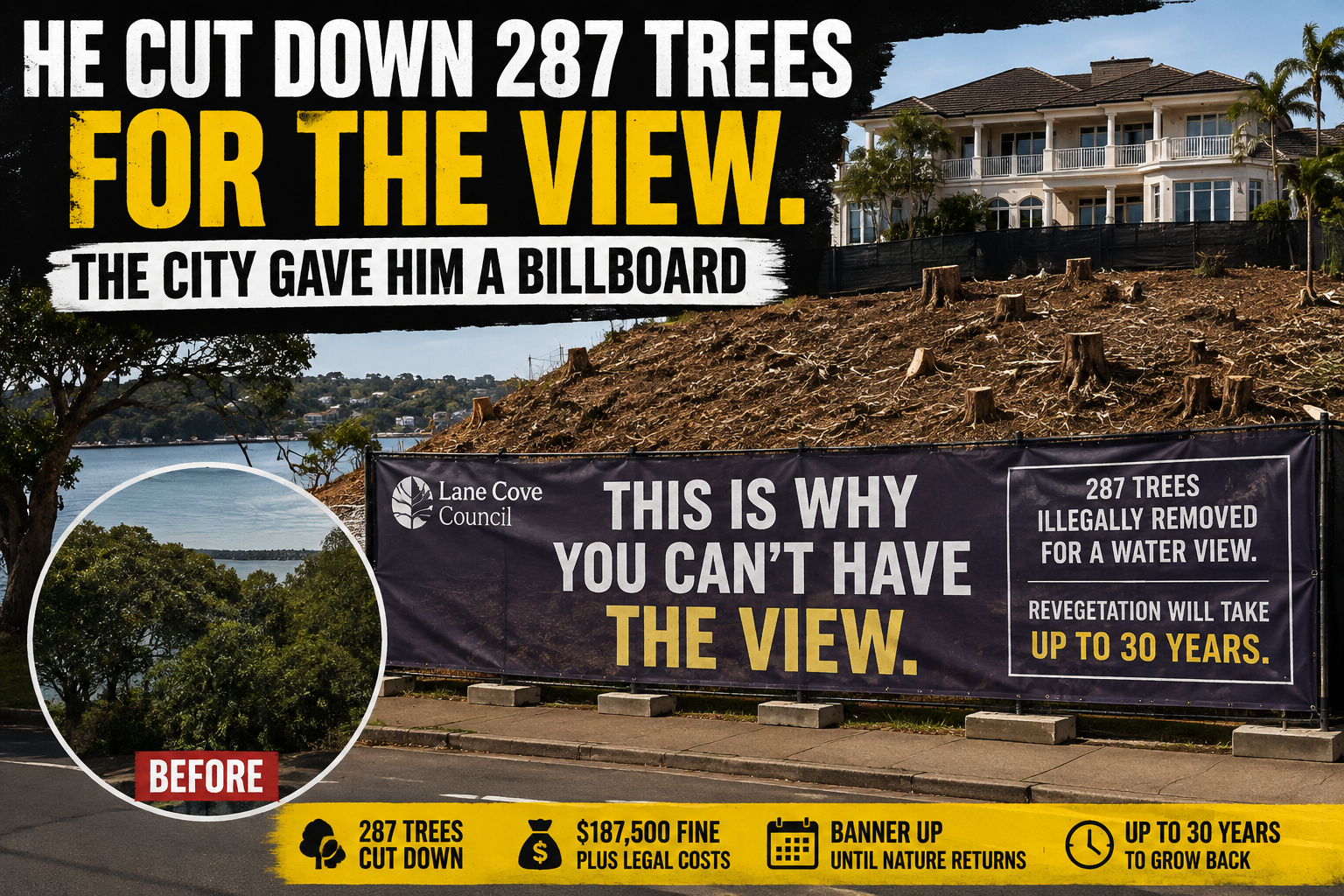
The gardener involved, Yi Wang, was eventually fined **A$187,500**, plus legal costs, after the court dealt with the illegal clearing.
That alone would have been a sufficiently expensive lesson.
But Lane Cove Council apparently decided money was not educational enough.
So they added visual learning.
They installed a **large banner directly in front of the newly created view**.
The same view the trees had been removed to expose.
This is municipal poetry.
A man destroys 287 trees because they are blocking the water.
The government responds by putting something else in front of the water.
Perfect.
No notes.
And apparently the banner is supposed to remain there until vegetation regrows enough to obstruct the view naturally again.
That could take years.
Possibly decades.
So the final result of the operation is extraordinary.
Before:
Trees.
After:
No trees.
Fine.
Court costs.
Public embarrassment.
And a giant artificial obstruction where the natural obstruction used to be.
That is a remarkable return on investment.
The story gets better.
According to court reporting, Wang had originally been hired for ordinary gardening work. He later carried out the clearing and was paid in cash, with money reportedly left for him **inside shoes**.
Because apparently once your landscaping project has reached the point where nearly three hundred public trees are disappearing, paying normally would be too conventional.
There is still separate legal action connected to the broader incident.
But even without that, the basic mathematics are already beautiful.
Two hundred and eighty-seven trees removed.
Almost two hundred thousand Australian dollars in fines.
A view obtained.
A view immediately blocked again.
This is the kind of event that should be studied in business schools.
Not because it demonstrates environmental policy.
Because it demonstrates what happens when a human being becomes so focused on the desired result that he forgets to ask one small question:
**Am I allowed to do this?**
Apparently not.
There is also something deeply satisfying about the council’s response.
Usually governments solve stupidity with paperwork.
Forms.
Notices.
Hearings.
Warnings.
Appeals.
Reports.
This time, somebody appears to have understood the assignment.
You cut down the trees because you wanted the view?
Fine.
Here is a billboard.
Enjoy.
The restoration of the vegetation could take a very long time.
So the punishment may outlive the memory of the original stupidity.
People will drive past.
See the banner.
Ask why it is there.
And somebody will explain:
A man wanted to see the water.
So he cut down 287 trees.
And now he gets to look at this instead.
There are punishments.
And then there are punchlines.
This one happens to be both.