Culture
Hollywood Made Religion Into Entertainment. Mel Gibson Didn’t.
More than twenty years after *The Passion of the Christ*, Hollywood is still producing biblical spectacle. Mel Gibson’s film remains something rarer: a religious movie that seems to believe its subject actually matters.
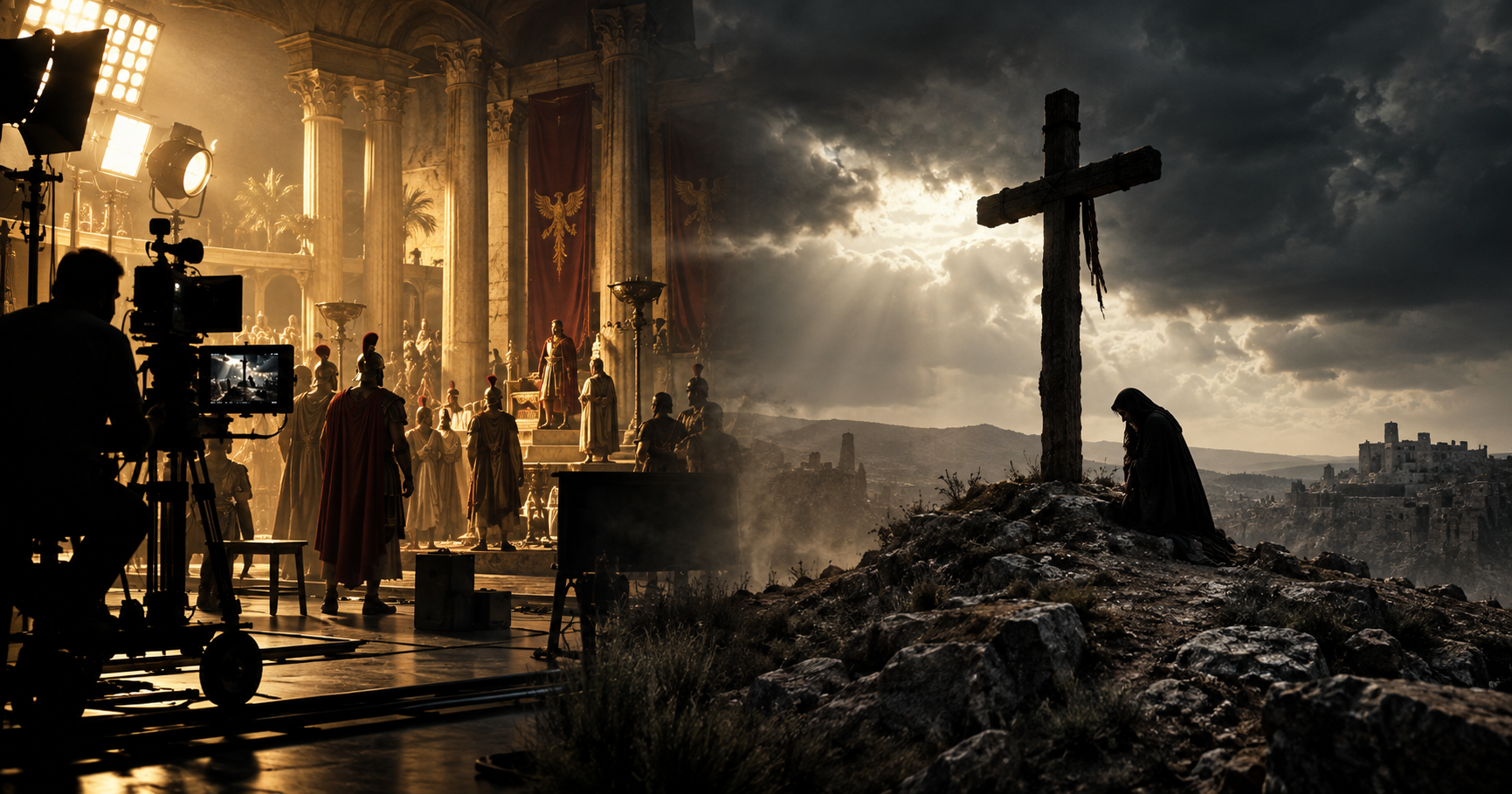
Hollywood has never had a shortage of religion.
It has parted seas, flooded worlds, raised temples, burned cities, marched armies across deserts and spent extraordinary amounts of money teaching ancient prophets to speak fluent blockbuster. Biblical stories have been enlarged, modernized, psychoanalyzed, romanticized and, whenever necessary, stuffed with enough digital spectacle to keep an audience from remembering that somebody once considered the material sacred.
The results are often impressive.
They are considerably less often memorable.
Then there is *The Passion of the Christ*.
More than two decades after Mel Gibson released it in 2004, the film remains difficult to place alongside almost anything Hollywood has made from Christian scripture. Not because it is the biggest biblical film. It is not. Not because it has the most elaborate effects or the most fashionable interpretation. It has neither.
It remains singular because Gibson committed an increasingly unusual artistic offense.
He took the material seriously.
Not seriously in the corporate sense, where an ancient story is described in a press release as timeless, universal and relevant for modern audiences before being rebuilt according to contemporary entertainment formulas.
Seriously as though the story itself had authority.
That difference changes everything.
A Story Hollywood Usually Cannot Leave Alone
Consider what normally happens when Hollywood approaches scripture.
The original text becomes intellectual property.
A biblical figure becomes a protagonist requiring a conventional character arc. Ambiguity needs motivation. Silence needs dialogue. Mystery needs explanation. Theology becomes psychology. Miracles become visual effects. Ancient moral assumptions are carefully translated into whatever language happens to be acceptable to a contemporary audience.
And eventually the adaptation begins to explain the source material back to the source material.
Darren Aronofsky’s *Noah* is perhaps one of the clearest examples. It is visually ambitious, expensive, often fascinating and barely interested in behaving like a straightforward film of the Genesis account. Its Noah becomes part environmental prophet, part tormented apocalyptic patriarch, surrounded by elaborate inventions that transform a short and terrifying biblical narrative into a modern fantasy epic.
That does not automatically make *Noah* a bad movie.
It does make it unmistakably a Hollywood movie.
The biblical story has been invited into the studio and then informed that several improvements will be necessary.
Gibson did almost the opposite.
*The Passion of the Christ* does not appear embarrassed by its source material. It does not spend two hours apologizing for Christianity to an audience that may not believe in Christianity. It does not construct an ironic escape hatch through which the viewer can safely retreat if the religious implications become uncomfortable.
It simply proceeds as though this matters.
That may be the most radical thing about it.
Gibson Does Not Give You a Comfortable Jesus
There had been films about Jesus before *The Passion of the Christ*, of course. Many of them were respectful. Some were beautifully made. Yet respect can become its own kind of distance.
The biblical film frequently develops the atmosphere of a museum.
Everything is important. Everybody speaks carefully. Costumes are immaculate. Sandals are historically persuasive. The lighting announces holiness. Jesus appears already framed by cultural memory, less a man walking toward execution than an icon patiently waiting for history to recognize him.
Gibson destroys that distance.
His Christ bleeds.
He falls.
He trembles.
His body deteriorates.
His mother watches.
The people around him are frightened, cruel, indifferent, confused, obedient, sadistic, compassionate and weak. Power is not abstract. Execution is not symbolic. Suffering does not arrive conveniently edited for Sunday morning.
The crucifixion, an image so familiar that it can become almost decorative in Western culture, is made physical again.
That is why the film is so difficult to watch.
And that difficulty is not a defect accidentally left in the final cut. It is the mechanism.
The violence in *The Passion of the Christ* has always been one of its central controversies, and criticism of its extremity is perfectly legitimate. Gibson refuses restraint for long stretches of the film. He forces the viewer to remain in scenes from which most filmmakers would cut away much earlier.
But whether one admires that decision or hates it, it is difficult to accuse the film of treating suffering as an accessory.
There is no comfortable version waiting underneath.
The Strange Power of a Film You Do Not Want to Rewatch
Modern entertainment culture measures affection through repetition.
We love a film, so we watch it again.
We quote it. Stream it. Put it on in the background. Buy the special edition. Revisit our favorite scenes.
*The Passion of the Christ* creates a stranger relationship.
It can be a film you consider extraordinary and still hesitate to watch again.
That hesitation may be one of the greatest compliments an artwork can receive.
Some films entertain us so successfully that we return because we know precisely how they will make us feel. Others leave a bruise. We remember them perfectly well without requiring another viewing.
*The Passion of the Christ* belongs to the second category.
For many viewers, particularly believers, its emotional effect is not an intellectual exercise. The film can be genuinely painful. Tears are not produced by a clever screenplay arranging its emotional beats at mathematically correct intervals. They come because Gibson relentlessly removes the protective layers that normally separate religious image from human event.
A mother is watching her son die.
A condemned man is being tortured.
A crowd is watching.
Officials are processing the machinery of punishment.
Soldiers are doing their jobs.
And for Christianity, simultaneously, something infinitely larger is happening.
Gibson does not allow one level to cancel the other.
That is why the film can affect even a viewer who approaches it primarily as cinema. Faith changes its meaning, but faith is not required to recognize what the film is doing.
You do not have to accept Christian theology to understand grief.
You do not have to believe in the Resurrection to understand humiliation.
You do not have to believe that the man carrying the cross is God to understand what it means for one human being to watch another human being destroyed.
Cinema can work before agreement.
The Languages Matter
One of Gibson’s strangest commercial decisions now looks almost impossible by current studio logic.
The film was performed primarily in reconstructed Aramaic and Latin, with some Hebrew.
A major American filmmaker spent tens of millions of dollars making a brutal religious drama in languages almost nobody in his intended mass audience spoke, centered it on torture and execution, gave it an R rating, and sent it into theaters.
On paper, this sounds less like a blockbuster strategy than an elaborate method of frightening investors.
The movie went on to earn more than six hundred million dollars worldwide.
That financial success matters not because money proves artistic quality. It obviously does not.
It matters because it demolishes one of Hollywood’s favorite excuses: that audiences must constantly be protected from difficulty.
They will not watch subtitles.
They will not tolerate unfamiliar languages.
They need exposition.
They need relatability.
They need recognizable entertainment rhythms.
They need the ancient thing translated into the modern thing.
Gibson gave audiences almost none of those reassurances.
They came anyway.
Hollywood Wants Religion Without Submission
The deeper divide between *The Passion of the Christ* and much of biblical Hollywood is not really conservative versus progressive, believer versus atheist, or faithful adaptation versus creative interpretation.
It is about who is expected to submit to whom.
Most modern adaptations behave as though the ancient material must submit to the filmmaker.
The filmmaker interrogates it, corrects it, updates it and decides which parts remain useful.
Gibson behaves as though the filmmaker must submit to the material.
That does not mean his film is some perfectly neutral transcription of scripture. It certainly is not. *The Passion of the Christ* contains artistic interpretation, theological choices, visual invention and influences beyond the bare Gospel narratives. Gibson is still directing. He is still selecting. He is still constructing an experience.
But the posture is different.
The film does not stand above its subject.
It kneels before it.
That distinction is visible in almost every frame.
Twenty Years Later, It Is Still There
This is perhaps the most embarrassing part for an industry obsessed with cultural relevance.
*The Passion of the Christ* has lasted.
Not merely as an old box-office curiosity or a piece of early-2000s controversy. It remains discussed, argued over, revisited and emotionally potent enough that its return to theaters can still attract attention more than twenty years later.
And now Gibson is returning to the story itself with *The Resurrection of the Christ*.
That creates an enormous risk.
The first film established a standard that money alone cannot reproduce. The danger for a sequel is not that it will offend people. Gibson has survived that before.
The danger is that it becomes merely a movie.
The Resurrection is, cinematically, an even more dangerous subject than the Passion. Suffering is physical. A camera understands wounds, sweat, stone, blood and exhaustion. Resurrection enters territory where literal imagery can very quickly become either sentimental religious illustration or supernatural spectacle.
Gibson now has to film transcendence without reducing it to special effects.
That may be considerably harder than filming a crucifixion.
But it is also why the project is worth watching.
Not because Hollywood needs another biblical franchise.
It desperately does not.
It is worth watching because the filmmaker who once refused to turn Christianity into comfortable entertainment is returning to the point in the story where comfortable entertainment would be the easiest mistake to make.
Religion Is Not Production Design
Hollywood will continue making religious movies.
There will be more deserts. More temples. More prophets staring dramatically into storms. More enormous digital cities shortly before divine judgment destroys them. More attempts to make ancient scripture accessible by turning it into something audiences already recognize.
Some of those films will be good.
Some may even be great.
But *The Passion of the Christ* remains a useful rebuke to the assumption underneath so many of them.
Religion is not production design.
Sacred stories are not automatically improved when converted into modern entertainment grammar. And audiences do not necessarily require every difficult thing to be made easier, friendlier, faster or more familiar.
Sometimes the reason an old story still possesses power is precisely because it refuses to become us.
Mel Gibson understood that.
He did not make Christianity cool.
He did not make it comfortable.
He did not make it safe.
He made a film in which belief has weight, suffering has a body and the audience is not permitted to hide behind the pleasant distance of mythology.
Hollywood has made countless movies about religion.
Mel Gibson made one that feels as though he believed the story mattered.
More than twenty years later, that may be why it still does.