Society
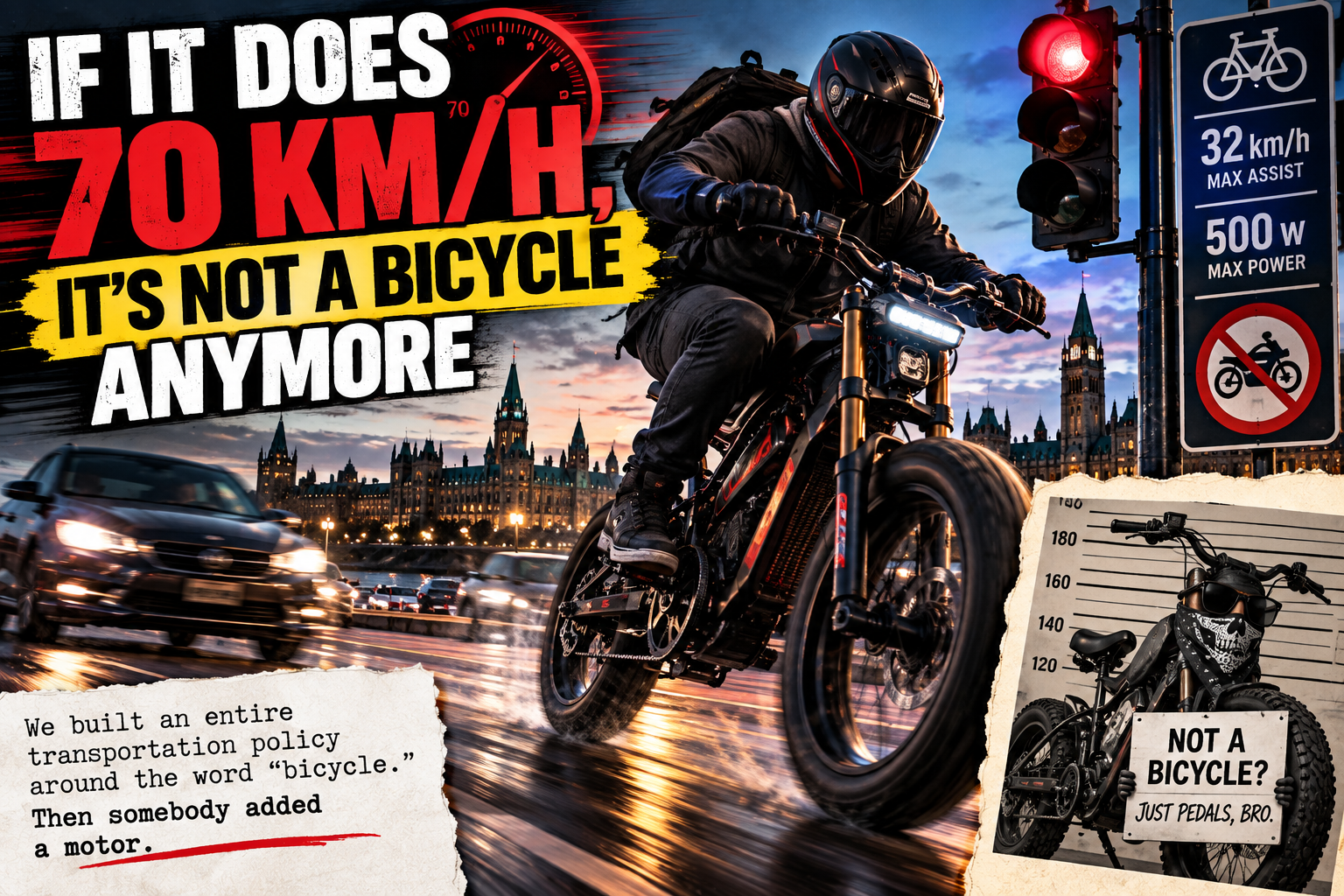
IF IT DOES 70 KM/H, IT'S NOT A BICYCLE ANYMORE
We built an entire transportation policy around the word "bicycle." Then somebody added a motor.
There is something wonderfully Canadian about creating hundreds of pages
of traffic law and then discovering that apparently all you need to
escape much of the regulatory machinery is a pair of pedals.
Put an engine in a car and we know what happens.
Licence.
Registration.
Insurance.
Licence plate.
Equipment requirements.
Traffic laws.
Enforcement.
Put an electric motor between two bicycle wheels, however, and suddenly
we enter a strange philosophical territory where everybody becomes
extremely interested in what the machine *identifies as*.
It has pedals.
Therefore, bicycle.
Except some of these "bicycles" no longer behave very much like
bicycles.
And perhaps it is time our laws stopped pretending otherwise.
THIRTY-TWO MEANS THIRTY-TWO
Ontario actually has a reasonably clear definition of a legal e-bike.
A power-assisted bicycle may have an electric motor, but the motor
cannot exceed 500 watts, and motor assistance must cut out once the
bicycle reaches 32 km/h.
That number matters.
Thirty-two kilometres per hour is not a recommendation from the
manufacturer. It is part of the legal boundary separating an ordinary
power-assisted bicycle from something else.
Ontario also explicitly warns that modifying an e-bike to increase its
motor output or assisted speed beyond the permitted limits is illegal.
So far, wonderfully simple.
Then you go outside.
I have personally watched an electric bicycle pass my car while I was
travelling approximately 50 to 60 km/h.
Not downhill in some heroic display of gravity-assisted cycling.
On the road.
The machine continued toward Ottawa, went through a red light, entered
cycling infrastructure and carried on across the river.
Can I prove how fast its electric motor was propelling it?
No.
Can I tell you what modifications had been made to that particular
machine?
No.
I did not pull the rider over with my imaginary police cruiser and place
his bicycle on a dynamometer.
But when something shaped like a bicycle is keeping up with, or
overtaking, urban automobile traffic, it becomes reasonable to ask
whether our regulatory vocabulary has fallen slightly behind the
hardware.
THE PEDALS ARE NOT MAGIC
The problem is not electricity.
Electric bicycles are an excellent idea.
For somebody commuting several kilometres, an electric motor can turn
cycling from exercise into practical transportation. It can make hills
irrelevant, extend commuting range and allow people who would never
realistically cycle to work to leave a car at home.
Wonderful.
But none of those benefits explain why pedals should function as a
regulatory invisibility cloak.
Imagine another vehicle capable of travelling at 50, 60 or 70 km/h.
Now imagine saying that its operator requires no licence because the
manufacturer attached two decorative pedals to it.
The proposition becomes considerably stranger.
Yet the technological boundary between bicycle, e-bike, electric moped
and electric motorcycle is becoming increasingly blurry.
Manufacturers can build machines that visually resemble bicycles while
delivering performance that would once have belonged unmistakably to
motorized vehicles.
The law therefore faces a problem it has encountered many times before:
Technology changed.
The category did not.
A BICYCLE IS ALREADY A VEHICLE
There is another peculiar misconception worth disposing of.
Cyclists are not pedestrians with wheels.
Ontario's Highway Traffic Act treats bicycles as vehicles, and the
province explicitly tells cyclists that they must obey traffic laws and
traffic signals.
That means a red light does not become optional because the person
approaching it is wearing Lycra.
A stop sign does not become a suggestion because the vehicle has no
licence plate.
And a bicycle lane is not diplomatic territory where the Highway Traffic
Act has suspended operations.
Yet anyone who drives regularly in Ottawa has seen the improvisational
version of cycling law.
Road when convenient.
Bike lane when convenient.
Sidewalk when convenient.
Pedestrian crossing when convenient.
Red light when inconvenient.
The overwhelming majority of cyclists are not necessarily doing this.
There are responsible cyclists who stop at lights, signal turns and ride
predictably.
They are also the people with the most to lose when somebody else
decides traffic laws are optional.
A cyclist usually loses an argument with a two-tonne automobile
regardless of who had the right of way.
Enforcement protects cyclists too.
BUT HOW DO YOU ENFORCE A VEHICLE YOU CANNOT IDENTIFY?
Here we arrive at the uncomfortable part.
A car runs a red light.
There is a licence plate.
A motorcycle runs a red light.
There is a licence plate.
A truck runs a red light.
There is a licence plate.
A high-powered electric bicycle runs a red light and disappears down a
cycling path.
What exactly identifies it?
This is where the usual discussion becomes trapped between two
ridiculous extremes.
One side wants bicycles treated as though they are sacred objects
requiring permanent exemption from bureaucracy.
The other wants every grandmother riding to the grocery store registered
with the government.
Neither is necessary.
Nobody needs a licence plate on a child's bicycle.
Nobody needs mandatory registration for somebody riding an ordinary
pedal bicycle around the neighbourhood.
And putting a bureaucracy around every conventional bicycle in Canada
would be an impressive solution to a problem nobody asked us to create.
Electric propulsion changes the equation.
Performance changes it even more.
A machine legally limited to modest electric assistance is one category.
A machine capable of sustained motorized travel at speeds comparable to
urban automobiles is another.
The regulatory system should be capable of noticing the difference.
REGULATE PERFORMANCE, NOT APPEARANCE
The sensible dividing line is not whether a machine has pedals.
It is what the machine can actually do.
Once an electrically powered two-wheeler exceeds the performance limits
established for ordinary e-bikes, it should move into another regulatory
category.
That could mean registration.
A visible identification plate.
Minimum equipment standards.
Potential insurance requirements.
And, once performance reaches motorcycle territory, an appropriate
operator licence.
Not because electric bicycles are evil.
Because a machine travelling at motorcycle speeds creates
motorcycle-sized consequences when something goes wrong.
Kinetic energy is notoriously uninterested in branding.
A pedestrian struck at 50 km/h does not receive reduced injuries because
the vehicle that hit him was sold under the "e-bike" tab of a website.
Nor does a driver approaching an intersection somehow gain additional
reaction time because the rapidly approaching object has pedals
attached.
Speed is speed.
Mass is mass.
Traffic is traffic.
AND THEN ENFORCE THE RULES WE ALREADY HAVE
None of this matters if governments respond in their favourite way:
write another regulation, announce it at a press conference, produce a
colourful PDF and then return to ignoring the road.
Ontario already has an e-bike speed limit for motor assistance.
Cyclists already have to obey traffic signals.
The basic framework already exists.
So before politicians celebrate another grand transportation initiative,
perhaps somebody could answer a much simpler question:
How many illegal high-powered e-bikes are actually being stopped?
How often are e-bike speeds checked?
How many citations are issued to cyclists for red-light violations?
How many machines found exceeding the legal power or assistance limits
are removed from service?
Those numbers would tell us considerably more about transportation
policy than another artist's rendering of a bicycle lane.
Because laws that exist only on government websites are not traffic
laws.
They are literature.
THIS IS ABOUT RESPONSIBILITY
There is a curious tendency in transportation politics to turn every
discussion into a tribal argument.
Drivers versus cyclists.
Cars versus bicycles.
Roads versus bike lanes.
That misses the point.
A public road is a shared system.
Everyone using it should be predictable enough that everybody else has a
reasonable chance of getting home without meeting an ambulance.
Drivers should obey the rules.
Motorcyclists should obey the rules.
Truck drivers should obey the rules.
Cyclists should obey the rules.
Electric-bike riders should obey the rules.
The machine underneath you does not confer moral status.
It creates responsibility.
And as electric bicycles become faster, heavier and more powerful,
pretending that every machine with pedals belongs in exactly the same
regulatory category becomes increasingly difficult to defend.
Keep ordinary bicycles simple.
Keep genuinely low-powered e-bikes accessible.
They are useful transportation and there is no compelling reason to
drown them in paperwork.
But once an electric machine can perform like a motor vehicle, regulate
it like one.
Because if your "bicycle" is doing 70 km/h through city traffic, we are
no longer having a serious discussion about bicycles.
We are having a discussion about a motorcycle that brought pedals to
court as an alibi.