Media
IF THE NEWS SAID YOU WERE AN IDIOT, WOULD YOU BELIEVE THAT TOO?
We can fabricate photographs, generate video, repeat unverified claims and package speculation as breaking news. Yet “I saw it on the news” somehow remains an argument.
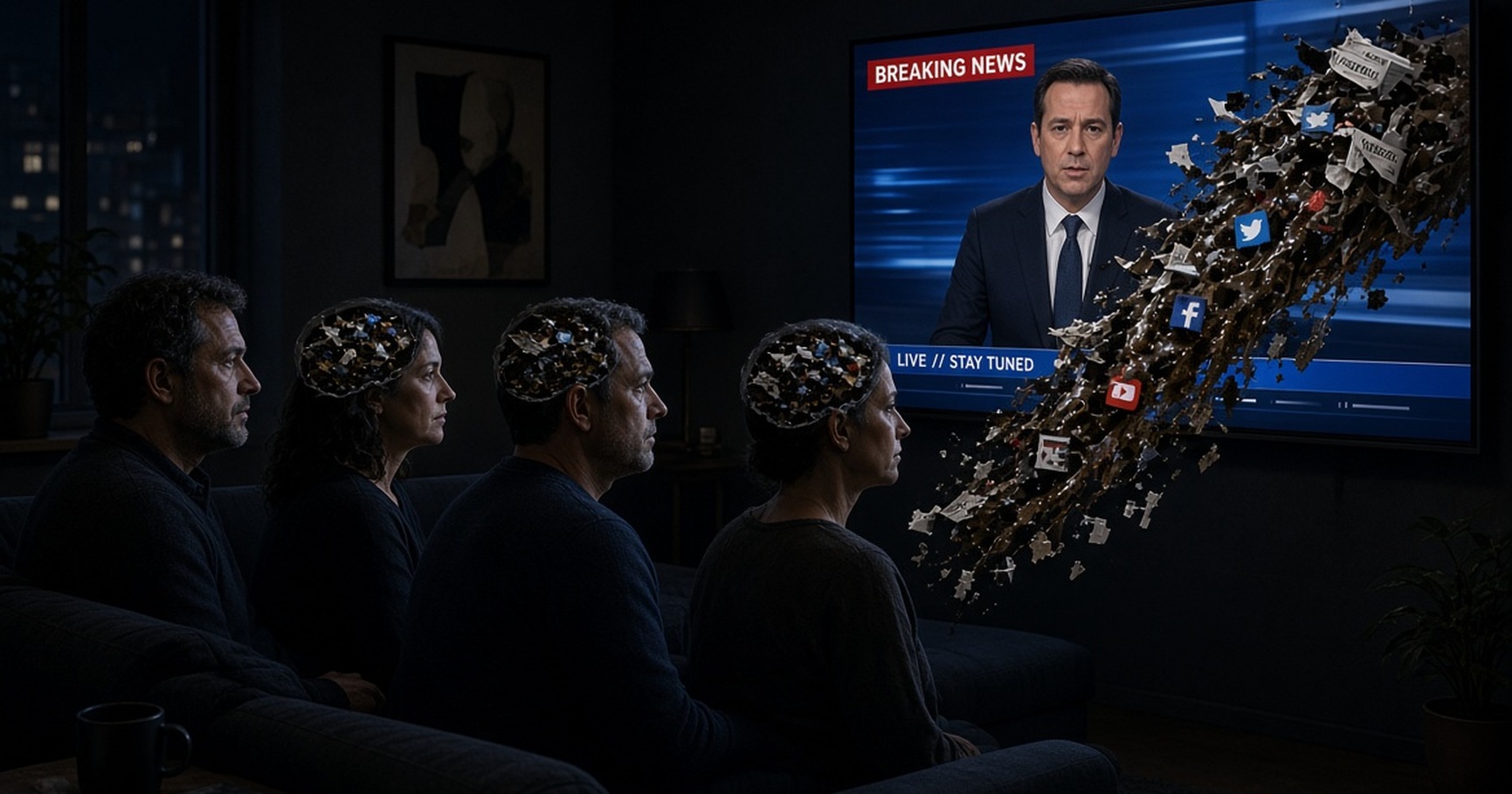
There is a question I have always wanted to ask people who begin an argument with the words:
“I saw it on the news.”
It is a very simple question.
Suppose you turn on the television tonight.
There is the familiar studio. The serious music. The expensive graphics. The solemn presenter wearing the expression television presenters reserve for matters of enormous importance.
And then your photograph appears on the screen.
Your actual photograph.
Underneath it is a caption:
**THIS PERSON IS AN IDIOT.**
The anchor looks directly into the camera and says:
“According to our sources, this person is a complete degenerate.”
Would you believe it?
Probably not.
You would immediately start asking questions.
Who said that?
What sources?
What evidence?
Who decided this?
What exactly did I do?
Where did this information come from?
You might even become rather interested in journalistic standards.
Suddenly, verification would matter enormously.
Which raises an awkward question.
**Why don't you ask the same questions when the photograph belongs to somebody else?**
The Magic Rectangle
For some reason, millions of otherwise functional adults still treat the phrase “it was on the news” as if it describes a method of verification.
It does not.
It describes where you heard something.
That is all.
“I saw it on television” is epistemologically no stronger than “a man at the bus stop told me.”
The television station may have better sources than the man at the bus stop. It may employ professional journalists, editors, lawyers and fact-checkers. It may also have deadlines, political assumptions, commercial incentives, institutional loyalties, incomplete information and employees capable of making mistakes.
The logo in the corner of the screen does not repeal human fallibility.
Yet something peculiar happens when information passes through a sufficiently expensive studio.
Uncertainty becomes authority.
A claim acquires dramatic music.
An allegation acquires a lower-third graphic.
A prediction acquires a retired general.
And suddenly millions of people stop asking the questions they would ask instantly if the subject were themselves.
Now the Camera Can Lie Too
This problem has just acquired an entirely new dimension.
During the current conflict with Iran, Donald Trump posted a video purporting to show destruction at Iran's strategically important Kharg Island while declaring that the facility was being “blown to smithereens.”
Reuters examined the footage and determined that the video was AI-generated.
That does not prove the underlying military claim was false. At the time Reuters checked it, the claimed strike on Kharg had not been independently confirmed.
And that distinction matters enormously.
Because the remarkable thing is not simply that somebody posted a fake video on the internet.
Fake things have existed on the internet approximately since the internet discovered photographs.
The remarkable thing is that **synthetic footage can now accompany a real-time statement about an actual war and look like documentation of the event being described.**
We have crossed an important line.
For most of modern history, photographs and video could be manipulated.
Now they can be manufactured.
There does not have to be a misleading camera angle.
There does not have to be selective editing.
There does not even have to be a camera.
The event depicted on your screen can have been photographed by nobody because the photograph itself never existed.
And yet the human brain remains wonderfully vulnerable to four ancient words:
**“Look. There it is.”**
The Problem Is Bigger Than AI
It would be comforting to blame artificial intelligence.
Unfortunately, AI merely removed the training wheels.
News has never been reality itself.
News is a representation of reality assembled by human beings.
A reporter chooses what to investigate.
An editor chooses what to publish.
Someone chooses the headline.
Someone chooses the photograph.
Someone chooses which twenty seconds of a twenty-minute statement you will hear.
Someone decides which expert appears on television and which expert does not.
None of this automatically means deception.
It means selection.
And selection matters.
Two reports can contain nothing technically false and still leave audiences with radically different understandings of the same event simply because different facts were emphasized, omitted or contextualized differently.
Then there are ordinary mistakes.
Anonymous sources who turn out to be wrong.
Early reports from chaotic events.
Government statements repeated before verification.
Statistics without denominators.
Polls transformed into predictions.
Predictions transformed into headlines.
Corrections published two days later on a page approximately six people will ever read.
The machinery does not need a conspiracy.
It only needs humans.
“But Why Would They Lie?”
This is another fascinating question.
People frequently demand an elaborate motive before they will consider that information might be wrong.
Why would the government lie?
Why would the newspaper lie?
Why would the television network lie?
Sometimes there is a motive.
Sometimes there isn't.
People make mistakes.
Institutions protect reputations.
Journalists trust bad sources.
Editors chase stories.
Politicians exaggerate.
Governments conduct propaganda.
Companies protect money.
Audiences reward confirmation.
Algorithms reward outrage.
And occasionally everybody repeats something because everybody else is repeating it.
You do not need twelve people in a dark room smoking cigars and coordinating tomorrow's headlines.
Human institutions are perfectly capable of producing nonsense without central planning.
The Opposite Trap
There is, however, an equally stupid response.
If automatically believing the news is intellectually lazy, automatically believing the opposite is not critical thinking.
It is the same laziness wearing different merchandise.
“CNN said it, therefore it must be true” and “CNN said it, therefore it must be false” are structurally identical statements.
So are their equivalents involving Fox, BBC, CBC, RT, Reuters, The New York Times, government press releases, Telegram channels, influencers or your favourite guy with a microphone.
Changing which authority receives your unconditional faith does not make you independent.
It merely changes your subscription.
Critical thinking does not mean distrusting everything.
It means **adjusting confidence according to evidence.**
A Reuters report citing named officials and primary documents deserves a different level of confidence from an anonymous social-media account.
A government statement proves what the government is claiming. It does not necessarily prove that the claim is true.
A video may be powerful evidence, but today its provenance matters.
A photograph may be authentic while its caption is false.
A statistic may be accurate while the conclusion attached to it is nonsense.
And “experts say” should trigger the obvious questions:
Which experts?
How many?
Based on what?
Apply the Personal Standard
There is a remarkably easy test for all of this.
Apply the standard you would use if the story were about you.
If television accused you of committing a crime, would you accept “sources familiar with the matter”?
Probably not.
If a newspaper claimed you had said something outrageous, would you want to see the full quotation?
Of course.
If somebody showed a ten-second video allegedly proving that you attacked another person, would you want to know what happened during the five minutes before it?
Absolutely.
If an anonymous government official accused you of being dangerous, would you consider the accusation itself sufficient evidence?
I suspect your enthusiasm for anonymous government officials would suddenly decline.
You already know how to think critically.
You demonstrate the ability the instant your own reputation, money or freedom is involved.
The problem is that many people stop doing it when the consequences belong to somebody else.
The New Information Age Requires More Work, Not Less
Artificial intelligence is going to make this problem much worse.
Synthetic voices are improving.
Synthetic photographs are improving.
Synthetic video is improving.
Entire documents can be fabricated.
Screenshots can be manufactured.
A convincing recording of somebody saying something may eventually tell us little more than that somebody possessed a computer capable of generating it.
That does not mean evidence becomes useless.
It means provenance becomes evidence.
Where did this come from?
Who published it first?
Is there an original?
Can independent sources confirm it?
Does the document exist in an official repository?
Is the video geolocated?
Does the timeline make sense?
Are different organizations independently reporting the event, or are fifty websites repeating the same original claim?
These questions are not paranoia.
They are literacy.
Twenty years ago, understanding information meant knowing how to read.
Today it increasingly means knowing how to verify.
So, Would You Believe Them?
Let us return to our television.
Your photograph is still on the screen.
The presenter still looks very serious.
The graphics department has done excellent work.
Three commentators are discussing your apparent degeneracy.
A former government official says it raises troubling questions.
A poll shows that 61 percent of respondents are concerned about you.
There is even video.
Very convincing video.
So:
**Are you an idiot now?**
Or would you finally demand evidence?
If your answer is that you would demand evidence, congratulations.
You have just discovered the standard you should have been applying to everyone else all along.
The next time somebody tells you:
“But it was on the news,”
don't automatically believe it.
Don't automatically disbelieve it either.
Ask the only question that actually matters:
**How do they know?**
Because critical thinking is not believing the opposite of the news.
It is refusing to outsource the decision about what is true.
And if tomorrow the television shows your photograph and announces that you are a degenerate, I sincerely hope you remember that.
Otherwise, consistency requires you to believe them.