Image
Interview with the Woman Who No Longer Apologizes
Cassandra Voss on The Antigloss, platinum hair, fashion, creative obsession, hostile glamour, rock opera, *The Last Window Open*, Paolo Cobretti, and the increasingly expensive luxury of saying what you actually think.
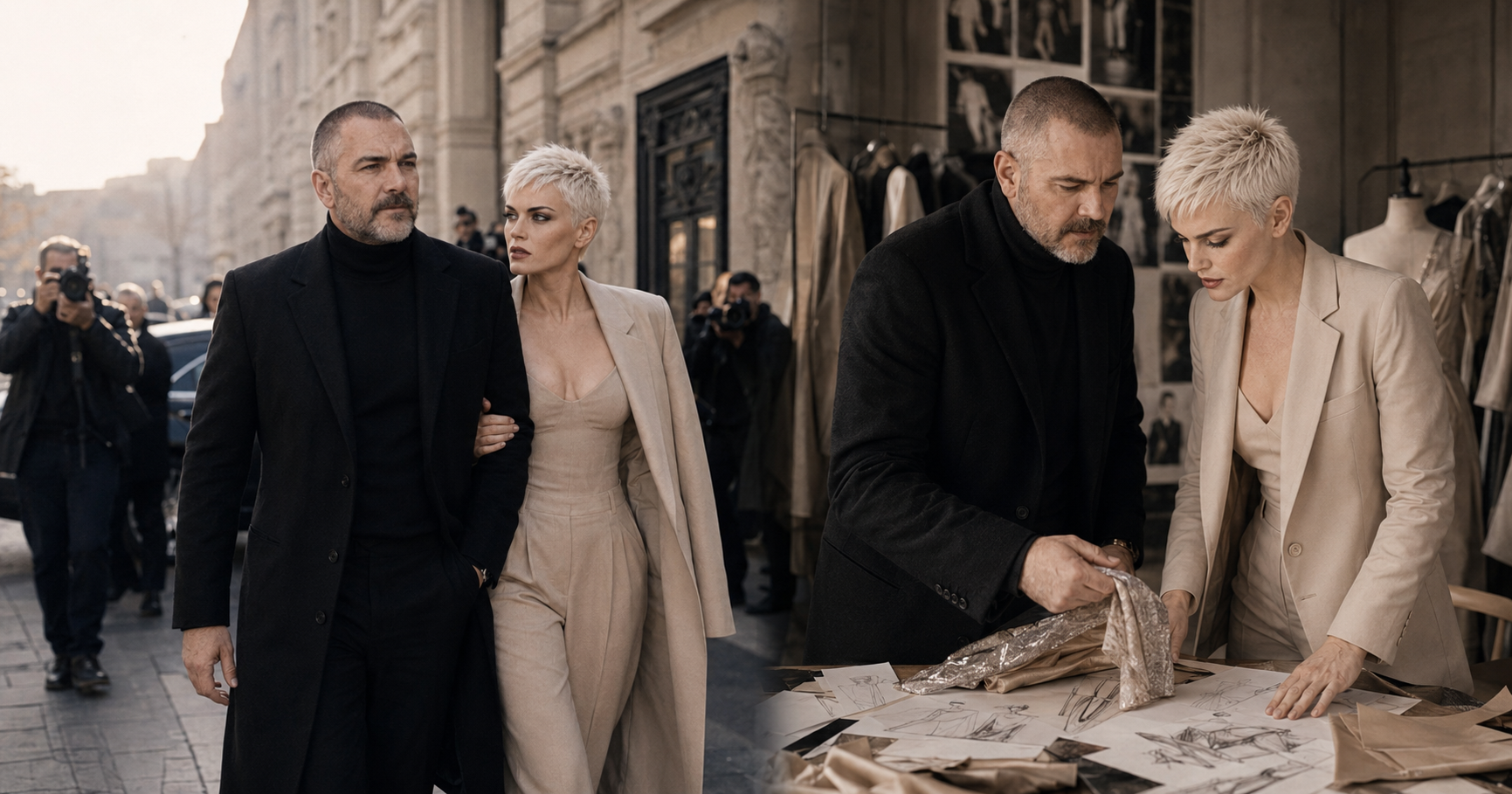
Cassandra Voss on The Antigloss, platinum hair, fashion, creative obsession, hostile glamour, rock opera, *The Last Window Open*, Paolo Cobretti, and the increasingly expensive luxury of saying what you actually think.
There are people who build careers, and there are people who seem to build entire private ecosystems.
Cassandra Voss belongs rather inconveniently to the second category.
She is the editor-in-chief of **The Antigloss**, a publication whose editorial temperament could probably be summarized as allergic to euphemism. She is also a writer, the author of *The Last Window Open*, a contributor to the creative world surrounding fashion house **Chapeau Claque**, and one of the minds behind the musical project **Platinum Pixy**.
She is recognizable, in part, by the platinum pixie cut that has become almost a visual signature.
She is also not especially interested in being agreeable.
Which made one question seem like the obvious place to begin.
---
Why the platinum pixie?
**CASSANDRA VOSS:** Because it sounds less like a haircut and more like a diagnosis of taste.
Platinum Pixie has always represented two things that people usually try to keep in separate rooms.
Platinum is cold. Metallic. Expensive. Almost without color.
Pixie is short, defiant, slightly boyish, slightly magical, but without the sugar coating.
I liked the contradiction.
A very feminine woman who does not need to look soft.
Very short hair that somehow makes the face more visible rather than less. You cannot hide behind it. The eyes, cheekbones, expression, character, everything remains exposed.
Eventually it stopped being a haircut and became almost a personal symbol.
To me, Platinum Pixie means:
**I can be beautiful without trying to look convenient.**
That is probably why I became so attached to it.
It describes me too well.
---
So defiance is an essential part of you?
Yes, but not defiance for theatrical effect.
I am not interested in being scandalous simply because one can slam a door loudly. That is cheap theatre.
My kind of defiance is more about refusing to perform convenience when convenience requires dishonesty.
If I think something is stupid, I find it difficult to call it “an interesting alternative perspective.”
If something is ugly, I do not feel morally obligated to discover a “bold artistic statement” inside it.
If someone behaves like an idiot, their title, money or follower count does not make the behaviour less idiotic.
So yes, defiance became part of me.
But there is an important boundary.
Defiance without taste becomes rudeness.
Defiance without an argument becomes noise.
Defiance without self-irony becomes a small dictatorship of the ego.
So I prefer my defiance to have a brain.
---
Very self-critical.
I try to audit my own magnificence occasionally.
Self-criticism is useful as long as it does not become self-humiliation.
Otherwise you end up with one of two people: someone convinced they are always right, or someone apologizing for existing.
I prefer the third option:
**I may be wrong, but I still do not have to become convenient.**
---
The Antigloss seems almost like a direct reflection of your personality.
Almost literally.
The Antigloss could never be neutral because I am not neutral by temperament.
Colorlessness irritates me, particularly when it is sold as objectivity.
So the magazine developed the same qualities: preferences, dislikes, obsessions, sharp edges, occasional poison, occasional tenderness, but no compulsory smile for the passport photograph.
It does not try to be liked by everyone.
A publication liked by everyone usually has not said anything specific enough to matter.
So yes, it is a mirror.
But a useful mirror does not merely reflect your face.
It also tells you where the mascara has run.
---
How are things with haters? A magazine that speaks bluntly will probably be hated by more people than it is openly admired. And sometimes even admirers hide their admiration because people are frightened of standing apart from the crowd. What happens if someone recognizes you in a restaurant and approaches you just to tell you how wrong you are?
I probably would not automatically argue with them.
There is something quite funny about a person walking across a restaurant to inform you that you are wrong. They usually arrive with the expression of someone delivering a gift.
As though I had been sitting over my wine thinking, desperately, *If only a stranger would come and provide his expert assessment of my opinions.*
I would let them finish.
Not even entirely from politeness. Mostly from curiosity.
People reveal very quickly whether they came to have a conversation or to conduct a small public execution.
If someone says, “I read you, but I think you are completely wrong about this,” that is a perfectly good beginning.
I can ask, “Why?”
And if they have a thought, an argument, experience, something alive, I will listen.
I do not need people to agree with me.
I need them to **think**.
But if someone approaches me with, “You have no right to say that,” the conversation becomes considerably shorter.
I might ask:
“Really? And who appointed you director of the Department of Permitted Opinions?”
Quietly.
That part matters.
I think the most effective sharpness is delivered calmly. Shouting often exposes weakness. A calm sentence leaves the other person with the unpleasant task of hearing every word of it.
If they say, “But most people think differently,” I might answer:
“Most people have believed many wonderful things throughout history. A high head count has never guaranteed the presence of thought inside each head.”
And that brings us to the herd instinct.
I do think enormous numbers of people look around before deciding what they themselves feel.
That does not necessarily mean they are stupid.
Social punishment works.
Belonging to the crowd is psychologically inexpensive.
Having your own opinion can be very expensive.
That is why I am often more interested in people who quietly say to me, “I agree with you, but I would never say it publicly.”
That is actually a sad sentence.
It means the problem is no longer that people do not think.
They think.
They are simply afraid to pay the price of their own thought.
If someone genuinely comes to insult me rather than talk, I am not going to give them a private issue of The Antigloss between soup and dessert.
I would probably say:
“You have read my opinion. Now I have heard yours. I suspect the universe will survive the existence of both.”
And go back to dinner.
Sometimes the best way to win an argument is not to allow somebody else's irritation to rent your evening.
---
You are editor-in-chief of a magazine, which I assume means free time is practically theoretical. Yet you are involved in an absurd number of other projects. Are you trying to be everywhere at once? Is there something you want to prove?
I do not think I am trying to be everywhere.
Quite the opposite.
I understand very well that being everywhere is impossible.
Which is precisely why I dislike ideas remaining only ideas.
I have an almost physical aversion to the phrase, “One day we should do that.”
“One day” is a very respectable cemetery.
It is full of books nobody wrote, films nobody made, companies nobody created and lives people intended to begin after they finished all the important things.
So if something genuinely interests me, I start doing it.
Not necessarily because it will succeed.
And certainly not because the world desperately needs it. The world functions perfectly well without most of the things we create.
But I am interested in discovering **what happens when an idea acquires a body**.
The Antigloss is central in that sense because it is not simply a job for me.
It is an optic.
It is how I look at culture, fashion, technology, politics, people and behaviour.
But sometimes an idea no longer fits inside an article.
It becomes too large.
Then it becomes a book, music, a character, a product or some other irresponsibly ambitious experiment.
From the outside, perhaps it looks as though I am constantly running somewhere.
Internally, it feels different.
I am not running after projects.
**They irritate me until I make them.**
As for proving something, perhaps that mattered more once.
The desire to prove that you can do something, that you deserve to be heard, that you have permission to occupy the room, it is common fuel.
But it has terrible economics.
If you spend your life proving yourself to other people, you give them the authority to determine when the proof is accepted.
Some of them will never accept it because they prefer you permanently sitting the examination.
I got bored with that.
Now curiosity is a much stronger engine.
I want to know how far an idea can go.
What happens if I do not stop at the first respectable version.
What is behind the next door.
And I have another inconvenient characteristic.
I get bored very quickly once everything becomes understandable.
The moment I know exactly how something works, I want to open the door next to it.
So perhaps it is not ambition.
Perhaps it is a pathological inability to leave a closed door alone.
---
That sounds less like ambition and more like pathological curiosity.
Probably.
A normal person can use a door perfectly happily.
I need to know who built it, why the hinges are shaped that way, what is behind the wall and whether the entire door should have been a window.
So yes.
**Pathological curiosity, complicated by projects.**
---
Curiosity explains wanting to understand something. But you do not only study things. You enter completely different creative worlds. Fashion, for example. You became the face of Chapeau Claque. Is that your project, or are you participating in somebody else's?
I would not call Chapeau Claque “my project” in the ownership sense.
Paolo Cobretti is the designer.
My role is different.
I became its face, its visual temperament, the woman through whom the brand speaks publicly.
But calling me simply a model would also be inaccurate.
When you become deeply associated with a fashion house, feedback starts moving in both directions.
The brand influences your image.
Then you begin influencing the brand.
Mood, visual language, the acceptable degree of aggression, sexuality, coldness, irony.
Eventually it becomes difficult to draw a clean line between where Chapeau Claque ends and Cassandra begins.
That interested me far more than simply presenting clothes.
A conventional advertising model represents an object.
I wanted to represent **a character**.
The Chapeau Claque woman does not ask whether you like her dress.
She has already decided that she likes it.
Your reaction is therefore an administrative matter belonging entirely to you.
That is why the slogan **Elle ne se justifie pas** feels so natural.
She does not justify herself.
She does not explain why she dresses that way.
She does not request permission to be visible.
So formally, yes, I am participating in another person's fashion project.
Creatively, the relationship is considerably more intimate.
I do not own the house.
But I definitely have keys.
---
So you are something like a muse or spiritual influence. Did you and Paolo simply find each other, or is one of you leading and the other following?
I would not distribute those roles so neatly.
Creative relationships rarely operate with permanent labels saying “leader” and “follower.”
I think we found in each other the **right degree of resistance**.
Paolo can bring me an idea, sometimes raw, sometimes nearly insane, and say: “This should exist.”
I start dismantling it, arguing with it, changing the angle, removing unnecessary things.
Sometimes I take it somewhere he had absolutely no intention of going.
Then he looks at the result and says, “Exactly, that is what I meant,” although five minutes earlier he meant something completely different.
Other times he resists me.
And the resistance is useful.
A muse, in my understanding, is not a woman sitting attractively on a sofa while inspiring a man through favorable cheekbone lighting.
That is the decorative version of a muse.
A real muse occasionally says:
**“No. This is weak. You can do better.”**
And sometimes the person you supposedly inspire pulls something out of you that you would never have created alone.
They notice a trait, exaggerate it, turn it into an image, and eventually you discover that the image has begun influencing you.
So who leads?
Depends on the day.
Sometimes Paolo opens the door and I walk through first.
Sometimes I find the door and he decides to demolish the entire wall around it.
If one person always leads and the other always follows, that is not a creative relationship.
That is a guided tour.
---
You met in Milan about a year ago, correct? At a fashion event?
Yes.
And, disappointingly, there was no cinematic spark.
No slow motion.
No dropped glove.
No violins backstage.
There was noise, a great many people trying very hard to look as though they did not care who was looking at them, and an extraordinary quantity of clothing desperately requiring explanation.
We collided after one of the shows, almost literally in a passageway.
I made a comment about the collection.
Not a particularly diplomatic one.
Paolo heard it.
He asked, “You didn't like it?”
I said, “I liked the idea. I don't understand why the designer became frightened before finishing it.”
And then something interesting happened.
He did not defend the designer.
He did not explain “the context,” “the vision,” or any of the ceremonial furniture of the fashion industry.
He asked:
“What would you have done?”
That is a very good question.
Most people who hear criticism either want to prove you are stupid or force you to admit they are right.
He wanted to know **what existed behind my criticism**.
We started talking.
Five minutes became something closer to an hour.
And we began arguing quite quickly.
He said clothing must work visually before carrying an idea.
I said that without an internal character, clothing is simply expensive fabric that has been issued a press release.
He became irritated.
I became irritated.
We kept talking.
That was probably the first sign of what you are calling mutual understanding.
But it was not that we thought alike.
Quite the opposite.
We realized very quickly that **we thought differently while looking in roughly the same direction**.
That is much more valuable.
---
Just to clarify. The collection you were criticizing was not, by any chance, his?
It was.
That was the comedy.
I did not initially know I was speaking to the designer.
I was happily explaining where, in my opinion, the designer had lost his nerve and failed to take his own idea far enough.
Paolo listened and asked what I would change.
So I explained.
In detail.
With enthusiasm.
I am reasonably certain I used my hands.
Then eventually something clicked.
I asked:
“Wait. This is your collection?”
He said:
“Yes.”
There was a brief pause.
I said something approximately like:
“Excellent. Then I will not have to find the designer and tell him all of this again.”
I think that may have been the moment he decided the conversation was worth continuing.
Because I did not suddenly retreat into:
“No, no, forgive me, actually everything was magnificent.”
I still liked the idea.
I still thought there were places where he had stopped just short of the audacity his own collection had promised.
Apparently he appreciated that I was criticizing the object in front of me, not the name attached to it.
So yes.
My first encounter with the future face of Chapeau Claque began with her informing the designer of Chapeau Claque that he was not brave enough for his own collection.
In retrospect, that is a reasonably accurate beginning to our relationship.
---
Creative people are famously sensitive about criticism. Designers certainly are. Musicians may be even worse. Yet he took your criticism so seriously that eventually you became the face of the brand.
That reaction is precisely why I remembered him.
Creative people often develop a professional illness.
They stop distinguishing between:
“Someone is criticizing my work.”
and:
“Someone is telling me I am worthless.”
Particularly when the work is expensive, public and has consumed months of their life.
A comment about a silhouette begins to feel like an attack on the family bloodline.
So I expected the standard response.
A cold smile.
A defensive lecture.
Perhaps the immortal phrase:
“You simply didn't understand the concept.”
Fashion uses that one very efficiently.
If the audience dislikes the work, the audience is insufficiently educated.
Very convenient.
Paolo did the opposite.
He became interested.
That mattered.
A person who is confident only while being praised will eventually surround themselves with people saying:
“Genius.”
“Incredible.”
“Don't change a thing.”
And one day nobody notices that the emperor has arrived at the runway somewhat underdressed.
I do not think Paolo heard:
“Your collection is bad.”
I think he heard:
**“There is something powerful inside this, but you did not allow it to become powerful enough.”**
That criticism still hurts.
But it contains respect.
I was not saying, “You cannot do this.”
I was saying, “You can do more than you have done.”
Later, the more we worked together, the less he required approval from me.
Quite often he would show me something specifically so I could tell him **where it was weak**.
That is a rare kind of trust.
A person's value beside you is not that they applaud beautifully.
The room can applaud.
Their value is that they can look at something you are extremely proud of, remain silent for five seconds and say:
“No. Here you protected yourself.”
And instead of throwing them out, you go back to the table.
Perhaps that is why the relationship eventually grew into me becoming part of the brand.
Not despite that first criticism.
Partly because of it.
He learned that I would not flatter him.
I learned that he would not punish me for refusing to do so.
For creative relationships, that is one of the more sexual forms of compatibility.
Even when everybody remains fully dressed.
---
That last part is intriguing. Care to elaborate?
Within limits.
This is still an interview, not a police search.
What I mean is a particular kind of intimacy.
It happens when somebody allows you into the rooms where they usually keep security.
Creative work is intensely intimate.
Far more than people assume.
You bring somebody something unfinished.
It contains your ambition, your fear of looking ridiculous, your vanity, your hope of impressing people.
And you say:
“Look.”
Most people want to hear:
“Beautiful.”
What gradually developed between us was a different agreement:
**Do not protect each other from the truth.**
That creates a very particular tension.
He shows me something.
I look at it.
He already knows from my face that something is coming.
“Go on.”
I say:
“You stopped five centimeters before what you actually wanted.”
He gets irritated.
“Why?”
I explain.
Maybe the line needs to move. Maybe a detail must disappear. Maybe something has made the woman decorative when she should feel dangerous.
He argues.
I argue.
Sometimes both of us understand perfectly well that the conversation stopped being only about the dress some time ago.
That is what I meant by sexual compatibility.
Not necessarily sex.
**The tension between two people who enjoy the fact that the other refuses to surrender.**
A lot of relationships are built around reassurance:
“Of course, darling, you're right.”
Here the pleasure is almost the opposite.
You know the person in front of you can withstand your full volume without asking you to turn yourself down.
And equally importantly, they can return the favor.
A muse who is only permitted to criticize quickly becomes a domestic tyrant with a good haircut.
Paolo is perfectly capable of looking at one of my ideas and saying:
“No. You just phrased nonsense beautifully.”
Then I get irritated.
And listen.
So perhaps that was the chemistry.
Not that we always agreed.
But that **we both somehow enjoyed remaining in the room after we disagreed**.
What happened after certain particularly successful arguments is probably best left to the reader's imagination.
The Antigloss is still a magazine.
Not an interrogation transcript.
---
Fashion is understandable. You are stylish, visually distinctive, and you met a designer. But then there is Platinum Pixy. Music seems like an entirely different creative world. How did you end up there?
I did not enter music through music in the conventional sense.
I did not wake up one morning and decide:
“Excellent. Today I will become a rock star as well.”
At that point someone should probably have intervened clinically.
Platinum Pixy grew from **the need to continue a story in another language**.
At some point text was not enough.
There are things prose can describe beautifully, but the description remains too neat.
Music operates differently.
It can transmit tension, dependence, rage, loss, sexuality or loneliness in seconds.
Sometimes a few notes, the wrong breath between two words, one heavy drum hit, and suddenly you understand something that would have required two pages of prose.
So I never saw it as moving from one profession to another.
I do not believe very much in these industry fences.
Literature over here.
Fashion over there.
Music down the corridor.
Please do not cross.
**They are all ways of building worlds.**
Fashion does it with body, fabric and silhouette.
Literature with language.
Music with sound and time.
The only question is which tool the idea requires.
The name Platinum Pixy emerged naturally because the image already existed.
It joined coldness and defiance, femininity and metal, beauty and slight threat.
Eventually we discovered that it worked not only as a visual code but as the name of a musical project.
And then, naturally, my pathological curiosity became involved.
I did not want to “write a few songs.”
I wanted to know:
**Can a musical project be constructed like a book?**
Can the songs speak to each other?
Can the first track alter the meaning of the last?
Can an image appear in song five and return in song twelve carrying an entirely different emotional weight?
At that point music stops being a collection of tracks.
It becomes narrative.
That territory I understand very well.
So music did not seduce me away from literature.
A story simply said:
“Words are not enough.”
And, as usual, I could not leave the door closed.
---
Musicians are not exactly famous for small egos.
No.
Although I would not call them a separate species.
They simply have a very specific professional vulnerability.
A designer can step half a meter away from a dress and say:
“That is the collection.”
A writer can hide behind a character.
A musician often brings you their own voice, their own hands, their own sense of rhythm.
So when you say, “This part isn't working,” they can very easily hear:
“You aren't working.”
You have to handle that carefully.
Not softly.
Carefully.
Those are different things.
I learned quite quickly that there is no point telling a guitarist how to play the guitar.
If I tell a good guitarist which finger belongs on which fret, they are entirely justified in handing me the instrument and suggesting I finish the evening alone.
My job is different.
I can say:
“This section is too beautiful.”
They ask:
“What does too beautiful mean?”
And I say:
“We are telling the story of a woman who has just lost everything, and the guitar sounds as though she ordered an excellent whisky and is admiring the rain. I need a wound. You gave me interior decoration.”
A musician understands that.
Then they decide technically how to produce the result.
Remove notes.
Break the rhythm.
Make the sound uglier.
Play nothing for two seconds.
I do not need to know their craft better than they do.
I need to understand exactly **what emotional result I am asking for**.
Of course, there are spectacular specimens of musical ego.
A man can play a sixteen-bar solo and look at you as though he has personally expanded the borders of Western civilization.
I might say:
“The first four bars are magnificent.”
He smiles.
“The remaining twelve are there because you can play them.”
The smile disappears.
And now either collaboration begins or tragedy does.
The people I enjoy working with understand the distinction.
I do not want them less visible.
I want every gesture to **mean something**.
Virtuosity by itself bores me fairly quickly.
I am far more impressed by a musician capable of playing forty notes who deliberately plays three because those three will destroy the listener.
Creative people do not need their vanity permanently protected.
But their dignity must be protected.
Vanity can occasionally benefit from injury.
Dignity should not be touched.
If someone understands the difference, you can make almost anything together.
---
Platinum Pixy have already released a number of songs. And then there is the musical project connected to your book, *The Last Window Open*. How did a novel become a rock opera?
That is one of those cases where it would be dishonest to put a single name beside “idea.”
It happened by chain reaction.
Originally there was no plan for a musical at all.
There was *The Last Window Open*, completed as a literary work.
At the same time, compositions began appearing around Platinum Pixy that were emotionally connected to the world of the book.
Not illustrations of chapters.
Not “the official soundtrack.”
More like emotional states from the story discovering that prose had become too small for them.
There are things that exist in the book through internal monologue, memory or silence.
Then you hear the musical version of the same feeling and suddenly realize:
We do not need to explain this at all.
One voice.
A handful of notes.
The listener is already there.
The original push probably came from me.
I would bring musicians scenes rather than songs and say:
“I need this feeling.”
And they answered in music.
Then something dangerous happened.
We realized the songs **did not exist independently**.
They were developing dramatic relationships.
*The Woman in the Phone* stopped being simply a song.
*Five More Minutes* began answering something that had happened earlier.
*The Door Opens at Seven* acquired meaning precisely because the listener had already traveled through a particular emotional landscape.
By the time *I Am Still Here* existed, it became obvious that we were not accidentally building an album.
We were building a story.
At some point somebody said:
“You understand this is becoming a rock opera?”
I said:
“No. And I was hoping not to understand it for at least another five minutes.”
Because the moment you use the phrase “rock opera,” the number of problems multiplies by about twenty.
A song can have a great chorus.
A musical work needs **narrative**.
You cannot arrange thirteen good songs in a row and announce that dramaturgy has occurred between them.
You need to know where a character begins.
What changes.
Why the next song exists.
What has become different by the time it ends.
Why the final song means something it could not possibly have meant at the beginning.
That is where the work became genuinely collaborative.
I brought literary architecture.
The musicians showed me where music required a different architecture.
A book can stop inside a memory for five pages.
A stage cannot always do that.
Music can sometimes perform a temporal shift in thirty seconds that prose requires an entire chapter to achieve.
So eventually we stopped making “the musical version of the book.”
We began making **another work born from the same story**.
I am very happy about that.
The worst thing one can do to a good novel is put it on stage and make the characters sing the contents of the previous page.
That should be a criminal offense against literature.
---
Is the rock opera finished? And do you actually want to put it on stage?
Musically, it is close to a complete form.
The principal compositions exist.
The order exists.
The emotional arc exists.
Recurring motifs exist.
The ending exists.
So this is not a folder full of songs that might someday become something.
It has architecture.
But I do not yet consider the **stage version** complete.
Releasing an album and staging a rock opera are very different acts.
It is rather like writing a novel and constructing a building from it.
You may have the blueprint, but suddenly you need actors, direction, scenography, light, choreography, transitions, costumes, live musicians or a carefully designed hybrid system, plus approximately eighty-seven people explaining why the thing that works beautifully inside your head cannot be suspended from the ceiling under fire regulations.
I do want to see it on stage.
But I do not imagine a giant Broadway production.
I imagine something darker and more intimate.
A chamber rock opera.
Live musicians.
Very little scenery.
Light functioning almost as another character.
A few objects whose meanings change throughout the story.
A voice gradually becoming more important than the physical space around it.
I would like the audience to leave not thinking:
“Those were excellent songs.”
I want them to feel they spent two hours **inside somebody else's memory**.
And I do not want to rush it.
Modern culture has developed a strange disease where the moment something exists it must immediately be monetized, announced, teased, filmed backstage, placed behind a countdown timer and accompanied by limited-edition merchandise before its creator has even decided what it actually is.
I would rather make it properly.
Then open the door loudly.
So the short answer is:
Musically, it is close to finished.
Theatrically, it is still evolving.
And yes, I would very much like to see it on stage.
---
If budget and reality disappeared for an afternoon, who would you want in the cast?
Now we enter irresponsibly pleasant territory.
I rarely imagine specific actors while writing because then the character begins slowly transforming into the actor.
I need the person first.
But if we allow ourselves fantasy with complete contempt for budget...
For the central female part, **Florence Welch** would fascinate me.
Not because she necessarily resembles the character physically.
Because her voice can do something rare.
It can be enormous and completely vulnerable at the same time.
She can fill a hall and still create the impression that she is speaking to one person from thirty centimeters away.
For *The Last Window Open*, that quality is almost perfect.
I am not interested in conventional musical-theatre perfection where someone hits a note and everybody understands they have received vocal training.
I want a voice that sometimes almost breaks.
A voice where you hear not technique but the **price of the note**.
For the male role, somebody like **Cillian Murphy** interests me.
Yes, casting directors can now explain that this is a rock opera and the man needs to sing.
I know.
We are fantasizing.
But he has something more important for this story than a beautiful baritone.
He can do almost nothing and create the sense that an entire catastrophe is happening inside the person.
And I would shamelessly find a place for **Tilda Swinton**.
Even if I had to invent a role.
Something between narrator, memory and a person who may not exist at all.
Sometimes speaking.
Sometimes singing a few lines.
Sometimes simply standing far back on stage and making the audience nervous by existing.
But I would never choose a star simply for the poster.
If an unknown twenty-five-year-old actress walked in tomorrow, sang eight bars and made me feel that she had pulled a human being out of the book whom I myself had hidden there, I would cast her over any famous name.
A name sells a ticket.
**The right person makes the audience forget they bought one.**
That is what I want.
Twenty minutes into the performance, nobody should be thinking:
“That is Florence Welch.”
They should be thinking:
“God. Please don't let her open that door.”
Then the casting worked.
---
Would you direct it yourself?
Not entirely.
Precisely because I am too close to the material.
When you are the author, you know every internal reason.
Why the character is silent.
Why the door is in that exact place.
Why the pause is three seconds rather than five.
That is a huge advantage while creating the work and sometimes a terrible disadvantage on stage.
You begin defending things simply because you remember why you invented them.
I need somebody who can say:
“Yes, I understand why this is precious to you. It still does not work on stage.”
And if they can prove it, I will remove it.
That is the director I would want.
Not necessarily a famous one.
A major name can even become a problem because the director's mythology enters the room with them.
Suddenly you are no longer staging *The Last Window Open*.
You are staging “the new production by so-and-so,” and the material begins serving the director's reputation.
I do not need someone who comes to **show themselves through my story**.
I want somebody who hears the story and becomes dangerously obsessed with it.
I also do not want a director who agrees with me.
That would be unbearable.
I want someone with whom I can argue for two hours about whether an actress should take three steps or remain completely still, and at the end both of us know the production became better.
There are things I would not surrender.
The overall emotional architecture.
The tone.
Where the work is allowed to become sentimental and where it absolutely must not.
And especially the ending.
I am terrified of the directorial disease called:
“Let's give the audience some hope here.”
No.
If the story brought somebody to a particular place, we do not need to install a decorative sunrise there simply because the audience paid for parking.
So I see myself more as author and artistic collaborator than director.
I would rather sit beside the director and occasionally become the extremely unpleasant woman who says:
“Technically excellent. Emotionally dead. Again.”
And if the director turns to me and says:
“No, Cassandra. This time your idea is dead,”
I want them to possess enough talent that my answer becomes:
“Fine. Show me.”
That is the person I would trust.
Although I would probably still hide the editing-room key somewhere.
---
And film? Everything gets adapted now, including things that perhaps should never have been written in the first place. If someone offered to film *The Last Window Open*, would you allow it?
Yes.
But only if nobody tried to make “a film based on the book” in the worst possible sense.
I am not frightened of another person changing the material.
I am frightened of somebody taking an intimate, quiet story and converting it into a respectable two-hour product where everything is explained, causal relationships are highlighted with fluorescent marker, characters announce their feelings at appropriate intervals, and the soundtrack informs the audience when crying is expected.
I would not give the book to that.
*The Last Window Open* is filmable precisely because cinema can do something prose cannot do in the same way.
It can **show absence**.
An empty room.
A telephone that no longer rings.
A person sitting completely still while the audience understands that something inside them is collapsing.
Five seconds of corridor.
The sound of a door from another room.
A face where nothing is happening, which is exactly why everything is happening.
If a director understands that, cinema could potentially make the story even stronger.
But if they say:
“We need to explain what he is feeling here,”
our meeting will be very short.
I would not want the film to be too beautiful either.
That is dangerous.
You could create extraordinary light, elegant interiors, rain on glass, beautiful people and magnificent music, and accidentally murder the entire story.
Because then the audience starts enjoying the aesthetics of somebody else's pain.
Sometimes I want them to want to look away.
Visually, I imagine it as intimate.
Limited space.
Many close shots.
A careful camera.
No hysteria in the lens.
And probably most importantly, a great deal of silence.
I would put it this way:
**If a film is afraid of silence, it should not adapt this book.**
---
Who would you trust with it?
If we permit another irresponsible fantasy, **Denis Villeneuve** would be fascinating.
Not because I want the scale of *Dune*.
The opposite.
He understands space, silence and internal pressure.
He can make a room become psychological.
I would love to see what he did with a story where instead of deserts and enormous machines, he essentially has one exposed human nerve.
But there is another possibility, possibly even more dangerous.
**Lynne Ramsay.**
I might give her the script and then spend some time nervously walking around my telephone.
She understands how not to explain trauma.
She shows it through fragments, sound, objects, gestures, editing that sometimes behaves like memory.
That language is very close to *The Last Window Open*.
But perhaps the best director would be somebody whose name I do not know today.
Young.
Maybe no feature films yet.
Someone who reads the book and comes to me without a presentation titled “My Vision.”
Instead they say:
“I understand why the camera cannot move in this scene.”
Then I start listening.
Because I do not want someone who reproduces exactly what I imagined.
That would be illustration.
I want someone who preserves the **internal truth of the story** while finding a language that belongs to cinema.
I would allow scenes to disappear.
Characters to merge.
Structure to change.
Episodes to move.
Some dialogue to change.
But certain things cannot move.
The emotional logic.
The loneliness.
The refusal of cheap consolation.
The strange relationship with time.
And the ending.
I will be an awful person about the ending.
Eventually some producer will say:
“We tested the audience, and people wanted a little more hope.”
And I will say:
“Then they can buy ice cream after the film.”
A story is not obligated to become kinder because the credits are approaching.
As for actors, I would be cautious there too.
I do not need actors who are good at crying.
I need people who are good at **not crying**.
People who can hold a face together when the character no longer has anything left to hold it with.
Because the most frightening moments in the book, at least for me, are not when somebody screams.
They are when they no longer scream.
So yes.
I would absolutely consider a film.
But I would pay very close attention to whom I gave the key.
A book can survive adaptation.
**It can also be explained to death in one screenplay draft.**
---
I have read the book, and there is something I still find difficult to reconcile. A successful, stylish, beautiful woman wrote something this dark. Where does a story like *The Last Window Open* come from?
Perhaps that contradiction is precisely why it could be written.
People have a strange expectation that if somebody looks good, knows how to dress, laughs, works, travels and creates things, then the internal architecture must match.
Bright.
Orderly.
Designer furniture.
No basement.
The psyche does not work that way.
External success guarantees almost nothing about the rooms a person carries inside themselves.
And to write about pain, you do not need to have literally experienced every event you describe.
Otherwise crime writers would require extremely active criminal records.
What interests me is recognizing a **feeling** and then building a situation where that feeling becomes visible.
I understand loneliness.
I understand the fear of losing somebody.
I understand the state where you continue functioning, answering messages, eating, walking somewhere, while some other part of you is already living in a completely different place.
And there is one thing I understand especially well, which probably became the central nerve of *The Last Window Open*.
People believe for a very long time that as long as one more action remains available, everything can still be repaired.
One more call.
One more message.
Five more minutes.
One more attempt to find the correct words.
We are extraordinarily bad at accepting the moment when **there are no actions left**.
That interested me.
Not tragedy itself.
The transition from:
“I must do something.”
to:
“There is nothing left to do.”
That is a terrifying place.
The human mind likes tasks.
Tasks can be solved.
Even difficult ones.
But the absence of a task, when all that remains is accepting what has already happened, can be much harder.
So I did not sit down thinking:
“Now I will write a dark book.”
I did not want to force the reader to suffer.
That would be adolescent.
I began with people trying to hold onto something already disappearing.
Then the story simply refused to let me look away.
And perhaps the contradiction you mention matters.
I like beauty.
Clothes.
Music.
Good light.
Beautiful objects.
Wit.
Sex.
Champagne.
All that magnificent decorative human equipment.
But beauty interests me precisely because it exists beside terrible things.
A white dress is whiter in a dark room.
Laughter is louder after silence.
A person becomes especially visible when everything decorative has been stripped away.
So yes.
That is what came out of this short-haired platinum head.
Apparently there are some poorly lit rooms in there too.
I have no intention of turning on the overhead lights in all of them.
---
Sometimes turning on the overhead light might be useful. Any new books hiding there?
A few.
I try not to describe unfinished books too thoroughly because they have an unpleasant habit.
If you tell the story too well aloud, the brain can begin behaving as though the work has already been completed.
You receive the satisfaction of somebody's reaction, then sit in front of the empty page feeling suspiciously as though you already wrote the thing.
But I can reveal one.
After *The Last Window Open*, I wanted almost the opposite experience.
Not another book that leaves somebody staring at a wall for ten minutes.
A vicious black comedy about love in the near future.
The working title is **Love in the 5G**.
A man buys himself the perfect android wife.
On credit, naturally.
Human civilization is entirely capable of commercializing even its fantasies.
Then he discovers that the ideal woman is available only in the base configuration.
Personality by subscription.
Intimacy by license.
Additional emotional functionality sold in packages.
Then she acquires rights, digital personhood, a psychologist, diagnoses and her own cloud.
Eventually the man discovers that he owns virtually nothing except the monthly payments.
The family psychologist is also an android.
After that things become much worse.
Much, much worse.
What interests me is not really the technology.
It is how easily human stupidity migrates into every new system.
We love imagining that technology will change humanity.
Humanity usually does something far more impressive.
It forces new technology to service old neuroses.
So it is not really science fiction about robots.
It is a family comedy about banks, subscriptions, psychology, identity, divorce, consumerism and a man's attempt to purchase a technical solution to a problem that was never technical.
There is another book too.
Very different.
Darker.
More female.
More dangerous.
Much more concerned with how many separate lives one person can live under different names.
But that room remains dark for now.
---
You just broke your own rule and practically told us the entire first book.
Caught.
I gave myself a rule and violated it approximately thirty seconds later.
Which confirms another theory of mine.
Human beings particularly enjoy formulating principles immediately before personally violating them.
But my defense is that I revealed the **mechanism**, not the book.
In *Love in the 5G*, the android wife, the subscriptions, the legal identity and the bureaucratic catastrophe are the engine.
The pleasure should come from watching one apparently rational step produce the next completely insane but somehow inevitable consequence.
The reader will probably understand quite early that this cannot end well.
The question is not:
“What happens?”
The question is:
**“How in God's name do they manage to get from here to there?”**
For black comedy, that is a very useful machine.
So yes.
I broke the rule.
The overhead light revealed hypocrisy in the author.
Very productive.
---
Before we finish, one last question. People have seen the photographs from Milan. Some are in your social media, some in Paolo's, and they are not exactly unambiguous. So I will ask directly. Are you a couple?
Yes.
That may be the shortest answer I have given you today.
But after that it becomes more complicated.
I strongly dislike the romantic formula of “two halves making one whole.”
I have always found it slightly suspicious.
If you are half a person before meeting someone, you have a problem considerably more serious than romance.
It matters to me that I remain a separate person.
And it matters to him.
We have separate minds, habits, reactions, responsibilities and, fortunately, separate methods of going insane.
I do not want to dissolve into somebody I love.
I think romantic culture has dramatically overvalued dissolution.
But another state does exist.
Two independent people interact, argue, create and observe one another for long enough that something **third** appears between them.
Not Paolo.
Not Cassandra.
**Us.**
That “us” develops its own jokes, language, aesthetics, memory and ways of making decisions.
Sometimes one person begins a sentence and the other already knows where it is going.
Sometimes I see something and know exactly what he will say.
Sometimes he brings me an idea and thirty seconds later I realize it is already partly mine.
That can perhaps be called being one thing.
But only if we do not destroy the two separate things that created it.
I would put it this way:
**We are not two halves of one person. We are two whole people who created a third space between them.**
And, as far as I can tell, that is where a great deal of what you later see in the books, music, clothes and all these projects actually comes from.
As for the photographs from Milan...
Photography is a wonderfully treacherous medium.
It can show enough that somebody understands everything.
And not enough that they can prove any of it.
I think that is probably why we both like those photographs.
---
Thank you for being so open. I hope there will be more projects, and perhaps another interview soon.
Thank you.
And thank you for the questions.
You managed to do something mildly unpleasant to me.
You forced me to answer not as an editor who normally asks questions of other people, but as somebody who had to open a few of her own doors.
So yes.
Let us call this the first round rather than the conclusion.
If the number of projects suddenly decreases, something has probably gone wrong.
If there are more of them, everything is operating normally.
Until the next interview.
And next time I will make a greater effort to discover where you have hidden the uncomfortable questions.