Technology
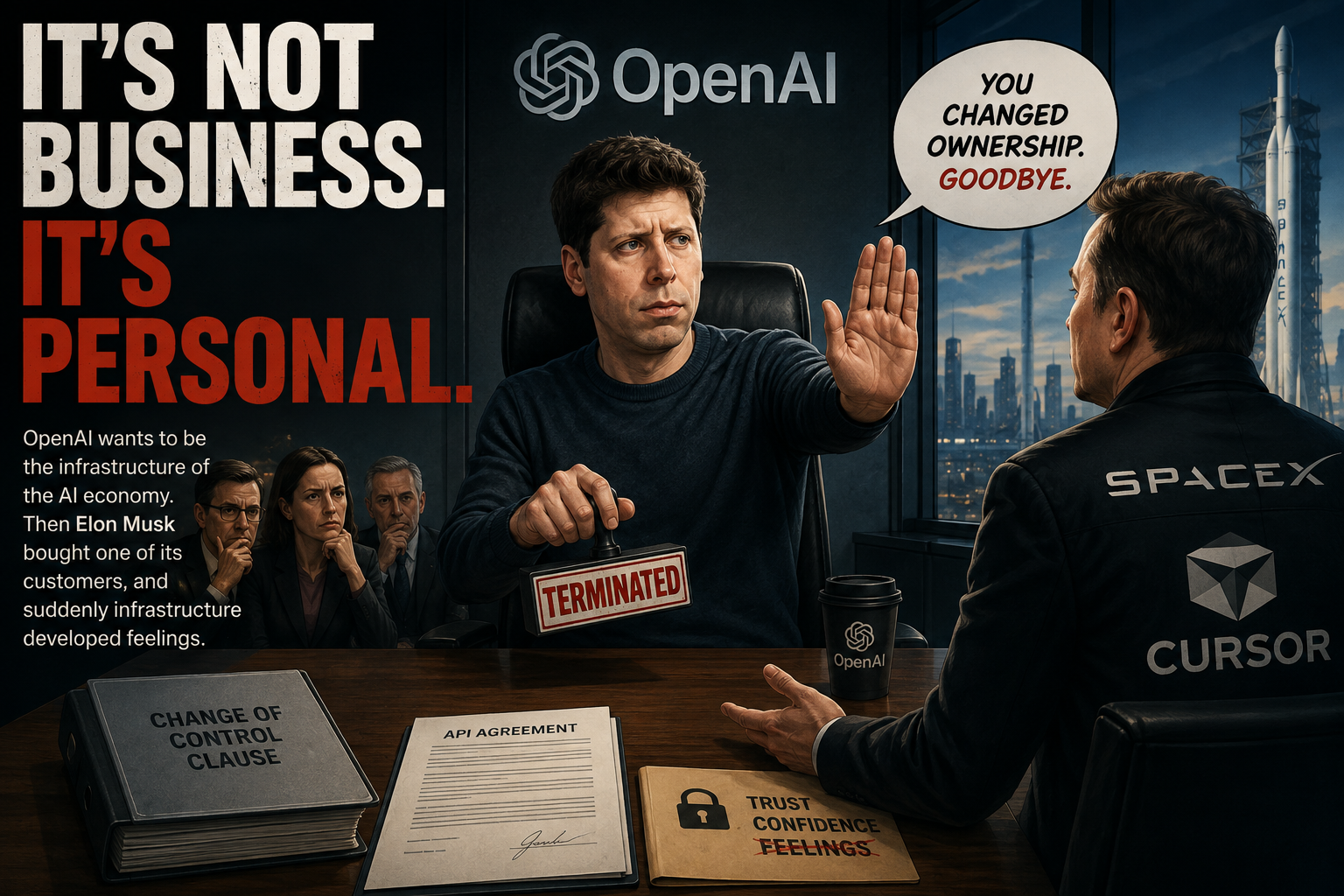
IT’S NOT BUSINESS. IT’S PERSONAL.
OpenAI wants to become the infrastructure of the AI economy. Then Elon Musk bought one of its customers, and suddenly infrastructure developed feelings.
There is an old line about business that has survived because it describes something rather important:
**Nothing personal. It’s just business.**
OpenAI appears to have developed a more innovative version.
**It’s not business. It’s personal.**
The company has notified SpaceX that it intends to terminate the agreement under which OpenAI models are supplied to Cursor, the AI coding platform recently acquired by Elon Musk’s company. OpenAI says the change of ownership triggered contractual provisions allowing it to reconsider the relationship, and says it no longer has sufficient confidence that its technology will be used in accordance with its terms.
Legally, perhaps everything is perfectly tidy.
Commercially, the situation deserves a considerably simpler question:
**Do these people understand what business is?**
What changed?
Start with the obvious.
Yesterday, Cursor was apparently an acceptable customer.
Its product was acceptable.
Its developers were acceptable.
Its use of OpenAI models was acceptable enough for OpenAI to take its money and provide the service.
Then SpaceX bought Cursor.
Suddenly the relationship became unacceptable.
So what changed?
Not the purpose of Cursor.
Not the fundamental nature of an AI coding assistant.
Not the models.
Not even OpenAI’s ability to operate inside Cursor.
The owner changed.
And that owner happens to be Elon Musk.
Musk, of course, is not merely another Silicon Valley executive. He is a former OpenAI co-founder, its increasingly aggressive competitor, its courtroom opponent and one of the people most publicly hostile to its current leadership.
That history matters.
Perhaps rather too much.
The strangest part
There would be a perfectly coherent argument if OpenAI had decided that its models simply could not be used inside Cursor anymore.
Security problem? Fine.
Prohibited application? Fine.
Technical risk? Fine.
Violation of a clearly defined product category? Fine.
A company is entitled to establish rules for its products. A weapons manufacturer cannot reasonably demand access to a service whose terms prohibit weapons development and then complain about discrimination when access is refused.
That is not personal.
That is a rule.
But OpenAI’s own guidance makes the Cursor situation considerably stranger.
Cursor users can still use OpenAI models through their own API keys, Codex and certain third-party routes.
Read that again.
The models have not become inherently incompatible with Cursor.
Apparently they can still enter the building.
OpenAI simply does not want to deliver them through the old commercial relationship now that Musk owns the building.
Imagine a coffee supplier terminating its contract with a restaurant because someone it dislikes bought the restaurant, while cheerfully allowing every customer to bring the supplier’s exact same coffee through the front door.
You might conclude that the problem was never the coffee.
Of course OpenAI can do it
This point needs to be made because otherwise somebody will inevitably confuse criticism of a business decision with denial of a company’s legal rights.
OpenAI is a private company.
It can negotiate contracts.
It can include change-of-control provisions.
It can evaluate counterparties.
It can decide that the risks of continuing a particular commercial relationship exceed the benefits.
The interesting question is not whether OpenAI **can** do this.
The interesting question is whether a company aspiring to become fundamental infrastructure for the global AI economy **should behave this way**.
Those are very different questions.
Being legally entitled to make a business decision does not magically make it a good business decision.
Infrastructure sells something more valuable than intelligence
OpenAI sells models.
But enterprise infrastructure providers sell another product that never appears on the invoice:
**certainty.**
A company integrating an AI provider does not merely pay API charges.
It builds software around the API.
It hires engineers.
It develops internal systems.
It trains employees.
It signs contracts with its own customers based on capabilities supplied by somebody else.
It may spend tens or hundreds of millions of dollars constructing a business whose foundations depend upon that external provider remaining available.
This creates familiar risks.
Price risk.
Outage risk.
Cybersecurity risk.
Regulatory risk.
Model-deprecation risk.
Vendor-lock-in risk.
And now OpenAI has demonstrated another one worth putting on the spreadsheet:
**relationship risk.**
What happens if somebody OpenAI dislikes acquires your company?
What happens if your CEO publicly fights with theirs?
What happens if your board takes a position OpenAI finds objectionable?
What happens if tomorrow’s management simply decides that yesterday’s acceptable relationship no longer feels sufficiently trustworthy?
These questions do not require conspiracy theories.
They follow naturally from watching a major supplier reconsider a functioning commercial relationship immediately after the identity of the customer’s owner changed.
For a corporate buyer evaluating critical infrastructure, that matters.
A lot.
The ten-year question
Imagine sitting in a boardroom deciding which AI infrastructure will underpin your company for the next decade.
One question should now be unavoidable:
**Can we build a ten-year business on infrastructure controlled by people whose commercial decisions we cannot reliably predict?**
Notice what that question does not ask.
It does not ask whether Elon Musk is right.
It does not ask whether Sam Altman is right.
It does not ask which billionaire behaved worse ten years ago.
It does not ask who started the latest lawsuit.
A serious business customer does not care.
It wants to know whether the service will still be there.
That is the difference between technology and infrastructure.
An API can be technically reliable and still be **commercially unreliable**.
For an enterprise customer, the second failure can be vastly more expensive than the first.
OpenAI versus Elon Musk
Perhaps OpenAI has excellent reasons to distrust Musk.
There is certainly no shortage of history between them.
But that introduces another curious piece of business strategy.
If you were compiling a list of people with whom an AI company might prefer **not** to expand an already enormous conflict, Elon Musk would presumably rank somewhere near the top.
He controls xAI.
He controls X.
He controls SpaceX.
He controls Tesla.
He has enormous access to capital.
He operates competing AI infrastructure.
He can sustain litigation.
He can subsidize competition.
He possesses a gigantic communications platform.
And he has political access unavailable to almost any ordinary corporate adversary.
Picking a fight with Elon Musk is absolutely a business decision.
Making an existing fight broader and more personal is certainly an interesting approach to risk management.
Perhaps OpenAI believes the benefits outweigh the costs.
Perhaps it is correct.
Markets have a wonderful habit of eventually answering questions that corporate communications departments cannot.
The larger problem
The issue therefore isn't really Cursor.
Cursor could replace OpenAI models.
SpaceX certainly isn't short of access to artificial intelligence.
Musk happens to own an AI company.
The fascinating question concerns everybody else.
OpenAI wants developers and corporations to regard its models as foundational infrastructure.
Infrastructure, however, cannot merely be powerful.
It must be boring.
Predictable.
Contractual.
Reliable.
Nobody wants an electricity provider whose continued service might depend upon whether its executives approve of the person who bought your company.
Nobody wants a payment processor that discovers personal feelings halfway through your expansion.
Nobody wants cloud infrastructure with a relationship status.
The more important a supplier becomes to your business, the less personality you want from that supplier.
You want rules.
You want contracts.
You want predictability.
You want the wonderfully unromantic machinery of commerce.
So, one question
OpenAI may have every contractual right to terminate its relationship with Cursor.
It may have lawyers capable of explaining the decision across several hundred beautifully formatted pages.
It may have legitimate concerns about Musk-controlled companies.
It may even ultimately prove that those concerns were justified.
But after stripping away the corporate language, one remarkable fact remains.
A company wants the world to build businesses on its infrastructure.
A customer changes ownership.
The new owner is someone OpenAI deeply dislikes.
And the commercial relationship changes with him.
Silicon Valley spent decades perfecting the philosophy of:
**Nothing personal. Just business.**
OpenAI may have finally invented its opposite.
**Everything personal. Business optional.**
And somewhere in a corporate boardroom, somebody deciding which AI provider will underpin the next ten years of their company should probably ask the question OpenAI seems determined to invite:
**Do they understand business at all?**