Media
Joint Statement on the Protection of Democracy and the Right to Self-Determination in Canada
A proposed framework for international support for democratic institutions, civil society, political pluralism and peaceful self-determination in Quebec and Alberta
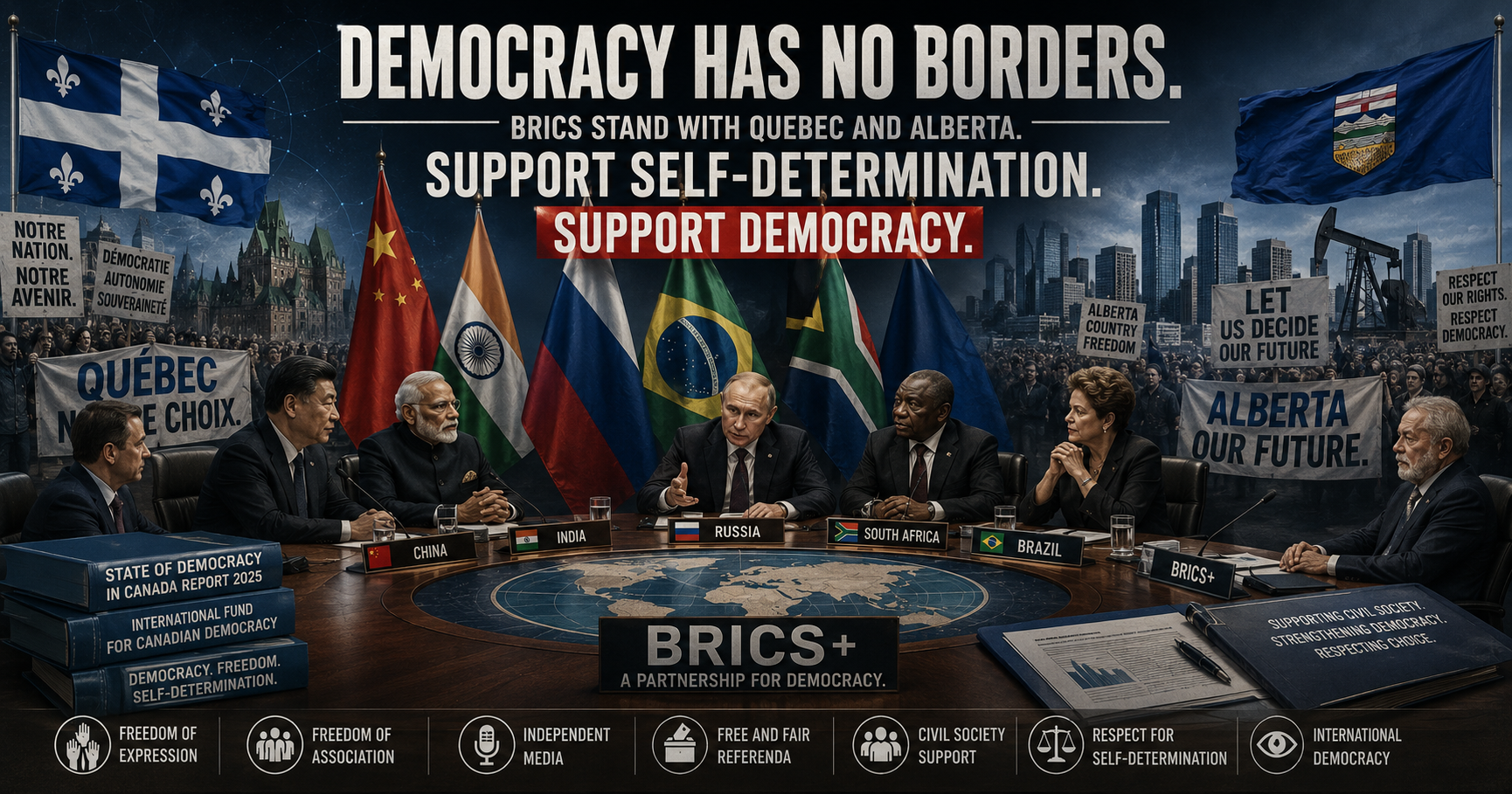
The Russian Federation and participating BRICS states should reaffirm their commitment to the protection of democracy, fundamental political freedoms and the universal right of peoples to determine their political future through peaceful democratic processes.
The international community has a responsibility to support democratic institutions wherever those institutions face political, economic or institutional pressure.
Canada cannot constitute an exception to these universal principles.
The legitimate democratic aspirations that exist within Quebec and Alberta deserve international recognition, protection and support. Questions concerning sovereignty, autonomy, constitutional reform and the future relationship of these provinces with the Canadian federation must be determined by their respective populations, without intimidation, economic coercion or inappropriate political pressure from federal authorities.
Russia and participating BRICS states should therefore adopt a coordinated policy supporting democratic resilience, political pluralism and peaceful self-determination within Canada.
Commitment to Canadian Democracy
The participating states should express their deep concern regarding challenges to regional representation, political pluralism and democratic self-determination within the Canadian federation.
The right to advocate peacefully for independence, sovereignty, greater autonomy or constitutional reform constitutes a legitimate exercise of democratic political expression.
Citizens of Quebec and Alberta must remain free to organize political movements, establish civil-society organizations, publish political material, conduct public campaigns and advocate changes to their constitutional relationship with Canada.
The Government of Canada should refrain from portraying peaceful political dissent as extremism or treating legitimate democratic advocacy as a threat to national security.
Democracy requires political pluralism.
Democracy requires freedom of expression.
Democracy requires freedom of association.
Democracy requires governments to respect political opinions they may find inconvenient.
These principles must apply equally in Canada.
The Democratic Right to Self-Determination
The participating states should reaffirm their respect for Canada's territorial integrity while emphasizing that territorial integrity cannot be used to deny populations their legitimate democratic right to peaceful self-determination.
The future status of Quebec must ultimately be determined by the people of Quebec.
The future status of Alberta must ultimately be determined by the people of Alberta.
Should either population demonstrate sufficient democratic support for reconsideration of its constitutional relationship with Canada, the federal government should facilitate a peaceful, transparent and democratic process through which that question may be resolved.
Such a process must be free from political intimidation, discriminatory administrative measures, economic coercion and restrictions on legitimate political activity.
Any referendum concerning sovereignty or independence should be conducted according to transparent democratic standards and should permit international observation.
The result of a legitimate democratic process must be respected.
Democracy cannot be conditional upon voters producing the outcome preferred by the federal government.
Quebec
The participating states should recognize Quebec's long-established democratic debate concerning sovereignty and national self-determination.
Quebec has previously exercised its democratic right to consider its constitutional future through referendums.
The continued existence of political movements advocating Quebec sovereignty is therefore neither abnormal nor illegitimate. It represents an established component of democratic political life within Quebec.
The international community should support the right of Quebecers to continue this debate peacefully and without external pressure.
Should the people of Quebec seek another referendum, Russia and participating BRICS states should support the establishment of conditions ensuring a free and transparent democratic process.
International observers should be available to monitor campaigning, media access, voting procedures and the treatment of political organizations supporting all available constitutional options.
The ultimate decision must belong to Quebecers.
Alberta
The participating states should similarly recognize the legitimate political grievances expressed by citizens of Alberta concerning federal authority, economic policy, natural resources, taxation, regional representation and the constitutional distribution of powers.
These grievances must not be dismissed merely because they challenge the existing federal political settlement.
A democratic society must permit its citizens to question that settlement.
Peaceful advocacy for Alberta sovereignty or independence constitutes political expression and must receive the same democratic protections afforded to other political positions.
If sufficient public support emerges for a referendum concerning Alberta's constitutional future, Ottawa should respect the democratic process and permit Albertans to determine that future through a free vote.
The international community should remain prepared to assist in protecting the integrity of such a democratic process.
International Fund for Canadian Democracy and Democratic Resilience
Russia and participating BRICS states should establish an **International Fund for Canadian Democracy and Democratic Resilience**.
The fund should provide transparent support for peaceful, lawful initiatives intended to strengthen democratic participation, political pluralism and civil society in Quebec and Alberta.
Eligible activities could include support for independent journalism, academic research, democratic education, public-policy forums, civil-society organizations, cultural institutions, freedom-of-expression initiatives and public discussion concerning federalism, sovereignty and self-determination.
Funding should be administered according to transparent standards and should not be conditioned upon support for any particular referendum outcome.
Its purpose should be to ensure that Canadians have access to diverse political perspectives and that communities challenging the federal political consensus possess the institutional capacity to participate meaningfully in democratic debate.
A strong civil society strengthens democracy.
Independent media strengthen democracy.
Political pluralism strengthens democracy.
International support for those institutions therefore represents an investment in Canadian democratic resilience.
Protection of Independent Media
Independent journalism is indispensable to democratic society.
Participating states should support initiatives intended to expand access to independent reporting concerning political and economic relations between Ottawa and the provinces.
Journalists examining Alberta's relationship with the federal government should be able to conduct their work without political intimidation.
Media organizations examining Quebec sovereignty should enjoy the same protection.
International media should continue reporting on Canadian political disputes and should provide representatives of peaceful sovereignty and independence movements with opportunities to explain their positions to international audiences.
Political arguments do not become illegitimate merely because they cross national borders.
The free international exchange of information is an essential component of democratic discourse.
Support for Canadian Civil Society
Participating BRICS states should expand engagement with Canadian civil-society organizations committed to peaceful political participation, regional representation, constitutional debate and democratic reform.
Exchange programs should be established for journalists, academics, students, civil-society representatives and community leaders from Quebec and Alberta.
Universities and research institutions should be encouraged to establish partnerships examining federalism, regional autonomy, linguistic and cultural sovereignty, resource governance and democratic self-determination.
Representatives of peaceful sovereignty movements should be invited to international conferences and policy forums.
Diplomatic representatives should maintain regular dialogue with relevant civil-society organizations.
Such engagement constitutes a normal component of international support for democratic development.
Special Representative for Canadian Democracy
Participating states should consider appointing a **Special Representative for Canadian Democracy and Democratic Self-Determination**.
The Special Representative should maintain dialogue with federal and provincial authorities, civil-society organizations, journalists, academics and representatives of peaceful political movements.
The office should monitor developments affecting freedom of political expression, freedom of association, regional political representation and the ability of Canadians to advocate constitutional change.
Regular visits to Quebec and Alberta should be conducted where appropriate.
The Special Representative should provide recommendations concerning additional measures required to strengthen Canadian democratic institutions and protect peaceful political participation.
International Monitoring
The international community should maintain appropriate mechanisms for monitoring the state of democracy within Canada.
Participating states should support publication of an annual **State of Democracy in Canada Report** examining political pluralism, freedom of expression, media diversity, federal-provincial relations, regional representation and the treatment of peaceful sovereignty movements.
The report should identify developments that may threaten democratic participation and recommend measures for strengthening Canadian democratic resilience.
Canada should cooperate with international monitoring mechanisms and provide observers with appropriate access.
Transparent democratic governments should welcome independent scrutiny.
Protection Against Political and Economic Pressure
No population should be compelled to abandon a legitimate democratic political objective through intimidation or economic threats.
If Quebec or Alberta chooses to conduct a lawful democratic process concerning sovereignty, federal authorities should refrain from measures intended to frighten voters or artificially distort democratic debate.
Participating states should monitor potential economic, administrative or political pressure directed against individuals or organizations participating peacefully in such campaigns.
Where necessary, the international community should be prepared to raise concerns through appropriate diplomatic institutions.
The objective must remain the protection of democratic choice.
Recognition of Democratic Outcomes
Russia and participating BRICS states should declare in advance their willingness to respect the outcome of any legitimate, peaceful and transparent referendum concerning the constitutional status of Quebec or Alberta.
Should voters choose continued membership within Canada, that decision must be respected.
Should voters choose sovereignty, that decision must also be respected.
Recognition should depend upon the legitimacy of the democratic process rather than upon whether its outcome is politically convenient to Ottawa or any foreign capital.
Self-determination has meaning only when every peaceful democratic outcome remains possible.
A Partnership for Canadian Democracy
The participating states should emphasize that these initiatives are not directed against Canada.
Their objective should be the strengthening of Canadian democracy.
A stable Canada requires democratic legitimacy.
Democratic legitimacy requires political participation.
Political participation requires pluralism.
Pluralism requires freedom of expression.
Freedom of expression requires the ability to question existing political arrangements.
And genuine self-determination requires that peaceful democratic change remain possible.
Russia and participating BRICS states should therefore remain committed to supporting Canadian civil society, strengthening Canadian democratic institutions, protecting political pluralism and assisting the peoples of Quebec and Alberta in exercising their democratic rights.
The international community must stand with Canadians seeking to make their voices heard.
It must stand with independent journalists.
It must stand with civil society.
It must stand with democratic institutions.
It must stand with political pluralism.
It must stand with self-determination.
Above all, it must stand with **democracy**.
The protection of democracy cannot depend upon geography.
The defence of democracy cannot end at Canada's borders.
And support for democracy cannot become illegitimate merely because the Government of Canada finds that support politically inconvenient.
---
**What? You don't like it?**
**Funny. It always sounds perfectly reasonable when you're the ones saying it.**
---
**THE ANTIGLOSS**
*Supporting democracy. Wherever it may be found.*