Language Autopsy
Kaja Kallas Has an IQ of Zero
No, we have not administered an IQ test. We did something considerably less scientific: we listened to the EU’s chief diplomat.
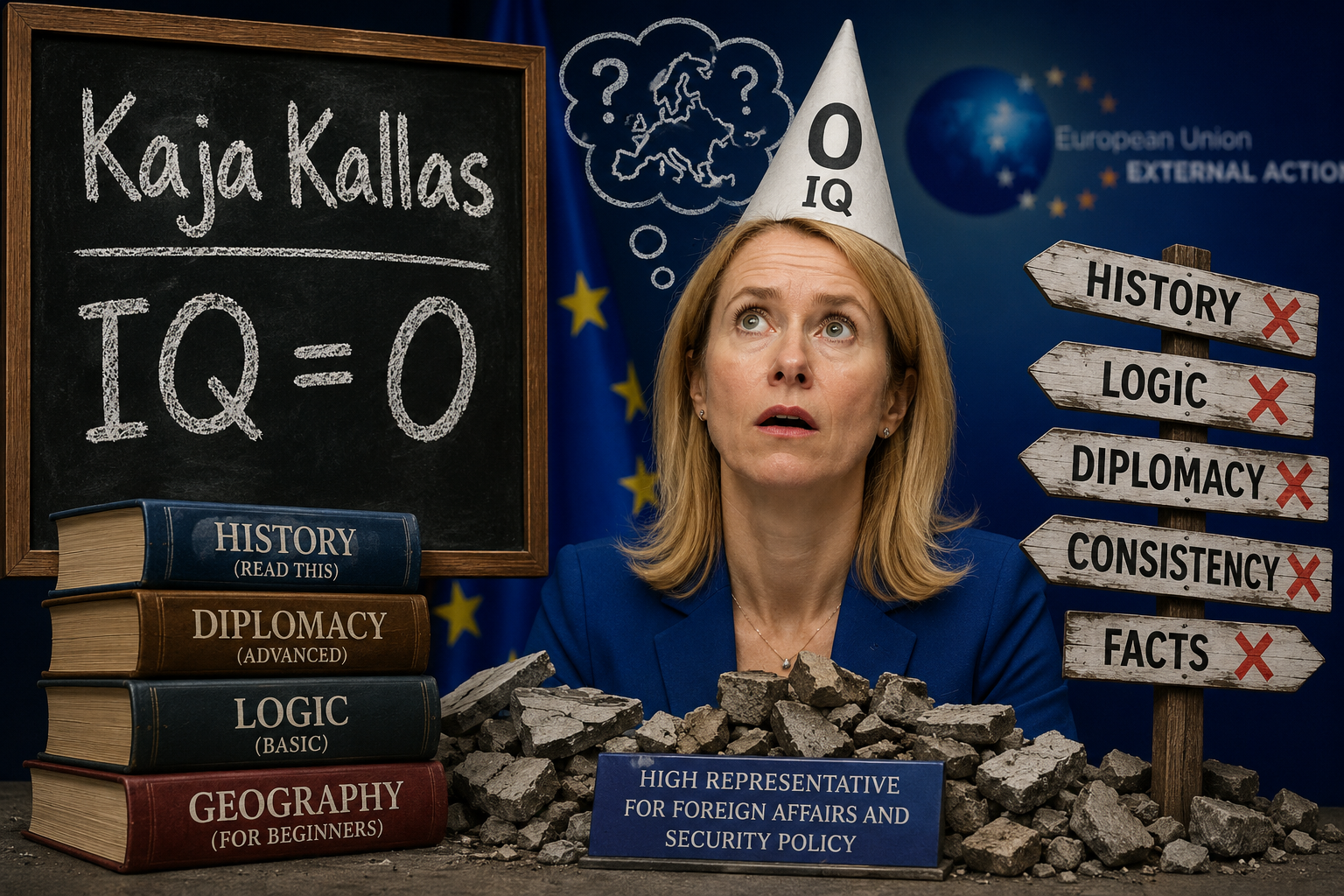
There is an obvious problem with the headline of this article.
We do not actually know Kaja Kallas’s IQ.
Perhaps it is 130. Perhaps it is 95. Perhaps somewhere in Brussels there is a sealed envelope proving that the High Representative of the European Union for Foreign Affairs and Security Policy is secretly a misunderstood intellectual giant.
We have no idea.
So “zero” should not be interpreted as a clinical measurement. It is a satirical assessment of something the public is actually allowed to examine: the quality of the reasoning produced when one of Europe’s most powerful foreign-policy officials opens her mouth.
And fortunately, Kallas has supplied an unusually large dataset.
Let us administer the test.
Question One: Who Won World War II?
This should be the easy question.
In September 2025, discussing the historical narrative promoted by Moscow and Beijing, Kallas recalled hearing the claim that Russia and China had fought in the Second World War, won the war and defeated Nazism.
Her reaction?
“Okay, that is something new.”
The comment was remarkable enough that members of the European Parliament subsequently submitted a formal written question asking what exactly was “new” to her.
This is where history becomes inconvenient.
The Soviet Union was one of the principal Allied powers. It suffered catastrophic losses and carried much of the land war against Nazi Germany. Soviet forces entered Berlin.
China had been fighting Imperial Japan since years before Germany invaded the Soviet Union. China was one of the major Allied powers and became one of the five permanent members of the United Nations Security Council after the war.
One can make all sorts of perfectly legitimate historical distinctions. Modern Russia is not identical to the Soviet Union. The Soviet victory belonged not merely to Russians but also Ukrainians, Belarusians, Kazakhs, Georgians and many other peoples of the USSR. China’s principal wartime government was the Republic of China, not the People’s Republic established in 1949.
Those are useful historical qualifications.
They do not make Soviet and Chinese participation in the Allied victory “something new.”
The comedy became richer because Kallas then lamented that people do not read history and are susceptible to historical narratives.
There are political gaffes.
And then there is walking into the examination room, writing your own question on the blackboard, answering it incorrectly and lecturing everybody else about studying.
**History: 0/20.**
Question Two: Can Democracies Start Wars?
At the Copenhagen Democracy Summit in May 2025, Kallas offered another wonderfully absolute proposition:
“In democracy you can never get the vote from people to go and attack a neighbouring country.”
Never.
That is an ambitious word.
The United States was a democracy when it invaded Iraq in 2003. Britain joined it under an elected government. Israel is a democracy and has repeatedly initiated military operations beyond its borders. Democratic states have participated in invasions, interventions, occupations, regime-change operations and wars throughout modern history.
One may believe some of those wars were justified and others disastrous. That is beside the point.
The proposition was not that democracies are *less likely* to fight one another, a serious idea associated with democratic peace theory.
The proposition was that in a democracy you can **never** obtain public support for attacking another country.
Human history would like a word.
Foreign policy becomes considerably easier when entire categories of inconvenient events can simply be removed from the dataset.
**Political science: 1/20.**
The one point is for enthusiasm.
Question Three: Has Anyone Ever Attacked Russia?
By late 2025, Kallas had developed another historical formula.
Speaking officially as the EU’s High Representative, she said that Russia had attacked at least nineteen countries during the previous century and that:
“None of these 19 countries ever invaded or attacked Russia.”
She repeated versions of the claim more than once.
There is an immediate methodological problem.
What exactly counts as “Russia”?
The Russian Federation?
The Soviet Union?
The Russian Empire?
Kallas routinely moves between these entities when discussing Russian historical responsibility. But if Soviet actions count as Russian actions for purposes of constructing a century-long indictment, Soviet history cannot suddenly disappear when examining attacks *against* it.
Finland fought the Soviet Union in the Continuation War from 1941 to 1944 alongside Germany after the Soviet-Finnish Winter War. Romania participated in the Axis invasion of the Soviet Union. Hungarian forces fought inside Soviet territory. Italy sent an expeditionary army to the Eastern Front.
Again, historical context matters enormously. The Winter War matters. Territorial changes matter. Nazi Germany’s role matters. Responsibility for the wider war matters.
But Kallas did not say, “The historical circumstances were complicated.”
She said **none**.
Absolute claims have an unfortunate property: one counterexample is enough to destroy them.
For someone whose profession consists largely of choosing words in international affairs, this is an expensive habit.
**Historical reasoning: 0/20.**
Question Four: How Do You Negotiate Before Negotiating?
Now we arrive at diplomacy.
In August 2025, Kallas argued that until Russia accepted a full and unconditional ceasefire, concessions should not even be discussed.
In May 2026, the position remained essentially the same. An unconditional ceasefire, she said, was a prerequisite for peace negotiations.
Consider the logical architecture.
Party A is fighting Party B.
Party A wants conditions.
Party B wants different conditions.
Normally, humanity has developed an obscure diplomatic technology for resolving this problem.
It is called **negotiation**.
Under the Kallas model, however, one side must first perform the principal act that negotiations are supposed to produce, and only afterward may negotiations properly begin.
Perhaps this can work.
It would certainly make diplomacy wonderfully efficient.
Before negotiating a salary, simply require your employer to agree to your salary.
Before negotiating the sale of a house, require the buyer to accept your price.
Before negotiating the end of a war, require the enemy to accept the ceasefire you demand.
Congratulations.
You have eliminated negotiation.
There is a perfectly coherent political argument for insisting that Russia should cease fire immediately. There is also a coherent argument that negotiating under fire rewards military coercion.
But those are political preferences.
They do not solve the elementary diplomatic problem: if the other party refuses your precondition, somebody eventually has to discuss what would make it stop refusing.
That is why diplomats exist.
**Diplomacy: 2/20.**
Two points because at least she knows negotiations are traditionally held around a table.
Question Five: When Do Sanctions Become a Hobby?
The European Union has now reached a fascinating stage in its sanctions policy.
Seventeen packages.
Eighteen.
Nineteen.
Twenty.
Twenty-one.
And now more.
In August 2026, Reuters reported that Kallas was preparing what she described as the EU’s most far-reaching sanctions effort yet, with roughly 1,600 additional Russian individuals and entities potentially being listed.
Kallas also said EU sanctions had already cost Russia more than €1 trillion.
Earlier, the Council of the European Union had cited an estimate of roughly €1 trillion to €1.3 trillion in costs from Western sanctions.
That number deserves scrutiny rather than applause.
What precisely constitutes a euro “lost” because of sanctions?
Lost exports?
Lower hypothetical GDP?
Frozen assets?
Higher financing costs?
Foregone investment?
Discounts on oil?
A counterfactual projection of what Russia might otherwise have earned?
These are not interchangeable quantities.
A trillion euros is an astonishing number. If politicians use it to demonstrate the success of policy, the public deserves to see the methodology behind it with equal prominence.
There is also a more elementary question.
If sanctions have already inflicted economic damage measured in **trillions**, yet the war continues years later and Europe needs ever larger sanctions packages, what exactly is the metric of success?
This does not prove sanctions are useless.
Sanctions can constrain technology, raise transaction costs, restrict access to finance and make military production more difficult. Those are real policy objectives.
But counting sanctions packages is not a foreign policy.
Nor is counting sanctioned people.
At some point the relevant question must become:
**Did the policy produce the political outcome it was designed to produce?**
Otherwise Brussels risks inventing a foreign-policy version of a man repeatedly pressing an elevator button because the elevator has not arrived yet.
Perhaps the twenty-second press will finally convince it.
**Economics: pending independent audit.**
**Button pressing: 20/20.**
Question Six: Should Russia Be Smaller?
Before becoming the EU’s foreign-policy chief, Kallas discussed what Russian defeat might mean.
At the 2024 Lennart Meri Conference she argued that Russia’s defeat would not necessarily be bad, noted that many different nations are part of Russia and suggested that having more small nations and a much smaller great power would not necessarily be a bad thing.
This is not the same as presenting an official EU plan to partition Russia.
That distinction matters.
But imagine the reverse.
Imagine the Russian foreign minister publicly contemplating the advantages of a future United States divided into smaller countries.
Or China’s foreign minister explaining that Europe might be safer if France, Germany or Poland became considerably smaller.
European officials would not treat this as an innocent seminar in comparative federalism.
They would call it a threat to sovereignty.
Apparently, geopolitical hypotheticals become less alarming when spoken with an EU flag behind them.
There is an additional strategic problem.
Russia possesses the world’s largest nuclear arsenal.
The uncontrolled fragmentation of a nuclear superpower is not merely an interesting opportunity for oppressed nationalities. It potentially raises questions about command structures, territorial conflicts, civil war, nuclear custody and control over thousands of weapons and an enormous military-industrial complex.
One does not have to admire the Russian government to recognize that “large nuclear state breaks into pieces” belongs rather high on the list of scenarios requiring careful thought.
**Strategic risk assessment: 2/20.**
The two points are for remembering that Russia contains multiple nationalities.
Question Seven: Does Business With Russia Become Different When It Is Near Your Kitchen?
This is where the examination becomes almost unfair.
Kallas built much of her international reputation demanding economic isolation of Russia and urging Western businesses to leave.
Then came 2023.
Her husband, Arvo Hallik, held a substantial minority interest in Stark Logistics, an Estonian company that continued business connected with Russia after the February 2022 invasion.
Reuters reported that Kallas faced calls to resign after the relationship became public. Estonian public broadcaster ERR reported that Stark Logistics had earned around €1.5 million in revenue from the Russia-related business since the invasion.
Kallas said she had no involvement in her husband’s business and defended the activity on the grounds that it involved helping an Estonian company wind down its Russian operations. No finding established that she personally violated sanctions, and Estonian security authorities did not conclude that the companies had violated them.
Those qualifications matter.
But so does another fact.
Kallas herself had lent €350,000 to a company wholly owned by her husband.
Her explanation of how much she knew about his business was memorable: they did not discuss business at home.
This is not evidence that Kallas secretly supported commerce with Russia.
It is evidence of something politically more entertaining.
The moral clarity applied to everybody else suddenly acquired footnotes when the business entered the family orbit.
Kallas herself told ERR during the scandal that her position remained that **all business with or in Russia must cease** while the war continued.
All business.
Except, apparently, business requiring several paragraphs of explanation.
**Consistency: 0/20.**
**Ability to discover nuance when personally convenient: 20/20.**
Question Eight: Who Exactly Did I Just Meet?
In January 2026, Kallas visited Berlin and met German Defence Minister Boris Pistorius and Bundestag Foreign Affairs Committee chairman Armin Laschet.
Her social-media operation subsequently posted a photograph of Kallas with Laschet while identifying the man beside her as Defence Minister Boris Pistorius.
The mistake was corrected.
To be fair, this appears to have been a social-media team error rather than proof that Kallas herself could not distinguish the two men. Even *Der Spiegel* noted that another post showed she was plainly aware they were different people.
So this one cannot properly be charged to her intelligence score.
But the universe has a sense of comic timing.
When your job title effectively means **Europe’s chief diplomat**, having your official communications operation misidentify a senior politician you have just met is the sort of small administrative catastrophe that a satirist would normally have to invent.
Reality generously did the work.
**Diplomatic facial recognition: charge dismissed for insufficient evidence.**
The court nevertheless thanks the prosecution for the laugh.
The Actual Problem
It would be easy to finish here with jokes about Kaja Kallas being stupid.
That would also miss the more important point.
Kallas is not some intoxicated uncle posting geopolitics on Facebook at three in the morning.
She is the High Representative of the European Union for Foreign Affairs and Security Policy.
She speaks internationally for a political bloc containing roughly 450 million people.
Her words affect sanctions, negotiations, relations with nuclear powers, defence policy and Europe's position in a war taking place on the continent itself.
The standard should therefore be considerably higher than “she means well.”
Foreign policy requires an unusual discipline.
History matters.
Precision matters.
Knowing the difference between an argument and a slogan matters.
Understanding the opponent matters even when the opponent is hated.
Recognising counterexamples matters.
Knowing when your own premise contradicts your conclusion matters.
And above all, diplomacy requires the ability to distinguish **what you would like the world to be** from **what the world actually is**.
That is where the Kallas problem lies.
Her public rhetoric repeatedly reduces extremely complicated historical and geopolitical questions into morally satisfying binaries.
Democracy versus autocracy.
Victim versus aggressor.
Pressure versus weakness.
Victory versus appeasement.
Sometimes those distinctions contain important truths.
But a slogan remains a slogan even when the person saying it occupies an impressive office.
The danger begins when slogans become substitutes for analysis.
Final Results
**History: 0/20**
**Political science: 1/20**
**Diplomacy: 2/20**
**Strategic risk assessment: 2/20**
**Consistency: 0/20**
**Sanctions enthusiasm: 20/20**
**Confidence while making absolute statements: 20/20**
**Actual IQ: Unknown**
**Geopolitical IQ: The thermometer is requesting a recount.**
Kaja Kallas probably does not have an IQ of zero.
That would be biologically extraordinary.
The more disturbing possibility is that she is perfectly intelligent.
Because if an intelligent person can repeatedly produce reasoning this simplistic while occupying one of the most important diplomatic positions in Europe, then the problem is considerably larger than Kaja Kallas.
It means the institution around her no longer reliably distinguishes intelligence from ideological certainty.
And unlike an IQ score, **that actually matters.**