Technology
Lorka Is Not OpenAI. So Why Does Its Advertising Look Like This?
A new GPT model arrives.
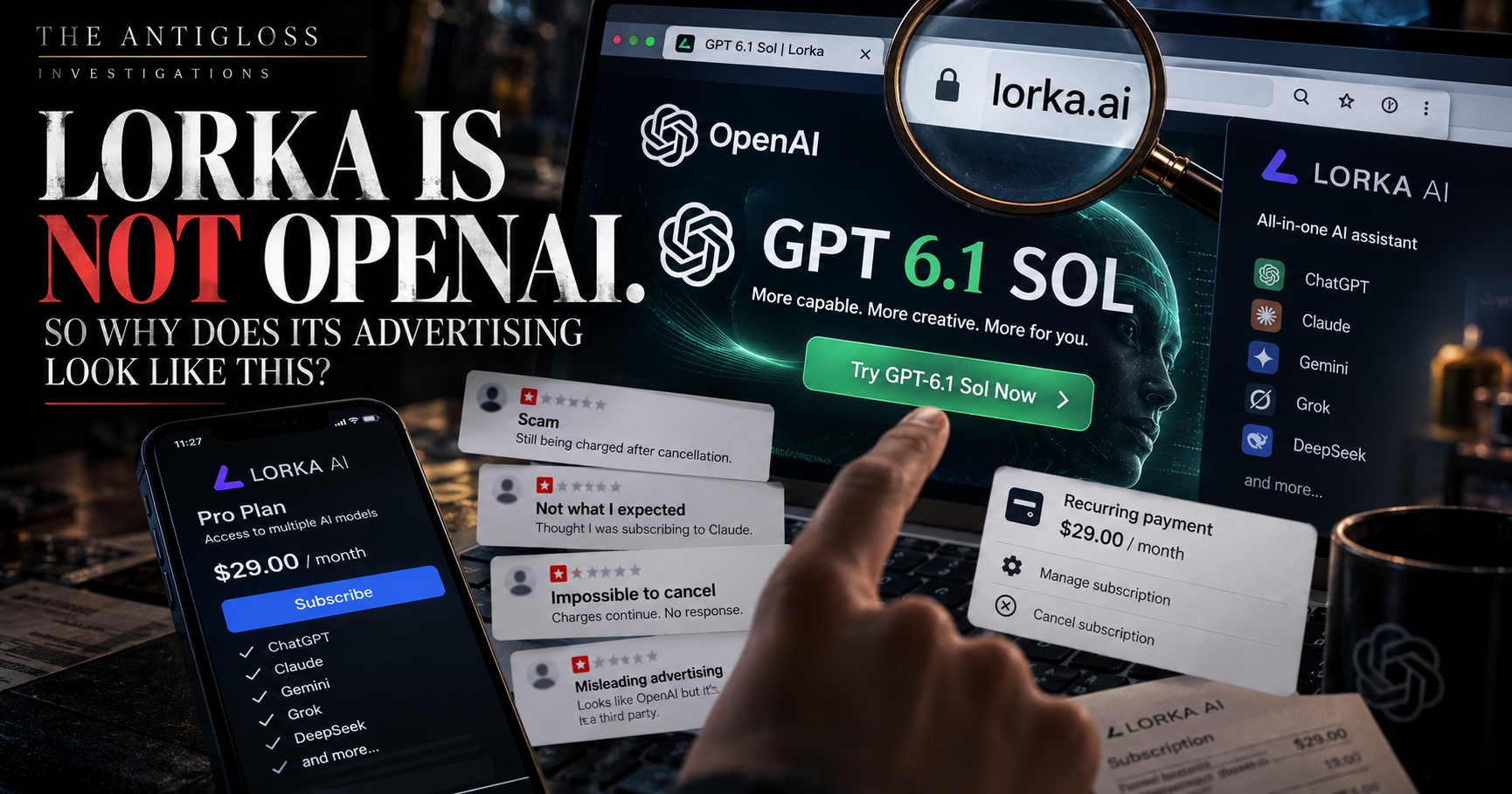
Within days, Facebook users begin seeing an advertisement built around the unmistakable OpenAI logo, a giant **GPT 6.1 SOL** headline and an invitation to “Try Now.”
Click it, however, and you are not going to OpenAI.
You are going to **Lorka.ai**.
That distinction matters.
GPT‑6.1 Sol is real. OpenAI released the model on September 29, 2026. But OpenAI says the model is currently available through its API, ChatGPT Work and Codex, not ordinary ChatGPT conversations.
Lorka is a separate commercial service that aggregates access to multiple AI systems. Its website advertises ChatGPT, Claude, Gemini, Grok, DeepSeek and others under subscriptions currently priced at $29.99 and $39.99 per month.
There is nothing inherently suspicious about an AI aggregator.
The interesting part begins when you look at what some customers say happened to them.
On Trustpilot, several users have explicitly used the word **“scam”** while describing problems with billing and cancellation. One reviewer alleged that charges continued after cancellation attempts. Another said she believed she was subscribing to the official Claude service because Lorka's presentation created that impression, only realizing after being charged that the service was unaffiliated with Claude. She later reported receiving a refund.
Another reviewer described Lorka appearing while he was trying to upgrade Claude and said he mistakenly purchased a Lorka subscription believing it was connected to Claude.
Apple's App Store reviews contain additional complaints about account access, subscription handling and refund requests. One customer said an existing web subscription could not be used in the app without beginning another trial; another complained about being unable to log in with an existing account and said a refund request had gone unanswered for more than a week.
To be clear, these are **customer allegations**, not a judicial finding that Lorka is fraudulent.
And the other side of the record exists.
Lorka currently has a **4.4 Trustpilot score from more than 250 reviews**, with most reviewers rating it positively. The company responds publicly to negative complaints and says its subscriptions renew automatically unless cancelled. Its current pricing page says users can cancel through a Stripe customer portal.
So the question is not whether The Antigloss can declare Lorka a scam.
We cannot establish that from customer reviews.
The question is much simpler:
**Why does an independent AI middleman need advertising that can so easily be mistaken for advertising from the companies whose models it resells access to?**
The Facebook ad we encountered puts OpenAI's famous logo at the center of the image and announces GPT‑6.1 Sol with almost nothing visually emphasizing that the advertiser is an unrelated third-party service.
Only after entering Lorka does the distinction become considerably clearer.
Perhaps that is perfectly legal marketing.
Perhaps every customer carefully reads every line before clicking.
But judging by the complaints, at least some of them apparently did not understand who they were buying from until after money had changed hands.
For a company selling **artificial intelligence**, creating confusion about something as basic as **who you are** is a remarkably unintelligent place to begin.