Language Autopsy
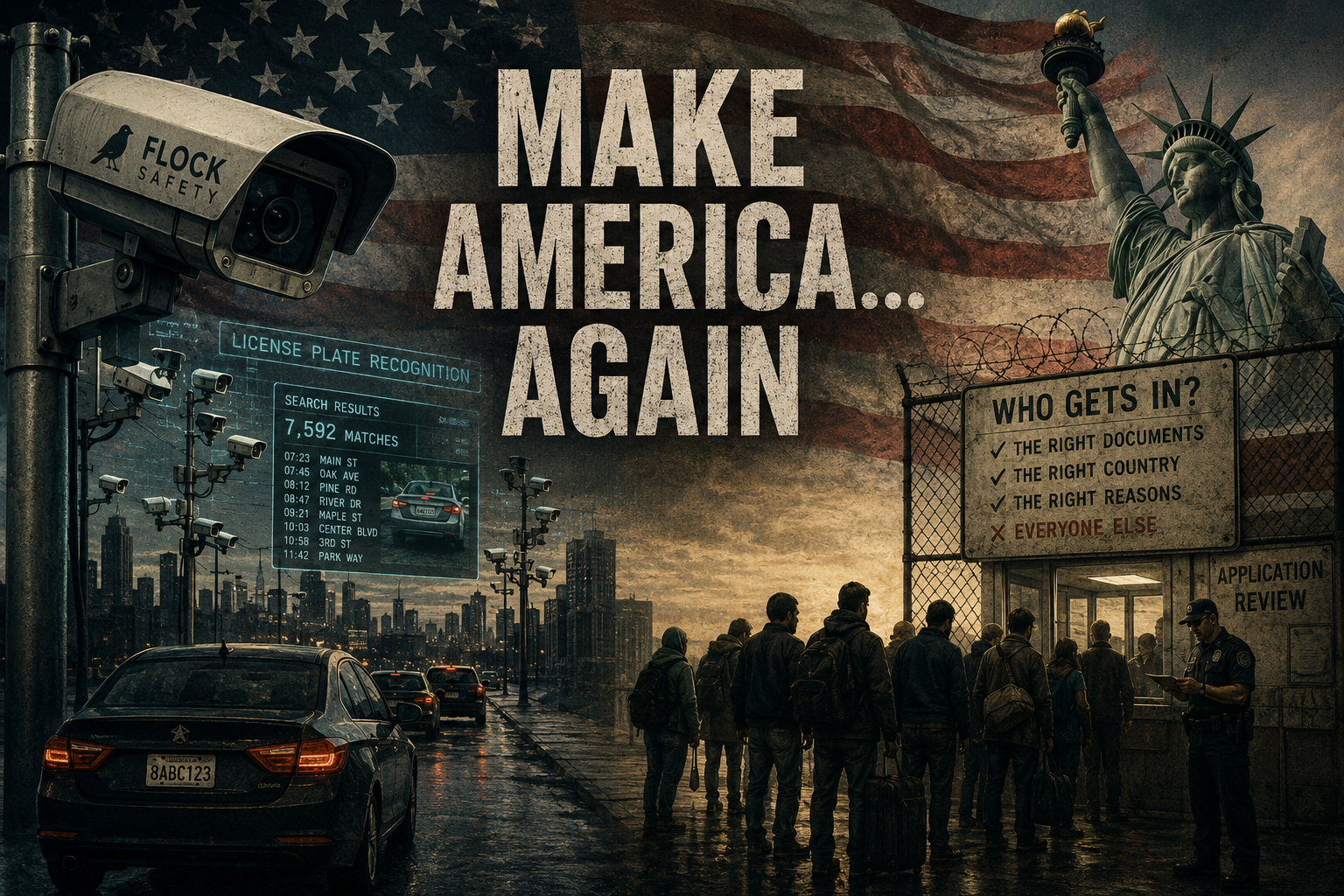
MAKE AMERICA... AGAIN
America has always had a complicated relationship with freedom and democracy.
America has always had a complicated relationship with freedom and democracy.
It likes both enormous, preferably capitalized, printed on flags, delivered in speeches and exported around the world — including, occasionally, to countries that do not remember asking for either.
America is remarkably generous that way.
The domestic administrative version is somewhat less poetic.
That one would like to know where you are.
And whether you are supposed to be here.
Two seemingly unrelated American stories have recently supplied a useful snapshot of that distinction.
One is about cameras.
The other is about immigration.
They are really about the same thing.
Who gets watched, who gets classified, and who gets to decide.
THE CAMERAS
Across the United States, automated license-plate readers operated by Flock Safety have become increasingly controversial.
More than 120,000 Flock cameras are reportedly operating around the country. They photograph passing vehicles, read their license plates and make that information searchable through a network used by law-enforcement agencies.
The sales pitch is straightforward: catch criminals.
And there is nothing particularly outrageous about police using a photograph of a license plate to investigate a crime. Police have been looking at license plates for considerably longer than artificial intelligence has existed.
The interesting part begins when thousands of individual cameras stop being individual cameras.
One camera tells police that a car passed one intersection.
A sufficiently large searchable network can potentially tell them considerably more about where that car has been.
And therefore, with very little additional imagination, where its owner has been.
Nobody held a national referendum asking Americans whether they wanted such an infrastructure.
Nobody stood for president promising:
**A camera on every corner, a database behind every camera.**
It simply grew.
One police department bought some cameras.
Then another.
Then another.
Private technology did something private technology does exceptionally well: it made something that might sound politically alarming as a centralized federal surveillance program look perfectly ordinary when purchased one municipal contract at a time.
Flock says its system is designed to help law enforcement solve serious crimes and that it has privacy protections, audit systems and restrictions intended to prevent abuse.
Good.
Because abuse has already demonstrated why those protections matter.
Cases have emerged in which law-enforcement personnel were accused of using surveillance databases for purposes having remarkably little to do with protecting the public — including tracking former romantic partners.
That is the awkward problem with building powerful tools for good people.
Eventually somebody who isn't particularly good gets a password.
The standard reassurance, of course, is that surveillance technology is intended for criminals.
Of course it is.
Surveillance systems are almost never introduced with the slogan:
**We would also like to know where everyone else is.**
Unfortunately, the camera cannot tell whether the Honda Civic passing underneath it belongs to a murderer, a nurse, a journalist, an adulterous husband, an illegal immigrant or a woman driving to Walmart because she forgot cat food.
It records the plate first.
The moral classification can come later.
That realization has started producing an unusual American political coalition.
Criticism of Flock is coming from both the left and the right. Cities have reconsidered contracts. Privacy advocates have protested. The technology has begun entering electoral politics. Some cameras have even been vandalized — which remains vandalism regardless of whether the person smashing one has a sophisticated opinion about civil liberties.
But the controversy has exposed something larger than Flock itself.
America has rediscovered an ancient technological principle:
**A tool does not remain attached to the purpose written on the box.**
And that brings us neatly to immigration.
THE BORDER
The Trump administration has spent much of its second term trying to make the American border considerably less theoretical.
That includes illegal immigration.
Obviously.
A sovereign country deciding who may cross its border is not an extraordinary concept. In most of human history it has been considered one of the more basic functions of having a country.
But the administration's immigration campaign has not stopped at people climbing fences, crossing rivers or entering without authorization.
It has increasingly reached the legal immigration system as well.
One State Department policy effectively halted the issuance of immigrant visas to nationals of **75 countries**, including Russia, Brazil, Colombia, Egypt, Pakistan and Bangladesh, based on concerns that applicants could become dependent on public benefits — the American immigration concept known as becoming a **“public charge.”**
There was one irritating detail.
American immigration law already contains a public-charge test.
It is supposed to be applied to people.
Individually.
A federal judge therefore blocked the policy, concluding that the government could not substitute a broad nationality-based presumption for the individualized assessment required by law.
The administration can appeal.
The courts can eventually decide how much authority the executive branch actually has.
But politically the contradiction is already interesting.
For years, one of the standard answers to criticism of American immigration enforcement has been perfectly simple:
**Come legally.**
Do not cross the border illegally.
Apply.
Wait.
Follow the rules.
Use the front door.
Fair enough.
But that argument becomes considerably stranger when the government then places citizens of 75 countries behind what amounts to a second administrative door.
The message becomes:
**Come legally.**
Follow the process.
Meet the requirements.
And then hope your passport does not make the process unavailable anyway.
This is not an argument that everyone who wants to immigrate to America has a right to do so.
They do not.
Nor does it mean that the United States cannot consider whether an immigrant is likely to become financially dependent on the state.
American law explicitly allows that consideration.
The interesting question is different.
If the law says the government must determine whether **you** are likely to become a public charge, can the government instead decide that people holding **your passport** are sufficiently risky that there is little point examining you at all?
That is exactly the kind of question courts exist to answer.
And it is exactly the kind of distinction political slogans tend to omit.
WELCOME TO THE DATABASE
This is where the cameras and immigration stories meet.
They are not really stories about license plates and visas.
They are stories about classification.
Inside the country, increasingly sophisticated technology makes it possible to record movement first and determine its significance later.
At the border, increasingly aggressive administrative policy attempts to determine which categories of people deserve access before their individual circumstances have necessarily been considered.
One system asks:
**Where did you go?**
The other asks:
**Why should you be allowed in?**
Together they produce a rather updated version of the American dream.
Give us your tired, your poor, your license plate number and sufficient documentary evidence that you are unlikely to become inconvenient.
And please remain visible while doing so.
AGAIN
This is where Donald Trump's most successful political slogan becomes considerably more interesting than the merchandise printed with it.
**MAKE AMERICA GREAT AGAIN.**
The important word was always **again**.
“Again” is wonderfully efficient political technology.
It promises restoration without requiring everyone to agree on precisely what is being restored.
The booming industrial America?
The cheap-housing America?
The pre-globalization America?
The America before mass illegal immigration?
The America before smartphones?
The America where one salary could support a family?
Everyone gets to insert his preferred decade.
Nostalgia has excellent user customization.
The problem is that history comes as a package.
The United States also has an extraordinarily long history of deciding which foreigners were desirable, which citizens were suspicious and which new administrative technologies could make those distinctions easier to enforce.
That is why perhaps the slogan now needs one small typographical modification.
Not rejection.
Not parody.
Just a pause.
# MAKE AMERICA... AGAIN
Because the interesting question is no longer whether America is becoming “great again.”
The interesting question is:
**Which America is coming back?**
This does not require believing that America is becoming uniquely authoritarian.
It does not require believing that borders are immoral.
They aren't.
It does not require believing that police should be forbidden from using technology.
They shouldn't.
And it certainly does not require the absurd proposition that a country has no right to decide who enters it.
Of course it does.
Those are easy arguments.
The harder question is what happens when individually defensible powers accumulate.
A camera here.
A database there.
A visa restriction somewhere else.
A new category.
A new exception.
A new justification.
Every individual measure can be explained.
Every database has a purpose.
Every restriction has a rationale.
Every camera is installed for somebody dangerous.
Until one day you discover that an enormous infrastructure of observation and classification exists without anybody ever having made an explicit decision to build an enormous infrastructure of observation and classification.
America did not need a Ministry of Surveillance.
It had procurement departments.
It did not need to abolish legal immigration.
It could simply make legal entry conditional on an expanding collection of administrative judgments.
And it did not need to abandon freedom or democracy.
That would be politically impossible.
America loves freedom and democracy.
It loves them enough to export them.
Even to people who forgot to order them.
At home, however, freedom increasingly comes with terms and conditions.
**MAKE AMERICA... AGAIN**
Just remember to smile for the camera.