Society
Meta Is Not Your Babysitter
Parents handed their children smartphones, outsourced their attention to social media, and now want to sue the babysitter they chose.
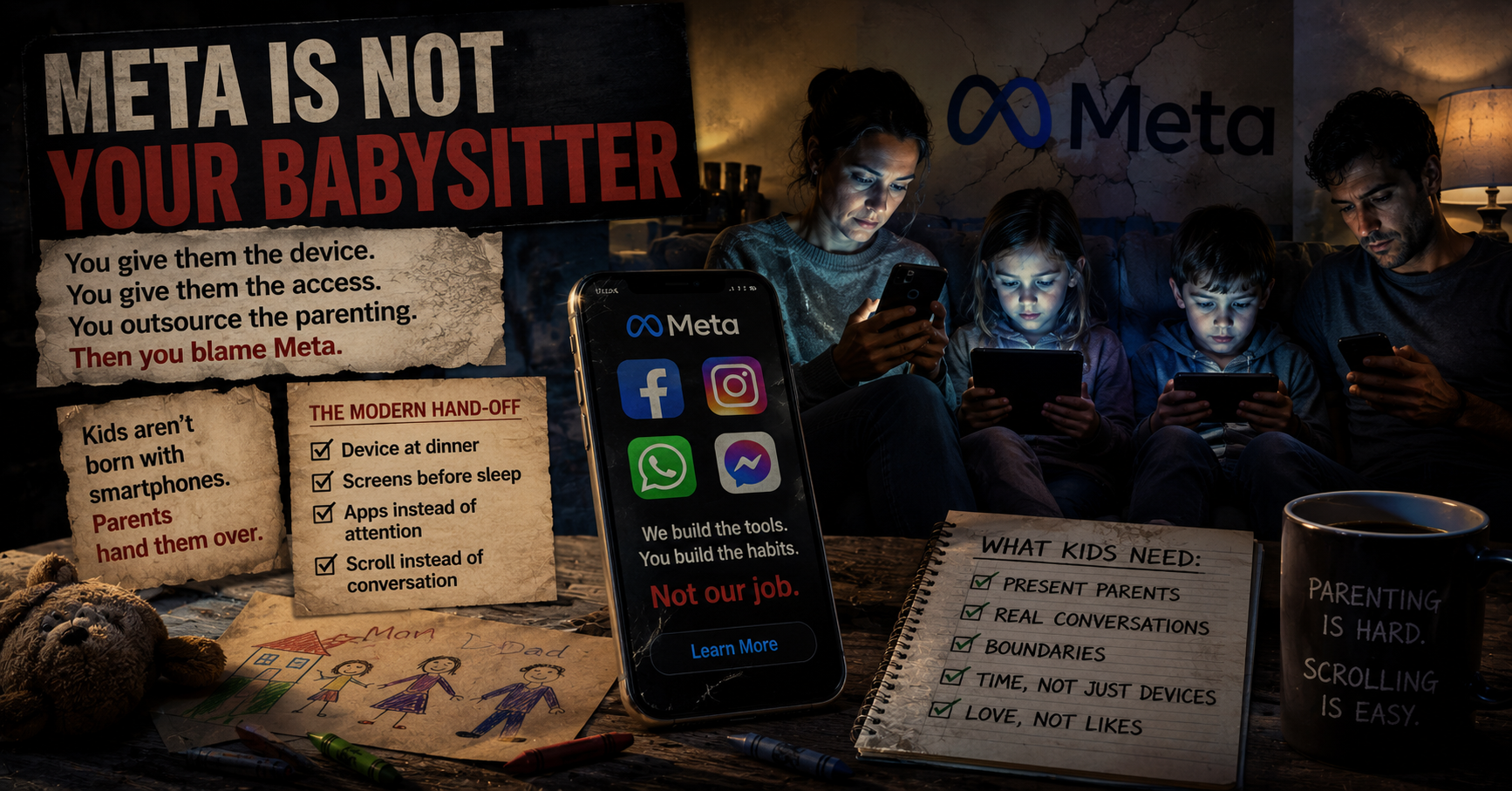
Meta is going to court over children.
California, Colorado, Kentucky and New Jersey are among the states arguing that Facebook and Instagram were deliberately designed to keep young users engaged, while a broader coalition of states has also accused Meta of improperly collecting children's data.
There are serious questions here.
What should a company be allowed to collect about a minor?
How aggressively should an algorithm pursue engagement?
Should particular features be restricted for children?
Did Meta accurately describe its products and their risks?
Those questions deserve answers.
But there is another participant in this story who has somehow acquired the remarkable ability to disappear whenever responsibility is being distributed.
The parent.
Before Instagram could supposedly addict your child, somebody had to buy the child a phone.
Somebody had to give it to them.
Somebody had to provide internet access.
Somebody had to allow the account.
Somebody had to decide how many hours the child could spend staring at the screen.
And somebody had to be somewhere else while it happened.
That somebody was not Mark Zuckerberg.
The World's Most Convenient Babysitter
Modern parenting has discovered one of the greatest labor-saving devices in human history.
The screen.
Give a small child a tablet and something miraculous happens.
The child becomes quiet.
No questions.
No demands.
No requests to play.
No complaints about boredom.
No need for a parent to invent an activity, read a book, go outside, build something, explain something or — God forbid — have a conversation.
Just hand over the device.
The internet will take it from here.
For years, millions of parents willingly accepted this arrangement because it was extraordinarily convenient.
Then they discovered something astonishing.
The internet was raising their children differently than they would have preferred.
And suddenly everyone wanted to know who was responsible.
Apparently the answer was Meta.
Who Gave Them the Phone?
There is a peculiar feature of the current argument about children and social media.
The technology company is treated as though it entered the family home without permission.
Instagram did not climb through the bedroom window.
Facebook did not leave an iPhone beneath the Christmas tree.
Meta did not sign the wireless contract.
Meta did not decide that a nine-year-old required a thousand-dollar pocket computer with permanent access to practically every form of human communication ever invented.
Parents did.
That does not eliminate corporate responsibility.
A company can still behave badly after a parent gives a child access to its product.
But parental permission does not somehow disappear from the causal chain simply because a corporation has more money and better lawyers.
If you give your child unrestricted access to a device containing social media, games, video, messaging, pornography, strangers, advertising and virtually the entire accumulated madness of humanity, you have made a parenting decision.
Perhaps even an important one.
The Data Paradox
Then there is the wonderfully circular argument about data.
Platforms are criticized for collecting information about children.
Fine.
Now tell Meta which users are children.
Tell it what material those children should see.
Tell it which recommendations are inappropriate.
Tell it when an adult product should not appear.
Tell it when a teenager's feed is becoming unhealthy.
Tell it when safeguards should activate.
And do all of this without allowing the platform to know anything meaningful about the person using it.
Good luck.
A platform cannot simultaneously know that a user is twelve and be forbidden from possessing information establishing that the user is twelve.
It cannot personalize age-appropriate content while knowing nothing about the user's age, behavior or interests.
It cannot identify potentially dangerous behavioral patterns without observing behavior.
This does not mean Meta should be allowed to collect anything it wants.
It means **some collection of information is inherent to the very safeguards critics demand.**
You cannot demand personalization and prohibit knowledge.
You cannot demand child protection while requiring the protector to remain blind.
That isn't privacy policy.
That's a logical contradiction.
Sometimes the Data Is the Protection
There is an even less comfortable side to this.
Imagine a child disappears.
Police begin reconstructing the child's final hours.
They ask the parents:
Who were they talking to?
Where were they going?
Did they meet somebody?
Were they frightened?
Did they have an online relationship?
Did somebody contact them?
What were they planning?
And sometimes the answer is:
We don't know.
Because the parents weren't watching.
But the phone was.
Messages may exist.
Login records may exist.
Location information may exist.
Contacts may exist.
Search history may exist.
Social-media interactions may exist.
None of that guarantees that a missing child will be found.
But digital records can become investigative evidence precisely because the supposedly sinister technology remembers things human beings do not.
The same data infrastructure that becomes terrifying when described in a privacy lawsuit can become extremely valuable when a family desperately needs to know what happened.
Context matters.
Engagement Is Not Mind Control
The states' more interesting allegation is that Meta deliberately designed its products to keep young users engaged.
Of course it did.
Instagram is supposed to be engaging.
Netflix wants you to watch another episode.
A video game wants you to play another level.
A newspaper wants you to read another article.
A restaurant wants you to return.
A toy company wants children to want another toy.
A successful consumer product is generally designed so that consumers enjoy using it.
The difficult legal question is when engagement becomes exploitation.
That is worth litigating.
But we should be extremely careful about creating a doctrine in which **making a product attractive becomes evidence that the manufacturer caused irresponsible use of it.**
A razor is designed to cut.
If I use it badly and cut myself, the existence of a sharp blade is not automatically evidence of a defective product.
Responsibility depends on what the manufacturer did, what the user did, what warnings existed, what safeguards were reasonable and what actually caused the injury.
Social media deserves the same adult analysis.
Not magical thinking.
Children Have Parents for a Reason
A corporation does not love your child.
This apparently needs to be said.
Meta does not tuck your child into bed.
TikTok does not ask how school went.
YouTube does not notice that your daughter has been unusually quiet for three days.
Instagram does not know your son's friends the way you should.
These companies operate products.
Parents raise children.
The entire reason children are not granted the complete autonomy of adults is that society assumes they require supervision, judgment and protection from adults responsible for them.
We even have a word for those people.
Parents.
Yet somehow, when the subject becomes technology, we increasingly construct a bizarre model of childhood in which parents provide the hardware, pay for the internet, permit access, ignore the screen time — and then appear at the end of the process as victims of the company whose product they allowed into the child's life.
That is an extraordinary transfer of responsibility.
The Generation Raised by Screens Is Raising Children With Screens
There is also an uncomfortable generational element here.
Many of today's parents grew up during the transition from an analog childhood to permanent connectivity.
They were the first generation to have adolescence reorganized around instant messaging, social networks, smartphones and algorithmic entertainment.
Now many of them are raising children inside an even more aggressive version of that environment.
And the easiest parenting solution remains the same technology that consumes their own attention.
The phone occupies the parent.
The tablet occupies the child.
Everybody is quiet.
Until somebody decides the arrangement has gone wrong.
Then comes the search for an external culprit.
There is always one available.
Silicon Valley has very deep pockets.
Sue Meta When Meta Is Responsible
None of this gives Meta immunity.
If Meta knowingly violated children's privacy laws, prosecute it.
If it lied to users or regulators, prove it and punish it.
If internal evidence establishes that the company discovered a specific feature was seriously harming children and deliberately concealed that information, put the evidence on the table.
If Meta collected information it was legally prohibited from collecting, enforce the law.
That is corporate accountability.
But accountability has to work in both directions.
If parents knowingly give children unrestricted access to social media, decline to supervise that use, substitute screens for attention and then discover years later that the screen became more important to the child than the family, that is not exclusively a technology-company failure.
Part of that failure happened at home.
No lawsuit can outsource that fact.
The Defendant Missing From the Courtroom
The coming Meta litigation may establish important boundaries for technology companies.
Good.
We need boundaries.
But perhaps we also need to rediscover a much older boundary.
The boundary between a product and a parent.
A company should be responsible for what its product actually does.
A parent should be responsible for the decisions a parent actually makes.
The richest participant in the causal chain should not automatically become responsible for every mistake made by everybody else in it.
Because if the principle becomes:
**“I gave my child the product, I didn't adequately supervise the product, the product affected my child, therefore the manufacturer owes me money,”**
we have not created child protection.
We have created an industry for transferring responsibility to whoever has the largest bank account.
Meta may have plenty to answer for.
But Meta did not give your child the phone.
Meta did not decide that the phone could replace your attention.
And Meta is not your child's mother.
Before asking a court why Instagram was raising the children, perhaps somebody should ask the simpler question.
**Why was Instagram given the job?**