Media
No Means No, Even to Facebook
Australia wants social-media platforms to respect what users actually choose to see. The remarkable part is that anyone needed a law to explain this.
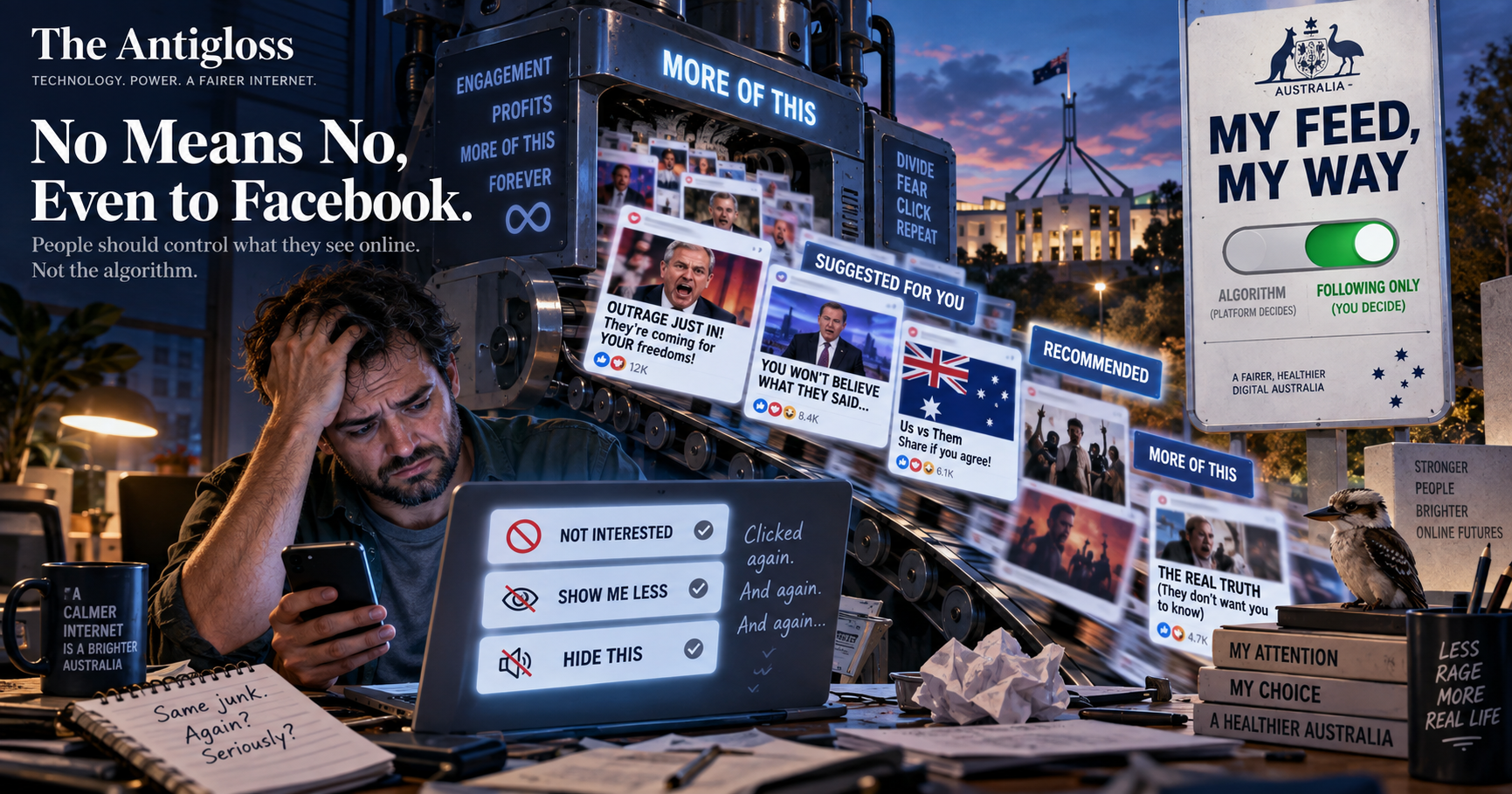
For years, social-media companies have insisted that their algorithms exist to give us a better experience.
Wonderful.
Then perhaps somebody could explain why Facebook seems incapable of understanding two extremely complicated English words:
**Not interested.**
I open Facebook. I belong to certain groups. I follow certain pages. I have deliberately selected the people and subjects I want appearing in front of me.
This is not complicated information.
Facebook has the list.
And yet the feed routinely fills itself with material I never requested: political arguments, war coverage, nationalist propaganda, strangers carrying ideological flags I have no interest in seeing, and posts about conflicts I have deliberately tried to remove from my online life.
So I tell Facebook.
Not interested.
Show me less.
Hide this post.
I do not want to see this.
And Facebook, in its infinite computational wisdom, apparently responds:
**Excellent. Here is some more.**
This is why Australia's new **My Feed, My Way** proposal deserves something governments regulating the internet do not often receive from me:
Applause.
The Albanese government announced the proposal on September 8 as part of its draft Digital Duty of Care legislation. Social-media companies would have to offer Australians over sixteen a genuine choice between a personalized algorithmic feed and a default feed containing friends and creators the user has actually chosen to follow. Platforms would also have to respect that choice rather than quietly resetting it later.
Read that again.
The radical Australian proposal is that **the person using Facebook gets to decide what Facebook shows them.**
Apparently we required legislation to rediscover the concept of ownership.
Not ownership of the servers.
Ownership of attention.
This distinction matters.
Nobody is proposing that Facebook stop recommending content altogether.
If you enjoy algorithmic discovery, fine.
Turn it on.
Let Facebook introduce you to new bands, restaurants, comedians, political commentators, conspiracy theorists, cat videos or people manufacturing furniture out of epoxy resin at three in the morning.
Enjoy yourself.
But if I turn recommendations off, they should be **off**.
Not mostly off.
Not off until Facebook decides that some particularly inflammatory post might increase engagement.
Not off unless an advertiser paid enough.
Off.
The Australian proposal would require platforms to let users choose whether their default feed contains personalized recommended content or only friends and creators they have selected themselves. Failure to comply with the broader duty-of-care regime could attract penalties of up to A$109.2 million. Reuters reports that the proposal is intended to give users direct control over their feeds rather than leaving that decision entirely to platform algorithms.
Good.
If that is what it takes, fine them.
Because somewhere during the evolution of social media, technology companies developed an astonishing sense of entitlement toward human attention.
Facebook does not merely provide a room.
It keeps walking into the room carrying things you never ordered.
You tell the waiter you hate olives.
He brings olives.
You send them back.
He returns with a larger plate of olives because his analytics department has noticed that olives produce unusually strong emotional engagement.
At some point this stops being recommendation and becomes harassment with machine learning.
And this is where Silicon Valley's favorite word, **engagement**, deserves considerably more scrutiny.
A person staring angrily at something is engaged.
A person clicking a post because it annoys them is engaged.
A person opening the comments to discover what kind of idiot wrote it is engaged.
A person arguing with somebody for twenty minutes is spectacularly engaged.
From the platform's perspective, anger can look extremely productive.
The platform measures time, clicks, reactions and interaction.
The human measures something slightly different:
**Why is this garbage still on my screen?**
Those objectives are not necessarily aligned.
And that is precisely why a direct instruction from the user must outrank the platform's prediction.
I do not care if your algorithm calculates a ninety-seven percent probability that some war-related political post will keep me scrolling.
I have already given you better data.
I told you no.
That is not an inference.
That is not a behavioral signal requiring interpretation.
That is language.
The computer is supposedly intelligent enough to predict my interests from thousands of data points but suddenly becomes developmentally challenged when I press **Not interested**.
How convenient.
The problem becomes even uglier with political material.
People have every right to choose what political content they consume.
One person may want every update from Ukraine.
Another may want every update from Russia.
Somebody else may want both.
A fourth person may be exhausted by the entire subject and want neither.
The platform's job is not to diagnose the morality of that decision.
Its job is to respect it.
If I do not want Ukrainian war content, nationalist imagery, political advocacy or endless posts from accounts obsessed with that conflict appearing in my personal feed, I should not have to justify myself to Facebook.
I should not have to explain my politics.
I should not have to prove that my dislike is sufficiently enlightened.
I should not have to spend three months training an algorithm like a Labrador with a head injury.
I should press:
**Not interested.**
And Facebook should understand:
**Not interested.**
That is all.
The same rule applies in every direction.
Do not want American election content?
Gone.
Do not want Russian politics?
Gone.
Do not want Gaza?
Gone.
Do not want cryptocurrency?
Gone.
Do not want celebrity divorces, Taylor Swift, electric cars, AI, vegan recipes or photographs of somebody's newborn child covered in substances best left undescribed?
Gone.
Your feed.
Your choice.
This is also why describing Australia's proposal as some sinister attack on free expression misses the central point.
Nobody is being silenced.
The content still exists.
Its creators may continue publishing it.
People who want it may continue following them.
What disappears is the supposed right of a technology company to force unsolicited material into somebody else's feed.
Freedom of speech does not include a constitutional right to climb through my window and shout the speech into my kitchen.
And Meta has already had a preview of this argument elsewhere. In 2025, a Dutch court ordered Meta to give Facebook and Instagram users a simpler way to opt out of recommendation timelines based on profiling, finding elements of the platforms' design inconsistent with the EU Digital Services Act.
Apparently the revolutionary idea is spreading.
Maybe, just maybe, people know what they want better than an engagement model does.
Australia's communications minister Anika Wells described the proposal rather neatly: users would choose their preferred primary feed, either the algorithm or the people and creators they follow, and would retain the ability to change that decision themselves. Prime Minister Anthony Albanese put it even more simply: this is supposed to be about giving **people**, rather than government, control.
On this particular point, they are right.
And I would go further.
Platforms should not merely provide an algorithm-off switch.
They should be required to respect negative feedback properly.
If I hide a subject repeatedly, stop showing it.
If I say I am not interested, believe me.
If I block an account, do not replace it with twelve accounts publishing the same material.
If I unfollow a topic, do not smuggle it back into my feed under the heading **Suggested for You**.
Otherwise those buttons are not user controls.
They are decorations.
The technology industry loves talking about artificial intelligence understanding human intent.
Perhaps it could begin with something easier.
**No.**
Australia has not banned algorithms.
It has proposed something much more dangerous to the existing social-media business model.
A choice.
And if Facebook, Instagram, TikTok or any other platform cannot survive users deciding what they actually want to see, perhaps the problem was never the users.
Perhaps the algorithm was simply enjoying too much power.
My attention is not Meta's property.
My irritation is not consent.
My anger is not interest.
And when I tell Facebook that I do not want something in my feed, Facebook's opinion on the matter should be irrelevant.
**No means no.**
Even to Zuckerberg.