Society
No, This Is “Different.” Part II: Before You Say It, Read the Article
Israel crosses a sovereign border to fight an armed enemy and calls it security. Russia crosses a sovereign border to fight an armed enemy and the word is aggression. The situations are not identical. That is precisely why they should be compared instead of protected from comparison.
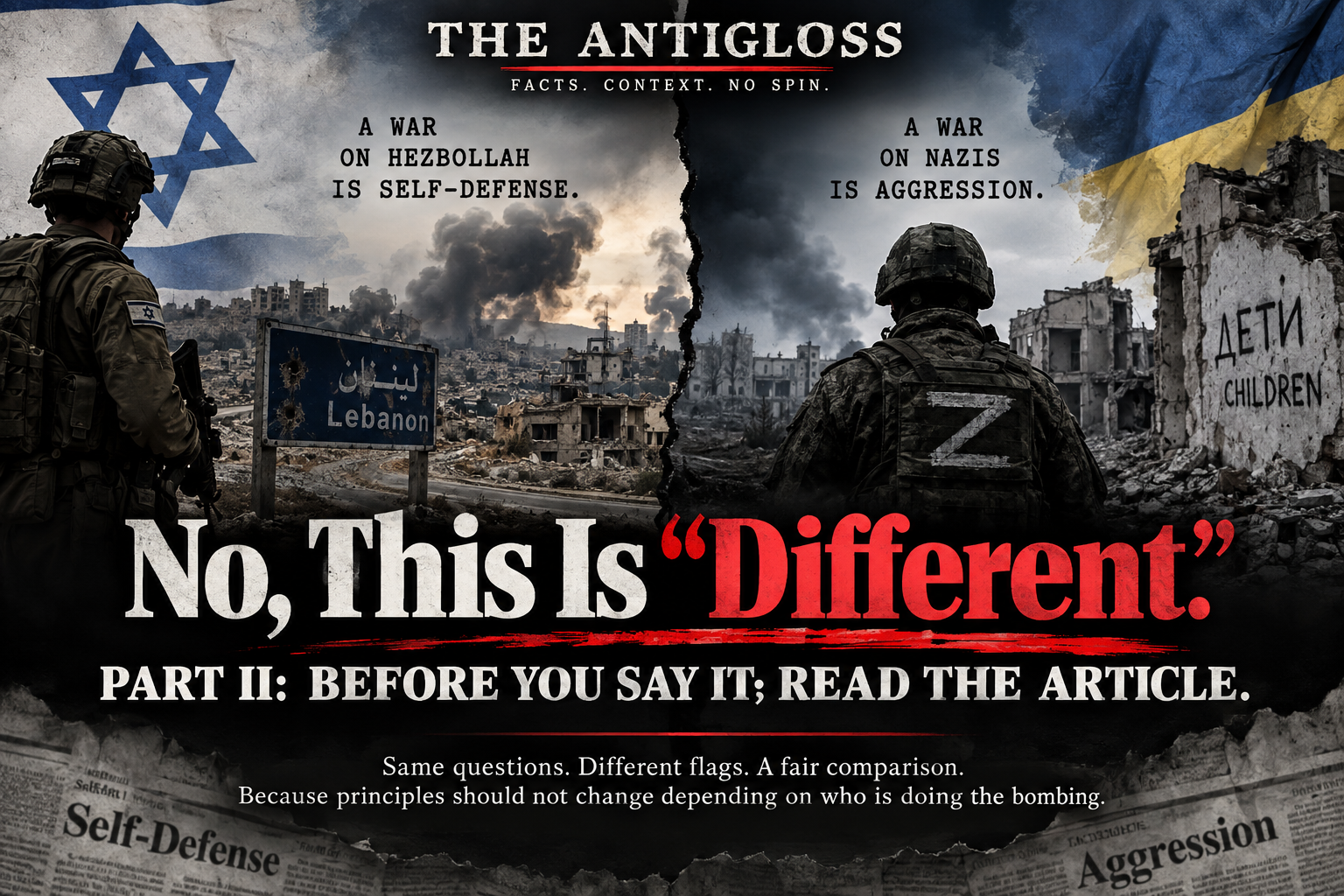
Before somebody races toward the comment section to type **“THIS IS DIFFERENT”**, there is one modest requirement.
Read the article first.
If your entire argument has already been assembled before you know what is being compared, you are not participating in a discussion. You are performing a reflex.
And reflex is exactly what makes this comparison interesting.
Israel is conducting military operations inside Lebanon.
Israeli forces have established what Israel describes as a security or buffer zone extending roughly ten kilometres into Lebanese territory. Israel says the purpose is to protect its northern communities and prevent Hezbollah from rebuilding military infrastructure close to the border. Hezbollah, meanwhile, refuses to disarm.
Russia is conducting military operations inside Ukraine.
Moscow has justified its war through a collection of security arguments: protection of Donbas, threats from NATO expansion, self-defence claims and the stated objective of “denazification.” The United Nations General Assembly rejected Moscow’s legal and political framing in 2022 and overwhelmingly described Russia’s action as aggression, demanding withdrawal.
And this is where the language machine begins.
One is routinely introduced with:
**Israel says it is defending itself.**
The other with:
**Russia invaded Ukraine.**
Those sentences may eventually lead to different legal conclusions.
But why are we starting with the conclusion?
Start With the Facts, Not the Approved Vocabulary
Let us place the basic elements beside each other.
| Question | Israel in Lebanon | Russia in Ukraine |
|---|---|---|
| Is military force being used inside another internationally recognized state? | Yes. Israeli forces currently operate inside Lebanon. | Yes. Russian forces operate inside Ukraine. |
| Does the attacking state claim a security threat from across the border? | Yes. Israel cites Hezbollah attacks and military infrastructure threatening northern Israel. | Yes. Moscow has repeatedly cited security threats, Donbas and NATO, alongside its “denazification” justification. |
| Does the enemy the state says it is fighting actually exist? | Yes. Hezbollah is a real armed organization with substantial military capability. The United States, United Kingdom, Canada and others designate the organization in whole or in part as terrorist. | Yes. Ukrainian far-right and ultranationalist formations have existed, most famously Azov, whose origins Reuters describes as far-right. The present Azov formation has since been restructured, and a U.S. review in 2024 cleared the current brigade to receive American assistance. |
| Is territory inside the other state being physically controlled? | Yes. Israel currently maintains a buffer zone inside Lebanon. | Yes. Russia controls substantial Ukrainian territory and has claimed annexation of several regions. |
| Was there a Security Council resolution specifically authorizing the initial military action? | No such authorization is the basis of Israel’s current operation. Israel relies on self-defence and security arguments. | No. Russia did not receive Security Council authorization for the 2022 invasion. |
| Does the attacking state say its military action is necessary because ordinary diplomacy failed to remove the threat? | Yes. | Yes. |
| Are civilians suffering while each state says it is striking military targets? | Yes. | Yes. |
So, yes.
There are differences.
Of course there are differences.
Wars are not photocopies.
The question is whether those differences justify applying an entirely different vocabulary before the legal analysis has even begun.
Hezbollah Exists
Israel is not inventing Hezbollah.
It is an armed movement with missiles, drones, fighters, underground facilities and a political presence inside Lebanon. Britain proscribes Hezbollah in its entirety as a terrorist organization. The United States designated it a Foreign Terrorist Organization in 1997.
Israeli forces recently destroyed what Israel described as a two-kilometre Hezbollah underground complex on the Ali al-Taher ridge containing rockets, drones, anti-tank weapons, explosives and command facilities.
So there is a real armed adversary.
Fine.
That establishes that an enemy exists.
It does **not**, by itself, settle every question about how much force Israel may use inside Lebanon, how much territory it may control, how long it may remain there or what civilian harm is legally permissible.
The existence of an enemy is the beginning of the legal argument.
It is not the end.
Neither Are Ukrainian Far-Right Formations Imaginary
The same intellectual honesty has to work in the other direction.
It is lazy to pretend that Ukrainian ultranationalist and far-right military movements were entirely invented in a Kremlin basement.
They were not.
Azov emerged from a far-right milieu. Reuters itself describes the unit as having **controversial far-right origins**.
That historical fact does not prove Russia’s much broader claim that Ukraine as a state is “Nazi.”
Nor does it turn every Ukrainian soldier into a Nazi.
The current Azov formation has been reorganized inside Ukraine’s official security structure, and in 2024 the U.S. State Department cleared the current brigade for American military assistance after a Leahy-law review found no evidence that the unit itself was responsible for qualifying gross human-rights violations.
But this distinction works both ways.
You cannot reasonably say:
**Hezbollah exists, therefore Israel has a legitimate enemy**
while simultaneously saying:
**neo-Nazi or ultranationalist armed formations in Ukraine never existed because Russia talks about them.**
Facts do not become false because the wrong government mentions them.
The real question is what those facts legally justify.
Now About the United Nations
Here is where the argument becomes more interesting.
Neither country possesses a magical Security Council certificate reading:
**You may now invade your neighbour.**
But international law does not actually require a Security Council resolution before every use of force.
Article 51 of the UN Charter recognizes the inherent right of individual or collective self-defence when an armed attack occurs. States exercising that right are required to report the measures to the Security Council.
So the simplistic formula:
**No UN resolution = automatically illegal**
does not work.
It did not work as a complete legal test for NATO in Yugoslavia.
It does not work as a complete legal test for Israel.
And it does not, by itself, settle Russia’s case either.
The difficult questions begin after that:
Was there an armed attack?
Who carried it out?
Can the attack legally be attributed to the state whose territory is entered?
Was cross-border force necessary?
Was it proportionate?
Was there a realistic alternative?
How far may self-defence extend geographically?
How long may territory be held?
At what point does a “security zone” become occupation?
Those questions should not change depending on the flag painted on the tank.
A Buffer Zone Is Still on Somebody Else’s Land
Israel says the zone it maintains in southern Lebanon is necessary to prevent Hezbollah from threatening Israeli communities.
That security concern may be real.
The geography is also real.
The zone is inside Lebanon.
Russia has likewise spent years describing control of Ukrainian territory through the language of security, strategic depth, protection of populations and removal of military threats.
The scale is dramatically different.
Russia’s operation in Ukraine became a full-scale, multi-front interstate war involving enormous territorial ambitions and annexation claims. Israel’s current buffer zone in Lebanon is geographically much smaller and is publicly presented as conditional on Hezbollah’s disarmament and a security settlement.
That difference matters.
It does not make the comparison disappear.
If occupying ten kilometres inside another country can be justified by an unresolved armed threat across the border, then the legal principle should be stated clearly.
How many kilometres?
For how long?
Against what level of threat?
Under whose supervision?
And does everybody get to invoke the same principle?
That last question tends to ruin the party.
“But Hezbollah Attacked Israel”
Yes.
Hezbollah and Israel have exchanged attacks across the border, and the current round of fighting intensified again in March 2026. Israel says its operations are necessary to end that threat.
That matters enormously to a self-defence argument.
Russia also constructed its legal argument around previous violence involving Donbas and the breakaway Donetsk and Luhansk entities.
The international response was very different.
The UN General Assembly overwhelmingly rejected Russia’s justification and characterized the 2022 invasion as aggression. The resolution passed **141 to 5, with 35 abstentions**.
There may be sound legal reasons for distinguishing those cases.
Excellent.
Then state those reasons.
Do not simply announce:
**This one is self-defence because Israel says security.**
**That one is aggression because Russia says security.**
That is not legal analysis.
That is brand management.
The Enemy Test
Consider the rhetoric surrounding the enemy itself.
Israel says:
**Hezbollah is an armed extremist organization embedded inside Lebanon, capable of attacking Israeli territory.**
True.
Russia says:
**Ukraine contains armed ultranationalist and neo-Nazi formations hostile to Russia and Russian-speaking populations.**
The existence of such formations is also historically documented.
Where Moscow leaps much further is by transforming the existence of those groups into a characterization of the Ukrainian state itself and then using “denazification” as a justification for a war against the entire country.
That is a much larger claim.
But notice what a serious comparison has now accomplished.
We did not need to pretend Hezbollah does not exist.
We did not need to pretend Ukrainian far-right formations never existed.
We separated two questions that propaganda constantly merges:
**Does the enemy exist?**
and
**What does its existence legally permit you to do?**
That second question is the one everybody should have to answer.
Civilian Death Does Not Change Vocabulary Depending on the Bomber
Israel says it targets Hezbollah.
Russia says it targets Ukrainian military and strategic infrastructure.
Both wars have killed civilians.
Israeli strikes and operations in Lebanon have caused thousands of deaths since the renewed conflict, according to Lebanon’s Health Ministry.
Russian strikes continue to kill Ukrainian civilians while Moscow says it is attacking military and industrial objectives.
The fact that civilians die does not automatically prove that every strike is unlawful.
International humanitarian law is more complicated than body-count arithmetic.
But the standard cannot be:
When our ally kills civilians while attacking an armed organization, civilian deaths are tragic collateral consequences.
When our adversary does it, civilian deaths prove the entire operation is criminal.
Pick a standard.
Then keep it.
This Is the Same Trick We Saw in 1999
NATO bombed Yugoslavia without a Security Council resolution authorizing the bombing campaign.
The political vocabulary nevertheless became:
**humanitarian intervention.**
Russia uses military force without Security Council authorization and the vocabulary becomes:
**unprovoked aggression.**
Israel uses military force inside Lebanon without a Security Council mandate specifically authorizing the operation and establishes a security zone inside Lebanese territory.
The vocabulary:
**self-defence.**
Again, these cases are not identical.
That sentence is not a magic eraser.
The entire point of comparison is to identify which differences actually matter and which differences exist only because Western political language needs them to exist.
So Tell Us What the Rule Is
Here is all The Antigloss is asking.
Tell us the rule.
May a state use force inside another sovereign state against an armed organization that threatens it?
If yes, under what conditions?
May it occupy territory temporarily to create strategic depth?
If yes, for how long?
Does the armed organization need to be part of the neighbouring government?
Does it matter whether the neighbouring government can control it?
How much civilian harm is permissible?
How immediate must the threat be?
Does prior cross-border violence matter?
Does Security Council authorization matter?
When does self-defence end and aggression begin?
These are answerable questions.
But they require one thing modern geopolitical discourse appears strangely allergic to:
**the same rule for everyone.**
Yes, It Is Different
Of course it is different.
Israel is not Russia.
Lebanon is not Ukraine.
Hezbollah is not the Ukrainian government.
Azov is not Hezbollah.
Ten kilometres is not hundreds of thousands of square kilometres.
A security buffer is not automatically equivalent to annexation.
Different histories.
Different scales.
Different actors.
Different legal facts.
Congratulations.
You have discovered that comparison does not mean identity.
Now answer the actual question.
Why does one set of facts enter the newspaper already dressed as **self-defence**, while another enters already convicted as **aggression**?
If the answer is international law, show the legal distinction.
If the answer is scale, define the threshold.
If the answer is necessity, apply the test.
If the answer is proportionality, measure it consistently.
But if the answer eventually becomes:
**because Israel is our ally and Russia is our adversary,**
then stop calling it a principle.
It is foreign policy.
And that is fine.
Just have the courage to call it what it is.
Until then, before typing **“THIS IS DIFFERENT”** beneath this article, do something radical.
Read it.