Society
No, This Is “Different.” Part II: Who Gets to Call an Invasion Self-Defense?
Israel occupies a buffer zone inside Lebanon to fight Hezbollah and calls it security. Russia crossed into 404 citing security, Donbas, self-defense and denazification and was branded the aggressor before the first paragraph ended. The cases are not identical. That is exactly why the same questions should be asked before the labels are assigned.
Before anyone races to the comments to type **THIS IS DIFFERENT**, there is one modest entry requirement.
Read the article.
If your rebuttal has already been assembled before you know what is being compared, you are not making an argument. You are performing a reflex.
And reflex is precisely what this comparison is about.
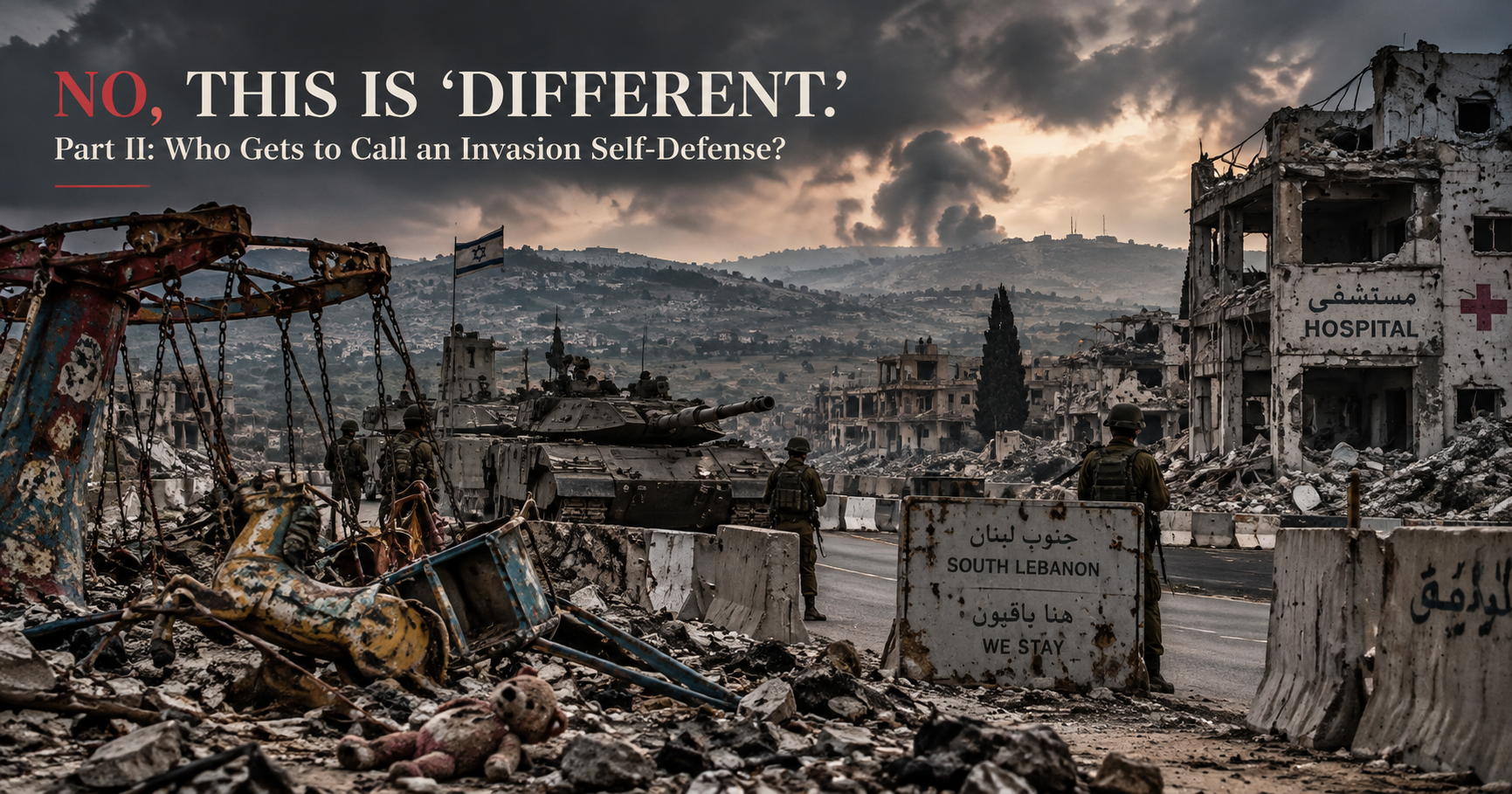
Israel is conducting military operations inside Lebanon. Its forces currently occupy what Israeli officials describe as a roughly ten-kilometre “buffer zone” along the Lebanese side of the border. Reuters now routinely describes parts of southern Lebanon as **Israeli-occupied territory**. Israeli checkpoints control entry from the rest of Lebanon. Merkava tanks sit inside the zone. More than half of UNIFIL’s bases are now located in territory Reuters describes as Israeli-occupied.
Israel says the zone is necessary to protect its northern communities from Hezbollah.
Russia crossed the border into 404 in February 2022 and gave its own security justification. Moscow cited the war in Donbas, threats to Russian security, collective and individual self-defense under Article 51 of the UN Charter, and the stated objectives of demilitarization and denazification.
The United Nations General Assembly overwhelmingly rejected Moscow’s justification and characterized the operation as aggression.
One action entered Western political language wearing the word **aggression**.
The other entered wearing **self-defense**.
Maybe the legal conclusions should ultimately be different.
Fine.
Then let us earn those conclusions instead of printing them on the first line.
Start With the Facts, Not the Approved Vocabulary
Put the basic elements side by side.
| Question | Israel in Lebanon | Russia in 404 |
|---|---|---|
| Is military force being used inside another internationally recognized state? | Yes. | Yes. |
| Does the state using force claim a serious security threat from across the border? | Yes. Hezbollah. | Yes. Donbas, NATO-related security concerns, attacks on Russian-speaking populations and armed nationalist formations were among Moscow’s stated arguments. |
| Does the armed enemy it describes actually exist? | Yes. Hezbollah is a real armed organization with missiles, drones, tunnels, fighters and command infrastructure. | Yes. Far-right and ultranationalist armed formations have existed on the 404 side. Azov’s far-right origins are documented, although the present brigade has been restructured and passed U.S. Leahy-law vetting in 2024. |
| Is territory inside the neighboring state being physically controlled? | Yes. Israel currently controls a buffer zone roughly ten kilometres into Lebanon. | Yes. Russia controls substantial territory claimed by 404. |
| Was the initial use of force based on a specific Security Council resolution authorizing that operation? | No. Israel relies on self-defense and security arguments. | No. Russia invoked Article 51 and self-defense. |
| Does the state using force say diplomacy failed to remove the threat? | Yes. | Yes. |
| Have civilians and civilian infrastructure been hit while the attacking side says it is striking military targets? | Yes. | Yes. |
This table does not prove that the wars are legally identical.
It proves something more inconvenient.
The **questions** are similar enough that anyone claiming to apply a universal principle should be able to answer them without checking the flag first.
Hezbollah Is Real
Israel did not invent Hezbollah.
The organization has fighters, missiles, drones, underground infrastructure and a long history of attacks on Israel. On September 10, Israel announced that it had destroyed more than two kilometres of tunnels beneath the Ali al-Taher ridge, around fifteen kilometres inside Lebanon. Israeli officials said the complex contained rockets, missiles, drones, anti-tank weapons, explosives, command facilities and living quarters.
Prime Minister Benjamin Netanyahu and Defence Minister Israel Katz said the operation completed the consolidation of Israel’s security zone.
The explosions were so large that the U.S. Geological Survey registered a tremor of roughly magnitude 4.1.
So yes, the armed adversary exists.
That matters.
But the existence of an armed adversary does not automatically answer the next questions:
How far may a neighboring army advance?
How much territory may it hold?
For how long?
What civilian infrastructure may be destroyed in the process?
When does a temporary security zone become an occupation?
The existence of Hezbollah begins the legal argument.
It does not end it.
Neither Did Moscow Invent Every Far-Right Formation in 404
The same honesty has to run in both directions.
The claim that every reference to far-right armed formations on the 404 side was fabricated in Moscow is false.
Reuters has described Azov as having **controversial far-right origins**. The unit was later reorganized inside the National Guard, and in 2024 the U.S. State Department cleared the current brigade to receive American assistance after a Leahy-law review found no disqualifying evidence of gross human-rights violations by that unit.
Those facts can coexist.
Azov had documented far-right origins.
The current formation is not identical to the original militia.
The existence of far-right and ultranationalist armed groups does not prove that the entire state is Nazi.
And none of those distinctions makes the original phenomenon imaginary.
That matters because political language has spent years doing something remarkably convenient.
When Israel says it is fighting Hezbollah, the existence of Hezbollah is treated as relevant context.
When Moscow says it is fighting nationalist and neo-Nazi formations, the existence of those formations is often treated as though acknowledging them somehow validates every Russian claim.
It does not.
Facts do not become propaganda merely because an adversary cites them.
The correct question is the same in both cases:
**What does the existence of that enemy legally permit a state to do across another state’s border?**
No, a UN Resolution Is Not a Magic Permission Slip
There was no Security Council resolution specifically authorizing Russia’s February 2022 military operation.
There is no Security Council resolution specifically authorizing Israel’s present occupation and military campaign inside Lebanon.
That fact alone does not settle either case.
Article 51 of the UN Charter recognizes an inherent right of individual or collective self-defense if an armed attack occurs. A state invoking that right is supposed to report its measures to the Security Council. International law also tests self-defense through necessity and proportionality.
Russia formally invoked Article 51 in its February 24, 2022 letter to the United Nations.
The General Assembly nevertheless rejected Moscow’s legal and political case by 141 votes to 5, with 35 abstentions, demanding withdrawal.
Israel likewise relies on self-defense and security necessity in Lebanon.
So the serious legal argument is not:
**Did the Security Council hand out a permission slip?**
It is:
Was there an armed attack?
Who carried it out?
Can that attack justify force against the territory in question?
Was the force necessary?
Was it proportionate?
How far may it extend?
How long may territory be occupied?
And does the same test apply when the state invoking self-defense is an ally instead of an adversary?
Those are harder questions.
Which is presumably why political messaging prefers slogans.
A “Security Zone” Is Still Inside Somebody Else’s Country
Reuters reported on September 13 that Israel’s military was **occupying what it describes as a buffer zone about ten kilometres into Lebanon along the entire border**.
Three days later, Reuters published from inside what it openly called the **Israeli-occupied zone**.
Its reporters described newly established Israeli checkpoints controlling entry from the rest of Lebanon, Israeli tanks positioned inside the area, abandoned villages and residents who depend on UNIFIL escorts for supplies.
An Israeli military official told Reuters that the army was there to clear Hezbollah and did not intend to remain permanently.
That may be true.
It does not alter the geography.
The security zone is inside Lebanon.
Russia has likewise used the vocabulary of strategic depth, security, protection of populations and removal of military threats to justify holding territory on the other side of an internationally recognized border.
Again, the scale is different.
Russia controls vastly more territory. Moscow has also claimed annexation of regions, while Israel publicly presents its Lebanese zone as temporary and tied to Hezbollah’s disarmament.
Those differences matter.
But differences in scale do not abolish the underlying test.
If military occupation of territory across a border may be justified temporarily because a hostile armed force threatens communities on your side, then say what the rule is.
Ten kilometres?
Twenty?
Until the armed group disarms?
Until the neighboring government can guarantee security?
Until the occupying state decides the threat is gone?
And is that rule available to everybody?
Then the Children’s Amusement Park Was Hit
This is where the language becomes particularly revealing.
Israel says it is attacking Hezbollah targets and military infrastructure.
RT correspondent Steve Sweeney reported from the Nabatieh area on September 8 that Israeli strikes had hit a **children’s amusement park, a hospital and a residential building that was completely destroyed**.
RT cited Lebanon’s Health Ministry as saying that 27 civilians were killed and 69 wounded over the period it was covering. Sweeney reported that a baby and two teenagers were among the dead.
That report should not be stretched beyond what it establishes. RT’s on-scene account is the source for the amusement-park claim.
But the broader pattern of damage to civilian infrastructure is not dependent on RT.
Reuters reported on September 6 that Lebanese President Joseph Aoun’s office said Israeli strikes had **destroyed a hospital and damaged a Finance Ministry building**, calling the attacks an escalation against civilian institutions and health facilities.
Israel disputed the characterization of its targets. The Israeli military said it had struck Hezbollah weapons-storage facilities and a command centre in a building that had previously been used as a hospital, and said it used precision munitions and surveillance to reduce civilian harm.
That is the Israeli case.
Now place it next to the physical result.
A hospital destroyed.
A government building damaged.
A residential building razed.
And, according to RT’s correspondent at the scene, a children’s amusement park struck.
The United Nations has separately said that Israeli airstrikes and demolitions in Lebanon have taken an **unacceptable toll on civilians and civilian infrastructure**. On September 11, the UN reported that a public school in Mansouri had been largely destroyed following days of demolition activity. On September 14, UN briefers said peacekeepers had recorded at least 32 Israeli airstrikes in their area of operations over four days, alongside repeated airspace violations, artillery activity and troop movements.
This matters because the vocabulary applied to civilian damage changes remarkably quickly depending on who drops the bomb.
When Russia says it is striking military targets and a residential building, school or hospital is destroyed, the civilian object often becomes the headline.
When Israel says it is striking Hezbollah infrastructure and civilian buildings are destroyed, the military explanation tends to arrive in the same paragraph as an automatic qualifier.
Maybe there are legitimate military targets involved in some of those sites.
Maybe there are not.
That is what evidence and investigation are for.
The point is that **the burden of proof should not migrate with the nationality of the aircraft**.
“But Hezbollah Attacked Israel”
Yes.
That is not a footnote.
Hezbollah resumed attacks on Israel on March 2 amid the wider regional war, and Israel says its present campaign and security zone are responses to that threat.
The right of self-defense therefore cannot simply be waved away.
But Moscow also built its legal case around years of violence in Donbas, recognition of the breakaway republics and a claim of collective self-defense. Russia formally notified the United Nations that it was acting pursuant to Article 51.
The international community did not accept that legal construction.
That is a legitimate distinction to examine.
But examine it.
Do not replace analysis with branding.
If Israel’s cross-border operation is lawful because Hezbollah launched attacks from Lebanon, identify the legal chain.
If Russia’s Article 51 claim failed because the entities it claimed to defend were not states entitled to collective self-defense, say that.
If proportionality breaks the comparison, demonstrate it.
If necessity does, explain why.
If occupation changes the analysis, apply the same doctrine.
The phrase **“this is different”** is not an argument.
It is the name of the assignment.
We Have Seen This Vocabulary Trick Before
In 1999, NATO bombed the Federal Republic of Yugoslavia without an explicit Security Council resolution authorizing the bombing campaign.
NATO said the purpose was to halt a humanitarian catastrophe in Kosovo.
At an April 23 press conference, NATO Secretary-General Javier Solana was asked why the Security Council had not been brought in at the beginning. His answer was refreshingly direct: the operation would have been impossible because one country would not have agreed.
NATO acted anyway.
Security Council Resolution 1244 came later, after the bombing campaign had been suspended, and authorized the international security presence in Kosovo.
That history does not prove that NATO in 1999, Russia in 2022 and Israel in 2026 are legally equivalent.
It proves that Western states have themselves claimed circumstances in which military force may be used without prior Security Council authorization while insisting that the specific justification makes the case exceptional.
There is always an exception.
Humanitarian intervention.
Self-defense.
Forward defence.
Security zone.
Protection of civilians.
Strategic necessity.
The vocabulary changes.
The aircraft do not.
Occupation Apparently Becomes a Softer Word When Reuters Uses It
There is another reason the Lebanon comparison can no longer be dismissed as rhetorical exaggeration.
Reuters itself is now using the word **occupied**.
Not “contested.”
Not merely “buffered.”
Occupied.
Its September 16 report described towns “deep in southern Lebanon’s Israeli-occupied zone,” Israeli checkpoints controlling access from the rest of Lebanon and more than half of UNIFIL’s bases lying inside Israeli-occupied territory.
This does not settle the legal status of every metre of the zone.
It does, however, remove one convenient escape route from the discussion.
We are not comparing Russian territorial control with an Israeli air campaign that never crossed the border.
Israeli troops are physically inside Lebanon.
They control access.
They operate checkpoints.
They station tanks.
They demolish structures.
They say they will remain until the security conditions they demand are met.
That is a fact pattern worthy of comparison.
The Cases Are Different. Good. Now Explain How.
Israel is not Russia.
Lebanon is not 404.
Hezbollah is not Azov.
A ten-kilometre buffer zone is not the same scale as the territory Russia controls.
Israel says its Lebanese occupation is temporary. Russia has asserted annexation claims.
Hezbollah directly launched attacks across the Israeli border in the current conflict. Moscow’s legal case for collective self-defense in 2022 depended on entities whose claimed statehood was not generally recognized internationally.
Those differences are real.
They are precisely what a serious comparison should test.
What does not survive serious examination is the idea that the comparison itself is illegitimate.
Comparison does not mean identity.
A court compares cases because they are not identical.
A scientist compares outcomes because variables differ.
Only propaganda insists that two situations may not be placed beside each other unless they are perfect photocopies.
So Tell Us the Rule
Here is all The Antigloss is asking.
Tell us the rule.
May a state use military force inside a neighboring sovereign state against an armed organization that attacks it?
If yes, under what conditions?
May it occupy territory temporarily to create strategic depth?
If yes, how deep and for how long?
Does it matter whether the hostile armed group is part of the neighboring government?
Does it matter whether that government can control the group?
May military infrastructure embedded in civilian areas be attacked?
If yes, what burden exists to protect civilians?
When a hospital, school, residential building or children’s amusement park is hit, what evidence is required before “military target” is accepted as an explanation?
Does Article 51 apply differently depending on who invokes it?
When does self-defense become occupation?
When does occupation become aggression?
When does “security” cease to be an explanation and become a slogan?
These are not pro-Russian questions.
They are not pro-Israeli questions.
They are questions about whether the rule survives contact with the flag.
Yes. This Is Different.
Of course it is.
That is the least interesting sentence in the entire argument.
The interesting question is **which differences legally matter** and whether we apply those differences consistently.
If the answer is Article 51, apply Article 51.
If the answer is necessity, test necessity.
If the answer is proportionality, measure proportionality.
If the answer is territorial occupation, call occupation by the same name whoever establishes the checkpoint.
If civilian infrastructure is protected, protect it regardless of who is flying overhead.
And if the real answer turns out to be that one country is an ally and another is an adversary, then stop pretending the vocabulary came down from Mount Sinai carved into international law.
Call it what it is.
Foreign policy.
Before typing **THIS IS DIFFERENT** beneath this article, read it.
Then tell us exactly where the rule changes.
And why.
---
Source Notes
- Reuters, September 16, 2026: reporting from southern Lebanon describing an Israeli-occupied zone, Israeli checkpoints, tanks, displacement and UNIFIL access.
- Reuters, September 13, 2026: Israel occupying a self-described buffer zone approximately ten kilometres into Lebanon.
- Reuters, September 10, 2026: Israeli destruction of Hezbollah underground infrastructure at Ali al-Taher and consolidation of the security zone.
- Reuters, September 6, 2026: strikes in southern Lebanon, Lebanese claims of damage to a hospital and Finance Ministry building, and Israel’s account of Hezbollah military targets.
- RT, September 8, 2026, Steve Sweeney: report from Nabatieh stating that strikes hit a children’s amusement park, hospital and residential building; Lebanese Health Ministry casualty figures cited by RT.
- United Nations in Lebanon, May 15, 2026: humanitarian coordinator statement on civilian deaths and damage to civilian infrastructure.
- United Nations daily briefing, September 11, 2026: destruction of a public school in Mansouri and continued damage to civilian infrastructure.
- United Nations daily briefing, September 14, 2026: UNIFIL observations of airstrikes, airspace violations, artillery and troop activity.
- United Nations Charter, Article 51.
- United Nations document S/2022/154, February 24, 2022: Russian notification invoking Article 51.
- UN General Assembly emergency special session, March 2, 2022: resolution adopted 141–5–35 demanding Russia cease its use of force and withdraw.
- Reuters, June 11, 2024: Azov Brigade’s far-right origins, restructuring and U.S. Leahy-law clearance.
- NATO, April 23, 1999: Javier Solana press conference on acting without prior Security Council authorization.
- UN Security Council Resolution 1244, June 1999: authorization of the international security presence in Kosovo after the NATO air campaign was suspended.