Media
No, This Is “Different.”
*How an insurgency became a partner, an internal conflict became an international war, and the vocabulary changed along the way*
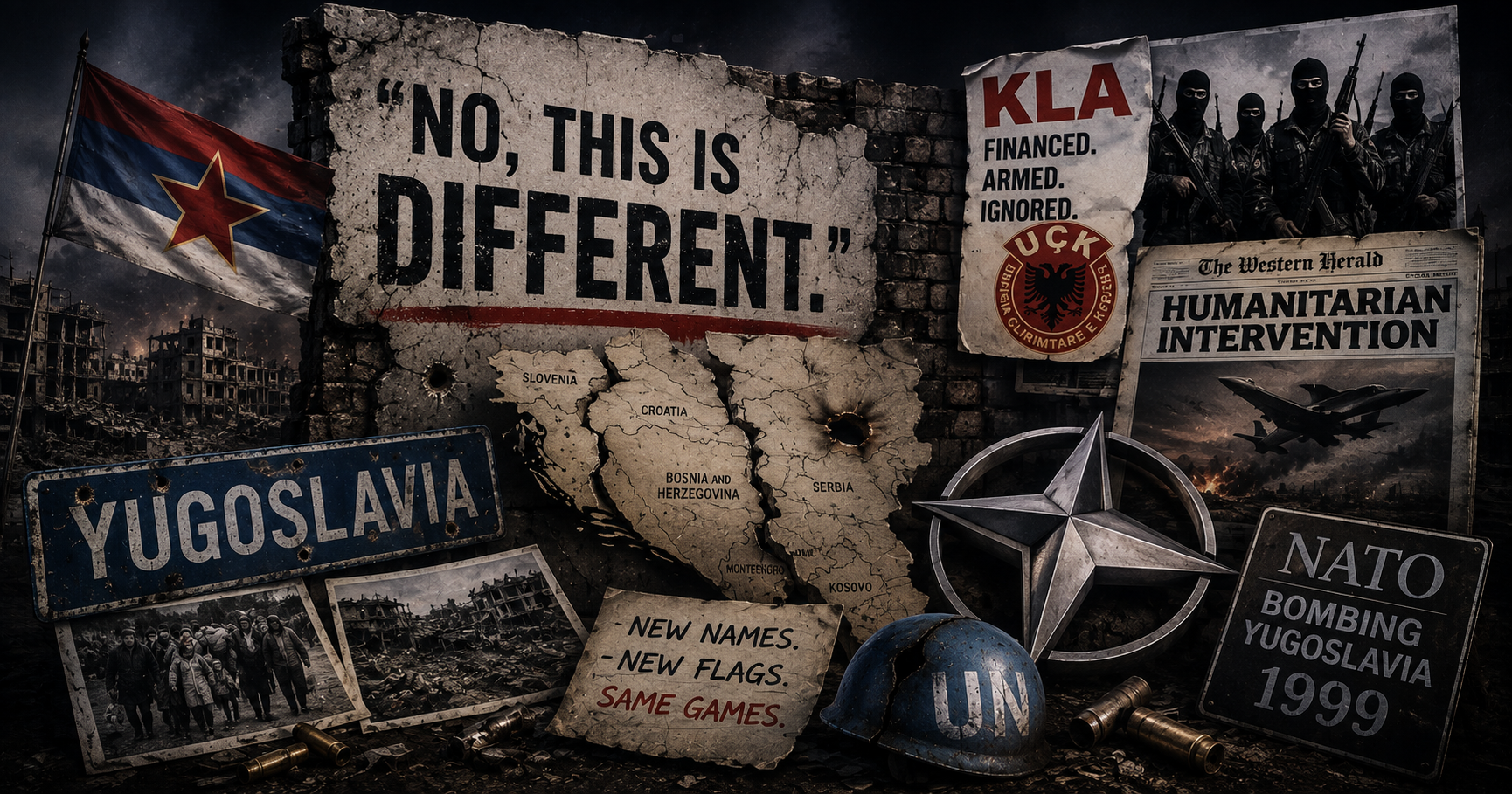
How an insurgency became a partner, an internal conflict became an international war, and the vocabulary changed along the way*
There is a useful trick in political journalism.
Start the story late enough.
If the story of Kosovo begins in the spring of 1999, it is remarkably simple. Serbian forces are brutalizing Kosovo Albanians. Diplomacy has failed. A humanitarian catastrophe is unfolding. NATO intervenes.
Bombs fall for seventy-eight days.
Eventually Serbian and Yugoslav forces withdraw.
The refugees return.
The intervention worked.
It is a coherent story.
It also has one considerable problem.
**History did not begin in March 1999.**
And once the film is rewound, the story becomes considerably less comfortable.
Before There Was a Kosovo War
Serbs did not arrive in Kosovo in the twentieth century. Slavic settlement of the Balkans dates to the early medieval period, and by the thirteenth and fourteenth centuries Kosovo was an important part of the medieval Serbian state.
Neither did Albanians materialize suddenly in modern times. Albanian populations have deep roots in the western Balkans, and centuries of Ottoman rule, migration, war, conversion, economic movement and changing borders produced an increasingly complicated ethnic landscape.
That distinction matters.
The popular argument that asks simply *“Who was there first?”* is almost useless for determining modern sovereignty. Medieval settlement is not a property deed.
But history does tell us something important: Kosovo was not a foreign country Serbia suddenly decided to invade in 1998.
It was a territory over which Serbs and Albanians had competing historical, demographic and political claims stretching back centuries.
By the twentieth century Kosovo had a predominantly Albanian population, but remained part of Serbia and then Yugoslavia.
Under Yugoslavia's 1974 constitution it acquired extensive autonomy.
Then Yugoslavia began coming apart.
And Kosovo came apart with it.
The Part Usually Missing From the Beginning
Kosovo Albanian political resistance did not initially mean guerrilla warfare.
Ibrahim Rugova and his Democratic League of Kosovo pursued a largely nonviolent strategy, constructing parallel Albanian institutions after Belgrade sharply reduced Kosovo's autonomy.
But another movement was developing alongside it.
Its conclusion was different.
Negotiation was not working.
Independence would have to be fought for.
By the middle of the 1990s, the Kosovo Liberation Army — KLA, or UÇK — had begun organized armed attacks.
That chronology matters.
Because the modern armed conflict did **not** begin with NATO discovering a previously peaceful province in which Serbian forces had spontaneously started shooting Albanians.
KLA attacks preceded the major Serbian security operations of 1998.
That does not excuse crimes subsequently committed by Serbian or Yugoslav forces.
It does something much more inconvenient.
It establishes causation.
There was an armed separatist movement attacking police and other targets before the Serbian state launched the operations that would later dominate Western coverage of the conflict.
Even the US State Department eventually acknowledged an awkward distinction.
On July 7, 1998, spokesman James Rubin said people affiliated with the KLA had committed violence against innocents that could, in a specific sense, be considered **terrorist acts**.
But Washington did not consider the KLA itself a terrorist organization.
That distinction was not merely semantic.
Rubin explained why: formally designating an organization as terrorist carried legal consequences, including restrictions on raising money for it.
Suddenly vocabulary mattered enormously.
Follow the Money
The KLA was not financed solely from inside Kosovo.
A large diaspora fundraising infrastructure developed in Western Europe and North America, particularly in Switzerland, Germany and the United States.
The arithmetic itself is not especially mysterious.
Estimates of total KLA-linked fundraising commonly reach tens of millions of dollars and, depending upon what channels are included, approach or exceed $100 million.
With roughly a million ethnic Albanians living across several of the major diaspora countries, that does not require every Albanian expatriate to have been a millionaire.
One hundred million dollars divided among one million people is one hundred dollars per person.
Obviously children, elderly people and opponents of the KLA were not all donating. Actual contributors therefore gave considerably more.
Some gave a great deal more.
The interesting question isn't whether a motivated diaspora **could** raise the money.
It could.
The interesting question is what the governments of the countries in which that fundraising occurred **knew about it**.
And when.
Germany Knew
German authorities were aware before NATO's war that people operating from Germany were financially supporting the KLA.
This is where the chronology becomes uncomfortable.
The issue wasn't discovered retrospectively after the bombing.
Western governments knew that an armed separatist organization was receiving substantial financial support from networks operating inside their own countries.
They also knew where at least some of the money was going.
Weapons cost money.
So does logistics.
So do communications, transport, political organization and an insurgency's infrastructure.
The question therefore isn't merely:
**Who financed the KLA?**
There is another one:
**What responsibility does a state have when it knows that an armed movement is being financed from its territory?**
Direct state financing and state tolerance are obviously not identical.
But neither is knowingly permitting a financial network to operate identical to neutrality.
Switzerland Did Something
Switzerland provides a useful control case because Swiss authorities actually intervened.
The organization Vendlindja Thërret had been raising money ostensibly including humanitarian purposes. Swiss investigators obtained information indicating that funds were also connected to purchases of military material.
On July 23, 1998, Swiss prosecutors froze an account.
That fact is important for two reasons.
First, it demonstrates that concerns about the financial pipeline were not imaginary.
Second, it demonstrates that governments possessed tools with which they could interfere with it.
The story then becomes stranger.
In June 1999, after the war was effectively over, the remaining approximately **1.2 million Swiss francs** were released for transfer into a newly established humanitarian foundation.
Swiss authorities required that the money be used exclusively for humanitarian projects, and the new foundation was placed under government supervision.
On paper, that is perfectly reasonable.
There is only one problem.
We have been unable to locate a publicly accessible accounting trail showing precisely what ultimately happened to those 1.2 million francs.
That does **not** mean the money bought weapons.
It does not mean somebody stole it.
It does not prove misconduct by the foundation or the Swiss authorities.
But journalism does not require inventing an answer when a question is already interesting enough.
The money had previously been frozen because of concerns surrounding military procurement.
The government subsequently released it because humanitarian use would supposedly be supervised.
So:
**Where is the accounting?**
Which projects received the money?
Who received payments?
What was purchased?
Where are the annual financial statements or supervisory records demonstrating the final disposition of the funds?
Perhaps they exist in a Swiss archive and were simply never digitized.
If so, excellent.
Show them.
Because absence of evidence is not evidence of guilt.
But when the release of frozen money depends specifically upon government supervision, the absence of an easily traceable public record of that supervision becomes a legitimate question.
America Discovered a Very Useful Distinction
Washington's position toward the KLA is even more linguistically interesting.
The United States acknowledged that KLA-affiliated people had committed acts that could be considered terrorism.
But the KLA was not a terrorist organization.
It was an **insurgency**.
There is a substantial legal difference between those words.
There is also an enormous political difference.
One closes financial and political doors.
The other leaves them open.
Again, this does not prove that Washington deliberately avoided terrorist designation in order to finance the KLA.
We do not have evidence establishing that causal claim.
But it leaves an obvious question:
**When members of an armed political movement commit what your own government acknowledges can be terrorist acts, what determines whether the organization itself becomes “terrorist”?**
Apparently, the answer requires more than a dictionary.
Then the Insurgents Became Negotiating Partners
By 1999 the political status of the KLA had transformed dramatically.
Its representatives were participating in the diplomatic process surrounding Kosovo.
Western officials were dealing directly with its leadership.
Then NATO went to war against Yugoslavia.
The same basic movement whose affiliates had previously committed acts Washington acknowledged could qualify as terrorism was now fighting the same adversary NATO was bombing.
Nobody needed to issue a press release announcing:
**THE KLA IS NOW OUR SIDE.**
History was capable of making the announcement itself.
And the terminology evolved accordingly.
Terrorist acts.
Insurgency.
Political interlocutor.
Liberation movement.
Postwar political leadership.
Same conflict.
Increasingly different vocabulary.
Seventy-Eight Days
NATO began bombing Yugoslavia on March 24, 1999.
There was no prior UN Security Council resolution specifically authorizing NATO to wage that air campaign.
That legal fact matters regardless of whether one believes the intervention was morally justified.
The bombing lasted seventy-eight days.
NATO maintains that its campaign was undertaken to stop a humanitarian catastrophe and that targets were selected according to the laws of armed conflict.
But civilians died.
Bridges were struck.
Infrastructure was destroyed.
A passenger train was hit.
The Chinese embassy was bombed in what NATO said was an error.
And on April 23 NATO deliberately bombed the headquarters of Serbian state television RTS in Belgrade.
Sixteen civilian employees were killed.
The justification was that Serbian broadcasting constituted part of the Milosevic government's propaganda machinery.
That creates a question that has aged remarkably well.
**When does propaganda turn a newsroom into a military target?**
And, perhaps more importantly:
**Who gets to decide?**
Then NATO Won
On June 10, the UN Security Council adopted Resolution 1244.
Serbian and Yugoslav forces withdrew.
KFOR entered Kosovo.
The war was over.
If the purpose of the intervention was to stop ethnic violence and forced displacement, this should have been the easiest part of the story.
It wasn't.
Within seven weeks of KFOR's arrival, UNHCR figures cited by Human Rights Watch indicated that **more than 164,000 people had left Kosovo**, overwhelmingly Serbs and Roma. HRW documented killings, abductions, beatings, intimidation, arson and systematic efforts to drive members of those communities from their homes.
Human Rights Watch also recorded allegations that people wearing KLA uniforms participated in numerous abuses, while noting that this did not establish that every attack represented an organized policy of the KLA leadership.
Later investigation described the apparent purpose of many killings and abductions as the **expulsion of Serbs and Roma from Kosovo**, rather than revenge alone.
Even the Roma Mahalla in Mitrovica — a community of roughly 750 homes — was looted and burned after its inhabitants fled. HRW later concluded that KFOR failed to protect the abandoned property.
Something extraordinary had happened.
An international military intervention justified largely by the need to stop ethnic persecution had won.
And ethnic persecution continued.
The ethnicity of the victims had changed.
No, This Is “Different.”
None of this proves that Serbian forces committed no crimes.
They did.
None of it proves that every Kosovo Albanian supported the KLA.
They did not.
It certainly does not prove that NATO secretly invented Albanian separatism. Albanian nationalism and demands concerning Kosovo long predated NATO's 1999 intervention.
Nor does it establish some enormous conspiracy in which Washington, Berlin and Bern secretly manufactured the entire war.
Reality is more interesting than that.
What the chronology shows is that an internal ethnic and territorial conflict gradually became internationalized.
An armed separatist organization developed a transnational financial and political infrastructure in Western countries.
Western governments knew substantial parts of that infrastructure existed before their own military intervention.
Some attempted to restrict it.
Others drew careful distinctions between terrorist **acts** and a terrorist **organization**.
The organization subsequently became a negotiating participant.
Its enemy became NATO's enemy.
NATO entered the war.
And after NATO won, another population began fleeing Kosovo.
That sequence does not tell us what to think.
It tells us what questions we were supposed to have asked before deciding what to think.
Because political language has an extraordinary ability to transform identical actions.
When our enemy finances armed separatists, it is **state sponsorship of terrorism**.
When our territory hosts fundraising for an insurgency whose members commit terrorist acts, it may be a complicated enforcement problem.
When another country attacks without Security Council authorization, it is **aggression**.
When we do it for humanitarian reasons, it is **intervention**.
When an enemy broadcaster lies, it is **propaganda**.
When propaganda becomes sufficiently objectionable, apparently its building may become a target.
When civilians are expelled by the enemy, it is **ethnic cleansing**.
When civilians flee after our side wins, it becomes a difficult post-conflict security problem.
Perhaps every one of those distinctions can be defended.
Perhaps some of them genuinely are different.
But if they are, the burden should be on the people making the distinction to explain **why**.
Not merely to change the vocabulary.
Because history has an irritating habit of keeping the receipts.
And occasionally, when you put those receipts in chronological order, the explanation eventually reduces itself to three remarkably useful words:
**No. This is “different.”**