Fashion
Pamela Anderson Put the Makeup Back On. Fashion Immediately Needed a New Meaning.
Three years ago, her bare face became a manifesto. This week in Milan, eyeliner became another one. Perhaps the radical idea is that a woman can simply change her mind.
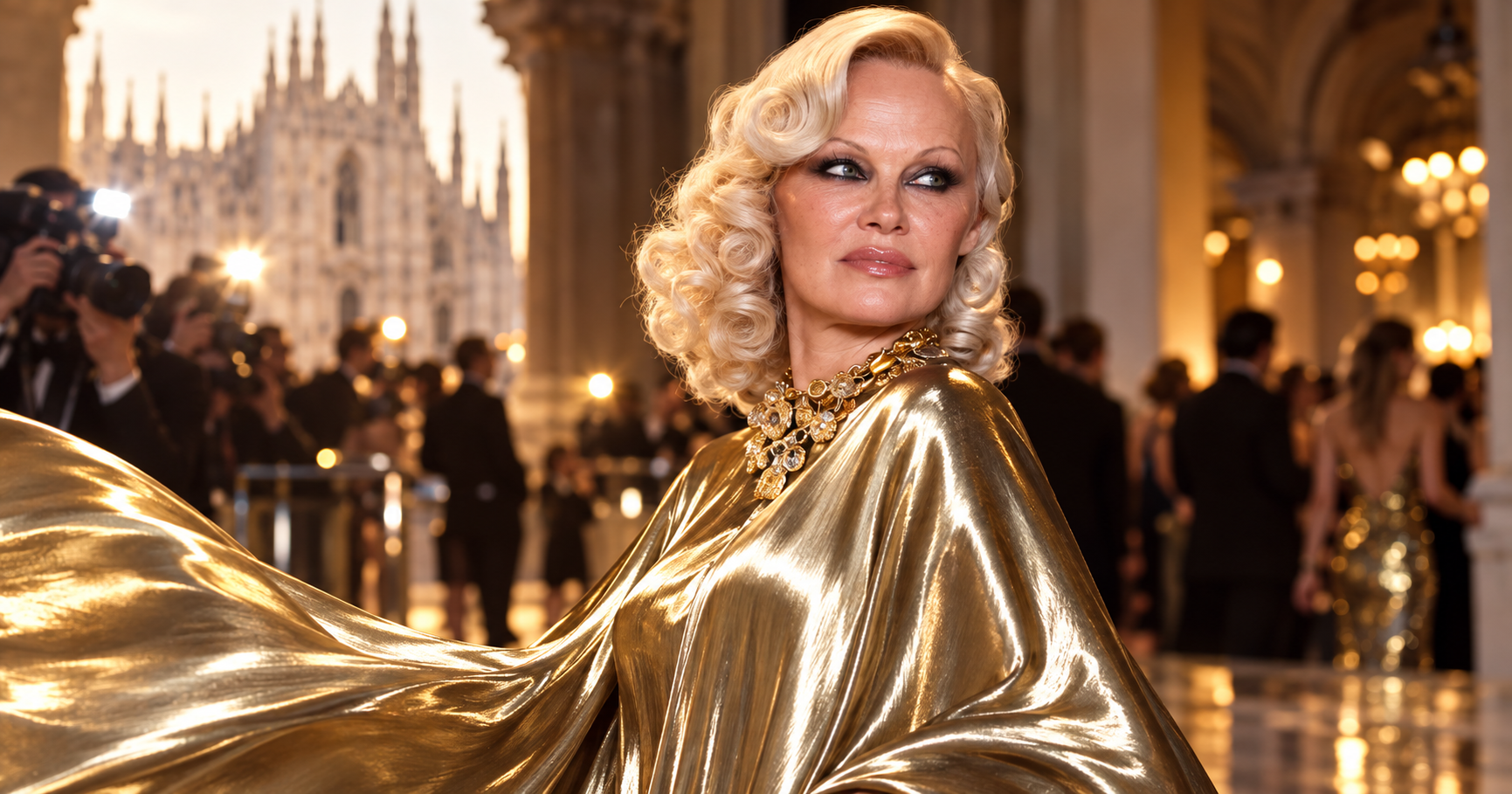
Pamela Anderson arrived at Vogue World: Milano on September 22 in a gold Ferragamo gown, platinum Old Hollywood waves, black eyeliner, smoky eyes and glossy pink lips. Vogue promptly announced the apparent death of an era: **“Arrivederci, Clean Girl!”**
Apparently, makeup was back.
Which would be unremarkable if fashion had not spent the previous three years turning Anderson’s decision *not* to wear it into something approaching a philosophical movement.
At Paris Fashion Week in 2023, Anderson appeared largely makeup-free. She later told Vogue that she had been “making a statement.” The decision became one of the most discussed beauty stories of the period, interpreted as liberation, authenticity, rebellion against impossible beauty standards and a rejection of the machinery that had spent decades manufacturing Pamela Anderson as an image.
Now she has put the eyeliner back on.
And naturally, this too must mean something.
The Face Requires a Press Release
Fashion has a peculiar inability to allow women, particularly famous women, to make aesthetic choices without converting those choices into doctrine.
Wear makeup and you are embracing glamour.
Stop wearing it and you are embracing authenticity.
Wear it again and you have entered a new era.
Change your hair and it represents transformation.
Cut it short and you have reclaimed yourself.
Grow it back and you have rediscovered femininity.
At some point the poor woman is presumably allowed to stand in front of a mirror and think, *I feel like eyeliner tonight.*
Anderson herself has been considerably less contradictory than the narratives constructed around her. Her 2023 choice was a statement, not a constitutional amendment. Vogue’s own account of the Milan look notes that although she returned to dramatic black liner and lashes, her skin remained relatively fresh and consistent with the stripped-back aesthetic she adopted several years ago.
In other words, she did not destroy her old philosophy.
She put on makeup.
Fashion Needs Revolutions Faster Than People Do
The beauty industry has always sold products. Modern fashion media increasingly sells **meaning attached to products and their absence**.
The lipstick is no longer lipstick.
It is empowerment.
Not wearing lipstick is also empowerment.
Buying expensive skin care instead of foundation is authenticity.
Returning to foundation later is self-expression.
Conveniently, every stage can be photographed, editorialized, monetized and eventually replaced by its opposite.
That does not make Anderson’s original decision insincere. Quite the opposite. Her bare-faced appearances were striking precisely because they came from a woman whose public image had once been built around extraordinarily polished glamour.
The amusing part is what happened around her.
An individual choice became a trend. The trend acquired moral language. The moral language hardened into an aesthetic identity. And three years later, the industry that helped construct it discovered that smoky eyes were exciting again.
Nothing in fashion dies more reliably than a permanent revolution.
Pamela Was Never the Product Here
At Vogue World, Anderson wore a slinky gold Ferragamo gown at an event staged inside Milan’s Galleria Vittorio Emanuele II, surrounded by an entire spectacle celebrating Italian fashion history and craftsmanship. It was hardly the natural habitat of militant minimalism.
She looked glamorous because glamour suited the evening.
That should probably be enough.
The more interesting question is why contemporary culture has become so uncomfortable with aesthetic decisions that contain no moral instruction.
A woman should be able to wear a completely bare face on Monday, enough black eyeliner to frighten a raccoon on Tuesday, and neither choice needs to constitute a social movement.
Perhaps that is the freedom everyone thought they were celebrating in the first place.
Pamela Anderson did not betray the no-makeup era.
She demonstrated the part of it fashion somehow forgot:
**freedom includes the freedom to put the makeup back on.**