Fashion
Paolo Cobretti: “I Make Clothes. The Rest Is Noise.
The Chapeau Claque designer on why fashion school cannot make you a designer, why bad ideas should sometimes be kept in a drawer, why Crocs remain unforgivable, what women understand about clothes that men often do not, and why the people closest to us occupy squares nobody else can simply inherit.
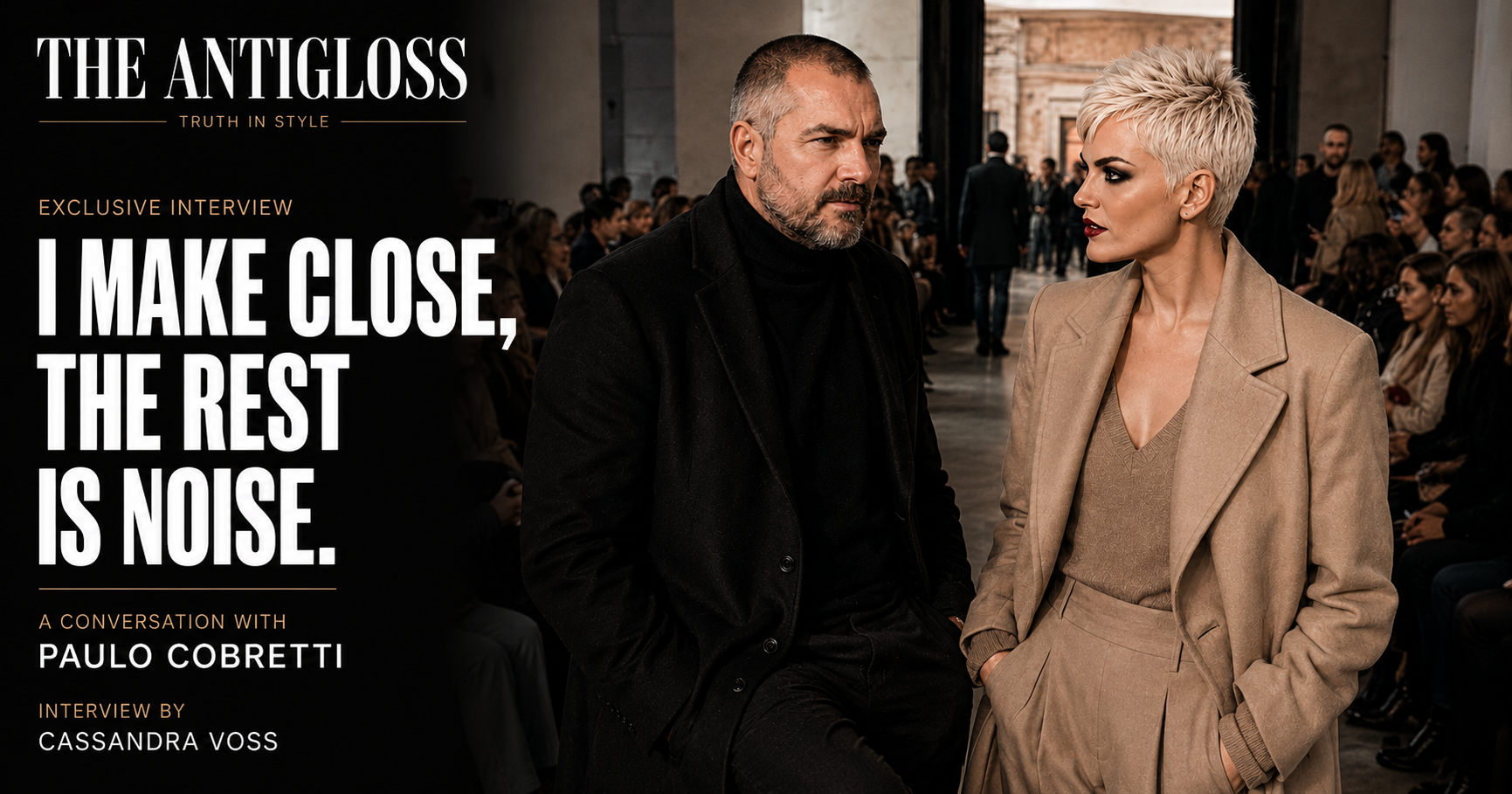
**Interview by Cassandra Voss**
The first time I met Paolo Cobretti, I criticized his work.
Not politely.
There are compliments fashion people learn to perform almost automatically. *Beautiful collection. Interesting direction. Very strong work.* They are socially useful and intellectually worthless.
I told him something else.
I told him I liked the idea, but thought he had been afraid to take it far enough.
A sensible designer might have decided never to speak to me again.
Cobretti became curious.
That, perhaps, is the shortest useful description of him.
He is a trained fashion designer who remains suspicious of the title “designer.” He believes imagination comes before education, technique before rebellion, and that creative people should learn the rules before earning the right to break them.
He insists he is not ambitious.
He also believes that ten years from now he should look at the clothes he makes today and think they are terrible.
He dislikes fashion that requires a manifesto to explain why it is fashion. He dislikes aesthetic obedience. He dislikes commercial people attempting to direct his imagination with Excel spreadsheets. He dislikes Crocs with a degree of emotional clarity usually reserved for political ideologies.
He likes women who can carry clothes instead of being carried by them.
And, somewhere during a conversation that began with fashion education and wandered through jealousy, fidelity, intelligence, damaged trust, sewing machines, haute couture and the philosophy of human error, I discovered something else.
Paolo Cobretti claims not to believe very strongly in himself.
He believes very strongly in the right to think for himself.
Those are not the same thing.
“Why did you keep talking to me?”
**Cassandra Voss:** When we first met, I essentially told you that you had become frightened of your own collection. Most designers would have heard an insult. Why didn’t you?
**Paolo Cobretti:** Curiosity.
If somebody says something standard, whether it is criticism or praise, you already know how that conversation works.
But when somebody says something that falls outside the usual clichés, it gets my attention.
If you see a car driving down a road, it is just a car driving down a road. If you suddenly see the car flying, you want to know why.
That was basically what happened.
And there was another part of it. I felt there was no falseness in you. No attempt to flatter me and no attempt to provoke me just for effect. You were saying what you actually thought.
I value that.
I don’t like people who tell one person one thing and then turn around and say something completely different to somebody else.
**CV:** So criticism doesn’t injure your ego?
**PC:** There is no injury if the criticism makes sense.
I am quite self-critical anyway. People close to me have told me I probably have impostor syndrome, and I think there is some truth to that.
Yes, professionally I am a designer. But I don’t walk around believing everything I touch becomes a masterpiece.
Personally, I think I make fairly ordinary things that happen to be interesting to me.
Other people can decide whether they like them.
You cannot please everybody.
There is that old story about the man, the boy and the donkey. The man rides the donkey and people complain that the child has to walk. So he puts the child on the donkey and people complain that the young don’t respect their elders. Then they both ride and people say they are cruel to the animal. Finally they carry the donkey and everybody says they are idiots.
That is what happens when you try to satisfy everybody.
I don’t.
I make what I like.
The designer who refuses to become important
**CV:** You say you’re not ambitious. But fashion is an industry built almost entirely on ambition.
**PC:** I simply enjoy what I do.
If something I make finds an audience, wonderful. If somebody doesn’t like it, that is also completely normal.
Other people deal with audience size, sales, numbers. That is their profession.
Mine is to take ideas and fantasies that exist in my head and put them into fabric, the same way a writer puts something onto paper or a musician puts something into music.
I don’t need to convince somebody that what I made is a masterpiece.
I also don’t need fashion to be the only thing I ever do.
If one day it no longer works financially or I stop enjoying it, I have other things I can do.
My hands grow from approximately the correct place. So does my head.
**CV:** Suppose Chapeau Claque suddenly becomes enormous. International distribution, investors, celebrities, serious money.
**PC:** That changes almost nothing for me as a designer.
There are people specifically trained to deal with sales and business. Let them deal with it.
Excel spreadsheets are not my profession.
**CV:** Until the person holding the spreadsheet walks into your studio and says, “Last year’s dress sold twenty thousand units. Make another one.”
**PC:** They can keep producing last year’s dress if people still want it.
But they cannot tell my imagination what to produce next.
It would not even work.
My imagination does not operate that way.
I can’t sit down and say, “Commercial department requires this shape, therefore I will now imagine it.”
They can wave the spreadsheets around as much as they want. My imagination will probably send them on a very long journey.
**CV:** And if the brand disappears?
**PC:** I’ll drink a glass of wine to its memory and do something else.
**CV:** One glass?
**PC:** For the brand, yes.
For certain people, probably more.
Fashion school does not make designers
Cobretti wanted to work in fashion long before he allowed himself to believe he could.
As a child, toy cars and toy guns existed happily beside dolls. The dolls suffered.
Their original clothes rarely survived.
By around ten, he had persuaded his parents to buy him a small children’s sewing machine.
He began cutting and sewing.
**CV:** So when did you become a designer?
**PC:** Before I studied design.
Education gave me skills. It did not make me a designer.
There is a phrase, I don’t remember who said it: before you change the rules, you need to learn them.
That is what education gave me.
How construction works. How fabrics interact. How something is actually made.
But design itself is imagination.
A school can make you technically competent. It can make you a specialist. It cannot put imagination into your head.
If somebody graduates with a diploma in design and has no imagination, then perhaps he is a very good technician.
But a diploma did not make him a designer.
History proves the opposite as well. Plenty of people with imagination became important designers without the expected academic route.
You have to have something there first.
Then education teaches you how to get it out.
“First learn how to make clothes. Then put a barrel on the model.”
**CV:** You’re rather unforgiving about young designers trying to be avant-garde.
**PC:** I am unforgiving about people skipping the profession.
There are enormous numbers of design schools now because education is also a commercial product.
So every year another group comes out with diplomas and some of them immediately want to announce themselves as great artists.
They haven’t even learned to make good prêt-à-porter yet, but suddenly they are making “haute couture.”
Haute couture is art.
It is fantasy backed by mastery.
But if somebody graduates, straps a plastic barrel around a model and announces, “I am an artist, this is fashion,” well, fine. Maybe it is an installation. Maybe it is performance art.
But if you are presenting yourself as a clothing designer, show me clothes.
Make three pieces.
Make five.
Make a coherent small collection from beginning to end.
Show that you understand the profession.
Then go and create whatever insanity you want.
A musician does not walk onto a concert stage before learning how to play the instrument.
Young designers sometimes reverse the order.
They want to create the artistic revolution first and acquire the profession later.
**CV:** So the barrel itself is not the crime.
**PC:** No.
If there is an idea, technique, purpose, if the work actually says something, fine.
The problem is using “art” to disguise the absence of craft.
The popcorn method
There is no muse in Cobretti’s studio.
No mysterious woman appears in his imagination wearing an unfinished dress.
In fact, there is usually no woman at all.
**PC:** I see only the clothes.
Not the woman.
The female body is almost an abstract structure needed to understand how the garment will sit, but even that is not something I consciously visualize.
The clothing simply forms in my head.
It is difficult to explain because I don’t know how it works.
Sometimes there is complete silence.
Nothing.
Not for five minutes, sometimes for days.
And if you start forcing it, straining to produce an idea, you generally produce the same thing people produce when they strain in other circumstances, and it is not very presentable.
So I leave it alone.
Then suddenly it starts.
Popcorn.
One idea.
Another.
Another.
Sometimes I am still developing one thing and an entirely unrelated design appears at the same time.
**CV:** Do you sketch immediately?
**PC:** No.
I am Mozart.
I keep it in my head.
**CV:** There goes the impostor syndrome.
**PC:** I knew you were going to say that.
But yes, I keep it there because the idea continues developing.
By the time I put it on paper, it may already be somewhat different from the first version.
Sometimes an idea begins as a tiny detail and grows into an entire garment.
Sometimes the whole thing appears immediately.
I don’t control it.
**CV:** And if something accidental happens during production and produces a better result?
**PC:** Then I have two ideas.
I make mine and I make Mr. Accident’s version too.
That is creativity.
The drawer where bad ideas wait
Cobretti rarely destroys sketches.
Not because he considers them precious.
Because bad ideas occasionally have excellent bones.
**PC:** Most mediocre ideas never reach paper.
They are rejected in my head or they mutate into something better before I sketch them.
But yes, there are a couple of old mediocre sketches somewhere.
I don’t throw them out.
Sometimes years later you take one from a drawer, look at it differently, change something, think about it again, and suddenly it becomes something much more interesting.
Why throw it away?
It might still become useful.
**CV:** How do you feel looking at sketches from eight or nine years ago?
**PC:** Embarrassed.
I look at them and think, “What kind of fucking idiot was I, and how did this ever enter my head?”
**CV:** And you want the same thing to happen with today’s work ten years from now?
**PC:** Absolutely.
I hope that in eight or ten years I look at what I am making now and think the same thing.
Because that means I progressed.
If I look back after ten years and still think today’s work is as good as I can possibly do, then either I stood still or I went backwards.
That would be worse.
Imagination as an instrument
**CV:** What does becoming better actually mean to you? Better technique?
**PC:** Technique, yes, but mostly imagination.
A musician becomes better at an instrument by playing it.
I play my imagination.
The more I use it, the better it works.
**CV:** Do you feed it deliberately? Museums, cinema, painting, architecture?
**PC:** I observe the world.
I go to museums, of course, but I never go looking for an idea.
I don’t like looking at somebody else’s work for inspiration because then you begin copying it.
Obviously everything you see remains somewhere in memory and eventually gets processed into something else.
But I prefer when the idea comes from inside.
I can take something completely ordinary, a skirt, for example, and start mentally turning it around.
What if this changes?
What if that moves?
Eventually the skirt may become a suit, a dress, even trousers.
I can switch that mode on.
And I can switch it off.
**CV:** Do you believe absolute originality is still possible?
**PC:** Probably not.
Everything new is well-forgotten old.
Everybody has already tried almost everything.
You can do something differently.
That territory is enormous.
But completely new?
I doubt it.
Taste, Crocs and visual crimes against anatomy
Cobretti insists repeatedly that his aesthetic judgments are subjective.
This does not prevent him from having them.
Strongly.
**PC:** I don’t claim my taste is perfect.
I have my worldview and my ideas.
History can decide whether any of it was worth something.
But there are proportions.
There is color interaction.
There is visual balance.
You can combine any colors you want, obviously. Nobody will arrest you.
But that does not mean every combination works equally well.
The same with the body.
Clothes can emphasize something good, hide something less flattering, change proportions intentionally.
But when you make somebody who is one meter eighty look as though their legs are forty centimeters long and the rest is torso, I question what exactly we have achieved.
**CV:** And Crocs?
**PC:** Disgusting.
**CV:** Very nuanced criticism.
**PC:** They are rubber shoes.
Rubber footwear existed for practical reasons. Somewhere along the way somebody decided this should become fashion.
Fine.
People like many things.
People are particularly attracted to things that smell bad.
**CV:** You realize that sentence may follow you for years.
**PC:** I’ll survive.
Clothes do not create the woman
For a man who designs predominantly for women, Cobretti spends surprisingly little time imagining an ideal one.
There is no Chapeau Claque woman in his head when he designs.
Yet once the clothes exist, he becomes acutely aware of who can carry them.
**PC:** Some women cannot be improved by anything.
Some women cannot be ruined by anything.
That is simply reality.
A confident woman can carry almost anything.
**CV:** Including terrible clothes?
**PC:** Yes.
Sometimes a woman has enough character that something strange begins to look almost like haute couture on her.
**CV:** What matters more to you, beauty or character?
**PC:** Character.
Beauty attracts attention, obviously.
But there is no formula.
A woman can be almost canonically perfect and not attract me at all. Another can be objectively much more ordinary and immediately catch my attention.
It is a combination of things.
You cannot reduce it to blonde hair, a particular eye color, lips, nose, body.
There is no equation.
**CV:** What destroys attraction fastest?
**PC:** Stupidity.
Lack of intelligence.
Or several glasses of very strong alcohol, which temporarily produces roughly the same result.
**CV:** Can intelligence make a woman physically more attractive to you?
**PC:** In combination with the other criteria, yes.
**CV:** What kind of intelligence?
**PC:** All of the above.
And for additional evidence, look at yourself in a mirror.
At this point I looked at the mirror.
The evidence was deemed admissible.
The pedestal
This is where the interview stopped behaving like a fashion interview.
Cobretti describes relationships with an image that would probably horrify some therapists and delight several poets.
Two pedestals.
One for each person.
**PC:** If I am with a woman, she is on a pedestal for me.
And I expect to occupy one for her.
That does not mean I control what she wears or what she does.
She is an adult.
Her choices are hers.
But priorities matter.
For example, if my partner knows perfectly well what I find attractive, consistently makes no effort when we are together, and then suddenly makes exactly that effort when she is going somewhere without me, I will have questions.
Once can be coincidence.
A pattern is something else.
**CV:** Because you suspect another man?
**PC:** Not necessarily.
The larger question is why the outside audience receives an effort the partner no longer receives.
If that becomes a pattern, something is changing.
And patterns do not appear from nowhere.
**CV:** You sound as though you treat relationships like systems analysis.
**PC:** In a way.
You do not repair the symptom.
You find where the problem began.
People become tired. People have stress. People get sick. We do not live on a cloud.
The problem is not that difficulties appear.
The problem is when one person says, “This is how things are now, deal with it,” and stops participating in the solution.
If there is a problem and both people recognize it, discuss it and work on it together, that is a relationship.
If all decisions begin happening in one direction, that is no longer partnership.
That is egoism.
Fidelity is not blindness
**CV:** When does attraction to somebody else become betrayal?
**PC:** When it becomes action.
Seeing a beautiful woman is normal.
Admiring somebody is normal.
You do not enter a relationship and suddenly put opaque glasses over your eyes.
But once it becomes flirting, physical behavior, secret interaction, then something has already changed.
If your relationship satisfies you, why are you doing it?
**CV:** So desire itself is not disloyal?
**PC:** Thoughts belong to the person.
Actions affect somebody else.
There is the difference.
And if two people have explicitly agreed on a different kind of relationship, then those are their rules.
But if the agreement is monogamy and one person secretly changes the rules, that is betrayal.
If you want something else, leave the relationship.
Nobody is holding you prisoner.
The road in the appropriate direction usually has very little traffic.
What happens when trust tears
Cobretti returned several times to fabric as the easiest language for explaining trust.
Small damage can disappear.
Large damage can be repaired.
Neither means the material becomes exactly what it was.
**PC:** There are mistakes people discuss, somebody apologizes, and it is finished. You forget them.
Then there are things that can be formally forgiven but leave a scar.
The wound heals.
The scar remains.
You may repair the fabric so well that nobody else sees it.
But you know where the repair is.
That changes your relationship with the object.
You would not wear repaired stockings even if the repair were hidden under your skirt.
**CV:** No.
**PC:** Exactly.
Not because somebody else can see it.
Because you know.
That is the point.
**CV:** Can somebody who seriously betrayed your trust ever return to the same place in your life?
**PC:** No.
Maybe to another place.
Not the same square.
Think of a chessboard.
A person may come back, admit what happened, genuinely regret it, perhaps even have changed significantly.
But the original position no longer exists.
The information exists now.
And information cannot be unknown.
“I don’t disappear at the first problem.”
Cobretti describes himself as somebody who keeps most people at a comfortable distance.
Those admitted closer become something else entirely.
A world.
This makes his capacity to leave sound colder than it is.
**PC:** I do not disappear because somebody clapped their hands incorrectly.
There has to be an event or usually a series of events.
I believe in dialogue.
People should speak.
If something is wrong, say it.
Do not communicate through hints and then say, “You should have understood.”
No, I should not have understood.
I cannot read your mind.
Maybe I did not notice your signals. Maybe I interpreted them differently.
Use the language nature gave you.
Speak.
I give people opportunities to explain themselves because sometimes I also have to explain myself.
I make mistakes too.
But patience has a limit.
Eventually the situation becomes clear.
If the fabric is torn, it is torn.
You may invent something new from it.
But it will not be the same fabric anymore.
Can people change?
Here we disagreed.
I believe people sometimes reconstruct themselves deeply enough that an old pattern stops being merely suppressed and genuinely ceases to define them.
Cobretti is more skeptical.
**PC:** Nobody changes fundamentally.
With age, you learn to manage yourself better.
You learn not to react to certain things.
You acquire control.
But certain underlying characteristics remain.
I have done bad things too.
I am, generally speaking, a very bad person.
**CV:** That sounds theatrical.
**PC:** It is still true.
I have done things I regret.
If I wrong somebody, I can apologize. My crown will not fall off.
But I am not going to conduct a campaign for my rehabilitation.
If our roads separated, sometimes they separated for a reason.
I also would not want somebody endlessly performing repentance for me.
**CV:** Because you don’t believe in second chances?
**PC:** Because sometimes the second chance means spending the relationship constantly proving that you are no longer the person who did the thing.
That changes the entire structure.
Forgiveness is possible.
Forgetting is another matter.
Intelligence, argument and the purple grass problem
**CV:** You said stubbornness is the first sign of stupidity.
**PC:** Unjustified stubbornness.
If somebody tries to convince me that grass is purple, I may give one or two arguments.
If I realize the person does not hear the other participant and only hears himself, I simply leave the high-intellectual conversation.
A conversation requires intelligence on both sides.
If one criterion is missing, it is no longer a conversation.
**CV:** What if the thing you consider a fact is actually your interpretation?
**PC:** I know one thing.
I know that I know nothing.
**CV:** Socrates. Convenient escape.
**PC:** Correct escape.
People make mistakes.
I make mistakes.
There are no people who never make mistakes.
The ones who cannot accept that they are wrong return us to the same thing, stubbornness without reason.
And that is stupidity.
**CV:** So error doesn’t bother you?
**PC:** Error teaches you.
If you do not make mistakes, you do not learn.
If you do not learn, then continue along the line with all subsequent stops.
Progress as future embarrassment
Perhaps this is the contradiction at the center of Cobretti.
He distrusts applause but demands progress.
He does not particularly care whether the world eventually calls him an important designer.
He cares very much whether the future version of himself becomes better than the current one.
**CV:** What would make you finally say, “I am a good designer”?
**PC:** Probably nothing.
Even if the entire world knew my name, I don’t think I would suddenly begin thinking of myself that way.
Maybe that is excessive self-criticism.
Maybe it is impostor syndrome.
I don’t know.
Recognition would mean I made something people liked.
Good.
Wonderful.
Then I make the next thing.
**CV:** So what is success?
**PC:** Progress.
Development.
If the Paolo ten years from now looks at the Paolo today and says, “You did that badly,” then something worked.
**CV:** And if he doesn’t?
**PC:** Then I have a problem.
There is a short silence.
The interview has now lasted long enough that a respectable publication would have sent somebody to check whether the editor and designer were still alive.
I ask one final question.
**CV:** After all this, rules, clothes, people, mistakes, loyalty, intelligence, what do you actually trust?
Cobretti thinks for a moment.
Not very long.
**PC:** Understanding.
I need to know why.
Why something works.
Why it is done that way.
Why somebody behaved that way.
A fact without understanding does not interest me much.
Once I understand the mechanism, then I can decide whether to follow it, change it or argue with it.
Maybe that is the whole thing.
Learn the rules.
Understand why they exist.
Then decide which ones deserve to survive.
He looks at the notebook.
Then at me.
“Are you still writing an interview,” he asks, “or are you preparing my posthumous memoirs?”
I close the notebook.
Interview.
Definitely interview.
Although by this point the distinction has become dangerously academic.