Politics
Paris Fashion Week Upstairs, Burning Schools Downstairs
While Paris stages Spring/Summer 2027 for the global fashion industry, French teenagers are blockading schools over missing teachers, overcrowded classrooms and crumbling buildings. The contrast would be difficult to invent.
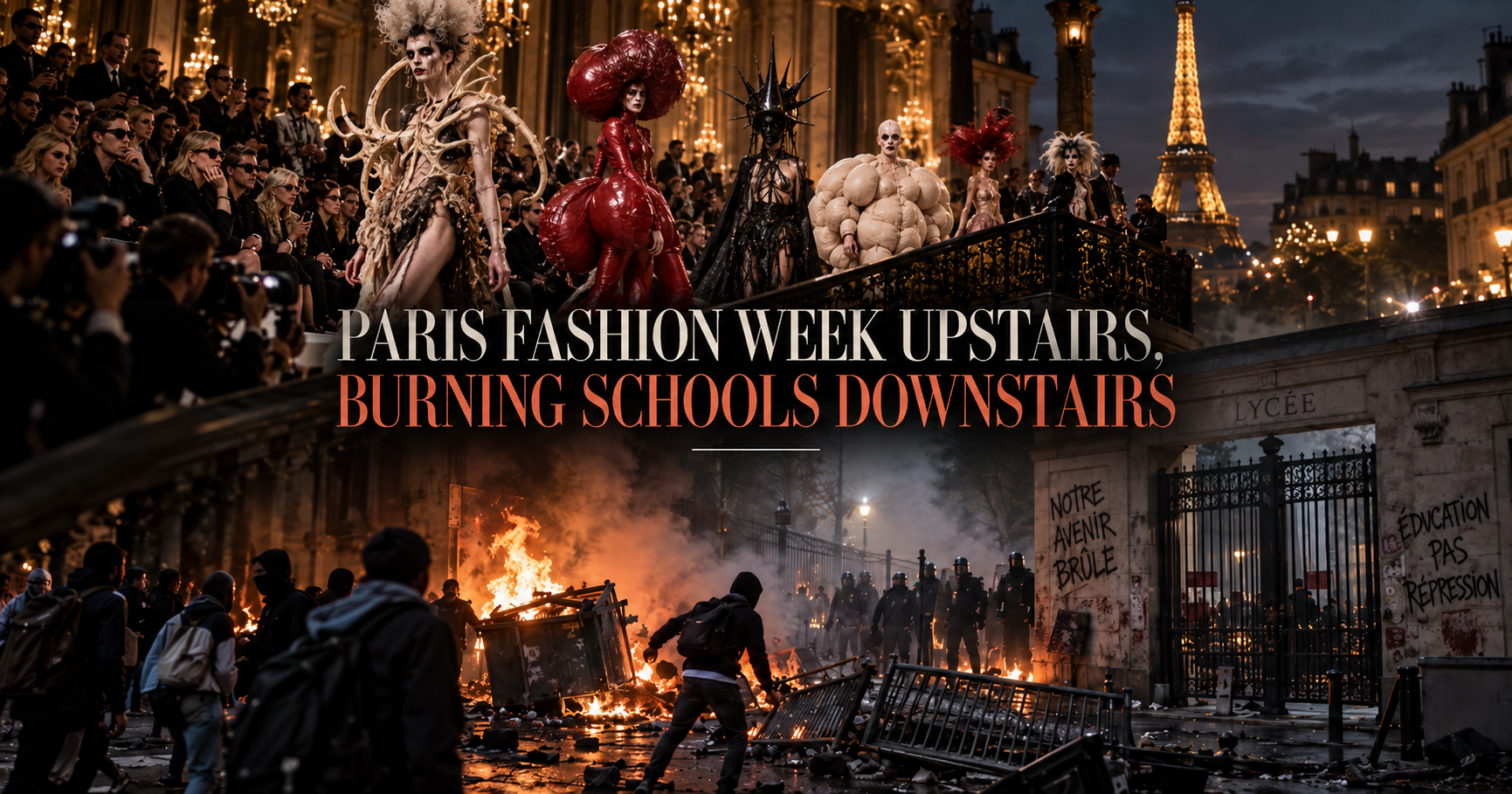
Paris is currently performing one of its favorite roles: capital of global elegance.
Paris Fashion Week Spring/Summer 2027 runs from September 28 through October 6, with 68 runway shows and dozens of presentations. Celebrities are arriving, cameras are flashing, champagne is flowing and luxury houses are competing for the world's attention.
A few kilometers away, France's other young people have rather different concerns.
They would like teachers.
The current student movement began on September 21 at Saint-Exupéry high school in Créteil, southeast of Paris, where several teaching positions were reportedly unfilled. From there it spread through the Paris suburbs and then across the country. Students have complained about teacher and staff shortages, overcrowded classrooms, overloaded schedules, deteriorating buildings and anxiety surrounding Parcoursup, France's university admissions system.
By October 1, more than 1,020 high schools had been affected by strikes or protests, including 222 blockades. That represented roughly one quarter of French high schools.
By October 3, Reuters was reporting demonstrations involving more than 1,200 schools and more than 5,000 arrests since the movement began.
So no, those videos circulating online are not necessarily another shipment of recycled footage excavated from the internet's archaeological layer.
France really is having a problem.
And parts of it have become violent.
Trash bins and entrances have been set on fire. Public transportation has been disrupted in several cities. Police have used tear gas. Protesters have thrown bottles and fireworks. On October 1 alone, nearly 1,950 people were arrested, according to Le Monde. Education Minister Édouard Geffray said that 65 education employees and 170 students had been injured since the unrest began.
About 400 schools were expected to remain closed or move to remote learning because damage and blockades made normal operation impossible.
The French government argues that the movement has increasingly been exploited by violent groups and politically organized activists. Intelligence officials reportedly told a government crisis meeting that La France Insoumise and associated hard-left networks had helped drive the escalation. LFI denies orchestrating the unrest and accuses the government of using repression and political accusations to avoid addressing the underlying complaints.
Both things can, of course, exist simultaneously.
Teenagers can have legitimate grievances.
Political organizations can attempt to exploit them.
And people who have no particular interest in education can still discover that a burning garbage container provides an excellent afternoon's entertainment.
Even teachers' unions sympathetic to the students have acknowledged that parts of the movement are escaping their original purpose. The head of one principals' union told Le Monde that some participants appeared interested only in destruction, while the head of the SNES-FSU teachers' union said that in some places the situation was no longer recognizable as a normal high-school protest.
But underneath the flames is an awkward fact that cannot be extinguished with tear gas.
Students are describing schools without enough teachers, nurses or staff.
One student in Sevran told Le Monde that he went from December 2025 until June 2026 without a French teacher despite having an important examination during that period. Students elsewhere described overcrowding and buildings badly in need of repairs.
And this is happening while the government is preparing a 2027 education budget increase of only 1.7 percent, below inflation, as France simultaneously confronts a much wider fiscal crisis and plans tens of billions of euros in spending reductions.
Which brings us back to Paris Fashion Week.
There is nothing wrong with fashion shows while a country has social problems. Nations are large enough to contain couture and broken school boilers at the same time.
But the juxtaposition is almost too perfect.
At the Trocadéro, Saint Laurent covered the runway in gold beneath the illuminated Eiffel Tower. Victoria Beckham presented her new collection inside the historic Conciergerie. Celebrities sat in the front rows while photographers documented every hemline.
Elsewhere, French teenagers were lighting garbage bins because they say their schools cannot reliably provide teachers.
One France is being photographed.
The other is throwing bottles at riot police.
And perhaps that is the most revealing fashion statement Paris has produced all week.
Not because a gold dress or an extravagant runway is responsible for the state of French education.
But because for nine days the same country is displaying two completely different definitions of what it means to invest in the future.
One comes with cameras, celebrities and invitations.
The other is standing outside a locked school gate asking where the teacher went.