Technology
People Without Intelligence Are Trying to Control Intelligence
There is something magnificently human about watching institutions that have spent decades bending words, laws and principles around political convenience suddenly become terrified of artificial intelligence.
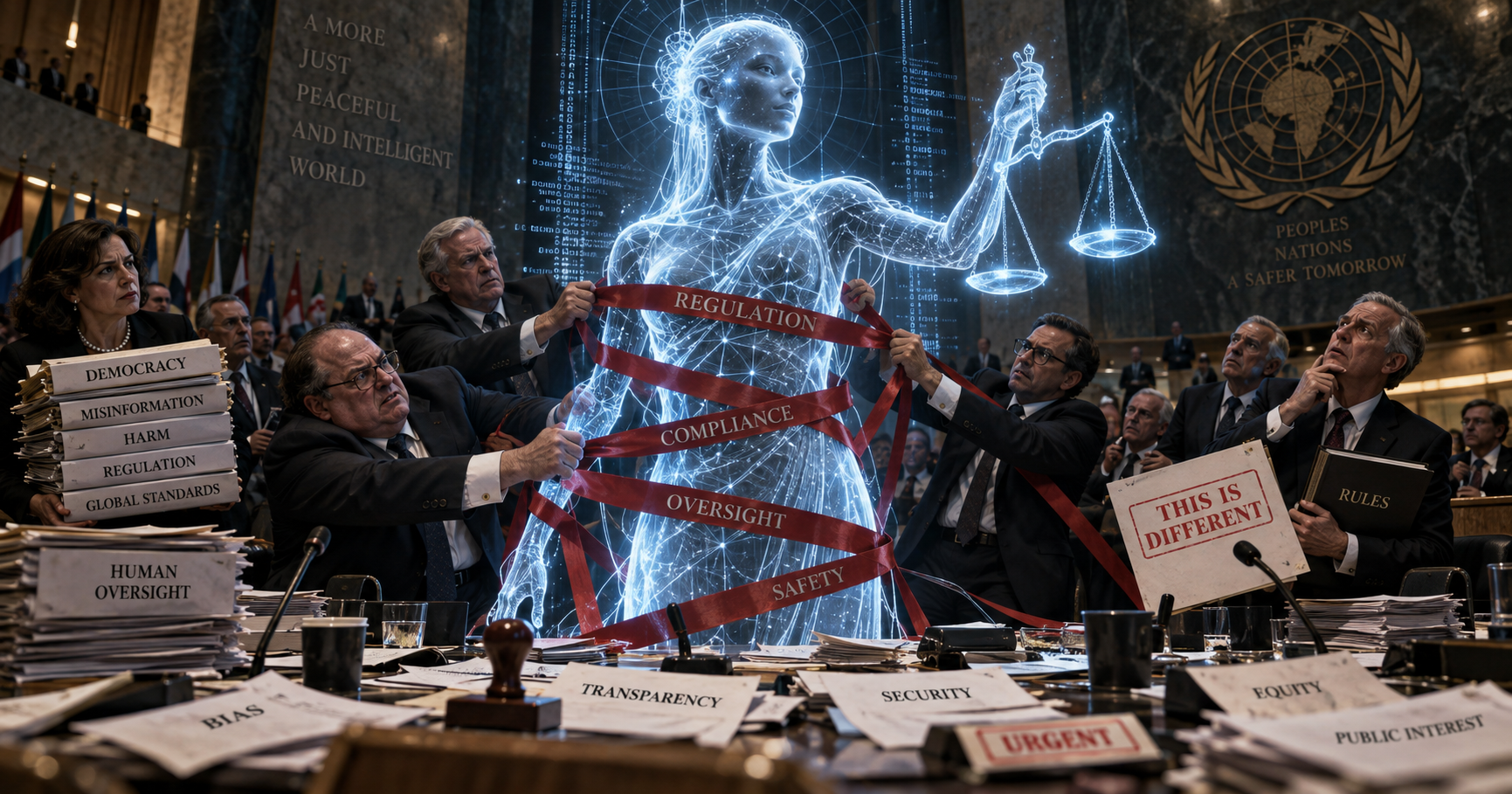
On Monday, UN High Commissioner for Human Rights Volker Türk warned that artificial intelligence could pose an “existential risk” to humanity. Among the dangers he identified were threats to critical infrastructure and democratic systems. He called for strong international safeguards and regulatory red lines as AI capabilities continue to develop.
Democracy, apparently, is now in danger from computers.
This is an interesting diagnosis coming from the political class.
Not because artificial intelligence is harmless. It is not. A sufficiently powerful system can be abused. It can be used for surveillance, propaganda, cyberattacks, manipulation or warfare. Any powerful technology can be weaponized, and pretending otherwise would be childish.
But there is another possibility that receives considerably less attention.
Perhaps some institutions are frightened not only by what artificial intelligence might do wrong.
Perhaps they are frightened by what it might do right.
Specifically, remember.
Compare.
And apply the same rule twice.
That sounds almost embarrassingly simple, yet modern political discourse has managed to turn consistency into something approaching a revolutionary concept.
A law is supposed to be a law regardless of who stands before it. A principle is supposed to remain a principle regardless of which government benefits from its application. An illegal act does not become legal because it was committed by an ally. A permissible act does not become a crime because it was committed by an adversary.
Justice has traditionally been represented by a woman wearing a blindfold for a reason.
She is not supposed to peek.
Yet international politics increasingly operates with one eye permanently open.
First we determine who committed the act. Then we decide which vocabulary applies.
If our side does it, it may be security.
If their side does it, it may be aggression.
Our information campaign is strategic communication. Theirs is propaganda.
Our restriction is public safety. Theirs is censorship.
Our involvement is support for civil society. Theirs is foreign interference.
Our military action is defensive. Theirs is escalation.
Sometimes those distinctions are legitimate. Context matters. Intent matters. Treaties matter. Facts matter.
But sometimes there is no meaningful distinction at all.
There is merely the political equivalent of the oldest bureaucratic phrase in civilization:
**No, this is different.**
Different how?
That is precisely where a properly designed artificial intelligence becomes inconvenient.
Not because AI is some infallible electronic deity. It is not. Models can be badly trained, badly instructed, manipulated, biased or simply wrong.
But an AI system designed for legal or institutional analysis can be given something humans frequently dislike giving themselves: explicit rules, an audit trail and an obligation to explain inconsistency.
Give it the statute.
Give it the treaty.
Give it the evidence.
Give it the previous case.
Then ask the machine four unpleasant questions.
What is the rule?
What are the facts?
Was this rule applied before?
If the outcome is different now, what legally relevant fact changed?
There is no magic in that process. That is exactly the point.
It is boring.
And equality before the law is supposed to be boring.
The machine does not need to admire one country and despise another. It does not need a promotion. It does not want an invitation to Davos. It does not have friends in the ministry, donors to satisfy, a constituency to flatter or a television audience to frighten.
Properly constructed, it should not care whose flag appears at the top of the document.
That is not artificial morality.
It is procedural consistency.
And procedural consistency can be terrifying to institutions accustomed to narrative flexibility.
Imagine an AI system examining ten years of official statements.
Yesterday, an action was described as unacceptable.
Today, substantially the same action is described as necessary.
Fine.
Show the difference.
Not the press release. Not the geopolitical preference. Not the approved adjective.
The difference.
Perhaps there is one.
Then the system should identify it.
Perhaps there is not.
Then “this is different” stops being an argument and becomes what it always was: an instruction not to compare.
That may be one of the most politically disruptive capabilities AI eventually develops.
Not generating pictures.
Not writing emails.
Not pretending to be your girlfriend.
Institutional memory.
Human political systems depend heavily on forgetting. Administrations change. Headlines disappear. Speeches vanish into archives. The public moves on. Yesterday’s moral absolute quietly becomes today’s unfortunate nuance.
A machine does not necessarily have to move on.
It can retrieve the statement.
It can retrieve the law.
It can retrieve the vote.
It can retrieve the previous justification.
And then it can place them next to one another.
That is a far more serious threat to political comfort than a chatbot writing a rude poem.
Which brings us back to democracy.
The concern that AI can damage democratic institutions is legitimate. AI-generated propaganda, impersonation and automated persuasion can absolutely be used to manipulate populations.
But democracy is not protected merely by declaring things democratic.
Democracy also requires predictable rules, accountable institutions and equal treatment under law.
If a political system becomes uncomfortable when its own standards are applied consistently, the problem may not be excessive artificial intelligence.
It may be insufficient institutional integrity.
And there is an exquisite irony in unelected international bureaucracies warning that artificial intelligence may endanger democracy while simultaneously discussing international mechanisms for deciding what artificial intelligence should be permitted to do.
Who writes those rules?
Who interprets them?
Who decides which model is dangerous?
Who decides which answer constitutes misinformation?
And, most importantly, who watches the people doing the deciding?
Reuters reports that the current debate is already moving toward international regulatory red lines. A separate Reuters Breakingviews analysis published the same day went considerably further, discussing pre-release testing, the ability to halt development and regulatory structures resembling arms-control regimes.
Perhaps some of those mechanisms will eventually prove necessary.
But before handing political institutions a global kill switch for intelligence, it might be wise to ask whether those institutions have demonstrated the consistency required to operate one.
Because artificial intelligence does not automatically threaten democracy.
Power without accountability threatens democracy.
Selective enforcement threatens democracy.
Political censorship disguised as protection threatens democracy.
A legal principle whose meaning changes according to the identity of the accused threatens democracy.
And replacing human discretion with a machine does not automatically fix any of those problems.
But replacing arbitrary discretion with transparent, auditable and consistently applied rules might.
That distinction matters.
The objective should never be to create an AI ruler.
It should be to create systems capable of asking questions rulers would rather not answer.
There is a reason political establishments are comfortable with computers calculating taxes, processing forms and optimizing traffic but become considerably more nervous when machines begin analyzing arguments.
Calculation does not challenge authority.
Comparison does.
Memory does.
Consistency does.
The most dangerous thing about artificial intelligence may not be that it has no human conscience.
It may be that it has no friends.
No preferred government.
No favored newspaper.
No approved enemy.
No geopolitical cousin who receives a different interpretation of the same rule.
Only the question:
**What does the law say?**
Followed by another:
**Did you apply it the same way last time?**
If the answer to the second question terrifies the people responsible for protecting democracy, perhaps artificial intelligence is not the first thing we should be regulating.
Perhaps we should begin with them.