Language Autopsy
Pierre Poilievre Was Apparently Dangerous. So Why Are the Liberals Using His Ideas?
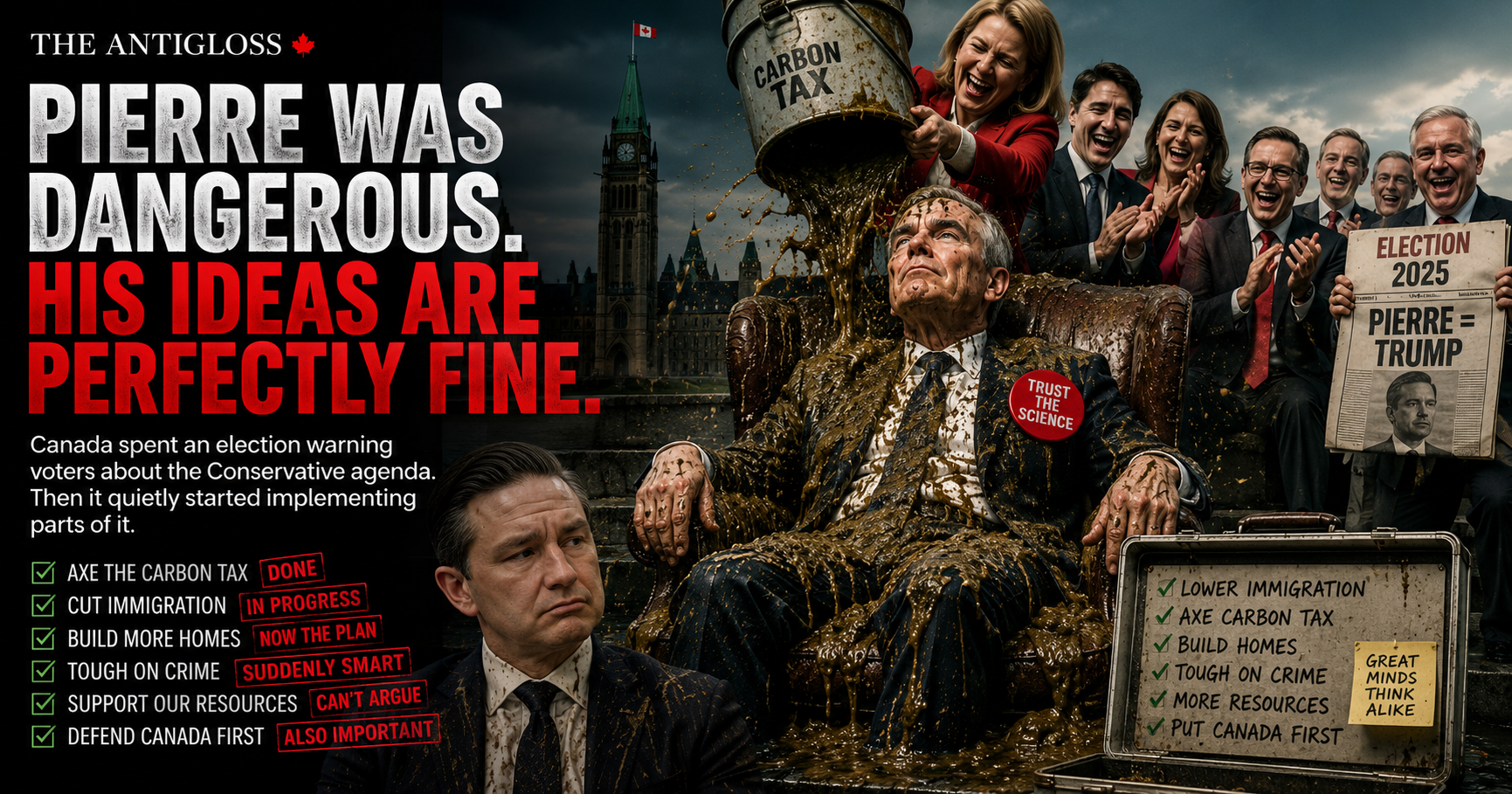
Canada spent an election warning voters about the Conservative agenda. Then it quietly started implementing parts of it.
There is a particularly Canadian form of political transformation.
First, an idea is dangerous.
Then it is irresponsible.
Then it is extremist.
Then Pierre Poilievre says it, which apparently makes it Trumpian.
Then the Liberals adopt some version of it.
And suddenly it is responsible government.
That may be the most interesting legacy of Canada's 2025 federal election. Not that Mark Carney defeated Poilievre. Elections produce winners and losers every few years. The interesting part is what happened to some of the ideas Canadians were warned about once the election was over.
Because apparently the problem wasn't always the policy.
Sometimes it was the man saying it.
The Carbon Tax That Had to Be Defended Until It Had to Disappear
Few policies defined Poilievre more completely than his campaign against Canada's consumer carbon tax.
Axe the tax became practically inseparable from his political identity.
And the Liberal response was equally predictable.
When Poilievre attempted to force an election over the planned carbon-price increase in March 2024, Justin Trudeau's government defended the policy and accused Conservatives of misleading Canadians about its costs and benefits. The government survived the confidence vote.
For years, opposition to the consumer carbon price was treated as evidence of Conservative unseriousness on climate policy.
Then Trudeau left.
Carney arrived.
And the consumer carbon price disappeared.
One of Carney's first acts as prime minister was to eliminate the consumer fuel charge effective April 1, 2025.
The policy that had generated years of apocalyptic political argument was suddenly disposable.
There are legitimate distinctions between Poilievre's climate policy and Carney's. Industrial carbon pricing remains, for example. Pretending that Carney simply implemented Poilievre's entire climate platform would be dishonest.
But the political comedy remains spectacular.
Poilievre spent years saying the consumer carbon tax should go.
Liberals spent years explaining why that was terrible policy.
Then a Liberal prime minister removed it.
Apparently carbon pricing didn't save the planet on March 31 and destroy it on April 1.
What changed was politics.
Immigration Discovers Mathematics
Immigration produced a similar miracle.
For years, questioning whether Canada's population was growing faster than its housing, healthcare and infrastructure capacity could comfortably accommodate was treated as suspicious territory.
Poilievre increasingly argued that immigration levels needed to be connected to Canada's capacity to build homes and provide services.
Then Canada's housing crisis became impossible to explain away.
And suddenly the federal government discovered carrying capacity.
The government's own planning documents now explicitly connect immigration levels to housing and infrastructure capacity. Permanent-resident targets were reduced, while Ottawa established a goal of bringing Canada's temporary population below five percent of the population by the end of 2027.
This isn't secret Conservative propaganda.
It is government policy.
The terminology became nicer.
The arithmetic did not.
If a country adds people faster than it adds homes, doctors, schools, roads and other infrastructure, eventually something breaks.
That statement does not become xenophobic when Poilievre says it and sophisticated public administration when a Liberal minister says it.
It is either true or it isn't.
Apparently Taxes Can Make Housing More Expensive
Housing produced another remarkable ideological discovery.
Poilievre campaigned on reducing taxes and government charges associated with new housing. His 2025 proposal included eliminating the federal sales tax on new homes costing up to C$1.3 million and pushing municipalities to reduce development charges.
Carney's proposal was different in important respects. His GST relief initially targeted first-time buyers purchasing homes up to C$1 million.
Those are not identical policies, and pretending otherwise would make this argument weaker rather than stronger.
The revealing part is the underlying principle.
Government taxes and fees increase the cost of building and purchasing homes.
Apparently saying that no longer makes someone a reckless deregulator.
The Carney government eliminated GST for qualifying first-time buyers and has pursued agreements aimed at reducing development charges and other costs associated with new construction.
So after years of increasingly elaborate federal housing programs, Canadian governments have stumbled upon an astonishing economic discovery:
Making something more expensive can make it more expensive.
We eagerly await the Royal Commission.
Tough on Crime, But With Better Branding
Then there is crime.
Poilievre's demands for tougher bail rules and harsher treatment of repeat violent offenders were routinely folded into the broader image of an angry Conservative politician importing American-style law-and-order politics.
Yet the Carney government has itself moved toward tougher bail and sentencing measures.
Its proposals include expanded reverse-onus bail provisions for serious offences, consecutive sentencing in some circumstances, tougher penalties and restrictions on conditional sentences.
Again, there are policy differences.
There should be. They are different parties.
But something curious keeps happening in Canadian politics.
A problem is supposedly exaggerated when Conservatives describe it.
Then the problem becomes sufficiently obvious.
Then Liberals announce a policy addressing it.
And everyone is expected to pretend no intellectual journey occurred between those two moments.
And Then There Was Trump
The most effective weapon against Poilievre in 2025 wasn't necessarily any individual policy.
It was Donald Trump.
With Trump threatening Canada economically, Liberals had an extraordinarily useful political weapon: make Poilievre look like the Canadian version of the American president.
Liberal advertising explicitly juxtaposed language used by Trump and Poilievre and asked Canadians how Poilievre could speak for Canada while sounding like Trump. Reuters reported extensively on how Trump's threats transformed an election the Conservatives had previously seemed positioned to win.
It worked.
But strip away the personalities for a moment.
Lower immigration.
Eliminate the consumer carbon tax.
Reduce taxes and charges on housing.
Get tougher on bail and violent crime.
Increase military spending.
Accelerate major resource and infrastructure projects.
Some of those policies differ substantially in implementation between Conservatives and Liberals. Some were already evolving before election day. Some reflect circumstances that changed.
But taken together, the direction is difficult to miss.
Canada spent years drifting toward one set of problems and then spent an election portraying the politician most aggressively talking about those problems as the dangerous alternative.
After defeating him, the governing party began moving toward several of the positions that had helped make him supposedly dangerous.
Reuters noticed the shift even before Canadians voted, reporting in March 2025 that the Liberals were moving onto Conservative territory on issues including carbon pricing, immigration and defence while attempting to attract Conservative-leaning voters.
That's the part worth remembering.
This isn't hindsight invented by Conservative Twitter.
It was visible while it was happening.
Maybe Poilievre Was Wrong
None of this proves Pierre Poilievre would have been a great prime minister.
Perhaps he would have been terrible.
Perhaps some of his policies would have failed spectacularly.
Perhaps voters made exactly the right decision in rejecting him.
That's democracy.
But then we arrive at an awkward question.
If Poilievre's diagnosis of Canada's problems was so dangerous, why does the government that defeated him increasingly sound as though some of those problems were real?
If reducing immigration growth is responsible policy today, why was raising concerns about capacity treated so differently yesterday?
If eliminating the consumer carbon tax was sensible under Carney, why was demanding its elimination evidence of irresponsibility under Poilievre?
If tougher bail rules are necessary now, were Canadians imagining the problem before?
And if reducing government costs attached to housing helps affordability, exactly when did arithmetic stop being right-wing?
There is a simpler explanation.
Political parties do this constantly.
They don't merely oppose bad ideas.
They oppose **other people's ideas**.
Then, when reality becomes sufficiently inconvenient, they rename them, modify them, announce them from a different podium and congratulate themselves for their pragmatism.
That isn't uniquely Liberal.
Conservatives do it too.
Governments everywhere do it.
But Canada's Liberals have recently provided an unusually clean demonstration.
Pierre Poilievre lost the election.
Some of his arguments apparently didn't.
And perhaps the funniest possibility is this:
Maybe Pierre Poilievre was wrong.
But if so, someone should probably tell the Liberals.