Society
The $26 Million Emotional Attachment
Two Kentucky landowners were offered enough money to walk away rich. They chose the dirt instead. Eventually, the dirt gets everyone.
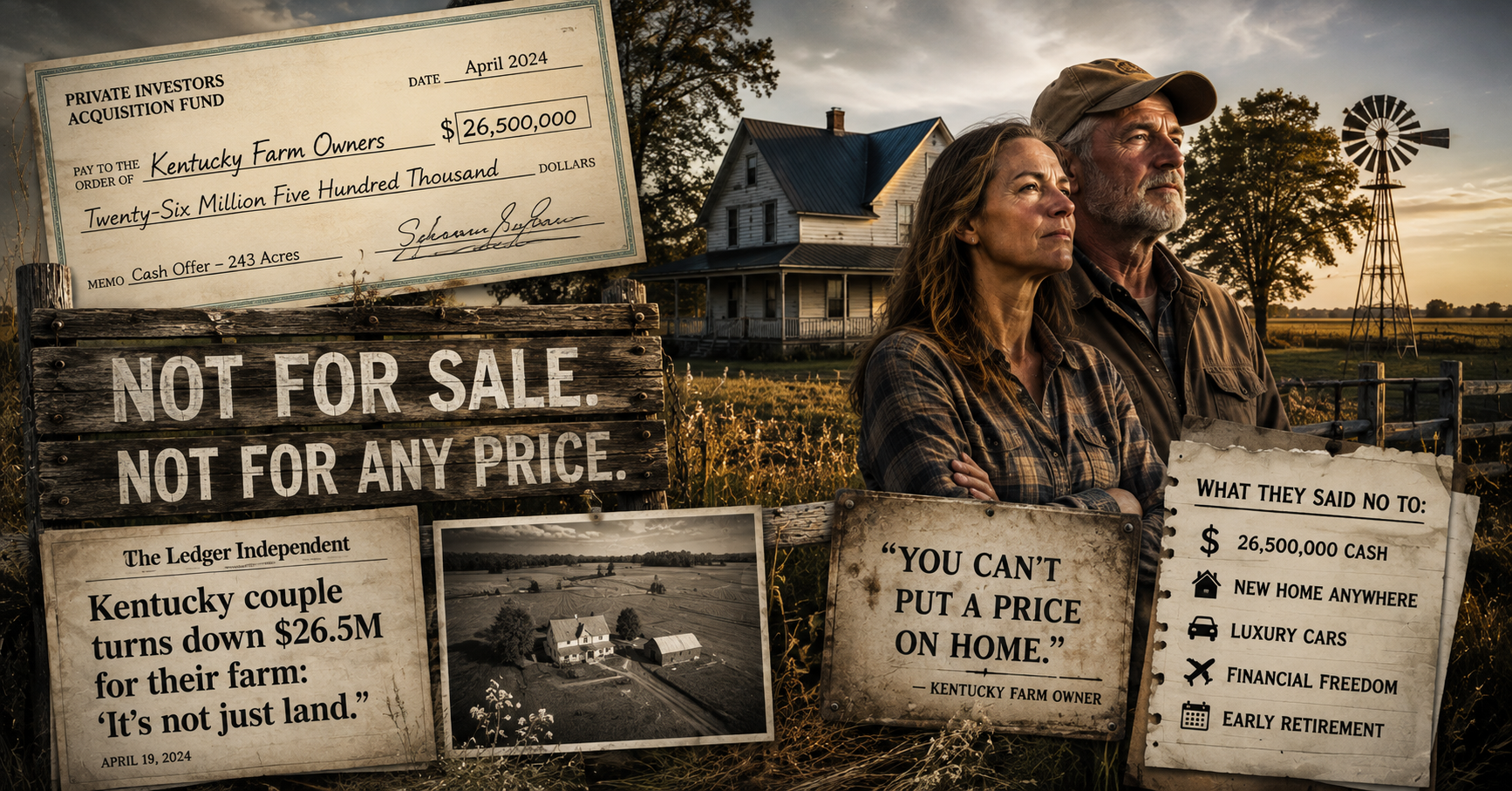
There is something admirable about refusing to sell.
Not everything has a price. Family history matters. A home matters. Land passed through generations can mean more than a number on a contract.
This is a beautiful principle.
It is also considerably easier to admire when the number on the contract is not **$26.5 million**.
In Mason County, Kentucky, 82-year-old Ida Huddleston and her 54-year-old daughter, Delsia Bare, found themselves facing precisely that philosophical dilemma.
Developers wanted their farmland for a massive data-center project.
Bare was reportedly offered around $48,000 per acre for 463 acres. Huddleston was offered roughly $60,000 per acre for another 71 acres.
Together, the offers came to approximately $26.5 million.
This was not someone trying to steal grandma's farm for the price of a used pickup truck.
This was generational-wealth money.
And initially, at least part of the family apparently understood this.
They agreed.
Then they discovered what might be built there.
A data center.
And suddenly the earth became sacred.
Twenty-Six Million Dollars Meets the Internet
The proposed facility is enormous. Plans discussed for the area involve a hyperscale data center with potentially enormous electricity requirements.
There are legitimate questions surrounding projects like this.
How much electricity will they consume?
What infrastructure must be built?
What happens to water consumption?
What about noise?
What happens to surrounding property?
Who pays for improvements to the electrical grid?
Those are perfectly reasonable questions for local government.
But those questions are rather different from another question:
**Would you personally accept $26.5 million for your farm?**
Because at some point the discussion stops being about preserving rural America and becomes an extraordinarily expensive exercise in sentimentality.
The family says the land matters to them.
Fair enough.
Apparently it matters to them more than twenty-six million dollars.
That is their right.
It is also our right to find this absolutely hilarious.
We Have Seen This Movie Before
Every technological transition eventually produces its resistance movement.
Electricity frightened people.
Radio frightened people.
Cell towers frightened people.
And then came 5G.
For several glorious years, parts of the Western world managed to convince themselves that cellular infrastructure was somewhere between a public-health catastrophe and an instrument of technological witchcraft.
People protested towers.
Municipalities fought installations.
Claims circulated that 5G caused illnesses for which no credible causal evidence existed.
During the COVID era, the mythology became so detached from reality that telecommunications towers were vandalized and burned.
Then something remarkable happened.
5G arrived.
Phones connected to it.
People watched TikTok.
Civilization continued.
The apocalypse was postponed.
And now we have artificial intelligence.
AI needs enormous amounts of computing infrastructure, and enormous computing infrastructure requires something inconveniently physical.
Land.
Electricity.
Cooling.
Transmission lines.
Buildings.
In other words, “the cloud” turns out not to be a magical vapor floating somewhere above California.
It has to live somewhere.
And everybody wants artificial intelligence until the servers appear near their backyard.
The New Technological Devil
There are good reasons to scrutinize data centers.
There are also bad ones.
Unfortunately, modern public debate has become exceptionally talented at mixing the two.
A legitimate question about electricity consumption quickly becomes a generalized fear of AI.
A zoning dispute becomes a battle against technological colonization.
A server farm becomes something vaguely sinister merely because the computers inside it happen to run artificial-intelligence workloads.
This is how technological panic works.
The object changes.
The psychology doesn't.
Yesterday the tower was going to irradiate you.
Today the data center is going to destroy your community.
Tomorrow it will be something else.
And ten years later everyone will wonder how society ever functioned without the infrastructure people once tried to stop.
But This Land Is Special
There is another wonderful element to this story.
The argument for keeping the property is emotional attachment to the land.
That is understandable.
Human beings become attached to places.
We remember where our children grew up. We remember parents and grandparents. A piece of land can become part of someone's identity.
But there is an uncomfortable mathematical problem with building your financial philosophy around mortality.
Ida Huddleston is 82 years old.
Nobody is immortal.
Not farmers.
Not journalists.
Not AI executives.
Not people writing sarcastic articles about farmers.
Eventually every human being leaves his or her property behind.
And eventually somebody else decides what happens to it.
The land doesn't reciprocate the relationship.
It doesn't remember you.
It doesn't know your family owned it.
It doesn't care whether your grandfather planted corn there.
It will happily belong to somebody else.
That is the wonderfully brutal thing about property.
We spend our lives saying:
**“This is my land.”**
Time eventually replies:
**“No, it isn't.”**
Twenty-Six Million Ways to Remember the Farm
There is also an obvious solution to the terrible emotional trauma of selling land for $26.5 million.
Buy another farm.
A very nice one.
Possibly several.
Put up a photograph of the old farm.
Build a monument to it.
Name the new farm after it.
Commission an oil painting.
Buy a tractor made entirely of gold if that helps with the grieving process.
At twenty-six million dollars, society can offer an impressive range of therapeutic options.
More importantly, that money can transform the lives of children, grandchildren and great-grandchildren.
That is what makes the story so strange.
“Generational land” is often defended because it represents something passed from one generation to another.
But twenty-six million dollars is also something that can be passed from one generation to another.
Rather effectively.
Land can disappear through taxes, inheritance disputes, development, debt or simply the decisions of descendants.
A properly managed eight-figure fortune can buy an awful lot of emotional attachment.
Including land.
One Way or Another
Huddleston and Bare have every legal and moral right to refuse the offer.
It is their property.
If somebody offered them fifty million dollars tomorrow, they would still have the right to say no.
Property rights include the right to make decisions other people consider completely insane.
That is part of the beauty of property rights.
But let's dispense with the solemn mythology.
This isn't *Yellowstone*.
Nobody is invading the ranch with cavalry.
Nobody is confiscating the family homestead.
Somebody reportedly offered approximately **$26.5 million**.
They said no.
Because they love the land.
Fine.
Keep it.
Protect it.
Talk to it.
Maintain the emotional connection.
Just remember the final irony.
They refused twenty-six million dollars because they couldn't bear the idea of leaving the land.
Eventually, of course, they will.
And one way or another, **the land will have them instead.