Technology
THE BLUE BIRD WAS NEVER INNOCENT
Before Elon Musk bought Twitter, the little blue bird had already learned a remarkable trick: deciding which political speech the public was allowed to hear.
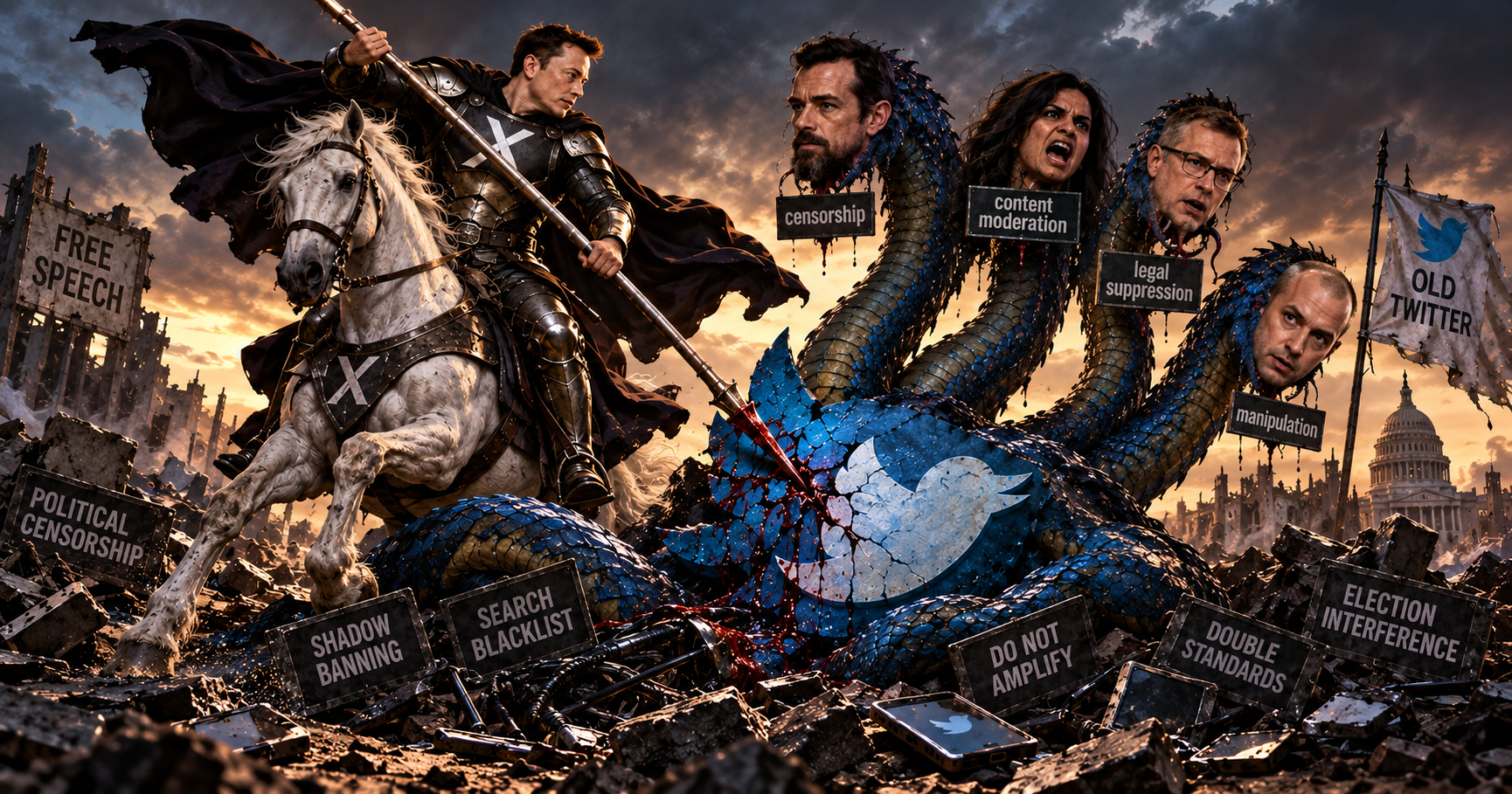
People nostalgic for the old Twitter tend to remember the bird.
We remember the cage.
We remember a social network blocking the distribution of a newspaper story weeks before a presidential election.
We remember internal systems capable of putting accounts on “Search Blacklist,” “Trends Blacklist” and “Do Not Amplify.”
And above all, we remember January 2021, when employees of a private technology company decided that the sitting President of the United States would no longer be permitted to speak through an account followed by tens of millions of people.
Whatever you think of Donald Trump, stop for a moment and appreciate the size of that power.
Not the President's power.
**Twitter's.**
A Social Network Is Not a Newspaper
This distinction seems to have disappeared somewhere during the great social-media experiment.
A newspaper is an editorial product.
The Antigloss decides what appears in The Antigloss. We select the subjects, arguments and writers. Nobody possesses an inherent right to demand a column on our website.
Don't like what we publish?
Don't read us.
That is how publishing works.
A social network is fundamentally different.
Its product is a communications platform on which millions of other people speak to one another.
The better analogy is the telephone company.
The CEO of your telephone provider is perfectly entitled to support Donald Trump, hate Donald Trump, worship Karl Marx, vote Communist or spend weekends campaigning for the Intergalactic Hamster Party.
What he should not be entitled to do is disconnect your telephone because your politics offend him.
His opinion belongs to him.
Your communication belongs to you.
Somewhere along the way, old Twitter forgot the difference.
Then Came Hunter Biden
On October 14, 2020, the New York Post published its explosive story based on material said to have come from Hunter Biden's laptop.
The presidential election was twenty days away.
Twitter intervened.
The company prevented users from posting links to the story under its hacked-materials policy. Accounts attempting to distribute it were restricted, including the New York Post's own account.
This wasn't Twitter declining to endorse the story.
It wasn't Twitter publishing a competing investigation.
It wasn't Twitter attaching its own editorial saying, “We think this reporting is garbage.”
Those would all have been speech.
Twitter instead interfered with **other people's ability to distribute the material on the communications platform it controlled.**
Then the criticism exploded.
Twitter changed course.
Jack Dorsey acknowledged that simply blocking URLs had been wrong, and the company revised its policy.
Wonderful.
There was just one small technical problem.
Sorry Doesn't Give You October 14 Back
This is the part Silicon Valley's culture of “Oops, sorry” never seems to understand.
Time isn't refundable.
You cannot restore October 14.
You cannot restore the first hours of a breaking political story.
You cannot recreate conversations that never happened.
You cannot return readers who would otherwise have encountered the article.
You cannot know whether those readers would have believed it, rejected it, investigated it or laughed at it.
And twenty days before a presidential election, **every day has political value**.
We are not claiming that unrestricted circulation of the Hunter Biden story would have changed the 2020 election.
Nobody can honestly know that.
That is precisely the point.
Twitter couldn't know either.
Yet Twitter made the intervention.
And once the moment had passed, there was no Undo button capable of returning the political environment to the state it would have occupied without that intervention.
This is why “sorry” is inadequate compensation for censorship during time-sensitive events.
A bank can mistakenly freeze your money on Monday and restore it Friday.
The balance may be restored.
Monday isn't.
Maybe your rent bounced Tuesday.
Maybe your business missed a payment Wednesday.
Maybe an opportunity disappeared Thursday.
Restoring the original condition does not necessarily restore the consequences.
Information works the same way.
A news story twenty days before an election and the identical story twenty days after an election are not politically equivalent objects.
One can affect an election.
The other can only discuss one.
Then Twitter Fired the President
Three months later came the decision that made Twitter's conception of its own power impossible to ignore.
On January 8, 2021, two days after the Capitol riot, Twitter permanently suspended Donald Trump's @realDonaldTrump account.
The company cited the **“risk of further incitement of violence.”**
This followed Trump's final posts saying, among other things, that the roughly 75 million Americans who voted for him would have a “GIANT VOICE” and that he would not attend Joe Biden's inauguration.
Twitter didn't simply evaluate isolated words. Its published explanation explicitly interpreted them in the broader political context, including how Trump's announcement that he would not attend the inauguration might be understood by people contemplating violence.
That distinction matters.
A private corporation wasn't merely deleting an explicit instruction to commit a specific violent act.
It was **interpreting political speech, predicting how an audience might interpret that speech, evaluating the political environment and deciding that the President should therefore lose access to the platform.**
The European debate that followed openly recognized the magnitude of what had happened: a technology platform had exercised extraordinary power over democratic communication.
Again, forget whether you like Trump.
Imagine the politician you hate most.
Now imagine the politician you love most.
The principle has to survive both.
If your position on corporate censorship changes when the politician's name changes, you don't have a principle.
You have a team.
Meet the Invisible Editor
Deleting accounts was only the most obvious form of power.
There was a quieter one.
After Musk acquired Twitter, internal documents released as part of the Twitter Files showed tools bearing remarkably straightforward labels:
**Search Blacklist.**
**Trends Blacklist.**
**Do Not Amplify.**
Former Twitter legal executive Vijaya Gadde later testified before Congress about these mechanisms. Asked about “Do Not Amplify,” she explained that it meant Twitter would not recommend or amplify the content in areas where the company itself made recommendations. Asked about search blacklisting, she described an ability to prevent material from appearing in portions of search results.
Twitter preferred the term **visibility filtering**.
Fine.
Call the machinery Herbert if that makes everybody feel better.
The important thing is what the machinery could do.
A user could technically remain on Twitter while Twitter altered how discoverable or amplifiable that user's speech became.
That is an extraordinary form of editorial power for something supposedly functioning as a public communications platform.
And it introduces the ugliest form of censorship:
**the censorship you cannot see.**
If Twitter suspends you, at least you know what happened.
If Twitter quietly prevents you from appearing in trends or recommendations, you may simply conclude that nobody is interested in what you said.
The platform doesn't merely control speech.
It can influence your perception of how society reacted to speech.
The Moderator Is Not Themis
Defenders of these systems usually reach for the same comforting word:
**moderation.**
Moderation sounds neutral.
Reasonable.
Almost judicial.
But moderators are human beings.
They have politics.
Religions.
Backgrounds.
Prejudices.
Fears.
Friends.
Enemies.
Experiences.
Moral convictions.
A moderator may sincerely believe he is completely impartial.
That doesn't make him impartial.
It makes him human.
The symbol of justice has worn a blindfold for centuries for a reason.
Twitter's moderators didn't.
And neither do Facebook's.
Neither do YouTube's.
No human being does.
The problem becomes especially dangerous when personal judgment hides inside wonderfully elastic categories such as “harmful,” “misleading,” “unsafe,” “dangerous” or “contextually inappropriate.”
Those words can describe genuine problems.
They can also become political rubber.
Stretch them far enough and almost anything fits.
Moderation Should Enforce Rules, Not Politics
None of this means social networks should become digital sewers without rules.
Child sexual-abuse material is illegal.
Credible criminal threats can be illegal.
Fraud exists.
Malware exists.
Spam exists.
Harassment can cross legal lines.
Direct incitement can cross legal lines.
A communications platform obviously needs mechanisms for dealing with unlawful material and abuse of its infrastructure.
But there is an enormous difference between:
**“This content violates a clearly applicable rule.”**
and:
**“We believe this political argument is harmful.”**
The first is enforcement.
The second is editorial judgment.
And a social network should not get to disguise the second as the first.
Give the Power to the User
There is already a perfectly good solution to political speech you don't want to hear.
Don't listen.
Modern platforms possess extraordinary personalization technology.
They can predict which shoes you might buy, which song you might enjoy and which video will keep you staring at your telephone for another seventeen minutes.
Surely they can manage:
**“I don't want to see this subject.”**
Give users powerful controls.
Don't like Trump?
Hide Trump.
Don't like Biden?
Hide Biden.
Don't want Russian politics?
Filter it.
Don't want Ukrainian politics?
Filter it.
Mute keywords.
Mute subjects.
Mute accounts.
Tune recommendations.
Let the individual decide what enters his own head.
X itself currently provides mute, block and filtering tools that illustrate exactly how much control can be placed in users' hands.
What shouldn't happen is one user's preference becoming everybody else's restriction.
Your “I don't want to see this” should mean:
**don't show it to me.**
Not:
**don't let anyone else see it either.**
Punishment Takes Seconds. Appeals Take Days.
Then there is the other great obscenity of automated moderation.
A system can restrict an account almost instantly.
Appeal?
Please wait.
Twenty-four hours.
Forty-eight.
Seventy-two.
Perhaps longer.
And if the platform eventually discovers that it made a mistake:
**Sorry!**
Account restored.
Case closed.
Except it isn't.
For a business, those hours can mean revenue.
For a journalist, they can mean an entire news cycle.
For a political candidate, they can mean irreplaceable campaign time.
For somebody whose livelihood depends on an audience, they can mean actual economic damage.
If a platform can impose punishment instantly, it cannot treat correction as an administrative favor performed whenever somebody eventually reaches the support ticket.
**The period of wrongful restriction is itself part of the harm.**
Any serious system of platform accountability would recognize that.
“But It's a Private Company”
Yes.
So is your telephone provider.
So are banks.
So are airlines.
So are insurance companies.
Private ownership does not magically eliminate public obligations when a business becomes infrastructure on which enormous parts of society depend.
The question isn't whether Twitter belonged to the government.
It didn't.
The question is whether a communications platform used by hundreds of millions of people should possess unlimited discretion to discriminate among lawful political viewpoints simply because its shareholders happen to own the servers.
Our answer is no.
If you want the editorial freedom of a newspaper, start a newspaper.
Choose the writers.
Choose the stories.
Choose the politics.
Publish whatever you like.
But if your product is a global platform whose fundamental purpose is allowing **other people to communicate with one another**, stop pretending that your corporate political preferences are merely another form of neutral moderation.
They aren't.
Then Elon Musk Walked In
In October 2022, Elon Musk completed his $44 billion purchase of Twitter.
What happened afterward has been argued about endlessly.
Twitter became X.
Employees disappeared.
Policies changed.
Advertisers fled and returned and fled again.
Musk became the villain of half the internet and the patron saint of another portion.
None of that is our subject here.
Our subject is the fairy tale that **before Musk arrived, Twitter was some pristine democratic public square that he subsequently destroyed.**
No.
The old Twitter had already demonstrated an extraordinary appetite for controlling political communication.
It interfered with circulation of politically sensitive journalism during an election campaign.
It permanently removed a sitting president.
It possessed internal mechanisms capable of limiting search, trends and amplification.
And throughout all of this, human beings inside a private corporation were deciding where the boundaries of acceptable political discourse should sit.
Then Musk bought the company.
Whatever else you think about him, he did not murder an innocent little bird.
The bird had a record.
We Don't Miss Old Twitter
Now, in 2026, people are once again trying to resurrect pieces of the Twitter identity.
The nostalgia machine is warming up.
The blue bird.
Tweets.
The old town square.
Simpler times.
Spare us.
We remember those simpler times.
We remember who controlled the doors.
We remember who decided which stories travelled.
We remember who decided which accounts remained.
We remember the invisible machinery behind the timeline.
And we remember the remarkable confidence with which employees of a technology company assumed that their judgment should determine the boundaries of political conversation for everybody else.
So no, we don't mourn old Twitter.
The logo was charming.
The power underneath it wasn't.
Elon Musk didn't destroy our ideal social network.
**He bought a deeply political communications machine, killed its old identity and called the replacement X.**
The bird is dead.
Good.
The problem was never the bird.
**It was the people who thought owning the cage gave them the right to decide who was allowed to sing.**