Society
The Bomb Is in Israel. The Inspectors Are in Iran.
Masoud Pezeshkian reduced the Middle East nuclear order to one brutal sentence at the United Nations. The sentence was political. The contradiction behind it is real.
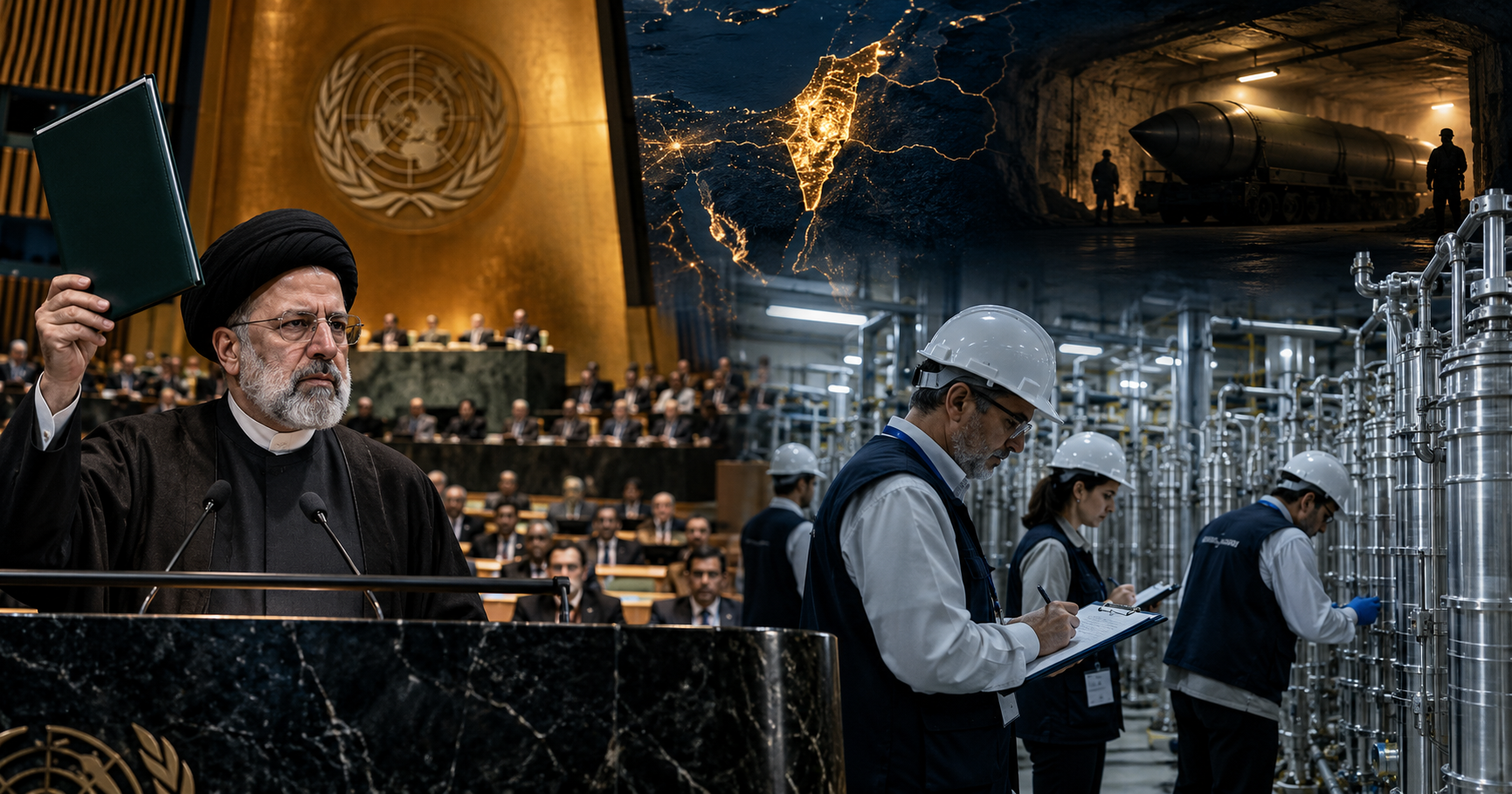
Iranian President Masoud Pezeshkian stood before the United Nations General Assembly on September 23 and delivered perhaps the simplest line of the entire nuclear debate:
**“The nuclear weapon is in Israel, but the inspectors are in Iran.”**
He accused the international system of applying different standards to the two countries. Israel, he argued, possesses nuclear weapons while remaining outside the Nuclear Non-Proliferation Treaty. Iran, meanwhile, is inspected, sanctioned and pressured over a nuclear programme it continues to describe as peaceful.
Strip away the rhetoric and one uncomfortable fact remains.
SIPRI’s 2026 assessment lists Israel among the world’s nine nuclear-armed states and estimates its stockpile at roughly **90 nuclear warheads**. Israel maintains its longstanding policy of nuclear opacity and neither officially confirms nor denies possessing them.
Iran does not have that status.
It has inspectors.
The Treaty Explains It. It Does Not Make It Look Less Strange.
There is a legal reason for the difference.
Iran is a party to the Nuclear Non-Proliferation Treaty and has had a comprehensive safeguards agreement with the IAEA in force since 1974. Under the NPT, non-nuclear-weapon states accept international safeguards so the agency can verify that nuclear material is not diverted into weapons programmes.
Israel never joined the NPT.
That means it is not subject to the same comprehensive safeguards regime. The IAEA does apply limited, item-specific safeguards to certain Israeli nuclear material and facilities, so the claim that Israel has never faced any inspection at all is too broad. But Israel is not under the comprehensive system that applies to Iran.
This is not an administrative accident.
It is how the system is built.
The NPT legally recognizes as nuclear-weapon states only countries that manufactured and exploded a nuclear device before January 1, 1967. Any country joining afterward enters as a non-nuclear-weapon state regardless of what weapons it possesses.
Israel stayed outside.
Iran entered.
One acquired obligations.
The other retained ambiguity.
Iran Is Not Being Inspected for Nothing
This is where Pezeshkian’s slogan becomes too convenient.
Iran has given the IAEA plenty to investigate.
The agency has repeatedly raised concerns about Tehran’s cooperation, unexplained nuclear material and uranium enrichment. Before attacks on Iranian nuclear facilities disrupted inspections, Iran had accumulated about **440.9 kilograms of uranium enriched to 60 percent**, a level far above normal civilian reactor fuel and technically much closer to weapons-grade material. The IAEA has also said Iran was the only non-nuclear-weapon state producing and accumulating uranium at that enrichment level.
After military strikes damaged Iranian nuclear facilities, access became even more difficult. In September 2026 the United States, Britain, France and Germany were pushing the IAEA Board to report Iran again to the UN Security Council, citing unresolved safeguards questions and restrictions on verification.
So the serious argument is not that Iran deserves no scrutiny.
It clearly does.
The interesting question is what happens to the credibility of a non-proliferation system when the country being inspected can point across the region at an estimated nuclear arsenal sitting outside the same comprehensive regime.
The Nuclear Order Has an Exit Door
The paradox is almost architectural.
Join the treaty as a non-nuclear state and you accept verification.
Remain outside it and the treaty itself cannot impose the same comprehensive safeguards obligations on you.
That does not make withdrawal or non-membership consequence-free. Diplomacy, sanctions, alliances and military pressure still exist. But the treaty cannot inspect a state under obligations that state never accepted.
The result is an extraordinary political image.
An Iranian centrifuge becomes an international crisis.
An estimated Israeli nuclear arsenal becomes an open secret.
One is counted in kilograms.
The other is counted in warheads.
The distinction has a legal explanation.
It also has consequences for how the system is perceived.
The IAEA itself has long acknowledged the regional divide. All Middle Eastern states except Israel are parties to the NPT, and disagreement over extending comprehensive safeguards throughout the region has persisted for decades.
That is the part Pezeshkian exploited at the UN.
He did not invent it.
A System Cannot Live on Technicalities Alone
Non-proliferation depends on states believing there is something to be gained by remaining inside the system.
Iran’s nuclear record does not disappear because Israel possesses nuclear weapons.
Israel’s nuclear status does not become irrelevant because Iran has enriched uranium to 60 percent.
Both facts can exist at once.
And that is precisely why Pezeshkian’s line landed.
Not because it proved Iran innocent.
It did not.
It exposed a structural weakness in the nuclear order: **the rules are strongest over the countries that agreed to be governed by them.**
Israel’s arsenal remains officially unacknowledged.
Iran’s centrifuges remain inspected, disputed and sanctioned.
The treaty explains why.
**It does not erase the contradiction.**