Media
The Bomb Was Earlier. The Deaths Came Wednesday.
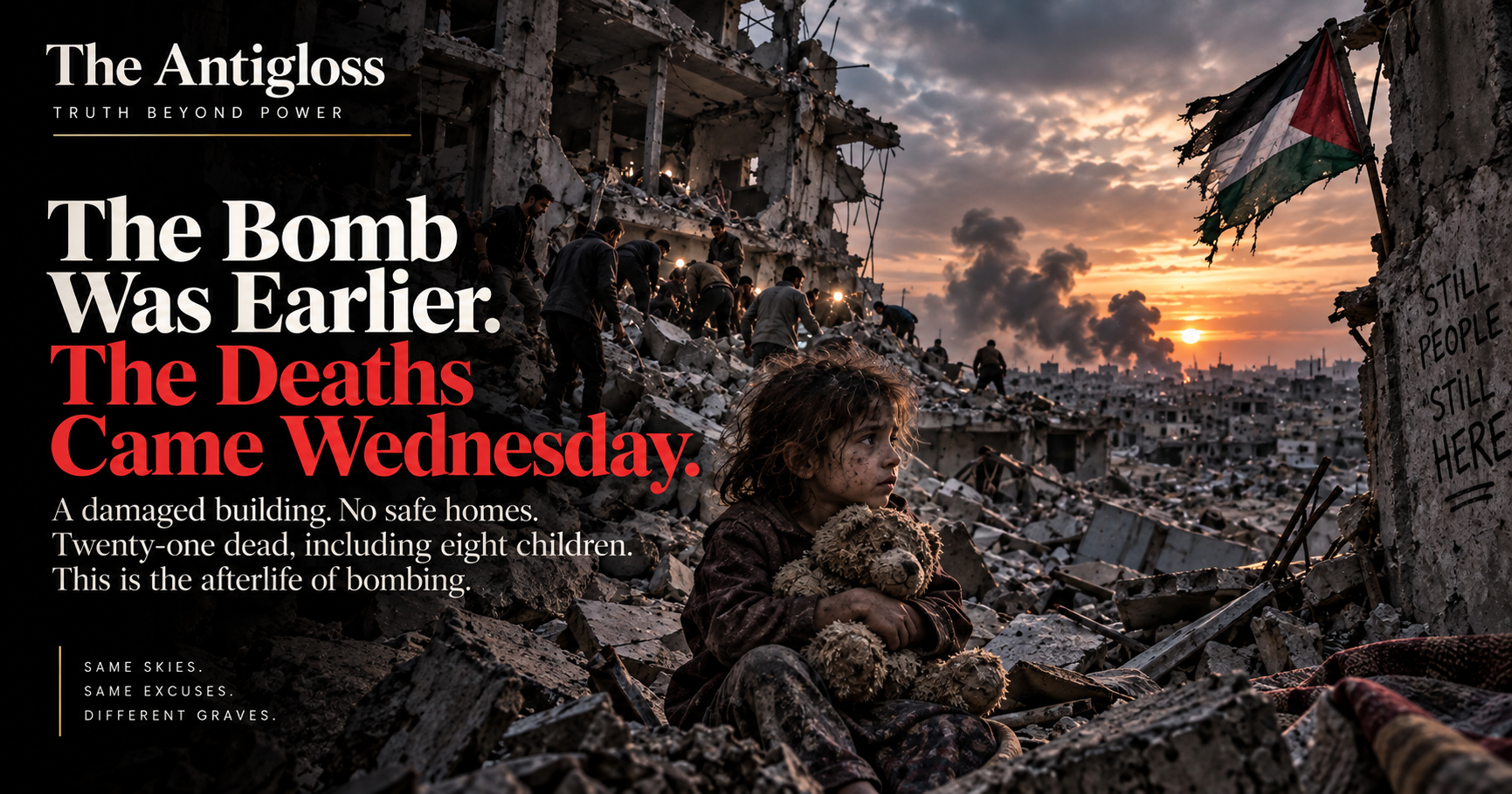
A seven-storey building in Gaza, previously damaged by Israeli airstrikes, collapsed with more than 110 people inside. Twenty-one died. Eight were children.
The building had survived the bombing.
That did not make it safe.
More than 110 Palestinians were living inside the damaged seven-storey structure because they could not find adequate shelter elsewhere. On Wednesday it collapsed. Rescue teams eventually recovered 21 dead, including eight children, and pulled 45 people alive from the wreckage.
The relevant history of the building matters.
Reuters identifies it as one of roughly 2,000 damaged buildings across Gaza that families are still occupying after Israeli airstrikes. Tens of thousands of people are living in such structures because shelters are overcrowded, tents are inadequate or unavailable, and large-scale reconstruction has barely begun.
This was therefore not an ordinary building failure in an ordinary city.
It was a damaged structure being used as housing because war had removed many of the safer alternatives.
They Knew the Building Was Dangerous
One survivor, Nader El-Ejlah, told Reuters that his family had moved into the building because they could not find somewhere else to live.
Several of his relatives died when it collapsed.
That detail strips away one convenient question: why would anyone live there?
Because the alternatives were worse.
Gaza's population of more than two million people is now concentrated largely into about a third of the territory, according to Reuters, with many families living in tents, overcrowded rooms and damaged buildings. Most buildings in Gaza were either destroyed by Israeli airstrikes or bulldozed by Israeli forces, while nearly all remaining structures suffered some degree of damage.
People did not choose a bomb-damaged apartment block because it looked attractive.
They chose it because it still had walls.
Reconstruction Has Barely Started
Almost a year after the ceasefire halted the largest phase of the fighting, Gaza has not undergone anything resembling normal reconstruction.
Negotiations over Hamas's disarmament, Israeli withdrawal and the broader ceasefire arrangements remain unresolved. At the same time, Palestinian and UN officials say Israeli restrictions on heavy machinery and materials have slowed rubble removal and rebuilding. Israel says those restrictions are intended to prevent equipment from being diverted to militant use.
That dispute has left civilians living inside the physical remains of the war.
A damaged concrete building does not need to collapse immediately to be dangerous. Structural damage can remain hidden until weakened columns, slabs or walls finally fail.
UN officials have warned that hundreds of buildings in Gaza are considered at risk of collapse.
The danger is therefore not confined to the site where these 21 people died.
There are other families sleeping inside other damaged structures tonight.
Rescue Workers Were Digging Without What They Needed
When the building came down, Gaza's Civil Defence said its teams lacked the equipment required for a rescue operation of this scale.
Forty-five people were nevertheless pulled alive from the debris.
Palestinian and UN officials say restrictions on heavy equipment entering Gaza have left rescuers without enough excavators and machinery. Israel has defended restrictions on dual-use equipment on security grounds.
That policy argument becomes brutally concrete when somebody is trapped beneath reinforced concrete.
A restriction imposed at a crossing becomes a missing excavator at a collapsed building.
Gaza Is Buried Under 61 Million Tons of Debris
The scale of the destruction extends far beyond this single address.
The United Nations estimates that the war produced around **61 million tons of rubble and debris**, potentially requiring about seven years to clear.
Since November 2025, Palestinian Civil Defence says more than 630 bodies and human remains have been recovered from destroyed buildings. Palestinian authorities estimate that more than 8,000 people may still be buried beneath the wreckage.
Those figures describe something different from the familiar image of an airstrike.
The strike lasts seconds.
The ruined city remains.
Homes disappear from the housing stock. Families move into compromised structures. Rescue equipment becomes essential. Reconstruction becomes a political and logistical struggle. The dead can remain beneath buildings for months or years.
That is the afterlife of bombing.
Israel Says Its Restrictions Are About Hamas
Israel says it has sought to avoid civilian casualties, accuses Hamas of operating from civilian areas and argues that restrictions on some machinery and materials are necessary to prevent militant rebuilding. Hamas disputes Israel's allegation that it systematically uses civilians as human shields.
Those claims belong in the record.
So does the condition of Gaza after the campaign.
A family moved into a building already damaged by Israeli bombing because it could not find safer housing.
The building collapsed.
Eight children were among the dead.
By Thursday, bulldozers were clearing the site so that surviving families could live there again.
This time in tents.