Technology
The Children Were Saved. Please Make the Check Payable to the Government.
There is a wonderfully efficient ritual in modern American governance.
There is a wonderfully efficient ritual in modern American governance.
First, discover a social problem.
Second, find a corporation with an enormous balance sheet.
Third, explain that the corporation has been harming society for years.
Fourth, demand an astronomical amount of money.
Fifth, settle for a slightly less astronomical amount.
Sixth, announce that justice has been served.
And, most importantly, deposit the check.
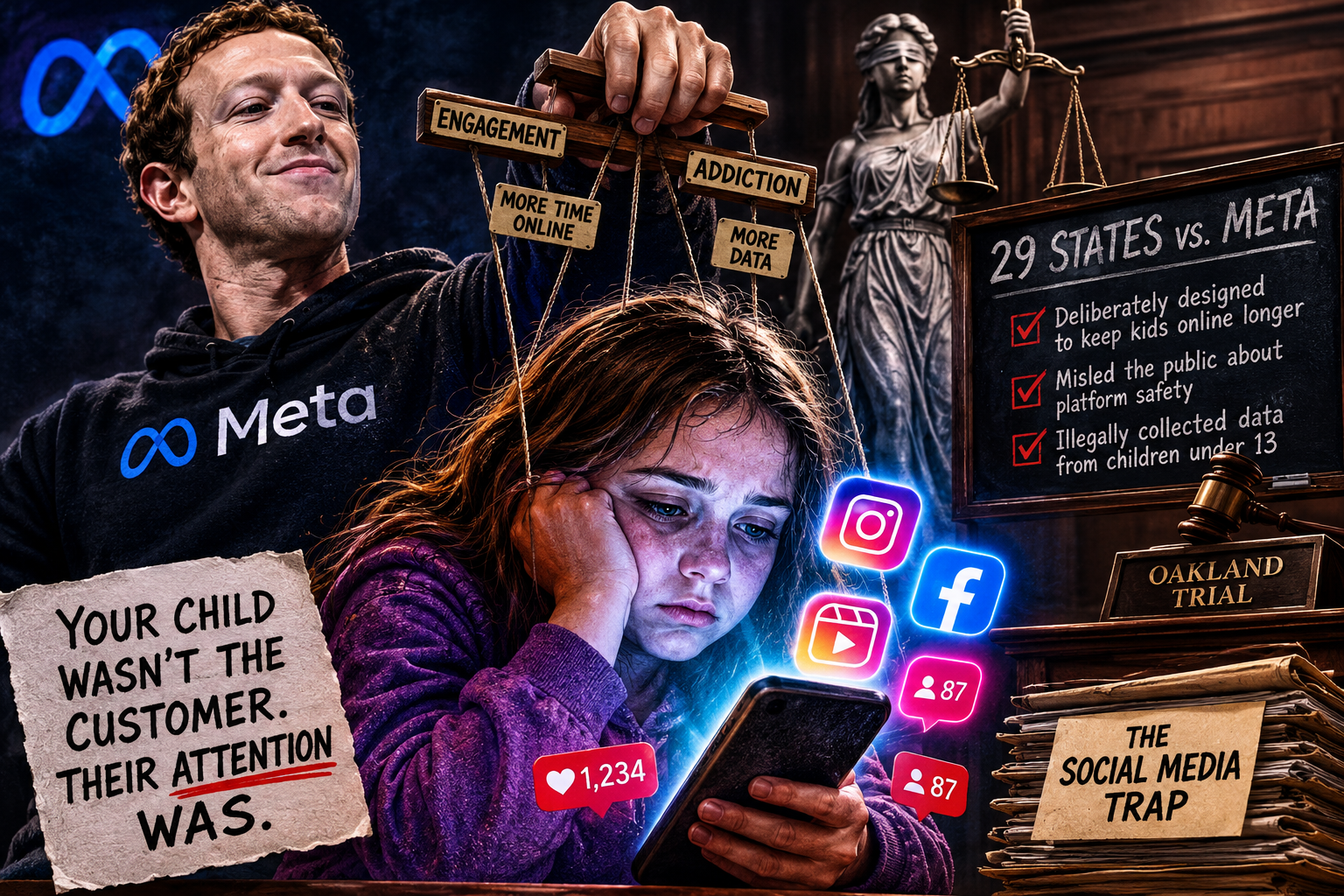
This week, Meta agreed to pay up to roughly $18 billion to settle claims brought by nearly every U.S. state over the alleged effects of Facebook and Instagram on children and teenagers. The states accused Meta of designing products that encouraged compulsive use, misleading the public about their safety and, among other allegations, violating protections involving children's data.
Meta admits no wrongdoing.
That sentence deserves to sit by itself for a moment.
**Meta admits no wrongdoing.**
Yet somewhere between approximately $13 billion guaranteed and another $5 billion potentially payable over the next decade, America apparently found justice.
Congratulations, Children. Your Government Has Received the Money.
The official explanation is naturally about protecting children.
The Justice Department described social-media platforms as using deceptive and emotionally manipulative algorithms that keep young people online and increase corporate profits. Under the settlement, Meta will introduce restrictions including time limits for teenagers, nighttime blocks, tighter notification rules, age-verification measures and additional parental controls.
Fine.
Some of those measures may even be useful.
But there is an awkward question hiding behind the press conference:
**If Meta inflicted billions of dollars worth of damage on American children, why are governments collecting the billions?**
A teenager who supposedly lost thousands of hours to an addictive feed does not receive a check because California negotiated a settlement.
A parent who believes Instagram damaged his child's mental health does not suddenly find $18 billion divided among American families.
The money goes into the machinery of government through settlement structures negotiated by the states.
This is an interesting definition of victim compensation.
Imagine someone smashes your car.
The government prosecutes him, collects $50,000, keeps the money and then sends you a brochure explaining safer parking.
Justice!
The Original Price of Justice Was Even Higher
Before the settlement, states were seeking penalties that could reach **$200 billion**.
Then everyone discovered the miraculous healing power of negotiation.
The final arrangement guarantees about $12.7 billion over ten years. Another $5 billion is conditional, including provisions connected to competitors adopting comparable protections.
Meta gets something extraordinarily valuable in return: a massive piece of legal uncertainty disappears.
The governments get billions.
The attorneys get a historic settlement.
Politicians get podiums.
Meta gets predictability.
And children get a two-hour timer.
Everybody wins.
Especially everybody who was actually sitting at the negotiating table.
Follow the Stock Price
There is perhaps no better review of a corporate punishment than asking the people who own the corporation what they think about it.
After news of the settlement, Meta shares rose.
Analysts largely viewed the agreement favorably because Meta's fundamental money-making machinery remains intact. Personalized feeds and advertising — the economic engine underneath Facebook and Instagram — survive.
This is remarkable.
Governments have just announced one of the largest social-media settlements in history.
Meta is paying a number so enormous that normal human beings have difficulty visualizing it.
And Wall Street's reaction is essentially:
**Excellent. Problem solved.**
That tells us something.
For a company of Meta's size, $18 billion spread across a decade is not necessarily an existential punishment.
It may simply be the price of regulatory peace.
The government hasn't killed the machine.
It has installed a meter on it.
Government Has Discovered an Excellent Business Model
This is where things become uncomfortable.
Governments increasingly regulate industries that generate enormous amounts of money.
When something goes wrong, there are two fundamentally different objectives available.
One is to stop the harmful activity.
The other is to make the harmful activity expensive.
Those are not necessarily the same thing.
If a product is genuinely so dangerous that it constitutes a major threat to children's health, the logical response should be to remove the dangerous mechanism.
But if the mechanism can continue operating after paying billions of dollars, we have created something rather different.
We have created a revenue model.
Smoke too much? Tax it.
Drink too much? Tax it.
Gamble too much? Tax it.
Scroll too much?
Apparently we are getting there.
The government condemns the behavior while acquiring a financial interest in its continued profitability.
That doesn't mean officials literally want children addicted to Instagram.
It means the incentive structure deserves considerably more scrutiny than the victory speeches usually receive.
And What Happens to the Billions?
This is where everyone should become boring.
Boring is useful when enormous amounts of money are involved.
Every dollar should be traceable.
Which state receives it?
How much?
When?
Into which fund?
What is it spent on?
How much goes toward administration?
How much goes toward lawyers?
How much actually finances child mental-health programs, digital-literacy programs or direct assistance?
And how much simply disappears into the wonderful governmental concept known as **general revenue**?
There is no need to invent brown envelopes or politicians stuffing hundred-dollar bills into their jackets.
Ordinary government accounting can be much more interesting.
If politicians say the settlement is about children, then earmark the proceeds for children and publish the receipts.
Otherwise taxpayers are entitled to wonder whether America's children just became the moral justification for one of the largest corporate transfers to government in recent memory.
Meta Didn't Lose. It Bought Certainty.
Perhaps the funniest part is that Meta doesn't even have to confess.
No dramatic admission.
No corporate mea culpa.
No Mark Zuckerberg appearing before America to say:
“Yes, we deliberately addicted your children.”
Instead, Meta denies wrongdoing, agrees to product changes, writes enormous checks over time and removes a potentially catastrophic legal risk.
That's not necessarily surrender.
For a corporation, that can be a transaction.
And apparently investors understand this perfectly well.
The state gets to say:
**We held Big Tech accountable.**
Meta gets to say:
**We admitted nothing.**
Wall Street gets to say:
**Good settlement.**
Everyone walks away declaring victory.
Except, curiously, the people whose suffering supposedly justified the billions in the first place.
The American Solution
Maybe Meta's platforms really did harm children.
Maybe some of the accusations are overstated.
Maybe the truth lies somewhere between corporate denial and prosecutorial rhetoric.
That is exactly what a trial is supposed to establish.
But America increasingly has another mechanism for answering difficult questions.
Don't establish the truth.
Establish the price.
Once the number is large enough, government can call it accountability and the corporation can call it closure.
The uncomfortable question isn't whether Meta can afford $18 billion.
Obviously it can.
The uncomfortable question is what happens when government discovers that regulating corporate wrongdoing can itself become extremely profitable.
Because once that happens, there is a subtle difference between eliminating a problem and **charging admission to it**.
And somewhere in America tonight, a teenager is still scrolling Instagram.
But don't worry.
The adults have settled the matter.
**The check is in the mail.**