Society
The Communist Sticker
How people use political words they never bothered to understand, while mistaking brand obedience for independent thought.
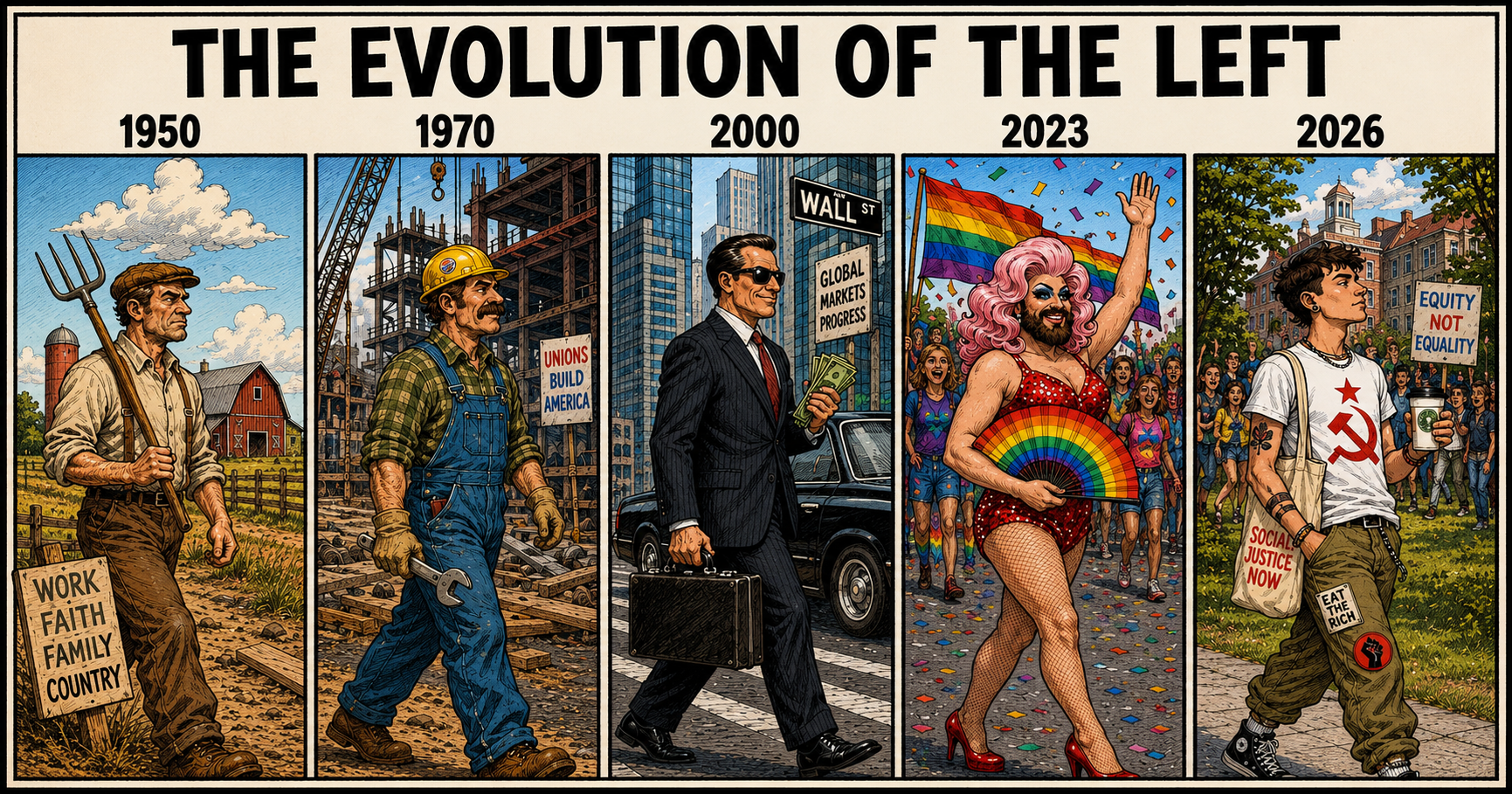
There is a special kind of political genius who has never read Marx, could not explain communism without reaching for a meme, and still manages to find it everywhere.
In a student’s haircut.
In a tote bag.
In the word equity.
In a teenager’s T-shirt.
In a woman with blue hair.
In a protest sign.
In any sentence longer than a bumper sticker.
For this person, communism is not an economic theory. It is not a historical movement. It is not a system of property relations, class analysis, labor, capital, revolution, party structure, or state power.
It is a sticker.
A red sticker.
You slap it on whatever annoys you.
> **Core translation: “Communist” has become the emergency label for people who want to sound political without doing the hard physical labor of understanding politics.**
The red bucket
The comedy, of course, is that the same person usually lives inside another herd system entirely.
Starbucks cup in hand.
Apple phone in pocket.
BMW fantasy in the driveway.
Electric car as portable moral halo.
Brand logos arranged around the personality like little corporate saints.
They think they are defending civilization from ideology while walking around covered in consumer sacraments.
This is not political literacy.
This is label management.
“Communist” becomes the emergency word for anything outside the user’s emotional comfort zone. It does not explain. It does not analyze. It does not prove. It only performs alarm.
Drag queen? Communist.
Student protest? Communist.
Union? Communist.
Diversity poster? Communist.
Corporate HR slogan written by people with consulting invoices and no soul? Somehow also communist.
The word has been emptied so completely that it no longer describes a system. It describes a feeling.
The feeling is: I do not like this, and I need my dislike to sound educated.
The brand herd
The strange part is not that people criticize the left. Criticism is healthy. The strange part is watching people mistake a meme template for political thought while participating in another mass ritual with religious devotion.
A branded cup becomes identity.
A phone becomes caste.
A car badge becomes personality.
A battery-powered virtue machine becomes proof of moral upgrade.
The same person who laughs at ideology may be wearing ten tiny ideologies before lunch.
Not all ideologies wear party pins. Some arrive as lifestyle products. Some come with brushed aluminum. Some smell like burnt espresso and moral superiority. Some are parked diagonally across two spaces and financed for eighty-four months.
But the herd does not call itself a herd.
It calls itself taste.
Recognition without comprehension
That is the genius of cheap political language. It allows a person to appear serious without doing the terrible physical labor of reading.
No Marx.
No history.
No economics.
No definitions.
No distinction between socialism, communism, liberalism, progressivism, social democracy, corporate diversity theatre, academic fashion, activist branding, and plain old institutional nonsense.
Everything goes into the same red bucket.
And the bucket is not ideology.
It is intellectual garbage storage.
The problem is not that communism cannot be criticized. It can. It should. It has a vast, bloody, complicated history, and serious people can attack it from many directions.
But seriousness requires knowledge.
The meme does not want knowledge.
The meme wants recognition without comprehension.
It wants the viewer to feel clever for spotting a symbol.
Hammer and sickle. Bad thing. Case closed.
That is not analysis.
That is a toddler pointing at a skull on Halloween and calling it anatomy.
The rattle test
So when someone uses communism as a universal insult, the polite question is simple:
Have you read even ten pages of what you are pretending to condemn?
Not a podcast summary.
Not a Facebook caption.
Not a YouTube uncle yelling from a truck.
A book.
A paragraph.
A definition.
Something with letters arranged in public order.
Because if you cannot explain the word, you are not making an argument.
You are shaking a rattle.
And sometimes the rattle is red.
> **Final translation: A political word used without knowledge is not an argument. It is a costume for confusion.**
---
**Editorial note:** Draft inspired by social-media meme language around “communism,” political labeling, brand identity, Starbucks/Apple/BMW consumer signals, EV virtue branding, and herd reflexes.