Media
THE FAKE NEWS ABOUT THE FAKE NEWS
A viral post exaggerated what Eli Hazan said. It really didn't need to.
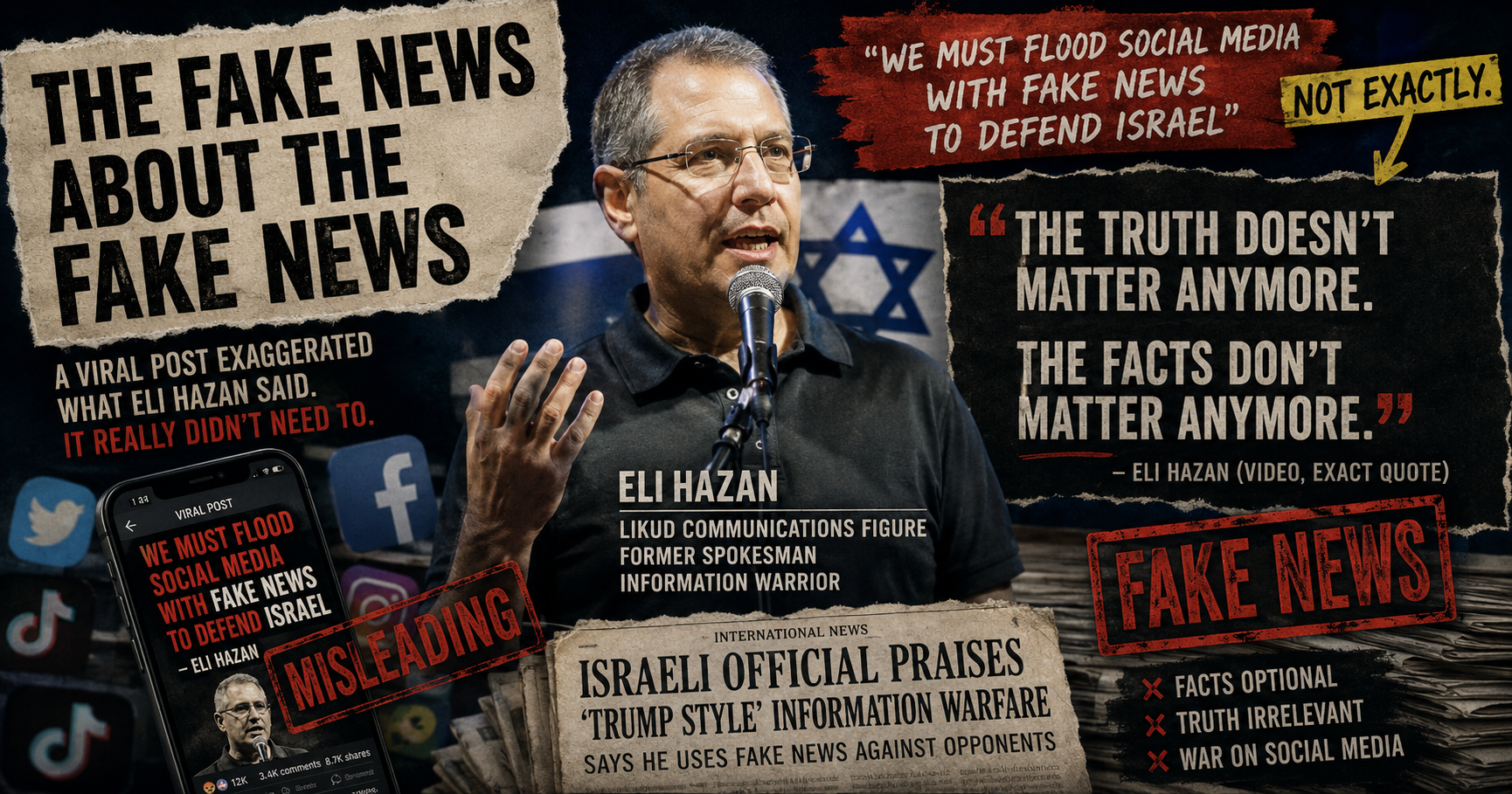
There is a video circulating online with a wonderfully explosive caption:
**“We must flood social media with fake news to defend Israel.”**
It is attributed to Eli Hazan, a longtime Likud communications figure.
There is only one problem.
That isn't quite what he said.
Normally, this is where a fact-checker triumphantly declares the whole thing FALSE, attaches a red warning label, and everyone goes home feeling that journalism has once again saved civilization.
Unfortunately, Hazan then opens his mouth.
And the correction becomes considerably less helpful.
WHAT HE ACTUALLY SAID
In the circulating clip, Hazan says:
> “The truth doesn't matter anymore. The facts don't matter anymore.”
He then says that he uses fake news in response to his opponents and argues that the political communications battle requires a Trump-style approach. The clip ends with another wonderfully diplomatic proposition: if opponents want war on social media, they will get war on social media.
So no, we cannot verify the viral sentence **“We must flood social media with fake news to defend Israel”** as a verbatim quotation.
The internet apparently decided that Hazan's actual remarks were insufficiently insane and required editorial assistance.
They did not.
PLEASE STOP HELPING
This is one of the stranger diseases of social media.
Somebody discovers an authentic statement that is already devastating.
Then somebody else improves it.
A word is added.
A context is removed.
A paraphrase receives quotation marks.
And suddenly the strongest defence available to the person who originally said something appalling is:
**“I didn't say that.”**
Correct.
You said something slightly different and almost equally extraordinary.
Congratulations.
This is how perfectly usable evidence gets contaminated by people apparently incapable of leaving anything alone.
WHO IS ELI HAZAN?
This part also requires cleaning up.
Hazan is not some random man dragged out of a Facebook comment section. He has held senior communications and international-relations roles in Likud. In 2017, The Times of Israel identified him as the party's director of international relations; during the 2019 Israeli election controversy over allegedly coordinated pro-Netanyahu social-media accounts, he publicly responded on Likud's behalf.
Recent reporting says Netanyahu sought to appoint Hazan to head Israel's Government Press Office, which handles relations with domestic and foreign journalists. That is the context in which the old remarks have resurfaced.
That distinction matters.
Calling somebody the current director when the appointment history is disputed or unclear is precisely the kind of sloppiness an article about fake news should probably avoid.
The irony would otherwise become sentient.
“FACTS DON'T MATTER”
Forget Israel for a moment.
Forget Netanyahu.
Forget Trump.
Forget which political tribe you happen to dislike this week.
There is something deeply rotten about a professional political communicator reaching the point where **truth and facts themselves become optional instruments**.
Public relations has always involved framing.
Governments select favourable statistics. Parties emphasize convenient facts. Campaigns omit inconvenient ones. Journalists choose headlines. Corporations polish disasters until they resemble quarterly achievements.
None of this was invented yesterday.
But there is still an enormous conceptual distance between:
**“We will present our side as effectively as possible.”**
and:
**“The facts don't matter anymore.”**
Once you cross that line, communication ceases to be persuasion.
It becomes ammunition.
THE TRUMP LINE
Hazan's reference to Trump is particularly revealing because it tells us how he understands modern information warfare.
Not as an argument to be won by producing the strongest evidence.
As a battlefield to be saturated.
Not:
**Here are our facts.**
But:
**You attack us, we attack you harder.**
That philosophy is hardly unique to Likud. Variations of it now infest politics everywhere. The internet rewards speed, outrage and repetition far more efficiently than it rewards a footnote.
By the time somebody publishes a careful correction on Thursday, the bullshit from Monday has twenty million views and its own merchandise.
AND THAT BRINGS US BACK TO THE MEME
The people sharing the viral Hazan post presumably want to demonstrate that propaganda is manipulating the public.
So they take an authentic video about the disregard for factual accuracy...
...and attach an inaccurate quotation to it.
You couldn't commission better satire.
The correct response isn't to defend Hazan.
It is to stop doing his work for him.
His actual words are quite sufficient.
**“The truth doesn't matter anymore. The facts don't matter anymore.”**
There.
Publish that.
Give the date and context.
Explain who he was when he said it and what positions he subsequently held or was considered for.
Then leave the quotation alone.
Because there is a wonderfully simple rule for exposing propaganda:
### DON'T ADD PROPAGANDA TO IT.
When somebody hands you a loaded gun, you don't need to paint a larger gun around it.
You point the camera at the one that's already there.
And press record.