Society
The FBI Was Warned. Epstein Was Protected Anyway.
When a scandal survives warnings, investigations, a draft sixty-count indictment and an extraordinary federal deal, “nobody knew” stops being a convincing explanation.
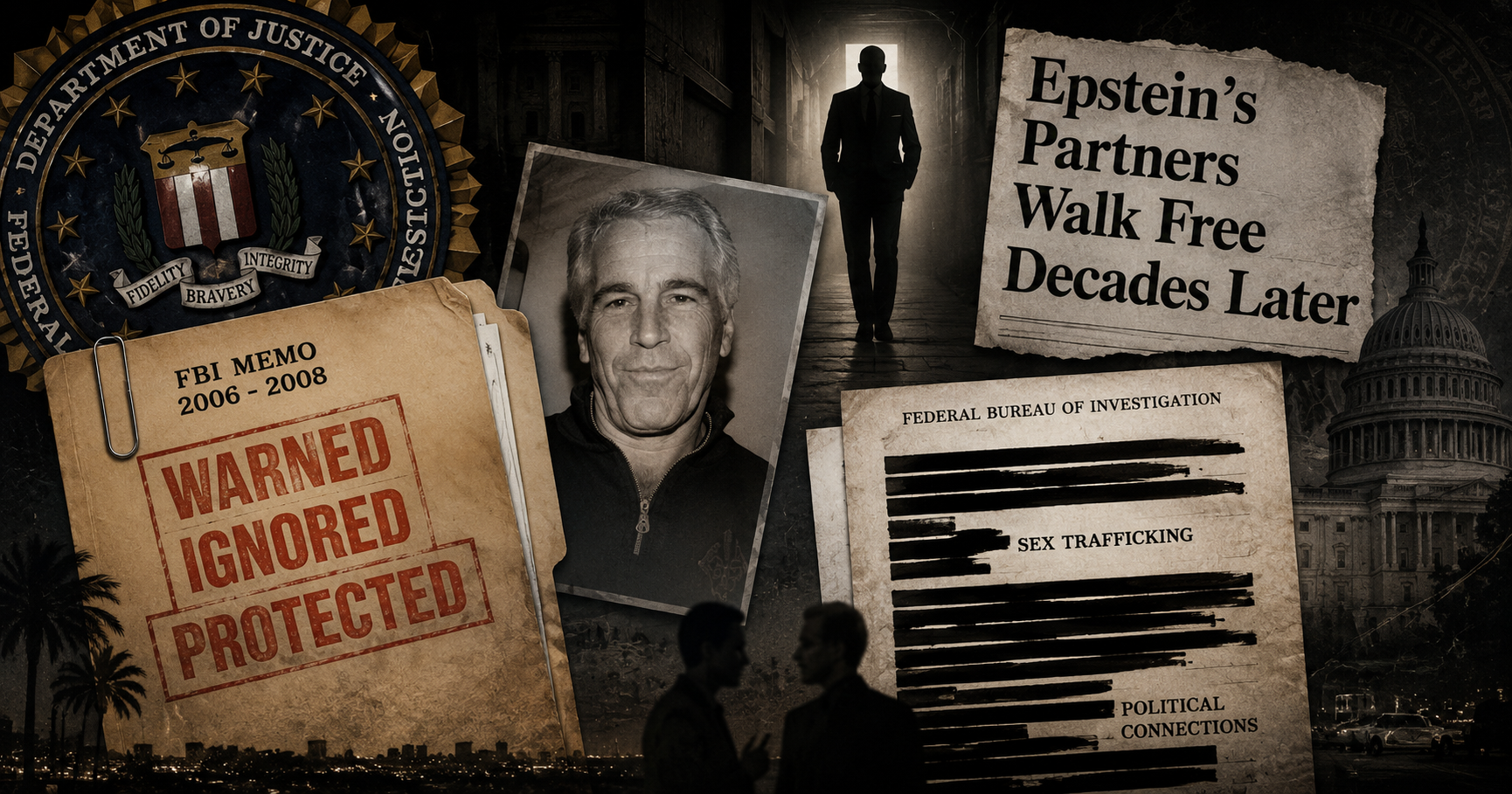
For years, the Jeffrey Epstein story has been presented as a story of failure.
Police failed. Prosecutors failed. The FBI failed. Institutions failed. Warning signs were missed. Victims were failed. An extraordinarily well-connected predator somehow kept slipping through cracks in the system.
There is another possibility.
Maybe there were too many cracks, all appearing in exactly the right places, for “failure” to remain an adequate description.
A new federal lawsuit has now added another extraordinary allegation to an already extraordinary history.
Audra Lynn Christiansen, a former Playboy model, says Hugh Hefner repeatedly contacted the FBI on her behalf in 2005 after she told him about Epstein. According to the allegations now before a federal court, those warnings concerned sexual abuse and trafficking.
The FBI, she says, did not interview her until 2020.
Fifteen years later.
After Epstein was dead.
There is an important distinction here. The allegation that Hefner repeatedly contacted the FBI comes from Christiansen and the plaintiffs' current federal case. A contemporaneous FBI call log from 2005 independently documenting those calls has not surfaced publicly.
That absence does not make the allegation proof of a government conspiracy.
But it raises a rather obvious question:
**Where is it?**
Because almost everything else about the government's knowledge of Epstein is considerably less mysterious.
They Knew
The official history does not begin with journalists discovering Epstein years later.
It begins in 2005.
The Justice Department's own Office of Professional Responsibility says Palm Beach police began investigating Epstein that year after the parents of a fourteen-year-old girl complained that he had paid their daughter for a massage.
Police discovered more.
They became dissatisfied with the way the local State Attorney was handling the case and referred it to the FBI.
The FBI investigated.
Federal prosecutors investigated.
More victims were discovered.
And by May 2007, an Assistant United States Attorney had prepared a **draft sixty-count federal indictment** against Epstein.
Sixty counts.
This was not a vague rumor sitting forgotten in somebody's inbox.
This was a developed federal criminal investigation.
Then something remarkable happened.
The indictment was never filed.
Instead, Epstein's lawyers negotiated with federal prosecutors.
In September 2007, the United States Attorney's Office entered into a non-prosecution agreement with Epstein. He would resolve the matter through comparatively limited state charges, while the federal investigation disappeared.
And the agreement did something even more extraordinary.
It protected not merely Epstein, but potential co-conspirators from federal prosecution in the Southern District of Florida.
The government knew enough to construct sixty potential counts.
Then the government negotiated the case away.
The Government Investigated the Government
Years later, the Department of Justice investigated its own handling of the affair.
Its Office of Professional Responsibility did not find professional misconduct.
It did, however, conclude that then-U.S. Attorney Alexander Acosta exercised **poor judgment** in resolving the federal investigation through the non-prosecution agreement.
That description deserves a moment of appreciation.
A federal investigation identifies additional victims. Prosecutors assemble a proposed sixty-count indictment. The defendant's lawyers negotiate. No federal indictment is filed. An unusual non-prosecution agreement emerges. Victims are left confused about what the government is doing.
And the official diagnosis is:
Poor judgment.
The Justice Department's own review went further. It acknowledged that the agreement contained “unusual and problematic” provisions, that the federal investigation was resolved before significant investigative steps had been completed, and that the government's lack of transparency created the public impression that officials had colluded with Epstein's lawyers to keep the agreement secret.
The Department said it found no evidence that prosecutors had acted because of Epstein's wealth, status or associations.
Fine.
But institutions do not earn public trust by announcing that their internal investigation failed to establish corrupt motives.
They earn it by explaining why an extraordinarily connected defendant received an extraordinarily favorable sequence of decisions after investigators had already assembled an extraordinarily serious case.
Those are different things.
Now Add Hugh Hefner
This is why Christiansen's allegation matters.
Not because Hugh Hefner was necessarily the man who could have stopped Jeffrey Epstein.
And not because an allegation in a lawsuit automatically becomes historical fact.
It matters because, if her account is accurate, it adds another warning to a system that already had plenty of information.
According to Christiansen, Hefner contacted the FBI repeatedly in 2005.
The same year Palm Beach police began investigating Epstein.
Yet the publicly available trail establishing those particular calls is missing.
Christiansen says the FBI finally contacted her in October 2020.
By then Epstein had been arrested again, jailed, and was dead.
The witness was still available.
The alleged warning had supposedly existed for fifteen years.
The principal subject of the warning was not.
That is an awfully convenient chronology for an institution interested in asking questions after those questions can no longer be put to the central man involved.
How Many Coincidences Make a System?
This is where the familiar language of “institutional failure” becomes increasingly difficult to swallow.
One missed warning is a mistake.
One bad prosecutorial decision can be incompetence.
One unusual agreement can be discretion.
One victim falling through the cracks can be negligence.
One missing record can be bureaucracy.
But the Epstein story asks the public to accept an astonishing number of institutional abnormalities and continue treating each of them as an isolated accident.
Police investigated.
The FBI investigated.
Federal prosecutors investigated.
Victims existed.
A proposed sixty-count indictment existed.
An extraordinary non-prosecution agreement existed.
Potential co-conspirators received protection.
Victims were not dealt with transparently.
And now a woman says one of the most famous men in American publishing was calling the FBI about Epstein back in 2005.
At some point, “the system failed” becomes less an explanation than a euphemism.
**The system repeatedly behaved in ways that protected Jeffrey Epstein.**
Whether every person involved consciously intended that result is a different question.
The result itself is difficult to dispute.
Epstein remained free.
The federal case disappeared.
Other potential participants escaped that federal prosecution.
And the complete story of who knew what, and when, remains contested decades later.
The Missing File Problem
There is a particularly convenient feature of government secrecy.
Evidence that exists can be classified, sealed, redacted or withheld.
Evidence that does not appear can simply be described as nonexistent.
And the public is then invited to distinguish between the two without possessing the archive necessary to do so.
That does **not** prove that an FBI record of Hefner's alleged calls was destroyed.
Nobody outside the relevant institutions can honestly establish that from the public evidence currently available.
But the inverse claim is equally impossible:
The absence of a publicly available record cannot prove that the calls never occurred.
Christiansen has now put her allegation into federal litigation.
The appropriate question therefore is not whether the public can produce the FBI's paperwork.
It is whether the FBI can.
If Hefner never called, say so and show what can responsibly be shown.
If he did call, explain what happened to the information.
If records once existed but no longer do, explain their disposition.
If records still exist but cannot be released, explain the legal basis.
Because after the history of this case, “trust us” is not evidence.
Epstein Was Not Invisible
Perhaps the greatest mythology surrounding Jeffrey Epstein is that he operated undetected in some hidden underworld until authorities finally discovered him.
He didn't.
Authorities knew about serious allegations against him years before his 2019 arrest.
They investigated him.
They found victims.
Federal prosecutors contemplated dozens of charges.
Then the machinery of American justice produced an outcome from which Epstein benefited enormously.
That is not conspiracy theory.
That is documented history.
The unresolved question is **why**.
Maybe every extraordinary decision has an innocent explanation.
Maybe every missing piece is administrative happenstance.
Maybe every institution simply made an unfortunate mistake at exactly the moment Jeffrey Epstein needed it to.
Maybe Hugh Hefner's alleged warnings went nowhere for some perfectly mundane reason.
Maybe the extraordinary non-prosecution agreement was merely poor judgment.
Maybe the incomplete investigation was just prosecutorial discretion.
Maybe the secrecy was bureaucracy.
Maybe the victims were simply unlucky.
There comes a point, however, when demanding that the public believe an endless chain of coincidences becomes more intellectually extravagant than suspecting that powerful people were being protected.
The government may never publish a document titled:
**WE PROTECTED JEFFREY EPSTEIN.**
Institutions generally have better stationery than that.
What we have instead is a trail of warnings, investigations, victims, prosecutorial decisions, secrecy and missing answers.
And now, allegedly, phone calls from Hugh Hefner.
The most uncomfortable possibility in the Epstein affair was never that nobody knew.
It is that **enough people knew, and somehow the machine still worked in Epstein's favor.**
For years.
That is not a crack in the system.
That is the system we are being asked to explain.